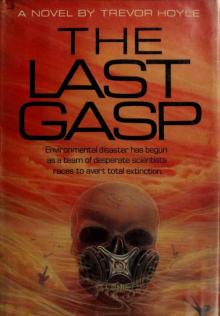
The Last Gasp, page 56


3
The dramatic shrinking of the Antarctic Ice Cap had rung serious alarm bells as far back as 2011.
Now, nineteen years later, things were warming up nicely on the West Antarctic Ice Sheet. The Rignot Effect was kicking in with a vengeance. In late April of 2030 a huge mass sheared off the Riiser-Larsen Ice Shelf – including what was left of Halley Bay Station, where Gavin Chase and Nick Power had carried out their underwater research. The base had been abandoned several years earlier; the living quarters and labs, the mess hall and R&R areas, the stairways and passages, were still there but now thirty feet below the surface, diminishing and disappearing as they were slowly crushed in the vice-like pressure.
This massive chunk of ice, containing a deep sub-stratum of permafrost several million years old, dwarfed the 2011 Pine Island breakaway. It was twice its size: forty-five miles long by thirty-three miles wide, as large as Rhode Island, the single largest free-floating iceberg the planet had ever known – more than 1,200 square miles – weighing approximately 2.9 trillion tonnes.
As with any large mass, it moved slowly and ponderously, heading northwards across the Weddell Sea towards the South Atlantic. At the start of its journey, it was travelling no more than a dozen feet every twenty-four hours. With the surrounding waters being only a degree or so above freezing, the Riiser-Larsen Calving Berg retained much of its bulk; its drifting speed would increase as it lost mass and thickness in the gradually warming currents.
And the speed would gain appreciably when it was caught up in the South Atlantic Polar Vortex and carried up the eastern coast of South America towards the much warmer waters of the Caribbean.
4
Waiting for the motor launch to take them back across the lagoon, Lieutenant Sprote was convinced he must be living in a dream. The swaying palm trees and the white sandy beaches and the little dancing waves gilded with sunlight seemed unreal, like a movie set. The actual reality, strangely enough, had been left behind in those innocuous white buildings with the rows of tiny barred windows behind the electrified fences.
He didn’t seem to be here; not on Starbuck Island in the middle of the Pacific Ocean. Sprote listened numbly to Colonel Malden’s voice.
‘If we can develop new mutant strains . . . it will be a fantastic achievement . . .’
Which only compounded the unreality.
‘. . . a new breed of human being that can survive in the most hostile environmental conditions. Something with twice the normal lung capacity and inbuilt resistance to chemical pollution.’ The colonel’s voice became harsher, more emphatic. ‘It should be possible. It will be possible.’
‘Starbuck Man,’ said the musing voice of Major Dukes. ‘Heir to the New Earth. Two hundred years from now it could be the only species left.’
Rolsom was more cautious. ‘Can we be certain the Russians or the Chinese aren’t working along the same lines? They could have advanced even more than we have—’
‘No.’ Colonel Malden refused to entertain the faintest doubt. ‘The Chinese don’t have the scientific expertise. The Russians are concentrating on the extermination plan.’ He addressed Rolsom directly. ‘That’s why the work you’re doing in Zone Two with TCDD is just as important as the work here in genetic manipulation. The “Longfellow” extermination plan is a vitally important element in our overall strategy. On that we cooperate fully with the Russians; we even invite them to look over Zone Two if necessary to demonstrate our total commitment and cooperation.’
‘Zone Two.’ Major Dukes’ voice. ‘Not Zone Four.’
‘Not Zone Four,’ Malden’s voice repeated.
‘That’s our baby.’ Rolsom’s voice.
‘So it is.’ Dukes’ voice. ‘Literally.’
5
The Desert Range missile silo complex straddled the state line dividing Utah and Nevada. Although sited geographically in Utah, part of the labyrinthine network of tunnels actually extended across the border.
Chase and Nick Power arrived at Wah Wah Springs after a seventeen-hour journey by aircraft, bus and finally diesel-engined Jeep. As Prothero had said, the nearest towns were considerable distances away: Richfield was a hundred miles due east and Cedar City about eighty miles southwest of the complex. There were a few small settlements – Black Rock, Milford, Lund, Beryl – but none of them nearer than forty miles. Chase had to admit that it was the perfect location.
With Nick at the wheel they drove along a crumbling concrete road with weeds and sagebrush growing in the cracks and gutters. The terrain was bleak. Undulating desert scrub as far as the eye could see, the ground compacted and fissured through lack of rain. There were no signposts – no visible evidence at all, in fact, that this had once been a restricted military area.
‘How much did you say the MX system cost?’ asked Nick, lolling back and steering with one hand. The road went straight as an arrow into the far distance.
‘Eighty billion dollars, give or take the odd billion.’ Chase shaded his eyes. ‘Altogether they constructed forty-four hundred silos connected by ten thousand miles of roads and two thousand miles of railway track spread across southern Nevada and southwest Utah. They planned to have two hundred missiles with nuclear warheads constantly moving on five-hundred-ton transporters. The idea behind it was to give each missile the option of twenty-two available silos. It was a crazy scheme and it never worked. They hoped to keep the Russians and Chinese guessing at which silo any one missile was at any given moment.’
‘Christ, a bloody expensive permutation if you ask me,’ Nick commented with a weary shake of the head.
‘Bloody futile as well,’ Chase said. ‘By the time the system was completed and operational, it was already obsolete. You know, it cost three hundred dollars for every man, woman and child in the United States. And this’ – he swept his arm out to indicate the barren landscape – ‘is what they got for their money.’
‘Hey, come on now,’ Nick chided him. ‘You’re forgetting the four thousand six hundred holes in the ground. I bet the gophers were extremely grateful.’
Fifteen minutes later they passed a concrete blockhouse almost completely buried in windblown sand. Chase unfolded the army map supplied by Prothero. The main installations were marked as broken red lines, indicating that they were below ground. The blockhouse was shown as a solid black dot, with the designation GP5.
‘Guard Post Five,’ Chase said, putting the map away. ‘Not far now. About six miles to the complex itself.’
‘How many silos in this one?’
‘One hundred and fourteen over a grid of two hundred square miles.’
‘Hey, Gav’ – Nick glanced quickly at him, struck by an uncomfortable thought – ‘you don’t suppose they left any missiles behind, do you?’
Chase shook his head, stern-faced. ‘Oh no. Just the one I asked for.’
‘Just the one . . . you fucking what?’ Nick blew out his cheeks and let the air explode. ‘You bastard.’
Six miles further on there was only a radio communications tower to be seen above ground. The antennae and microwave dish had been stripped off, the structure held by taut steel guy wires that sang in the wind. Because of the dry desert air the tower and wires were untarnished, without a speck of rust.
Finding the entrance wasn’t easy. They wandered around for several minutes trying to locate it, until Chase happened to come upon a sloping gully that was partly filled with sand, rocks and sagebrush. He hardly gave it a look and almost passed on before noticing that the shallow bank of sand followed a regular descending pattern. It was a flight of steps leading down to a studded metal door that was silted three-quarters of the way up. After scooping the sand away they were at last able, with a little forceful persuasion, to slide the door open.
Chase led the way with an iodine halogen lamp into the musty passages of slabbed concrete. The bright beam showed the tunnels were strung with skeins of thick multicoloured cables secured by aluminium cladding. The cladding was brightly polished, proving that Prothero had been right about the installation: it was still in pristine, unblemished condition.
He swung the circle of light around and picked out arrows painted in varying colours where the passage branched in different directions. Beneath the arrows, in corresponding colours, they saw:
COMPLEX 88-B
RED DOCK
GREEN DOCK
BLUE DOCK
LAUNCH CONTROL
MASTER ENGINEER
ELECTRICAL STORES
The beam roved higher. ‘Buggeration,’ Nick said gloomily. ‘Don’t like the sound of that, one tiny cotton-pickin’ bit.’
Above the arrows somebody had scrawled a message in chalk.
WELCOME TO THE TOMB
‘You and me neither, old chap,’ Chase said, swinging the lamp away and moving on.
Taking one of the wider passages they came upon three enormous freight elevators with their doors yawning wide, big enough to take a truck apiece. Further on, a wide concrete stairway with the edges of the steps painted yellow led downwards. As they descended Chase took a careful note of each turning and the number of levels; he didn’t have a plan of the complex and he didn’t fancy getting lost in several hundred miles of tunnels.
Three levels down and ninety feet underground they came to the launch control room. Here they found row upon row of empty metal racks and faceless consoles, the equipment and instrumentation ripped out. One panel remained intact, its fascia protected by a solidly bolted stainless-steel cover two inches thick. Nick read out the inscription.
‘“Silo Door Release Mechanism”.’ He fingered one of the bolts. ‘Pity we can’t find out if it still works.’
At the bottom of the missile silo they were able to gaze up the circular shaft lined with black ceramic heat-deflector tiles to the silo dome itself, two hundred feet above them, dimly reflecting the beam of the flashlight.
Chase’s ghostly voice echoed upwards. ‘They had to keep the missiles at a constant 16° C and thirty per cent humidity. The air-conditioning plant in just one of these silos is enough for a one hundred and twenty room hotel.’
Nick said, ‘And if it’s radiation-proof, which it must be, it’s got to be airtight as well. It could have been custom-built.’
They looked at each other, their faces bathed in the penumbra of the upturned beam, the same thought in both their minds: the silo and adjoining control rooms were a self-contained sealed enclosure. They could provide protection and life support, irrespective of the conditions outside. And there were more than a hundred such silos in this complex alone, connected by two to three hundred miles of tunnels. Desert Range was perfect.
On the way back up, pausing for breath on one of the landings, Nick said, ‘Has it occurred to you that the joker who named this hole in the ground might have been a prophet as well as a cynic?’
Chase frowned at him. ‘Named it?’
Nick gestured upward, his expression lugubrious. ‘The Tomb.’
6
Twenty minutes later they were climbing over the sand and windblown debris that had spilled through the door. Chase switched off the lamp, squinting in the raw sunlight. A shadow rippled down the sand-covered steps. Chase stared up at the figure of a man silhouetted against the clear blue sky, his face a dark featureless blur. All that Chase could make out was spiky blond hair: recognition happened instantaneously, the time and place and circumstance of their last encounter telescoped so that it might have been yesterday. Chase’s throat was parched dry. He was thirsty and he was also very afraid.
Sturges turned and disappeared from view. Nick stumbled up the shallow slope behind Chase. ‘Who is that?’
A six-wheeled square-bodied hummer, painted silver, with large rectangular smoke-blue windows was parked not far away. Attached to it was a long streamlined silver trailer, rounded at both ends like a bullet. Vehicle and trailer bore an embossed motif in the shape of a golden conch shell.
Sturges stood by the open door of the trailer. He wore black shades with wraparound lenses, the sun glaring off them in splinters of light. His forehead was tanned and deeply lined, shaggy blond eyebrows peeping over the glasses.
He waited impassively, a glint of gold at his throat and wrist.
‘What’s going on?’ Nick murmured in Chase’s ear. ‘I don’t get it, Gav. What’s happening?’
‘I think we’re about to find out.’
Chase walked across, past Sturges and up the three open-mesh aluminium steps into the silver-bullet trailer. Close behind, Nick gave Sturges a malevolent stare as if he might be the devil incarnate.
After the harsh desert light the interior was pitch-black, and it took several moments before they were able to discern a sheen of greenish light reflecting off curved metal. There was a row of green dials set in stainless steel casings and a panel of touch-screens showing red and black calibrated displays. It reminded Chase of a medical laboratory, or maybe an operating theatre. Taking up most of the space, right in the middle of the trailer, a coffin-shaped shell with a curved transparent cover at the end nearest them; the whole arrangement was connected by thermoplastic tubes to a coil in which cascades of bubbles were swirling.
From the apparatus came soft gurgling and swishing sounds, rhythmical and sinister.
Now accustomed to the subdued lighting, Chase and Nick could see a human form beneath the transparent cover. It appeared to be the foreshortened shape of a man. He looked ancient: bald and gaunt-cheeked, his rib cage clearly outlined in the emaciated torso.
Behind them, the door of the trailer clicked shut. Sturges unhooked a pencil microphone from the wall and thumbed the button. ‘I have them, Mr Gelstrom. They’re here.’
Inside the transparent shell Chase saw white skeletal fingers trembling towards a keypad; it was so positioned to allow Gelstrom to view it without lifting his head. It would have been impossible, anyway, on such a thin stalk of neck, to raise it from the foam pillow.
The fingers hovered and trembled and tapped and on a screen above the sarcophagus shell a green blip spelled out:
Is Desert Range suitable, Dr Chase?
Sturges handed the microphone to Chase. The pump gave a long, drawn-out aaaaaahhhhh as it evacuated the spent air.
Chase realised his jaw was aching from the clamped pressure. When he managed to speak, his voice was unnatural, strained and quivering. ‘Nobody told me you were involved in this project. Or said anything about the JEG Corporation.’
The white fingers touched the keys.
My stipulation to Senator Prothero. I knew you would refuse outright: emotion over rational behaviour. But you have accepted thus far. I am funding the project personally. If you decide to go ahead I must know your verdict. Suitable or not?
The trailer was air-conditioned and yet Chase could feel rivulets of sweat between his shoulder blades. ‘Yes, it’s suitable.’
Good. Are you willing to accept the funding and proceed?
The pump churned and sighed aaaaaahhhhh.
Chase had trouble holding the microphone, which felt cold and slippery. His mind couldn’t grasp any of his slippery thoughts either, which were swirling around like the bubbles in those damn gurgling tubes. Somehow the past was all mixed up with the present moment, and the unreal present with the unknown future.
When he didn’t answer, Sturges said from behind him, ‘Eight months ago Mr Gelstrom suffered an attack that left him dependent on medication and this respirator lung. The condition was diagnosed as acute anoxia. It is a malignant condition and there is no cure, which Mr Gelstrom accepts. He has decided to back this project with all the resources at his disposal, personal, financial and corporate.’
Chase didn’t know whether to laugh or to cry. What wonderful, rich irony that Gelstrom had been snared in a trap of his own making. The wealthy tycoon had made his billions by inflicting damage on the environment and now he was trying to buy his way out. Fifty million dollars for the promise of . . . what? Redemption? Salvation? No, make that two hundred million. No, wait – better make it five hundred million. A billion. Two billion. Ten billion. Whatever it takes. As much as you need. Just name your price.
But there was a catch, a flaw, and Chase almost felt exuberant. He was torn between triumphant anger and hysterical, gloating laughter.
‘It’s too late. You’ve made all those profits without thinking of the consequences; and the laugh is you’ve reaped your own destruction as well. What did you think, Gelstrom? That if we succeeded with this project you’d get your life back?’
The white fingers moved across the keypad, but Chase didn’t wait. He couldn’t. It was like a surge of adrenalin through his bloodstream, purging, purifying.
‘Gelstrom, you are going to die and there’s nothing you can do about it. Your disease is terminal. You are finished. You must know that – not even if you spent every last cent you possess.’
The big blond man at his shoulder said, ‘You don’t understand – that isn’t—’
Chase cut him short. ‘It’s too late, too fucking late! This project, even if it succeeds, is a lifetime too late for him! He’s got a couple of years at most and this will take decades, perhaps centuries.’
But it seemed that he was wrong and Sturges was right; Chase hadn’t understood. He stood looking into the transparent shell, at the deep eye sockets in the shrivelled face. The trembling hand moved to the keypad, tapped, and as the green blip danced across the screen he read the words:
I expect nothing for myself. My end is near. But like you, Dr Chase, I have a son. Twelve years old. I want him to survive, to have a future and somewhere to live. You want the same for your son. I have money. You have knowledge. Together we can save them.
Chase finally did understand.
7
1
‘You don’t feel sick or dizzy or anything? Sure?’
‘I’m all right now. Honestly.’
The dramatic shrinking of the Antarctic Ice Cap had rung serious alarm bells as far back as 2011.
Now, nineteen years later, things were warming up nicely on the West Antarctic Ice Sheet. The Rignot Effect was kicking in with a vengeance. In late April of 2030 a huge mass sheared off the Riiser-Larsen Ice Shelf – including what was left of Halley Bay Station, where Gavin Chase and Nick Power had carried out their underwater research. The base had been abandoned several years earlier; the living quarters and labs, the mess hall and R&R areas, the stairways and passages, were still there but now thirty feet below the surface, diminishing and disappearing as they were slowly crushed in the vice-like pressure.
This massive chunk of ice, containing a deep sub-stratum of permafrost several million years old, dwarfed the 2011 Pine Island breakaway. It was twice its size: forty-five miles long by thirty-three miles wide, as large as Rhode Island, the single largest free-floating iceberg the planet had ever known – more than 1,200 square miles – weighing approximately 2.9 trillion tonnes.
As with any large mass, it moved slowly and ponderously, heading northwards across the Weddell Sea towards the South Atlantic. At the start of its journey, it was travelling no more than a dozen feet every twenty-four hours. With the surrounding waters being only a degree or so above freezing, the Riiser-Larsen Calving Berg retained much of its bulk; its drifting speed would increase as it lost mass and thickness in the gradually warming currents.
And the speed would gain appreciably when it was caught up in the South Atlantic Polar Vortex and carried up the eastern coast of South America towards the much warmer waters of the Caribbean.
4
Waiting for the motor launch to take them back across the lagoon, Lieutenant Sprote was convinced he must be living in a dream. The swaying palm trees and the white sandy beaches and the little dancing waves gilded with sunlight seemed unreal, like a movie set. The actual reality, strangely enough, had been left behind in those innocuous white buildings with the rows of tiny barred windows behind the electrified fences.
He didn’t seem to be here; not on Starbuck Island in the middle of the Pacific Ocean. Sprote listened numbly to Colonel Malden’s voice.
‘If we can develop new mutant strains . . . it will be a fantastic achievement . . .’
Which only compounded the unreality.
‘. . . a new breed of human being that can survive in the most hostile environmental conditions. Something with twice the normal lung capacity and inbuilt resistance to chemical pollution.’ The colonel’s voice became harsher, more emphatic. ‘It should be possible. It will be possible.’
‘Starbuck Man,’ said the musing voice of Major Dukes. ‘Heir to the New Earth. Two hundred years from now it could be the only species left.’
Rolsom was more cautious. ‘Can we be certain the Russians or the Chinese aren’t working along the same lines? They could have advanced even more than we have—’
‘No.’ Colonel Malden refused to entertain the faintest doubt. ‘The Chinese don’t have the scientific expertise. The Russians are concentrating on the extermination plan.’ He addressed Rolsom directly. ‘That’s why the work you’re doing in Zone Two with TCDD is just as important as the work here in genetic manipulation. The “Longfellow” extermination plan is a vitally important element in our overall strategy. On that we cooperate fully with the Russians; we even invite them to look over Zone Two if necessary to demonstrate our total commitment and cooperation.’
‘Zone Two.’ Major Dukes’ voice. ‘Not Zone Four.’
‘Not Zone Four,’ Malden’s voice repeated.
‘That’s our baby.’ Rolsom’s voice.
‘So it is.’ Dukes’ voice. ‘Literally.’
5
The Desert Range missile silo complex straddled the state line dividing Utah and Nevada. Although sited geographically in Utah, part of the labyrinthine network of tunnels actually extended across the border.
Chase and Nick Power arrived at Wah Wah Springs after a seventeen-hour journey by aircraft, bus and finally diesel-engined Jeep. As Prothero had said, the nearest towns were considerable distances away: Richfield was a hundred miles due east and Cedar City about eighty miles southwest of the complex. There were a few small settlements – Black Rock, Milford, Lund, Beryl – but none of them nearer than forty miles. Chase had to admit that it was the perfect location.
With Nick at the wheel they drove along a crumbling concrete road with weeds and sagebrush growing in the cracks and gutters. The terrain was bleak. Undulating desert scrub as far as the eye could see, the ground compacted and fissured through lack of rain. There were no signposts – no visible evidence at all, in fact, that this had once been a restricted military area.
‘How much did you say the MX system cost?’ asked Nick, lolling back and steering with one hand. The road went straight as an arrow into the far distance.
‘Eighty billion dollars, give or take the odd billion.’ Chase shaded his eyes. ‘Altogether they constructed forty-four hundred silos connected by ten thousand miles of roads and two thousand miles of railway track spread across southern Nevada and southwest Utah. They planned to have two hundred missiles with nuclear warheads constantly moving on five-hundred-ton transporters. The idea behind it was to give each missile the option of twenty-two available silos. It was a crazy scheme and it never worked. They hoped to keep the Russians and Chinese guessing at which silo any one missile was at any given moment.’
‘Christ, a bloody expensive permutation if you ask me,’ Nick commented with a weary shake of the head.
‘Bloody futile as well,’ Chase said. ‘By the time the system was completed and operational, it was already obsolete. You know, it cost three hundred dollars for every man, woman and child in the United States. And this’ – he swept his arm out to indicate the barren landscape – ‘is what they got for their money.’
‘Hey, come on now,’ Nick chided him. ‘You’re forgetting the four thousand six hundred holes in the ground. I bet the gophers were extremely grateful.’
Fifteen minutes later they passed a concrete blockhouse almost completely buried in windblown sand. Chase unfolded the army map supplied by Prothero. The main installations were marked as broken red lines, indicating that they were below ground. The blockhouse was shown as a solid black dot, with the designation GP5.
‘Guard Post Five,’ Chase said, putting the map away. ‘Not far now. About six miles to the complex itself.’
‘How many silos in this one?’
‘One hundred and fourteen over a grid of two hundred square miles.’
‘Hey, Gav’ – Nick glanced quickly at him, struck by an uncomfortable thought – ‘you don’t suppose they left any missiles behind, do you?’
Chase shook his head, stern-faced. ‘Oh no. Just the one I asked for.’
‘Just the one . . . you fucking what?’ Nick blew out his cheeks and let the air explode. ‘You bastard.’
Six miles further on there was only a radio communications tower to be seen above ground. The antennae and microwave dish had been stripped off, the structure held by taut steel guy wires that sang in the wind. Because of the dry desert air the tower and wires were untarnished, without a speck of rust.
Finding the entrance wasn’t easy. They wandered around for several minutes trying to locate it, until Chase happened to come upon a sloping gully that was partly filled with sand, rocks and sagebrush. He hardly gave it a look and almost passed on before noticing that the shallow bank of sand followed a regular descending pattern. It was a flight of steps leading down to a studded metal door that was silted three-quarters of the way up. After scooping the sand away they were at last able, with a little forceful persuasion, to slide the door open.
Chase led the way with an iodine halogen lamp into the musty passages of slabbed concrete. The bright beam showed the tunnels were strung with skeins of thick multicoloured cables secured by aluminium cladding. The cladding was brightly polished, proving that Prothero had been right about the installation: it was still in pristine, unblemished condition.
He swung the circle of light around and picked out arrows painted in varying colours where the passage branched in different directions. Beneath the arrows, in corresponding colours, they saw:
COMPLEX 88-B
RED DOCK
GREEN DOCK
BLUE DOCK
LAUNCH CONTROL
MASTER ENGINEER
ELECTRICAL STORES
The beam roved higher. ‘Buggeration,’ Nick said gloomily. ‘Don’t like the sound of that, one tiny cotton-pickin’ bit.’
Above the arrows somebody had scrawled a message in chalk.
WELCOME TO THE TOMB
‘You and me neither, old chap,’ Chase said, swinging the lamp away and moving on.
Taking one of the wider passages they came upon three enormous freight elevators with their doors yawning wide, big enough to take a truck apiece. Further on, a wide concrete stairway with the edges of the steps painted yellow led downwards. As they descended Chase took a careful note of each turning and the number of levels; he didn’t have a plan of the complex and he didn’t fancy getting lost in several hundred miles of tunnels.
Three levels down and ninety feet underground they came to the launch control room. Here they found row upon row of empty metal racks and faceless consoles, the equipment and instrumentation ripped out. One panel remained intact, its fascia protected by a solidly bolted stainless-steel cover two inches thick. Nick read out the inscription.
‘“Silo Door Release Mechanism”.’ He fingered one of the bolts. ‘Pity we can’t find out if it still works.’
At the bottom of the missile silo they were able to gaze up the circular shaft lined with black ceramic heat-deflector tiles to the silo dome itself, two hundred feet above them, dimly reflecting the beam of the flashlight.
Chase’s ghostly voice echoed upwards. ‘They had to keep the missiles at a constant 16° C and thirty per cent humidity. The air-conditioning plant in just one of these silos is enough for a one hundred and twenty room hotel.’
Nick said, ‘And if it’s radiation-proof, which it must be, it’s got to be airtight as well. It could have been custom-built.’
They looked at each other, their faces bathed in the penumbra of the upturned beam, the same thought in both their minds: the silo and adjoining control rooms were a self-contained sealed enclosure. They could provide protection and life support, irrespective of the conditions outside. And there were more than a hundred such silos in this complex alone, connected by two to three hundred miles of tunnels. Desert Range was perfect.
On the way back up, pausing for breath on one of the landings, Nick said, ‘Has it occurred to you that the joker who named this hole in the ground might have been a prophet as well as a cynic?’
Chase frowned at him. ‘Named it?’
Nick gestured upward, his expression lugubrious. ‘The Tomb.’
6
Twenty minutes later they were climbing over the sand and windblown debris that had spilled through the door. Chase switched off the lamp, squinting in the raw sunlight. A shadow rippled down the sand-covered steps. Chase stared up at the figure of a man silhouetted against the clear blue sky, his face a dark featureless blur. All that Chase could make out was spiky blond hair: recognition happened instantaneously, the time and place and circumstance of their last encounter telescoped so that it might have been yesterday. Chase’s throat was parched dry. He was thirsty and he was also very afraid.
Sturges turned and disappeared from view. Nick stumbled up the shallow slope behind Chase. ‘Who is that?’
A six-wheeled square-bodied hummer, painted silver, with large rectangular smoke-blue windows was parked not far away. Attached to it was a long streamlined silver trailer, rounded at both ends like a bullet. Vehicle and trailer bore an embossed motif in the shape of a golden conch shell.
Sturges stood by the open door of the trailer. He wore black shades with wraparound lenses, the sun glaring off them in splinters of light. His forehead was tanned and deeply lined, shaggy blond eyebrows peeping over the glasses.
He waited impassively, a glint of gold at his throat and wrist.
‘What’s going on?’ Nick murmured in Chase’s ear. ‘I don’t get it, Gav. What’s happening?’
‘I think we’re about to find out.’
Chase walked across, past Sturges and up the three open-mesh aluminium steps into the silver-bullet trailer. Close behind, Nick gave Sturges a malevolent stare as if he might be the devil incarnate.
After the harsh desert light the interior was pitch-black, and it took several moments before they were able to discern a sheen of greenish light reflecting off curved metal. There was a row of green dials set in stainless steel casings and a panel of touch-screens showing red and black calibrated displays. It reminded Chase of a medical laboratory, or maybe an operating theatre. Taking up most of the space, right in the middle of the trailer, a coffin-shaped shell with a curved transparent cover at the end nearest them; the whole arrangement was connected by thermoplastic tubes to a coil in which cascades of bubbles were swirling.
From the apparatus came soft gurgling and swishing sounds, rhythmical and sinister.
Now accustomed to the subdued lighting, Chase and Nick could see a human form beneath the transparent cover. It appeared to be the foreshortened shape of a man. He looked ancient: bald and gaunt-cheeked, his rib cage clearly outlined in the emaciated torso.
Behind them, the door of the trailer clicked shut. Sturges unhooked a pencil microphone from the wall and thumbed the button. ‘I have them, Mr Gelstrom. They’re here.’
Inside the transparent shell Chase saw white skeletal fingers trembling towards a keypad; it was so positioned to allow Gelstrom to view it without lifting his head. It would have been impossible, anyway, on such a thin stalk of neck, to raise it from the foam pillow.
The fingers hovered and trembled and tapped and on a screen above the sarcophagus shell a green blip spelled out:
Is Desert Range suitable, Dr Chase?
Sturges handed the microphone to Chase. The pump gave a long, drawn-out aaaaaahhhhh as it evacuated the spent air.
Chase realised his jaw was aching from the clamped pressure. When he managed to speak, his voice was unnatural, strained and quivering. ‘Nobody told me you were involved in this project. Or said anything about the JEG Corporation.’
The white fingers touched the keys.
My stipulation to Senator Prothero. I knew you would refuse outright: emotion over rational behaviour. But you have accepted thus far. I am funding the project personally. If you decide to go ahead I must know your verdict. Suitable or not?
The trailer was air-conditioned and yet Chase could feel rivulets of sweat between his shoulder blades. ‘Yes, it’s suitable.’
Good. Are you willing to accept the funding and proceed?
The pump churned and sighed aaaaaahhhhh.
Chase had trouble holding the microphone, which felt cold and slippery. His mind couldn’t grasp any of his slippery thoughts either, which were swirling around like the bubbles in those damn gurgling tubes. Somehow the past was all mixed up with the present moment, and the unreal present with the unknown future.
When he didn’t answer, Sturges said from behind him, ‘Eight months ago Mr Gelstrom suffered an attack that left him dependent on medication and this respirator lung. The condition was diagnosed as acute anoxia. It is a malignant condition and there is no cure, which Mr Gelstrom accepts. He has decided to back this project with all the resources at his disposal, personal, financial and corporate.’
Chase didn’t know whether to laugh or to cry. What wonderful, rich irony that Gelstrom had been snared in a trap of his own making. The wealthy tycoon had made his billions by inflicting damage on the environment and now he was trying to buy his way out. Fifty million dollars for the promise of . . . what? Redemption? Salvation? No, make that two hundred million. No, wait – better make it five hundred million. A billion. Two billion. Ten billion. Whatever it takes. As much as you need. Just name your price.
But there was a catch, a flaw, and Chase almost felt exuberant. He was torn between triumphant anger and hysterical, gloating laughter.
‘It’s too late. You’ve made all those profits without thinking of the consequences; and the laugh is you’ve reaped your own destruction as well. What did you think, Gelstrom? That if we succeeded with this project you’d get your life back?’
The white fingers moved across the keypad, but Chase didn’t wait. He couldn’t. It was like a surge of adrenalin through his bloodstream, purging, purifying.
‘Gelstrom, you are going to die and there’s nothing you can do about it. Your disease is terminal. You are finished. You must know that – not even if you spent every last cent you possess.’
The big blond man at his shoulder said, ‘You don’t understand – that isn’t—’
Chase cut him short. ‘It’s too late, too fucking late! This project, even if it succeeds, is a lifetime too late for him! He’s got a couple of years at most and this will take decades, perhaps centuries.’
But it seemed that he was wrong and Sturges was right; Chase hadn’t understood. He stood looking into the transparent shell, at the deep eye sockets in the shrivelled face. The trembling hand moved to the keypad, tapped, and as the green blip danced across the screen he read the words:
I expect nothing for myself. My end is near. But like you, Dr Chase, I have a son. Twelve years old. I want him to survive, to have a future and somewhere to live. You want the same for your son. I have money. You have knowledge. Together we can save them.
Chase finally did understand.
7
1
‘You don’t feel sick or dizzy or anything? Sure?’
‘I’m all right now. Honestly.’