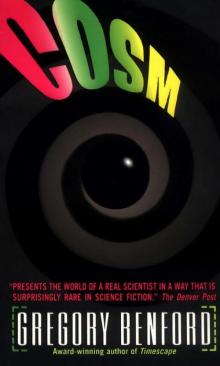
The Galactic Center Companion, page 5


A sewer smell came swarming up from nearby. A woman gazed directly back into his eyes. She said nothing but her skin ran with tinkling streams of urine. Nearby a little girl was a concert of ropy pink cords, red-rimmed where they all tried to speak.
The twelve spread out in a daze. Some recognized warped versions of people they had known. There were people here from far antiquity and places no one knew.
Paris found an entire aisle of shivering couples, entwined in sexual acts made possible by organs designed in ways nature never had allowed: sockets filled by slithering rods, beings which palped and stroked themselves to a hastening pace that rose to a jellied frenzy, shrieked from fresh mouths, and then abated, only to begin again with a building rhythm.
An Isis man was vomiting nearby. “We’ve got to save them,” he said when Paris went to help him.
“Yeasay,” a woman pilot agreed. The survivors were drifting back together, pressed by the enveloping horror.
A wretched nearby sculpture of guts that sprouted leaves managed to get out three words, “No…don’t…want…”
Paris felt the fear and excitement of the last few hours ebbing from him, replaced by a rising, firm feeling he could not force out through his throat. He shook his head. The woman started to argue, saying that they could take the cases that had been deformed the least, try to free them from the alterations.
Paris found his voice. “They want to go. Listen.”
From the long axis that tapered away to infinity there rose a muttered, moaning, corpuscular symphony of anguish and defeat that in its accents and slurred cadences called forth the long corridor of ruin and affliction that was the lot of humanity here at Galactic Center, down through millennia.
He stood listening. Parts of his mind rustled—moving uneasily, understanding.
The Mantis sculptures got the most important facets profoundly wrong. The Mantis had tried to slice human sliding moments from the robed minds of the suredead, but it could not surecopy them: their essence lay in what was discarded from the billion-bit/second stream. In the mere passing twist and twinge of a second, humans truncated their universe with electrochemical knives.
Hot-hearted, to humans death was the mother of beauty. Their gods were, in the end, refracted ways of bearing the precarious gait of the mortal.
To Paris as a boy the compact equation ei+1=0 had comprised a glimpse of the eternal music of reason. The simple line linked the most important constants in the whole of mathematical analysis, 0, 1, e, , and i. To Paris the simple line was beautiful.
To a digitally filtered intelligence the analog glide of this relation would be different, not a glimpse of a vast and various landscape. Not better or worse, but irreducibly different.
That he could never convey to the Mantis.
Nor could he express his blood-deep rage, how deeply he hated the shadow that had dogged his life.
But his fury was wise in a way that mere anger is not. He surprised himself: he breathed slowly, easily, feeling nothing but a granite resolve.
Paris began killing the sculptures systematically. The others stood numbly and watched him, but their silence did not matter to him. He moved quickly, executing them with bolts, the work fixing him totally in the moment of it.
He did not notice the sobbing.
After a time he could not measure he saw that the others were doing the same, without discussion. No one talked at all.
The wails of the sculptured people reverberated, moist glad cries as they saw what was coming.
It took a long time.
The Mantis was waiting outside the Hall of Humans, as Paris had felt it would be.
I was unable to predict what you and the others did.
“Good.” His pencil ship lifted away from the long gray cylinder, now a mausoleum to madness.
I allowed it because those are finished pieces. Whereas you are a work in progress, perhaps my best.
“I’ve always had a weakness for compliments.” He could feel his very blood changing, modulating oxygen and glucose from his body to feed his changing brain. The accretion disk churned below, a great lurid pinwheel grinding to an audience of densely packed stars.
Humor is another facet I have mastered.
“There’s a surprise.” Vectoring down, the boost pressing him back. “Very human, too. Everybody thinks he’s got a good sense of humor.”
I expect to learn much from you.
“Now?”
You are ripe. Your fresh, thoroughly human reactions to my art will be invaluable.
“If you let me live, you’ll get one or two centuries more experience when I finally die.”
That is true, for yours has been an enticingly rich one, so far.
There are reasons to envy the human limitations.
“And now that I’ve seen your art, my life will be changed.”
Truly? It is that affective with you, a member of the very medium? How?
He had to handle this just right. “Work of such impact, it will take time for me to digest it.”
You use a chemical-processing metaphor. Precisely a human touch, incorporating the most inefficient portions of your being.
Nonetheless, you point to a possible major benefit for me if you are allowed to live.
“I need time to absorb all this.”
He could feel his body’s energy reserve sacrificing itself in preparation for the uploading process. He had come to understand himself for the first time as he killed the others. Some part of him, the Me, knew it all now. The I spoke haltingly. “I think you have truly failed to understand.”
I can remedy that now.
“No, that’s exactly what you won’t. You can’t know us this way.”
I had a similar conversation with your father. He suggested that I invest myself in you.
“But you won’t get it just by slicing and dicing us.”
There is ample reason to believe that digital intelligences can fathom analog ones to any desired degree of accuracy.
“The thing about aliens is, they’re alien.”
He felt intruding into him the sliding fingers of a vast, cool intellect, drawing him toward a dissolving sea. Soon he would be an empty shell. Paris would become part of the Mantis in the blending across representations, in their hologram logics. He could feel his neuronal wiring transfiguring itself. And accelerated.
Art is everywhere in the cosmos. I particularly liked your ice sculptures, melting in the heat while audiences applauded. Your tapestry of dim senses and sharp pains and incomprehensible, nagging, emotional tones—I wish to attain that. An emergent property, quite impossible to predict.
“Never happen. You could understand this if you would allow me to fill out my natural life span.”
That is a telling point. I shall take a moment to ponder it.
Meanwhile, cease your descent toward the accretion disk.
Here was the chance. The Mantis would withdraw to consult all portions, as an anthology intelligence. That would give him seconds to act. He accelerated powerfully down. “Take your time.”
For long moments he was alone with the hum of his tormented ship and the unfolding geysers outside, each storm bigger than a world.
I have returned. I have decided, and shall harvest you now.
“Sorry to hear that,” he said cheerfully. Dead men could afford pleasantries.
I wish you could tell me why you desired to end all my works.
But then, shortly, I shall know.
“I don’t think you’ll ever understand.”
Paris took his ship down toward the disk, through harrowing, hissing plumes of plasma.
His I sensed great movements deep within his Me and despite the climbing tones of alarms in his ship, he relaxed.
Pressed hard by his climbing acceleration, he remembered all that he had seen and been, and bade it farewell.
You err in your trajectory.
“Nope.”
You had to live in each gliding moment. This mantra had worked for him and he needed it more now. Cowardice—the real thing, not momentary panic—came from inability to stop the imagination from working on each approaching possibility. To halt your imagining and live in the very moving second, with no past and no future—with that he knew he could get through each second and on to the next without needless pain.
Correct course! Your craft does not have the ability to endure the curvatures required, flying so near the disk. Your present path will take you too close—
“To the end, I know. Whatever that means.” His Arthur Aspect was shouting. He poked it back into its niche, calmed it, cut off its sensor link. No need to be cruel.
Then Arthur spoke with a thin cry, echoing something Paris had thought long ago. The Aspect’s last salute:
If Mind brought humans forth from Matter, enabling the universe to comprehend itself—to do its own homework—
“Then maybe that’s why we’re here,” Paris whispered to himself.
The only way to deprive the Mantis of knowledge no human should ever give up, was to erase that interior self. To keep it from the consuming digital.
You are too close—
He skimmed along the whipped skin of doomed incandescence. Ahead lay the one place from which even the Mantis could not retrieve him, the most awful of all abysses, a sullen dot beckoning from far across the spreading expanse of golden luminance. Not even the Mantis could extract him from there. Flares broke in ruby radiance around him now.
Paris smiled and said good-bye to it all and accelerated hard, hard.
An Afterword
Gregory Benford
In the Ocean of Night (1977)
Across the Sea of Suns (1984)
Great Sky River (1987)
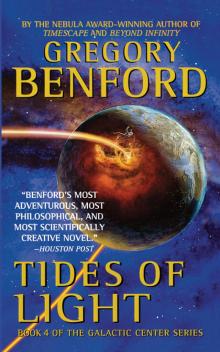
Tides of Light (1989)
Furious Gulf (1994)
Sailing Bright Eternity (1995)
The series comprises six novels, composed over a twenty-five-year span. The events stretch from the early 2000s to A.D. 37518, an immense scope imposed because its central focus, our galactic center, is 28,000 light-years away, and characters had to get there to take part in the galaxy’s larger games.
But as well, I wanted to convey the huge scales of both time and distance that a galaxy implies. We are mayflies on the stage lit by the dim, distant stars, and science fiction should remember that.
In the Ocean of Night, published in 1977, explored our discovery that computer-based life seemed dominant throughout the galaxy. A British astronaut in NASA’s space program, Nigel Walmsley, had uncovered the implication that “evolved adding machines,” as he put it, had inherited the ruins of earlier, naturally derived alien societies. We realized this by finding wrecked craft on the moon, and because a roving machine from an ancient interstellar society enters the solar system to study it.
Across the Sea of Suns follows Walmsley on the first manned interstellar expedition. Drawn by curiosity, humans want to know more about nearby stars, where there are aliens of very strange properties. There Walmsley finds that Naturals—organic beings like us—have been annihilated or at least greatly hampered by the galaxy’s pervasive machine societies.
During this flight Earth is invaded by an ocean-living species, as a method the machine-based civilizations use to disrupt any advanced Natural society. As soon as others know of our presence, they seek to wipe us out, as feared Natural rivals. The novel concludes with a few remaining people, including Walmsley, capturing a sophisticated interstellar ship. They head for the galactic center, to find out what’s going on.
In our galactic core, within a few light-years of the exact center, there are a million stars within a single light-year. Imagine having several stars so close they outshine the moon!
Worse, the galactic center was the obvious place for machines to seek. Virulent gamma rays, hot clouds, and enormously energetic processes dominate the crackling activity.
Great Sky River opens on this landscape; the title refers to the ancient American Indian name for the Milky Way. Its central figure is a man named Kileen, who flees with his Family Bishop across a ruined landscape. Its sky is dominated by the black hole at True Center, which his people call the Eater of All Things—though they don’t quite know why.
In this ravaged panorama humans have fallen from grace. Though the Walmsley-led expedition reached the Center and did well there, building a considerable civilization, they could not evade the superiority of machines. Pursuing them is an enigmatic mech, or machine, the Mantis, who views humans as an endangered species, their extinction inevitable. It wishes to record what it finds worthy in the few remaining societies. Not since humans lived in immense space stations called Chandeliers have they been on even terms with the mechs.
The Bishops flee their home world, Snowglade, in hopes of finding refuge and a solution to their many riddles about the true nature of mechs closer to the black hole. In the fourth novel, Tides of Light, they reach another planet and form an alliance with another organic species, one also endangered by the relentless mechs. We meet other kinds of mechs, too. Machines which can reproduce themselves would inevitably fall under the laws of natural selection, and would specialize to use local resources. The entire panoply of biology would recapitulate: parasites, predators, prey.
The Bishops deal with this while trying to fathom enigmatic messages from an intelligence lodged in the magnetic strands that loom throughout the Center. It tells of a place, the Wedge, where humans might find refuge and perhaps discover the legendary Galactic Library, which comprises a history of the entire galaxy.
In the fifth novel, Furious Gulf, we enter the gulf around the powerful black hole, and see another kind of gulf, that between intelligences born of different realms. Our human concern with mortality and individualism as a feature of biological creatures is unnecessary among intelligences that never had to pass through our Darwinnowing filter.
If we can copy ourselves indefinitely, why worry about a particular copy? What kind of society would emerge from such origins? What would it think of us—us Naturals, still hobbled by our biological destiny?
A slowly emerging theme in these novels, then, is how intelligence depends on the “substrate,” whether in evolved humans or adaptive machines—both embodying intelligence, but with wildly different styles.
Since the second novel we had not seen Nigel Walmsley, though there are hints that he was active near True Center much earlier. Much history echoes in ruins and enigmatic messages. Finding and entering the Wedge finally brings signs of humans who have sustained themselves against the mechs, though in a bewildering folded space-time (the s-t, or esty).
Sailing Bright Eternity, book six, finished in 1995, pulls all the series’ major characters together. In the Wedge they find that humans themselves have been carrying information they did not know they had, data crucial to stopping the mechs from erasing all Natural life.
It had been twenty-five years since I started on In the Ocean of Night, and our view of the galactic center had changed enormously. Some parts of the first two books, especially, are not representative of current thinking. Error goes with the territory.
The themes of the series resolve in favor of humanity as unique and worth saving, even in as hostile a galaxy as I envisioned. But I suspect that if natural life is as foolish and vulnerable as we seem to be, quite possibly machines may inherit the galaxy, and thus sit bemused, watching us with cool indifference from afar.
This added story deals with an essential question asked of humans at the beginning of their decline, about A.D. 36000. It also reveals several aspects of the dreaded Mantis I never found room for in the novels.
—Gregory Benford
Mandikini
(First appeared in The Universe, ed. Byron Preiss, Bantam Spectra, November 1987)
Things were going fine until Hard Ella landed on a Snout.
She had jumped from the far rocky ridgeline, tumbling slowly to give her inbody scanners a look at the distant terrain. Slow, serene, she enjoyed the long parabola down.
“Nosee, sunflowers,” she had reported over comm, and headed down for her bounce in a long, lazy arc.
The Snout must have sensed her coming. Snouts had surface sensors and had adapted on this world to a lot of airborne traffic.
Black Sam saw her hit, her shocks smoothly compressing—and the ground broke open.
She shrieked, a thin high cry of surprise hardening into fear. Her left shock stopped its accordion fold and locked firm, throwing her sideways as the brown soil split like a vast cynical smirk.
She flailed to her right and locked that shock too. Something whipped out of the widening ground-grin and wrapped around her left foot-armor.
“Naysay! Don’t loft!” Black Sam called. “You’ll tear off a leg.”
And die, he thought. They were too far from a Casa to get her medical help in time.
He kicked his power-pack into override and shot along the terrain, letting his downlook skate for him as fast as it could. Hard Ella’s ceramic body-armor arms chopped futilely at the spindly brown tongues that grabbed at her legs.
Hard Ella spat out words between deep, strained gasps. “I can’t—damn!—break its—”
“Hammer your shocks open,” Shagfoot yelled. He was ten klicks away and no use, but Black Sam yelped agreement with his advice.
The Snout broke its granitic cover and surged free. It was gray, angular and scarred from its perpetual burrowing after metals. Ports popped open on both sides of a rusty, tapered nose. Polished blue lenses peered at its catch with a gaze much like a real creature’s.
The analogy with animal forms was false. The nose was a fan-drill, and smelled nothing. Its rear drum-dishes saw sonic pulses, nothing special at all. The articulating wormlike tendrils were fashioned to intrude into the cracks of deep rockbeds, not to pluck and eat. But that did not lessen Black Sam’s instant impression that Hard Ella was caught in the maw of a huge, lumbering beast of burnished hide and grasping feelers.
Black Sam knew that some of the Snout’s ports were cluster-perceptors that tasted the dim infrared far better than they did the bright sunlight’s blare. The Snout would detect his approaching jet flame then, and turn this way.