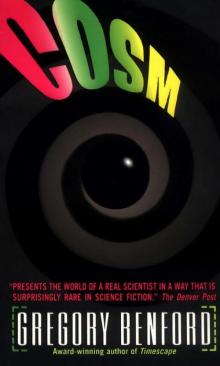
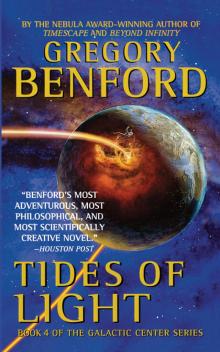
The Galactic Center Companion, page 15


Taken as a unified work (which requires a bit of gerrymandering of the earlier novels, which Benford has done), the “Galactic center” series raises so many questions about the nature and problems of SF that it has to be regarded as one of the major accomplishments in the recent history of the field, even if you question the success of some of its parts. It suggests, for example, that Stapledon indeed had a firm handle on SF’s grand theme, although in looking beyond Stapledon I’d modify Aldiss’s claim that this theme could be identified simply as communication. No, the grand theme of SF, as revealed by Benford out of Stapledon (with Clarke as intermediary), is nothing less than the relationship of mind and nature. It’s a theme which not only haunts the work of all three writers, but which subsumes nearly every favorite subtheme of the genre, from space travel to alien intelligence to technology—all of which are important to Benford’s series as well. By taking up such a vast theme, Benford is also forced to devise strategies to address the main problems inherent in it: namely, how do you get characters meaningfully involved in such questions in such a way that their actions have consequences at the cosmic level—as Walmsley himself asks at the end of Sailing Bright Eternity, “Does human action have any meaning?”—and how do you devise a kind of rhetoric that seems stylistically consistent while accommodating complex scientific notions, abstract philosophical questions, and intimate character relationships? These are problems that every SF writer faces in part, but Benford takes them all on at once.
Anyone who has tried to get non-SF readers involved with the genre is aware that some novels are good entry points and others are not. Much of the popularity of Clarke and Asimov derives from their skill at consistently producing such entry-level texts, and Benford has often, but not always, done the same thing; In the Ocean of Night is a pretty good SF entry point, but Sailing Bright Eternity is not; from its opening prose poem on black holes, “photovores,” and “metallovores” to the strange space-time continuum or “esty” in which much of the action takes place, the novel demands some awareness of the “protocols” that Samuel R. Delany says we need to fully appreciate SF aesthetics. (The entire six-volume sequence might even be read as a course in how to understand SF.) This doesn’t mean that Benford asks too much of the reader; throughout the novel are enough passages of scientific exposition to make sense of everything (curiously, some of the most basic explanations of organic vs. machine evolution are saved for the final pages), and the challenge to the reader is to make the connections between these large-scale speculations and the environments through which the characters move.
This is the classic problem of hard SF, of course: a rhetoric of action and human drama must be juggled with a rhetoric of science and philosophy in a way that must be made to appear seamless. Benford presently does this better than anyone else. While other writers either give us cardboard characters against a spectacular backdrop, or fudge the science in order to make the plot work out, Benford (as he puts it) plays with the net up—and not only the net of scientific consistency, but the net of character as well. His style is at its best when he tries to construct a kind of poetics of scientific speculation; such passages in Sailing Bright Eternity work perfectly well quite apart from the narrative (as Benford himself shows in his science column on “The Far Future” in the July 1995 Fantasy and Science Fiction, which weaves in several word-for-word passages from the novel without mentioning it). He is less successful when he insists on such unlikely neologisms as “TwenCen” (for twentieth century) or “Darwinnowing” (for natural selection), or when he sometimes strains to valorize and sentimentalize the “outward-seeking” urge that he views as making humanity almost unique among organic intelligences.
But by and large the rhetoric of the novel works, and it works as a kind of summative statement of Benford’s career to date. Nigel Walmsley, the Cambridge-educated astronaut whose encounter with the Snark in In the Ocean of Night began to reveal the nature of the universal war between mechs and organic life, arrives near the galaxy’s core some 30,000 years in the future and meets the survivors of the Family Bishop, whose pursuit by the mechs was recounted in the most recent three novels in the series. Somewhat protected by an artificial “esty” constructed by higher intelligences and consisting of different “lanes” and timelines, they brace for a final confrontation and discover that the key to defeating the mechs may lie in a “trigger code” embedded in the human genome. What this key is turns out to be so bold it’s almost comic--galactic warfare reduced to a parody of addictive self-destructiveness. But—and this is where Benford differs from almost every other hard SF writer—the literary side of the equation gets almost equal time. Walmsley, a 30,000-year-old savior of the universe, aspires only to become like Eliot’s J. Alfred Prufrock, while members of the family Bishop embark on a classic river journey deliberately evoking Twain. (Benford is not only among the most rigorous of hard SF writers; he’s also among the most quintessentially American in terms of literary models.) Toward the end of the novel, Toby Bishop (whose ambivalence at inheriting his father’s leadership role was made clear in Furious Gulf) undertakes a hunt for the wounded Mantis, the brutal artist-mech who has haunted the Family Bishop from the beginning, and the hunt echoes not only Benford’s own Against Infinity but that novel’s source in Faulkner’s “The Bear.” Another strategy Benford uses for keeping the human scale in focus is purely physiological—gruesome descriptions of the bodies of mech victims, or convincing sensory details.
Throughout the Galactic Center series, Benford’s basic strategy has been to focus on small groups of individuals acting against spectacular backdrops, while introducing his epic themes through a variety of dramatic devices—conversations with mechs or cyborgs, occasional trips into the far future, flat-out narrative exposition. The result is that his Stapledonian perspective emerges only as a function of the ways in which he has constructed the novels themselves—the novels control our perspective, not the other way round as it was with Stapledon. This has to be counted as a major achievement in realizing the potential of hard SF not only as speculation, but as literature, and it suggests that Sailing Bright Eternity, even though it might have some problems as a stand-alone novel (which it clearly isn’t intended as), is Benford’s most important single work to date, and the series as a whole is his masterpiece.
From Science Fiction: The 101 Best Novels 1985-2010 (2012)
Damien Broderick and Paul Di Filippo 42: Gregory Benford Sailing Bright Eternity (1995) [Galactic Center Saga]
Ever since the first fictional robot showed some signs of failing to tug at its chrome-plated forelock in the presence of its human masters—and this would have occurred circa 1920, with the appearance of Karel Čapek’s R.U.R.—the theme of rebellion among the mechs has been an sf “power chord,” subject to endless fresh reinterpretations. Perhaps the first author to move this theme of fractious and intelligent killing machines off Earth and out into an interstellar setting was Fred Saberhagen, with his sharply inventive, but somewhat repetitive Berserker stories, the first of which appeared in 1963, and established the template which would later see such media success in the Battlestar Galactica and Terminator franchises. Around the same time, Keith Laumer explored this meme from a slightly different angle with his Bolo tales, many of which featured sentient killing machines friendly to their human masters.
But few authors have endowed the trope with as much power, majesty and scope as Gregory Benford, in the six-book saga known as the Galactic Center sequence that commenced with 1977’s In the Ocean of Night. (Actually, given the fact that this opening novel contains material originally published in 1970, and the concluding salvo appeared in 1995, Benford devoted a round quarter-century of his writing career to the project.) Benford blended the simpler theme of robot dominance of humankind with various cosmological, philosophical and existential speculations to produce a star-flecked tapestry spanning some 35,000 years of galactic history.
The first two books—In the Ocean of Night and Across the Sea of Suns—may be regarded as a diptych or even a single novel broken in two. The first book opens in the now-bypassed “yesterday’s tomorrow” of 1999, and finds astronaut Nigel Walmsley making the first contact with an alien intelligence within our solar system. In Across the Sea of Suns, Walmsley and crew are embarked, some sixty years later, on humanity’s first interstellar voyage. Reaching another planetary system, they find themselves stranded there at book’s end—but with hopeful portents.
Readers expecting an immediate continuation of Walmsley’s career when Great Sky River appeared must have suffered a short, sharp shock. But trust in Benford’s schemes would ultimately prove to be rewarded. Instead of a resolution to Walmsley’s quandary, the action takes place tens of thousands of years into his future, after humanity’s glorious ascent and painful fall, against hordes of mechanical rivals.
On the planet Snowglade, the small tribe known as the Bishop Family live a harried life as prey to intelligent machines—”techno nomads.” (Think a combination of William Tenn’s Of Men and Monsters and Thomas M. Disch’s The Genocides.) Mutated into new clades along Stapledonian lines, these weakly posthuman humans employ a scavenger’s bricolage technology and rely on the advice of embedded software ancestors. Led by headman Killeen, the Bishops find a starship and escape their deadly world.
In Tides of Light, they arrive at their intended refuge planet only to find it being gutted by a huge cosmic string under intelligent direction. Picking up Quath, a new ally from the myripodia aliens, they push inward toward the seething Galactic Center. Arriving in Furious Gulf, they find a hidey-hole with other humans, the “esty,” “a space-time kernel” embedded in the warped cosmic substrate around a massive black hole. The artificial esty is a whole universe of wonders in itself. And there, impossibly, Killeen’s son and heir Toby meets up with—Nigel Walmsley.
Sailing Bright Eternity at first unfolds Nigel’s backstory to a listening Toby, hooking up past to future with the literal and metaphorical wormhole connections that the ancient man, preserved by various Einsteinian time contractions and paradoxes, has experienced. He recounts the discovery of the Old Ones, immaterial intelligences like gods, subsisting in enormous filaments of information floating in space. He discloses the ultimate aim of the mechanicals: to engineer their essences into the soup of particles at the Omega Point at the end of all time. After learning all this, Toby embarks on his own odyssey across the Labyrinth of the esty—with deliberate shades of Huck Finn’s river quest. Curiously enough, this quest comes to resembles Moorcock’s warped New Orleans passages in his Second Ether volumes (Entry 40).
Through the efforts of all the players, acting in fashions that mix predestination with free will, the mechs will eventually be subdued into a more beneficial role, and the Syntony will blossom: a new paradigm for intelligence to inhabit. As Benford signs off his Timeline, caps sic: “END OF PREAMBLE. LATER EVENTS CANNOT BE THUS REPRESENTED.” We have passed into post-verbal Singularity territory.
Benford’s chapters in this final volume are like nuggets of dwarf star matter: small but full of gravity, as if together they can assemble a pointillistic portrait of something too big to depict with conventional strokes of the narrative brush.
Nigel thought of them as The Phylum Beyond Knowing. They spoke to him as he sat there… Only the voice. One rolling articulation, threaded with chords. But without words.
Information is order. By the Second Law of Thermodynamics, order is a form of invested energy…. Information is order is food.
While memes swim in the warm bath of cultures—both Natural or mechanical/electronic—others could operate as pure predators. These use the energy equivalent of information. They can swallow data banks, or whole mentalities—not to harvest their memes, but to suck from them their energy stores. When a lion eats a lamb, it is not using the lamb’s genetic information, except in the crudest sense. Predators do not propagate memes; they feed upon them.
So there arose in mental systems the datavores.
His language when dealing with cosmological issues acquires a bardic heft worthy of Poul Anderson. His metaphysical musings foreshadow the kind of quasi-religious speculative physics that scientist Frank Tipler would later engage in.
In the Xeelee sequence, begun some 15 years after Benford’s, Stephen Baxter (Entry 26) achieved a future history of the same magnitude and nature as Benford’s, one perhaps even more complexly baroque. But no one has surpassed this ground-breaking achievement in mapping the unmappable depths of space, time, and consciousness.
#
The critic Paul Witcover interviewed Benford about the series, and brought out as the conversation developed a theme he had little noticed while writing the books, but now seems obvious to him.
Your Galactic Center novels tell of the conflict between human and machine intelligences. How likely do you think it is that an artificial machine or computer intelligence will arise (or has already done so somewhere in the cosmos), and is there any reason to suppose it would be hostile to humans?
Benford: I just attended a one-day conference on the implications of alien artificial intelligences, at NASA’s Ames Center in the Bay Area. I believe such AAIs would be a good long-term bet for SETI, and so support a beacon-seeking strategy for radio listening, over the current search of the nearest 155 light years (1,000 stars of G type). But indeed, some AAIs may be hostile to expansive organic forms, afraid they’ll eat up the galaxy’s resources, which a truly long-lived culture would want to husband. We might look like scavengers to them. I wrote the Galactic Center series to explore those ideas in an exhaustive six novels over 25 years. Whoosh!
In all your fiction, the universe teems with life and intelligence. And in fact, here on Earth we’re finding that life does not merely exist but thrives under the harshest, most seemingly inhospitable conditions. Do you believe there is a creative, anti-entropic force at work in the universe that favors the development and evolution of life?
Benford: I suspect so, and support two experiments to test the idea: looking for life beneath Mars, and an expanded SETI search along the lines I just mentioned. Enough theorizing! We need hard data. Only then will we know if the universe’s laws favor intelligence, as I suspect.
It’s perhaps strange to speak of the regional roots of a science fiction writer. Yet I can’t help feeling that your Southern heritage had a lot to do with the Galactic Center novels, in which a decimated humanity fights on in a glorious “lost cause” against technologically and numerically superior mech opponents.
Benford: Good insight. I recently wrote an essay, “The South in Science Fiction,” touching on this, which I’ll probably install on my Web site, (www.gregorybenford.com. Up soon, I hope.) The Bishop family of the Galactic Center novels comes from my cousins, the Bishops, and they speak with a Southern accent, typical of Fairhope, Alabama, where I grew up (to the extent that I ever did). Yes, what does appeal about the Lost Cause? And could humanity become one?
What writers and scientists have influenced you the most?
Benford: Oh, geez ... Hemingway and Heinlein, Faulkner and Forward ... many. Dyson and Einstein, Minsky and Fermi (the last great physicist to do both experiment and theory, as I’ve tried to do myself). Many.
What is your favorite among your novels?
Benford: Against Infinity—the easiest to write, too. An odd choice, I know. After that, the whole Galactic Center series. By now they’ve become a whole work to me, about three quarters of a million words. It’s worth remarking that my novel Timescape has sold more copies, about 1 million, than any others, so I suppose it’s the most popular. Hollywood seems to think so; it’s been optioned often.
I’ll resist the temptation to ask about the search for intelligent life in Hollywood and ask instead about this brave new century of ours. Will our species survive its wonders and terrors?
Benford: Sure, easily. We’re mean, stupid, ugly, and the terror of all other species—but we’re damned hard to kill.
#
“I consider the Galactic Center series to be one of the greatest sf series ever written, and I hope that I’ve been able to provide some evidence why.”
Fred Runk
Gregory Benford’s Galactic Center: a critical study
1. In the Ocean of Night
I’ve recently reread Gregory Benford’s Galactic Center series, which I consider to be one of the best sf series ever written.
The first work in the series is In the Ocean of Night, which covers a period from 1999 to 2019. It begins with a classic threat to Earth—an encounter with Icarus, an asteroid which began emitting a plume of gas and dust, turning it into a cometary object and gaining considerable interest among solar system astronomers. Both its nature and trajectory were affected, putting it on a collision course with Earth.
The novel consists of three separate encounters in space over twenty years; these are not three completely separate incidents, for several reasons. The full importance of the three encounters is not fully realized on Earth until the second book, Across the Sea of Suns, which takes place some three or four decades later. At the end of Ocean, Nigel and some of his friends suspect there’s a connection of some sort, but they don’t have sufficient information to figure out what it is.