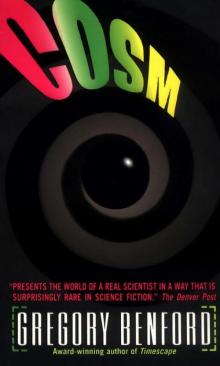
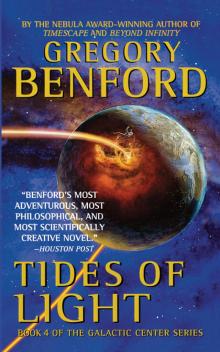
The Galactic Center Companion, page 17


At one point during his wanderings, Toby fashions a raft, deciding that it would be easier to float down a large river than to try to make his way by foot along the bank. He eventually comes to a town built on the river, trading with mighty riverboats.
Toby eventually gets a job on one of these boats, the Natchez, because of his recent experience coming down the river. At one point, Toby begins to have some thoughts about the river that seem familiar:
Under Mr. Preston [Toby] was coming to see that the face of the wedded water and metal was a wondrous book, one in a dead language to him before but now speaking cherished secrets. Every fresh point they rounded told a new tale. Not one page was empty. A passenger might be charmed by a churning dimple on its skin, but to a true riverman that was an italicized shout, announcing a wreak or reef of wrenching space-time Vortex about to break through from the undercrust of timestone.
Passengers went oooh and aahhh at the pretty pictures the silver river painted for them without reading a single word of the dark text it truly was.
Compare this with a passage from Mark Twain’s Old Times on the Mississippi:
The face of the water in time became a wonderful book—a book that was a dead language to the uneducated passenger but which told its mind to me without reserve, delivering its most cherished secrets as clearly as if it uttered them with a voice. And it was not a book to be read once and thrown aside, for it had a new story to tell every day. Throughout the long twelve hundred miles there was never a page that was devoid of interest, never one that you could leave unread without loss, never one that you could want to skip, thinking you could find higher enjoyment in some other thing. . . . The passenger who could not read it was charmed with a peculiar sort of faint dimple on it surface . . . but to the pilot that was an italicized passage; indeed it was more than that, it was a legend of the largest capitals with a string of shouting exclamation-points at the end of it, for it meant that a wreck or a rock was buried there that could tear the life out of the strongest vessel that ever floated. . . . In truth the passenger who could not read this book saw nothing but all manner of pretty pictures in it, painted by the sun and shaded by the clouds, whereas to the trained eye these were not pictures at all, but the grimmest and most dead-earnest of reading matter.
Again the mechs attack, and again Toby is forced to flee. After various adventures, he does meet up with Killeen and Abraham. The Mantis reappears and is able to get the all-important DNA samples. The mechs now can decipher the DNA and study the weapon to determine just how dangerous it really is.
Yet, something is still missing, for there are gaps in the coding. Under threat of torture, Abraham reveals the code, which had been handed down through numerous generations in the Bishop family. He sings the code, which is actually a song, “a passage from the most hallowed of the musics the Bishops carried in their sensorium store. They had played it on the long marches together, knew its lines by heart. . . . The highest of arts, the Mose Art.”
The Mantis says, “I see the connection. The unused sites in the Bishop DNA—that is the key. The notes of this piece, arrayed in harmonics, yield the solution. I relay this to the Exalteds now.”
Now the long search has ended: the Exalteds (higher-order mechs) had the information and could now begin to develop a defense against this weapon, whatever it was.
However, as smart as the mechs are, they can’t come close to the deviousness of the Naturals. The humans are, in reality, bait. They never were expected to build this weapon and use it against the mechs. Instead, this is all a ruse designed to fool the mechs. The DNA coding and the aria are not instructions for a super-weapon or even a revelation of some serious weakness in the mechs—the codes themselves are, themselves, the weapon. They form an idea virus that attacks and ultimately destroys the memory and logic sections of the mechs. As a further example of the Naturals’ deviousness, the virus includes a directive that impels any mech infested with the virus to transmit the virus to any mech within reach.
The long war is over.
Now comes the hard part—persuading the few surviving mechs to join with the Naturals, for the universe will come to an end in a few billion years. The mechs must be convinced that they and the Naturals have a common goal here—to find out how to prevent this from happening or at least learn how to survive, until the next universe forms. Cooperation between them would seem to be absolutely necessary at this point.
7. Conclusion
Situations and events in the Galactic Center series bring to mind Clarke’s Rendezvous with Rama and also his landmark short story, “The Sentinel.” And, along with the incoming asteroid, Benford somehow manages to insert Bigfoot into the narrative, as well as a religious cult that has gained sufficient political power to prohibit certain types of research and prevent the publication of research results that conflict with their religious beliefs (must be fiction, couldn’t happen here in the USA).
The overarching plot structure of Benford’s Galactic Center series is reminiscent of E. E. “Doc” Smith’s Lensmen novels, which, like Benford’s, consists of six works. In both works, the humans, although in the forefront of the fighting, are really weapons wielded by a superior race—Smith’s Arisians and Benford’s Higher-ups. And, the enemy forces also are controlled by superior beings—Smith’s Eddorians and Benford’s Exalteds. The identity of the leaders of the opposing forces aren’t known to the humans at the beginning of the conflict. It’s only as the conflict gains in intensity and scope that hints and clues emerge which tell the humans that there are others involved in the struggle. Again, it’s only in the final volume of both works that the ultimate leaders of both sides come out of hiding and reveal themselves. This is especially true of the first publication of Smith’s series, for he later revised the first volume to give the readers complete knowledge and novels’ characters some knowledge of the Arisians and Eddorians and their struggle for control of the universe.
I consider the Galactic Center series to be one of the greatest sf series ever written, and I hope that I’ve been able to provide some evidence why. Perhaps someone reading this might be inspired to pick it up.
In the first novel, Nigel Walmsley spends almost as much time and energy fighting NASA bureaucrats as he does the mechs. It is, therefore, fitting that these should be the last words of Sailing Bright Eternity, the final volume of this magnificent series:
All was now quite modern and different around there and most of the ancient names on the graves mean nothing to anybody. There are Cards aplenty and Bishops and even a few Dodgers.
Nearby, old markers relate the names in a language now dispersed or dead. Killeen Bishop. Nearby, slightly less worn, Toby Bishop. These graves are unusually large, suggesting to archeologists that these were from the Hunker Down Era.
Always slightly distanced, alone and apart, Nigel Walmsley is buried on a separate knoll, in full view of the ocean of night.
A version of this essay originally appeared on freds-ramblings.blogspot.com.
About Gregory Benford
http://www.GregoryBenford.com
Physicist, Educator, Nebula Award-Winning Writer
Author of more than 20 Science Fiction novels, a two-time Nebula Award Winner, Gregory Benford sets the science and the physics of today into his stories of the future.
Gregory Benford, New York Times bestselling author (with Larry Niven) of Bowl of Heaven, also author of top-selling novels, including Jupiter Project, Artifact, Against Infinity, Eater, and Timescape, is that unusual creative combination of scientist scholar and talented artist; his stories capture readers—hearts and minds—with imaginative leaps into the future of science and of us.
Many of Benford’s best known novels are part of a six-novel sequence beginning in the near future with In the Ocean of Night, and continuing on with Across the Sea of Suns. The series then leaps to the far future, at the center of our galaxy, where a desperate human drama unfolds, beginning with Great Sky River, and proceeding through Tides of Light, Furious Gulf, and concluding with Sailing Bright Eternity. At the series’ end the links to the earlier novels emerge, revealing a single unfolding tapestry against an immense background.
Often called hard science fiction, Benford’s stories take physics into inspired realms. What would happen if cryonics worked and people, frozen, were awakened 50 years in the future? What might we encounter in other dimensions? How about sending messages across time? And finding aliens in our midst? The questions that physics and scientists ask, Benford’s imagination explores.
An Award-Winning SF Author
In addition to winning one of Science Fiction’s top awards, the Nebula Award twice, Benford has won the John W. Campbell Award, the Australian Ditmar Award, and the 1990 United Nations Medal in Literature.
A Professor and Scholar
Meanwhile, as a University of California faculty member since 1971, Benford has conducted research in plasma turbulence theory and experiment, and in astrophysics. His published scientific articles include well over two hundred papers in fields of physics from condensed matter, particle physics, plasmas and mathematical physics, and several in biological conservation.
His scientific credits go on: He is a Woodrow Wilson Fellow and a Visiting Fellow at Cambridge University, has served as an advisor to the Department of Energy, NASA, CIA and the White House Council on Space Policy; and in 1995 received the Lord Foundation Award for contributions to science and the public comprehension of it.
www.GregoryBenford.com
Gregory Benford, The Galactic Center Companion