The Galactic Center Companion, page 16


Nigel Walmsley is the main character in all three encounters. Nigel is a British astronaut who has somehow convinced NASA to accept him. Moreover, when Icarus’ threat is discovered, he is chosen to plant the H-bomb which is expected to destroy it. However, once there, Nigel discovers that the asteroid/comet isn’t what it seems to be. The small rocky body has been turned into a spaceship, at least several hundred thousand years old. At this point Nigel, on the scene, and Houston, back on Earth, begin to differ about what to do next.
This delayed revelation of the threat reminds me of E. E. “Doc” Smith’s Lensmen series in which each novel reveals more of the nature of the threat looming in the background. After the series was initially published, Smith then produced the first novel which provided the necessary background, so subsequent readers all knew from the beginning who the real villains were.
Other subplots deal with Nigel’s complex romantic life; the rise of the New Sons, an anti-science religious group; and an encounter between one of Nigel’s friends and several hairy bipeds in northern California.
In the Ocean of Night is an independent work, though, and according to the inside cover it is the first in a trilogy, which was probably Benford’s thinking at that time. However, we all know what frequently happens to two- or three-book series: This trilogy turned into a sextet.
2. Across the Sea of Suns
Nigel Walmsley is back—just as obstreperous and cranky as before, and still a pain in the bureaucratic backside. In 1999, Nigel was an experienced astronaut, suggesting he was in his late twenties, if not older. Across the Sea of Suns begins in 2056 and ends in 2064. Nigel must now be close to 90. He’s still capable of going beyond the narrow limits of the various sciences to get an overall view.
And that’s his problem now. His overall view doesn’t coincide with the official view. Seeing a connection between the three alien encounters and the observations now being made of a planet circling a star some 8.1 light years from Earth, he doesn’t remain silent. Back on Earth, that wouldn’t have been a problem; he could just go on vacation or take a leave of absence and stay out of sight until all was forgotten or the bureaucrats he had angered had moved on. But, he’s not on Earth now, and he can’t drop out of sight.
A decade or so ago, transmissions were received from the unnamed star—English words transmitted at random. Several probes were sent, but little was learned. The powers on Earth, therefore, decided to send people, and based on information gained from the alien encounters, Earth built its own asteroid ship, the Lancer. This ship was hastily converted into a research vessel and sent to the star. Nigel and Nikki, a woman he met while working on the alien ship that had crashed on the moon, are both crew members.
The first part of the book details the discovery of the signals’ source, a strange alien race which survives on a planet on which it seems impossible for life to have evolved. A satellite orbits the planet, apparently doing nothing. Nigel argues that the satellite is a Watcher, there at least to observe the planet, and that the planet was attacked and reduced to its present state after life evolved there.
After leaving that system, the Lancer visits several other systems and finds Watchers around other devastated planets and around other planets on which life had yet to appear.
Meanwhile, Earth faces its own problems. Aliens suddenly appear in the oceans and completely disrupt shipping and travel. (This reminds me of the John Wyndham novel, Out of the Deeps, aka The Kraken Wakes). Benford provides a second plot which focuses on Warren, a survivor of an attack by the aliens on his ship. He shares some characteristics with Nigel, namely the attitude that bad things happen and the best course is to deal with it and forget about recriminations and finger pointing. And, most ominously, a Watcher has appeared in orbit around Earth.
The novel ends with a full scale nuclear war on Earth and the surviving crew of the Lancer boarding a Watcher. Nigel, however, has managed to survive, so there’s hope yet for the human race.
3. Great Sky River
Great Sky River is set on the planet Snowglade, in orbit around a star and a black hole. When this takes place is not clear, except for a brief mention that the original settlers of the planet traveled some 70,000 years to reach this planet, and that was long ago. Earth is not mentioned, so all we know is that a nuclear war had taken place. Were the original settlers refugees from a destroyed Earth? Or, perhaps from colonies that had been settled by humans? Moreover, several large structures called Chandeliers orbit the planet. Tradition says they are of human construction, but if so, when were they constructed and by whom—the original settlers, or a later group?
The humans who initially settled the planet were technologically developed far beyond the humans of the first two books, but their descendants lost most of it, and what little they retained was a mystery.
After having co-existed with the mechs—mechanical servitors of a lost alien civilization—each ignoring the other for the most part, the humans were almost eliminated by a surprise attack by the mechs. Humans, up to a decade or so before, lived in various citadels, and Killeen Bishop, the main character, is now on the run with perhaps 250 other survivors of the sneak attack. In each subsequent encounter with various mechs, the humans manage to destroy their foes, but usually at the cost of one or two of their own. The Bishops are slowly dwindling. They don’t even know if any humans in other citadels survived the mech attack. It is clear that the humans are slowly losing the battle with the mech civilization.
The Bishops have come close to becoming cyborgs, as they rely on electronically enhanced senses and mechanically enhanced physical abilities. The electronic senses allow them to detect the mechs at a distance, but it also allows the mechs to use electronic measures to attack them.
Generally, most mechs are of low intelligence and are primarily workers with limited skills. They ignore humans unless humans get in their way, at which point they treat them as they would any natural obstacle—go around them. More intelligent mechs, Marauders, also ignore the humans unless the humans somehow attract their attention, at which point, they try to destroy them.
Then something new appears, something that had been the subject of rumor and considered myth by most—the Mantis. The Mantis was supposed to be designed to be a hunter, and its prey?—humans. The humans occasionally detect a mech of some sort following them, something that hadn’t happened before. The humans have several encounters in which they think they have destroyed it, but each time, before long, the Mantis is once again on their trail. Killeen began to suspect it was herding them somewhere.
His suspicions increase as the Bishops encounter another group of humans for the first time since the mechs attacked. At the moment of the encounter, when both groups in their joy at meeting other survivors relax their vigilance, the mechs attack again. Eventually it is destroyed—they think—but the humans lose more than 38 irreplaceable lives. And, in the distance, they can see worker mechs picking up the various parts of the Mantis and carrying it off, perhaps to be reassembled.
Benford has not simply created a tale of warfare between good humans and bad mechs. Both humans and mechs are far more complex in their actions and their loyalties. When mechs wear out or suffer a serious malfunction, they are ordered back to a mech center to be dissembled and their parts stockpiled for other mechs. Some, however, rebel and turn renegade (Rennies). They exist by preying on other mechs and by stealing parts and equipment from mech centers. Some even make deals with humans. Also, as Killeen learns, the Mantis, a highly intelligent mech, is not just a hunter of humans, but an artist, or at least an artist as mechs understand the term.
Along with humans and mechs, Benford introduces a third entity, one that can use the magnetic storms that envelop the planet to communicate. It lives partially in and partially outside the event horizon of the black hole. I wonder what Stephen Hawking would make of this. It seems to want to help the humans and informs them of a space ship that was buried in the vicinity. How it knew of this is unknown.
And what of Nigel Walmsley of the first two volumes? We left him and his fellow human crew members of the asteroid ship in control, maybe, of a mech ship. He doesn’t appear in this volume, but during their wanderings, Killeen and his group come across an ancient human structure. The Mantis says that the humans had called it the Taj Mahal, and that the leader of the humans who had built the structure had put his initials on the structure: NW. If this is a replica of the Taj Mahal, or something that serves the same purpose as the Taj Mahal, then whose wife is buried here? Nigel outlived Alexandria, his first wife. Has he also outlived Nikki, his second?
This is an excellent novel with fast-paced action and a host of ideas sufficient for three or four novels. It would be fascinating just to read a story about the Mantis.
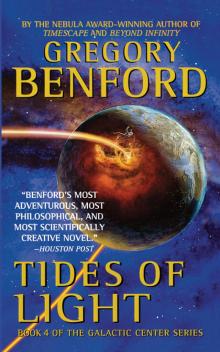
4. Tides of Light
Greg Benford’s Tides of Light picks up the story around two years after the conclusion of Great Sky River. Now aided by the Mantis, possibly gone rogue or at least with its own agenda, the humans lift off in the Argo in hopes of finding a planet they can settle without fear of extermination by the mechs.
They approach a planet that they hope will be the new Eden. So optimistic are they that they’ve already named the planet New Bishop, prematurely as they soon learn. The planet is not unoccupied; already present are other humans and the myriapodia, a cybernetic alien race far advanced from the surviving humans and that has been locked in a deadly struggle with the mechs for thousands of years. Whereas the humans have usually fled for other parts of the galaxy, hoping to elude the mechs and build a civilization in peace, the myriapodia have done the opposite. Feeling that the mechs pose an inescapable threat to all organic life, they have deliberately engaged in battle with the mechs whenever the opportunity arises, and in some cases, have gone searching for opportunities.
Briefly, the mechs on the planet, programmed to engage in competition with one another to simulate the effects of evolution, have lost contact with the central intelligence. Over the years, the competition has become severe enough to degenerate into open warfare among competing mech groups. The warfare weakened them sufficiently to allow humans on the planet to begin their own campaign against the mechs. Just as the humans were about to destroy the mechs, the myriapodia arrived on the scene, took advantage of the situation, and quickly destroyed the remaining mechs.
It is at this point that Killeen and the others arrive. Initially mistaken for mechs by the myriapodia, the humans barely escape to the planet’s surface where they make contact with the humans. They discover that the humans are led by a religious fanatic who believes God had directed him to attack and destroy the mechs and now directs him to destroy the myriapodia. Killeen is doubtful about this but must go along or he and the rest of the Bishop clan will be destroyed.
To make life even more interesting, the myriapodia, led by their ruling council, the Illuminates, are puzzled by the arrival of Killeen and the Bishop clan. Having taken the Argo, the myriapodia discover information about the humans that results in an open division among the Illuminates, which ultimately results in civil war. One group feels that the humans must be destroyed, while a second group believes that the humans, in some way unknown as yet, are necessary for the destruction of the mechs and therefore, will ensure the safety of organic life in the galaxy.
Overall, this novel is as good or perhaps even better than its three predecessors. It has action, interesting characters (human and alien), and, what’s always necessary for good sf, some scientific extrapolation. In this novel, the major scientific idea is the control of cosmic strings by the myriapodia. (For a very brief and readable explanation of string theory, I recommend this PBS site, .)
The myriapodia have learned to control a string and are using it for planetary mining. The string is used to slice into a planet. Once it reaches the core, it becomes a conduit for draining the core of needed minerals. There is much talk today that sf is too often being overtaken by real events. I don’t think Benford has anything to worry about here. Assuming that strings even exist, it will be some time in the future before we learn to control them, if that’s even possible.
Killeen once again leads his people off-planet and heads for the Galactic Center, this time accompanied by Quath, one of the myriapodia who comes along as an ambassador.
Benford has included a four-page appendix to the novel—“Chronology of Human Species (Dreaming Vertebrates) at Galactic Center.” There’s sufficient material here for another 20 or 30 novels, but so far Benford has resisted the temptation and the series seems to have ended at six. We still don’t know what happened to Earth. For those who are wondering about the fate of Nigel Walmsley, as I am, we still don’t know. However, Benford did include some oblique references to him in this volume, so perhaps we are not to forget about him completely.
5. Furious Gulf
Furious Gulf opens with the Argo nearing the Eater, the massive black hole at the galactic center. The POV shifts to Killeen’s son Toby. We experience events from Toby’s perspective, including his view of his father, who is struggling to keep the crew under control.
Killeen faces a mutiny aboard ship, for his crew has been on reduced rations for some time, and he has ignored their requests to stop and replenish supplies. Killeen, at this point, resembles Captain Ahab much more than Captain Kirk. Killeen is obsessed with reaching the Center, for legends, myths, and his instincts tell him that the secret of survival in the war with the mechs lies at the Center, and he seems willing to sacrifice his ship and crew in pursuit of that secret.
With the aid of the mysterious electromagnetic entity who appeared in Great Sky River, the Argo is able to avoid the mechs and find a temporary haven at a space station on the edge of the black hole. At this point, the disagreement between Killeen and his son Toby emerges, and the result of one of the strangest Oedipal conflicts I have ever read.
The humans running the station are not doing so out of any warm feelings for humanity but for profit. The Bishops and the Argo can stay, but there are various fees, one of which is access to the so far untranslatable tiles found on the ship.
Benford has allowed us to listen in while the mechminds debate their course of action with regard to the humans, and we have discovered that they also are intrigued by these tiles. They just might be a threat to the mech civilization. The mechs are also concerned because they know that mysterious intelligences superior to them exist. Are these intelligences more highly evolved mechminds or could they, impossibly, be organic?
Toby, about two-thirds of the way into the novel, finally breaks with his father and escapes into the strangest environment yet presented. The landscape consists partially of more or less “solid” time. I’m not going to attempt to explain this.
While Toby is on the run, the mechs make a concerted attack on the human stronghold. They, like Killeen, believe there is a threat here to mech survival, and it seems to have something to do with getting three generations of a family together. Somehow, Abraham, Killeen’s father, has managed to escape the final attack on the Bishop stronghold on Snowglade and get to the Galactic Center. The mechs want to capture the Bishops, if possible, to discover the nature of the threat or, failing that, eliminate them to remove the threat.
Toby eventually manages to reach a sanctuary and is greeted by Nigel Walmsley, who has survive 30,000 years through judicious use of cold sleep and the time-dilation effects of existence on the edge of a black hole. We are now ready for the climactic struggle between the mechs and humanity.
Thus ends Furious Gulf.
The star of the show is the Eater. I’ve read other accounts and have even seen at least one film of the environment of a black hole, but Benford is the first to really focus on and bring out its strangeness, and that includes several life forms. That he is able to do this is, no doubt, the result of his education and training as an astrophysicist. In the afterword to Furious Gulf, Benford writes:
It has been an unusual experience to conjure up imaginary events about a place that I was also doing hard calculations about. Freed of the bonds of The Astrophysical Journal, I have felt at liberty to speculate on what processes might have transpired, over the galaxy’s ten billion years of furious cooking, to create forms of life and intelligence beyond our ken.
6. Sailing Bright Eternity
Sailing Bright Eternity picks up immediately after the end of Furious Gulf, with Toby, who has become separated from his father and the rest of the Bishop family. He has encountered a crusty old man who occupies what appears to be some sort of galactic library and who claims to be from the mythical planet Earth. It is Nigel Walmsley, who, as will any old timer who hasn’t had anybody to talk to for awhile, proceeds to fill Toby in on his part in the war against the mechs, a period which covers roughly 35,000 years.
As Walmsley finishes his tale, the mechs, once again, appear and attack. Walmsley and Toby are separated, and we follow Toby as he flees the mechs and searches the Wedge for his family and friends. The Wedge is an habitat created long ago as a refuge for Naturals fleeing the mechs; it has various “pockets,” with varying environments.
What Toby doesn’t realize is that the mechs don’t want him dead, just yet. They are looking for his grandfather, Abraham. The mechs have recently learned, as have some of the humans, that there is a secret weapon that could destroy the mechs if it ever could be constructed. The instructions for the weapon are encoded in human DNA, that part called “junk” DNA that doesn’t seem to play any role in human development. To get the information, DNA from three closely related humans is required. In this case, the mechs have decided to get the instructions from Abraham, Killeen, and Toby. Therefore, the mechs keep prodding Toby on in hopes that he will meet up with his grandfather, whom everybody mistakenly thought had died long ago.