The Galactic Center Companion, page 12


I focused on the inner few light years, for dramatic effects, even though I knew the sheer particle and energy flux there made humans quite vulnerable. To protect them I made them huge and armored. The central figure was a man named Killeen, who flees across a ruined landscape dominated by the black hole, which his people call the Eater of All Things—though they don’t quite know why.
This ravaged panorama seemed an ample stage to act out my main theme, the superiority of machines in much of the galaxy. I also got to spring their size as a twist at the very end of the series, when they meet Walmsley, whom they take to be a dwarf.
By then, measures of the orbital velocities of stars very close to the true galactic center, called Sagittarius A, suggested that a point mass of about a million stellar masses lurks there, giving off very little light.
Much controversy surrounds these observations, though, with some holding that the data could mean only a thousand stellar masses is needed. I opted for a million, because then a ship could fly through the ergosphere, the very rim of the black hole, and not be crushed by the tidal forces. This would be crucial to the last volume, #5—I thought.
The profligate energetics of the center would draw sentient machines, I felt. The black hole would intrigue any inquisitive life form, their struggles surging across a virulent territory. Humans would be part of it all, but certainly not the major players.
How to put humans in this mix? I collided here with the classic hard sf dilemma: humans versus the immense landscape. How to make them seem significant? How to simply make it plausible that they could survive? One could invoke miracles, of course, in the form of magic materials or offstage events which just happen to put people where you need them. I wasn’t willing to do that. Picky, perhaps, especially in a time when fantasy novels unbounded by visible constraint began dominating the marketplace, and hard sf held little sway on the bestseller lists. But I couldn’t make myself take a simpler path, and this proved a significant slower of my work. I pondered and time slid by.
After stalling yet again on my “Galactic Series,” slowly I went back to fundamentals. I began envisioning what it might be like at stage center, where the diet of particles and photons is rich and varied. Only hard, tough machines could survive for long there.
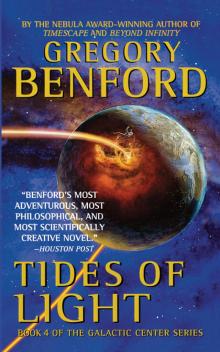
In the fourth novel, Tides of Light, I drew out these contrasts. Hard work, but fun. I devised “photovores” and “metallovores” as adaptations to special evolutionary niches. After all, machines that can reproduce themselves would, inevitably, fall under the laws of natural selection, and adapt to use local resources. The entire panoply of ecology would recapitulate: parasites, predators, prey.
How to envision this? I prepare for novels by writing descriptive passages of places and characters. In spare moments I began working up snapshots of possible life forms and their survival styles.
Years before I had found a technique to deal with “obstructions”—a better word than the fearsome “block,” and to me it meant something rather more subtle. At times I simply couldn’t get my subconscious to flower forth with free material along the lines of the novel.
So I pretended that I was working on another story entirely and wrote that. Sometimes I found I was right—it really didn’t connect with the novel. Most times, with some tuning, it did. I made a policy of following through, publishing the work independently if possible, out of an almost superstitious belief that my subconscious would catch on. So far it hasn’t . . . I think.
That’s why occasionally pieces of my novels appear first as short stories. I often don’t know whether they fit the novel, sometimes until years later. This trick I had to use again and again, because my subconscious proved lazy and headstrong. I’d planned to rap out three novels and be done by 1989, but #3 appeared in 1987, #4 in 1989 . . . and then I got interested in another novel, Chiller, wrote it in three tough years…and ground to a halt. That pesky subconscious just wouldn’t cooperate with my game plans. This cost me considerably, for the series’ momentum broke and undoubtedly some readers lost the thread.
In 1990 I had to start from scratch again, thinking through the overarching logic of the series. Slowly it dawned that some part of me had shied away from doing the last novel because I couldn’t reconcile the many forces within the narrative. I realized with a sinking feeling that one more book wouldn’t be enough, either.
Intelligent machines would build atop the galactic center ferment a society we could scarcely fathom—but we would try. Much of #5, Furious Gulf was about that—the gulf around a black hole, and the gulf between intelligences born of different realms.
For years 1 had enjoyed long conversations with a friend, noted artificial intelligence theorist Marvin Minsky, about the possible lines of evolution of purely machine intelligence. Marvin views our concern with mortality and individualism as a feature of biological creatures, unnecessary among intelligences which have never had to pass through our Darwinnowing filter. (This term, and TwenCen, the critic Gary Wolfe deplored. But word play is the essence of writing to me and anyone’s ear is surely the last judge, down the long corridor of time.)
If we can copy ourselves indefinitely, why worry about a particular copy? (This theme really bites when you are an identical twin, as I am.) What kind of society would emerge from such origins? What would it think of us—the primitive Naturals, still hobbled by biological destiny?
Through books 3, 4, and 5 I had used the viewpoint of humans hammered down by superior machines. This got around the Walmsley lifetime problem, but demanded that I portray people enormously different from us. They had to seem strange, yet understandable—a classic sf quandary. My sole source of inspiration lay in the devices invented by the great modernist geniuses—Faulkner, Woolf, Joyce, so many others I read through my middle years. (Teaching Faulkner in high school would be a huge error, in my view. He’s much too dense.) After a while I saw that the great southern novelist Twain was in a way a modernist, too—for the southern voice was a discordant one, however homey. All this I digested. Most of my true toil comes surfing through to me on waves of intuition, my unconscious laboring off stage. (My mathematical work I get done much the same way.)
A slowly emerging theme in the novels, then, was how intelligence depended on the substrate, whether in evolved humans or adaptive machines—both embodying intelligence, but with wildly different styles.
By the time I reached the last volume, in 1992, I had spent over twenty years slowly building up my ideas about machine intelligence, guided by friends like Marvin Minsky. I had also published several papers on the galactic center and eagerly read each issue of Astrophysical Journal for further clues.
I finished the last novel, Sailing Bright Eternity, in summer 1994. It had been twenty-five years since I started on In the Ocean of Night and our view of the galactic center had changed enormously. Some parts of the first two books, especially, are not representative of current thinking. Error goes with the territory.
I had taken many imaginative leaps in putting together a working “ecology” for the center. I included outré ideas, such as constructions made by forcing space-time itself into compressed forms, which in turn act like mass itself: reversing Einstein’s intuition, that matter curved space-time.
All this was great fun, requiring a lot of time to think. I let my subconscious do most of the work, if possible—surely an easier way to write, but it stretches out projects, too.
Long-suffering readers wrote asking when the next volume would appear and I felt badly about it, but I knew the writing could not be rushed. I had not anticipated that each volume would demand so much thought, and still less that I would need an extra novel or two to do the job. In the end, all six books comprise about three quarters of a million words.
My published physical model of the galactic center is done in what I call the “cartoon approximation”—good enough for a first cut, maybe, but doomed to fail somewhere. Sf works in this approximation, necessarily. That paper, “An Electrodynamic Model of the Galactic Center,” appeared in The Astrophysical Journal in 1988 and seems to be accepted now, in 2013, as a plausible view of how the bright filaments thronging the region within a few hundred light years of the black hole work.
In any case, models are like art, matters of taste. Nobody expects a French Impressionist painting to look much like a real cow; instead, it suggests ways of looking at cows. Sf should do that.
I learned a lot of tricks along the way, many of them embarrassingly obvious. In 1969 I never outlined, though that year I had sold my first novel with a three-page description and ten thousand words of a novelette. By 1992 I kept notes by subheadings—INCIDENTS, NOTIONS, TECH, TIMELlNE, CHARACTER, BITS O’ BUSINESS, etc.—in a three-hole binder and on computer, so I could lift and insert.
More important, I had grasped that the climaxes of each book should resemble a stairway. Each should play for higher stakes which do not undercut the resolutions of the earlier novels. Each should open the philosophical canvas at least a bit, particularly in a galactic, hard sf novel sequence such as mine. Each should explain mysterious elements of the past novels, but leave some shadows to shed a glow into the future. Each should tell us something deeper about the lead figure. Each figure should move through a defining moment of his life.
This last point may be crucial. I used two central figures, Walmsley and Killeen, neither particularly likeable. This may be a quirk of mine, but I’ve never enjoyed trotting around in the head of a bright-eyed, perpetual optimist; this may reveal more about me than I wish, but there it is.
Each of these men had to learn and grow, but not abandon themselves to the cosmic perspectives. As Gary Wolfe remarked in reviewing the last novel, “This is the classic problem of hard sf, of course: a rhetoric of action and human drama must be juggled with a rhetoric of science and philosophy in a way that must be made to appear seamless. . . (often) writers either give us cardboard characters against a spectacular backdrop, or fudge the science in order to make the plot work out.”
I felt the pressure of keeping these people to seem human more and more as the novels waxed on. So I gave them vices, irksome habits, troubles with their love lives, men and women alike, faults—big ones, including bad tempers and emotional isolation. (Even Einstein picked his nose, remember.) Yet each figure made progress, or at least came to understand themselves better. Most of my characters are men because I know them better. Women are harder for me, more an act of imagination. I’ve written more women characters since I finished the series. A smaller compass makes for finer detail.
I didn’t actually figure all this out clearly. In fact, some of the above paragraphs have made these points clear to me only while I was writing them. (This is a common experience for me, too. I don’t know what I think until I express it. That old subconscious, again.)
I had always intended to make the series Stapledonian, recalling Star Maker, but squeezed through the aperture of a modern, rounded novel. I used talks with aliens, with machines, with disembodied intelligences lodged in magnetic configurations, with archly amused denizens of the far future—anything to avoid the overweening bigtime Narrative Voice; though I used that, too.
This single diffractive decision, to employ distant voices—more aesthetic than craftsmanly, and made unconsciously as well—created more work for me than anything else in the sequence. Looking at angles is my preferred method overall, even outside the “Galactic Series,” but it imposes great constraints. That fits with my own feeling about hard sf—that it works best because of its self-imposed restrictions, in the fashion that a sonnet does. Constraints improve.
Would I write a series again? Maybe, but not right away.
Do it this way again? Nope. I do hope I’d avoid some of the traps. One learns by doing.
But the impulse remains. To measure humanity, one needs a scale for comparison. What can be the yardstick of a species such as ours? The galactic scale tempted me. We will never know how we fare on such scales, but it is very human to ask.
Astrophysical Journal, 1988: An Electrodynamic Model Of The Galactic Center
Gregory Benford
University of California, Irvine
Received 1987 November 19; accepted 1988 April 12, The Astrophysical Journal, 333:735-742,1988 October 15 © 1988. The American Astronomical Society. All rights reserved. Printed in U.S A.
Abstract
Molecular clouds moving at Keplerian velocities can induce strong electric fields in ionized regions near the Galactic center. The v x B induced field can drive currents over equivalent circuits ~ 100 pc along the highly ordered magnetic fields, B ~ 10-3 G. Such current paths drive low-level ion acoustic turbulence, providing a resistance in the circuit. Small magnetic pinches form which are generally kink unstable but which can organize into larger, long-lived structures. Ohmic losses are energetically important in the molecular clouds, where high-density regions should be most luminous. Electrons can accelerate in the induced fields to relativistic energies, yielding the radio luminosity. Electrodynamic flares may occur on year time scales. Such electrodynamic deceleration of clouds can powerfully increase accretion toward galactic centers and enhance their luminosities.
Subject headings: galaxies: nuclei—hydromagnetics—interstellar: molecules
1. Introduction
Near Galactic center lie several types of ordered, luminous structures visible in the radio bands. Most prominent is the Arc, which has two very different segments: straight nonthermal filaments perpendicular to the Galactic plane, and the Arch—thermally emitting filaments above the Galactic plane which turn back toward Galactic center. These features are weakly echoed at negative Galactic latitude, suggesting an overall structure connecting the ends of the straight filaments toward the Galactic center. This paper attempts an electro-dynamic model for these observed bright elements.
Observations of recombination lines and thermal dust emission show that the Arch filaments are thermal emitters. They appear to lie near giant molecular clouds and often overlap the edges. These clouds are denser (~ 104 cm-3, by CS and NH3 emission seen throughout the clouds), warmer (gas temperatures of 50-100 K), and of larger local line width (20-40 km s-1) than their counterparts in the galactic disk a few kiloparsecs from the center (Gusten and Downes 1980; Gusten, Walmsley, and Pauls 1981; Armstrong and Barrett 1985; Bailey et al. 1987). Distribution of ionized and molecular gas suggests that they are ionized by external sources (Serabyn and Gusten 1986). Low dust temperature and high gas temperatures there further suggest that shock dissipation or some other unusual process does this heating, rather than gas-dust collisions.
Heyvaerts, Norman, and Pudnitz (1988) recently proposed a model of energy transfer from the inner parsec of the Galactic center through expanding magnetic loops. While this model explains some morphological and energetic puzzles close to the center, in order to explain the well-ordered filaments and high luminosity it must invoke a set of shock waves where the loops meet a heavier medium. To observe their shocks as linear filaments requires a special viewing angle. Further, although their loops apparently expand symmetrically from the center and so should strike the dense outer medium on both sides of the center, there is conspicuously less luminosity on the side opposite the Arch. It seems plausible that another agency closer to the filaments might be the cause of so much Arch luminosity.
Two prominent clouds, G0.1+0.08 and G0.18-0.04, apparently interact with the Arch. A cloud with 40 km s-1 velocity seems to protrude into the Arch, judging from contour maps of molecular line emission. Yusef-Zadeh and Morris (1987) estimate a milligauss magnetic field in this region, and perhaps throughout the entire volume. Emission measures give a relativistic electron density of at least 4 x 10⁻⁴ cm-3.
Further, these giant clouds move oppositely to the direction of galactic rotation at high velocity, perhaps on highly eccentric orbits (Bally et al. 1987). Serabyn and Gusten (1986) propose that tidal disruption forces portions of these clouds inward toward Galactic center.
This unusual configuration suggests a connection with the straight filaments, especially since Yusef-Zadeh and Morris (1987) show that polarization peaks at the overlap between the straight filaments and the Arch, suggesting interaction and particle acceleration there. Their work reveals linear polarization along the straight filaments, which remain coherent and smoothly luminous for 30 pc perpendicular to the Galactic plane. Some depolarization along their length implies intervention of nonthermal matter along our line of sight. The spectral index of nonthermal filamentary emission is flat, implying young, monoenergetic electrons (Yusef, Morris, and Chance 1984). The straight filaments curve slightly concave toward galactic center, along loci of constant angular velocity.
As the straight filaments extend away from the Galactic plane they become diffuse and broad, leading to polarized lobes aligned with the filaments and placed symmetrically (Seiradakis et al. 1985; Tsuboi et al. 1986). This could arise from a decrease in external gas pressure away from the plane, or an adjustment of possible magnetic confinement of the filaments. Yusef-Zadeh and Morris (1987) detect apparent helical structure winding about the system of linear filaments with constant pitch angle and radius of curvature ~9 pc. They see three distinct helical segments crossing in front of the filaments, with a common axis at the mean position of the filaments. They further suggest that some filaments gently twist about each other. They resemble the individual filaments near the plane, which are separated by ~1 lt-yr. The regular pattern of the straight filaments suggests some ordering principle, since it is unlikely that we are in a privileged observing position and are witnessing, for example, a family of shocks seen sidewise. This ordering vanishes in the Arch. Further from the Arch and straight filaments, which together comprise the Arc, isolated, thin, nonthermal threads extend over 30 pc with diameters of less than 0.5 pc.