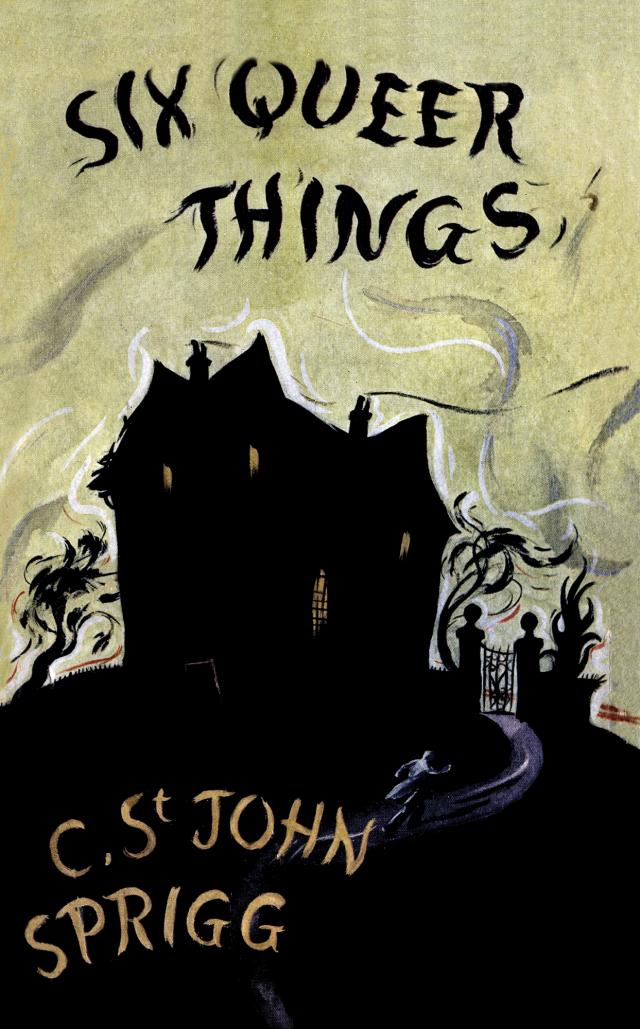
The Six Queer Things, page 24


Suddenly he stiffened. A small dark figure had detached itself from the shadows. It carried something glittering. The something caught the moonlight and winked wickedly.
The figure moved like a cat. After the moment when it had revealed itself in the moonlight, it sank back into the shadow of the wall, and seemed to melt into the brickwork. By straining his eyes, Morgan could see that the figure was pressed against the drainpipe, and was rising. It clung there like some great bat.
Presently it was leaning, still with two legs curled round the drainpipe, upon the window sill. Morgan could hear his own heart pounding in the silence. The window sill was half in moonlight, and once again Morgan saw the glittering thing wink at the moon in the hand of the dark figure. Then there was a sound like the puff of a suddenly deflated tyre, and a red flash which made the moonlight seem cold and garish.
Morgan did not hesitate but, raising the revolver which all the time had been clasped in his hand, he levelled it at the man. Morgan was a dead-cold marksman, and the weapon was shot out of the hand of the human cat. Revolver and body dropped in the yard almost simultaneously.
Morgan rushed out to pick him up. He did not struggle. Like most supercrooks, he did not mind cold steel or firearms, but shirked hand-to-hand encounters. He gave himself up to arrest without a fight. Only his eyes, burning impotently in the moonlight, snapped balefully as Morgan clamped the handcuffs on his wrists. The fingers of his right hand were shattered by Morgan’s bullet.
“Now we’ll turn on the lights,” said Morgan triumphantly, “and see what fish we’ve got.”
The torch lit up the contorted features of George Hawkins, former chauffeur of the medium, husband of Bella Crispin, alias the Director. . . .
Upstairs in Burton’s room, Morgan inspected the damage. A wax model, with some resemblance to Samuel Burton, borrowed from the outsize window of Gellows, the 30/- tailors, had had its head shattered beyond repair. The waxen fragments were scattered all over the pillow. As he saw this, Hawkins’ face twisted in pure chagrin—one of the most painful emotions of the vain man. It was to give place later to a kind of sullen resignation.
He had been trapped. . . .
“Everything you say may be used against you at a later date,” Morgan warned him. “At the same time, you are so compromised that I do not see that it would do you much harm to be truthful. Yours was a remarkable—in fact a brilliant—crime. Unless you enlighten us, its details will never be known, and I think it would be a pity if it were lost, and your name did not figure in the annals of crime.”
Morgan was sufficiently a psychologist to know that now, when the man’s vanity was most wounded, was the time to use it to effect his purpose.
“I am more compromised than you think,” answered Hawkins with a snarl. “What is it you want to know? It seems to me you know a good deal as it is!”
“I want to know why you killed Crispin.”
“Why does one kill women?” asked Hawkins impatiently. “Any woman? Because she is a damned nuisance! I am prepared to bet that if you go into the details of any big plan that has gone wrong, you’ll find a woman in it somewhere, messing it up. They can’t keep their emotions and their business separate.”
“What do you mean? I don’t quite follow,” prompted the detective.
“Only that this horse-faced piece of femininity conceived a fatal passion for me!” replied Hawkins bitterly. “She nearly worried the life out of me with her lovesickness. It’s possible to discipline most of the emotions of human beings. I’ve specialised in making the whip crack round their heads and seeing them sit up and beg. Fear is a great tamer! Fear and gold together can do everything—except make a woman in love behave sensibly. Can you imagine anything more foolish and degrading—a woman of her age and experience falling in love like a sloppy schoolgirl—worse, in fact, than a schoolgirl?”
Morgan looked at Hawkins closely, and realised that his small, dark litheness might make a powerful appeal to women. Something in him made him feel even a little sorry for the woman Crispin, utterly devoid of feminine charm, and with a life no doubt completely starved of affection, suddenly falling a victim to the Aphrodite she had flouted and denied so long. Ridiculous—and yet how human and understandable!
“I could have managed her alone, I think,” went on Hawkins. “After all, I had only to tell her to do a thing, and she’d do it, if it meant a kind word from me. She had got to that stage! But then there was the difficulty of Bella.”
“Of Bella?”
“Yes, Bella had been in love with me for some time. I had encouraged it, thinking it might be useful. I could use Bella to watch her sister, and I always believe in having an observer to check up on one’s agents. But these two sisters became jealous of each other. I don’t know if you’ve ever had any experience of the jealousy of two sisters, but if not—well, it’s something to terrify Heaven! It didn’t terrify me, but it irritated me, interfered with my plans, and at last got to a stage where it became definitely dangerous. She actually threatened me that if I did not send Bella away, she would blow the gaff on me! She quite coolly and calmly told me that, which showed the state she was in! No one had ever dared to threaten me before.
“Bella was equally mad. She had a fairly tough disposition beneath her outward meekness. Between the two of them I saw that the whole business was becoming impossible, and had better be ended quickly. I wasn’t altogether sorry. I had exploited the idea on which it was based for some years fairly profitably, and I was getting tired of it. I never like to run a scheme too long, however paying it is. After all one has an artistic conscience, and a part to play; and these things get boring if they are carried on too long!
“So I poisoned the older sister, and married the younger. Bella was by no means unattractive, and very devoted. I could foresee her being useful. When I say ‘married’, of course you will realise I speak in a Pickwickian sense. I have long passed the age when I rush into permanent entanglements of this kind, even were I legally able to. But in fact a wife of mine is still alive somewhere. God knows where, but I could have found her if it became necessary at any time to convince Bella that her position was not so favoured as she imagined. That kind of lesson soon brings them to heel!”
“Forgive me if I point out one flaw in your scheme! It puzzles me. Why use strychnine when, by using prussic acid, you could have ensured that the police found a culprit at once—Ted Wainwright?”
Hawkins smiled.
“For a policeman that might be a satisfactory ending. For anyone with a sense of finesse it is not. If Ted Wainwright were to be found guilty, not only might the whole murder come to light, but there would still be the business itself to clear up—the asylum, Marjorie Easton, and so forth. By keeping Ted Wainwright alive, and by posing as Marjorie Easton’s deliverer, I was able to ensure myself at least as substantial a share of her fortune as I would have got by acting as her jailer, with the added advantage that I had the whole business off my hands, and could start on a new and larger swindle I had just devised. There was one small mistake——”
“The Six Queer Things?”
“Yes. I cleared out all other clues but those. It was very careless of Crispin to leave a locked drawer.”
“But weren’t you afraid that one of the people in the racket, Wood, or Mrs Threpfall, or Marsden, might give you away when they found you had betrayed them?”
“No. None of them knew my identity. I had always dealt with them through Bella or her sister. Once Crispin was dead, only two were left alive who knew the secret—Bella and Samuel Burton. Where is Burton, by the way?”
“Safe in a prison cell. He demanded it. He said it was the only place where he would feel safe while you were alive.”
A gleam of pride lit the Director’s face.
“Quite true. I see he knows me.”
He nodded in the direction of the shattered wax model.
“Yes, if Burton had really been there I should have been safe! No one would have been able to give me away!”
“What about Bella?” Morgan taunted him. “Do you still trust a woman after your experiences?”
A gentle, almost childlike smile of self-satisfaction spread over Hawkins’ face.
“I shot the bitch dead before I came here.”
ABOUT THE AUTHOR
Christopher St. John Sprigg was born into a Roman Catholic family in Putney, southwest London, in 1907. He published seven mystery novels as “C. St. John Sprigg,” beginning with Pass the Body (1933), published in America as Crime in Kensington. However, it is for his nonfiction writings focusing on Marxist ideology, published posthumously under the pseudonym Christopher Caudwell, that he is best known today. He died in 1937, killed in action while serving in the International Brigade during the Spanish Civil War.
C. St. John Sprigg, The Six Queer Things