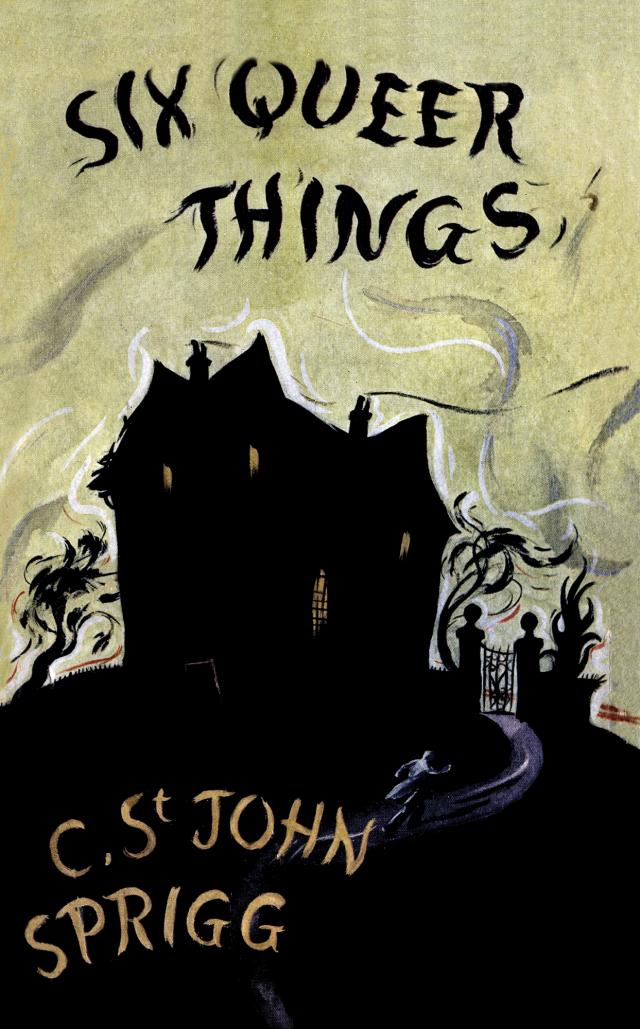
The Six Queer Things, page 16


“It is true. You know it’s true!”
The doctor shook his head. “On the contrary, it is a malicious invention. I must insist on your writing him the truth. Somewhat as follows: You are feeling very weak and ill, and not at all sure what has happened. Your mind is confused. You want to write and tell him you are staying at a very lovely place. You don’t know where it is, but you are very happy and everyone is very friendly. Some day, when you are better, he must come and see you.”
Marjorie was dumbfounded for a moment by the calm effrontery of this suggestion. At last she gasped out:
“How dare you stand there and suggest my saying that?”
“Why not? It is the truth. Come, be reasonable, Miss Easton. Write this letter!”
“No,” she answered firmly.
He attempted to coax her.
“You know, you are taking up an extraordinarily antagonistic attitude towards us! We are only doing this for your own good!”
“Keeping me here against my own will for my good! Hitting me and tying me up for my own good!”
“Dear, dear,” he said in a dismayed tone. “These ideas of violence again! Do try and see they are only delusions, Miss Easton. Put up a fight against them! I ask you to put this question to yourself: Why are we going to all this trouble, except for your own good? Our motives are obviously disinterested. This house costs money. Feeding you costs money. The attendants have to be paid. I have to be paid. Pardon my bluntness, but you have no personal money of your own. It is costing us money to keep you here. Would we do it if it were not for your own good?”
The extraordinarily plausible way in which he put forward the argument silenced her for the moment. Then she burst out impatiently:
“I don’t know why you are doing these horrible things to me. I only know that you are doing them. I shall not write to my uncle and tell him that I am happy here. I want to get my freedom. I shall never rest until I do.”
“Then I am very sorry. It is a pity you should prove such a refractory patient. Let me explain the situation to you simply. Whether you do what we ask or not, you will remain here. That is quite definite. But if you do the little things we ask, like writing a reassuring letter to your uncle, and give us your word not to do anything silly such as you attempted yesterday, then you will have a more comfortable room, you will have books to read, and you will be free to go into these grounds. But if you don’t——”
He broke off significantly.
“If I don’t?” she repeated.
“Then I am afraid it will be necessary to prescribe a very severe régime! You will be shut up here alone, without food, until you behave yourself. If you still resist, then there are various methods open to us. Certain drugs for example . . . You will find your will is not as strong as you think when your body is weakened.”
He said this in as casual a tone as if he were prescribing a tonic. Marjorie was unable to answer. He smiled pleasantly.
“I am glad to see you are thinking it over! Believe me, Miss Easton, we should hate to have to use the measures I have mentioned, but as a doctor I am trained to ignore any pain which is inflicted for the patient’s good. I’ll leave you to come to a sensible decision. If you do, ask the woman who looks after you to send for me. My name is Dr Marsden. I am afraid that, owing to the circumstances of our first meeting, I forgot to introduce myself.”
Marjorie was left to her thoughts. She realised that she was in a cleft stick. She had to leave them to post the letters she wrote, so that any letter sent could only be one of a kind they would approve. On top of that, even if no letter came from her, her uncle would not get agitated, because he would have received a satisfactory explanation of her absence already. No doubt he had communicated the news to Dr Wood and Ted. Neither of them would be much surprised. Wood knew that she was on the verge of a mental breakdown; Ted had become alienated from her, and had regarded her as half mad from the moment she had become a medium. The thought of Ted’s probable reaction to the news filled her with despair.
Would it not be better to give in to their request and get some peace? If she refused, God knows what they might not do. They had already shown they were absolutely ruthless. If, on the other hand, she gave in, and they in return allowed her more liberty, then there would be some chance of her getting a message to the outside world.
It was impossible to guess what their motives were. It seemed incredible that so much trouble could be taken merely for the sake of making her suffer. What could be the motive? It was better not to puzzle one’s brains about that, she decided finally.
When the hard-faced woman came in to her with some dry bread and a glass of water, she asked for Dr Marsden. He came within a few minutes.
“I’ll write the letter,” she told him, “if you will promise in return to give me some liberty—a daily walk in the grounds—and books.”
“Certainly. You must promise not to escape, and we will gladly do that.”
“Very well, I promise.”
Privately she decided that any promise could justifiably be broken against such blackguards. No doubt they would also regard the promise only as a matter of form. The doctor dictated the letter, and she wrote it. He took it from her, scrutinised it carefully and nodded.
“Fine. We’ll see you get a proper meal sent up now, and afterwards you can go in the garden. . . .”
2
On the morning after the odd business of the snake and the dead dog, Morgan received an unexpected letter in the post.
Dear Sir:
Seeing from the papers that you are in charge of the Crispin case, and that the police want any news of a young chap named Ted Wainwright, I write to tell you that in my opinion my young lodger is this chap, although he goes under a different name. Please come and see me at an early date, as I don’t know how long this young fellow is staying here. I never had any idea till then he was the man you wanted.
Edward Harness.
The letter came from a small village in Hampshire.
The name of the cottage was romantic—Nightingale Roost—but the place itself turned out, when the inspector’s car stopped in front of it, to be one of the pink asbestos-roofed bungalows with which the green and pleasant land of England is slowly being covered, wherever land values are still low and communications bad. It had a lonely, weary air, as if the reproachful spirits of ex-servicemen, who had attempted to make poultry farming pay in it and had failed, still hung over its roof.
Edward Harness was a large, loose-limbed, loose-lipped individual whose breath smelt strongly of alcohol even in the early hour of the morning at which the inspector called. He had come out to the inspector’s car, and directly he had introduced himself, Morgan asked him:
“Is this fellow inside?”
Harness nodded.
“Yes, he’s still in bed. I’ve turned the key in the lock.”
“That was rather drastic. Are you sure it is him?”
“As certain as one can be from the photographs in the papers. They’re not very distinct.”
“Well, here’s an original,” said Morgan, pulling a photograph out of his brief case.
Harness scrutinised it for a moment.
“Yes, that’s it!” he admitted. “It’s him all right!”
“How did he come here?”
Harness’ shifty blue eyes wandered over the landscape without coming to rest on Morgan’s.
“Well, I’m going to tell you the truth, Inspector!”
“Yes, it’s much better to do that.”
“He came here with a recommendation of a friend of mine, a friend what’s done me a good turn in the past when I was ill. . . .”
“Name?”
“I’m sorry, sir, but I just couldn’t tell you that. I just couldn’t. Why, he lent me the money to set up here—not that I do more than drag a living out of these bloody fowls, but still I live, and thanks to him I can do it. So you see I can’t give him away.”
“All right. There’s no need to give your friend away. I think I can guess who it is, Mr Harness. By the way, the name is Harness?”
The man flushed slightly and looked at him suspiciously.
“Why?”
“I’m just wondering, that’s all.”
“Well, if you want to know, it isn’t. I don’t mind being frank with you on that. I got into a spot of bother a few years ago, so naturally I took a new name when I turned over a new leaf. Harness isn’t my name. I’ll admit it. My past isn’t all it might have been. I admit it. That’s why I hesitated a good bit about writing to you. But then I thought——”
“That one good turn deserves another? Quite right. The police are never afraid to be grateful. We’ll look after you if you help us.”
“That wasn’t the reason I sent for you—to set off one thing against another.”
“No, I understand. You were only doing your duty as a citizen!” commented the inspector, with scarcely veiled irony. The irony was missed by Harness however.
“That’s right!” he said eagerly. “I felt it my duty. I never guessed at first that this chap was the man you wanted! I knew he was someone who was in trouble; but I understood he was some youngster who’d done something a little silly and wanted to keep out of the way until it blew over. You could have knocked me down with a feather when I saw the photograph in the paper, and I said to myself, Bli—I mean, good gracious me! That’s Jim Hill! For Jim Hill is the name he goes under here.”
Morgan had summed Harness up fairly quickly. One of the seedy ne’er-do-wells without the guts to succeed either on the straight and level path or at wrongdoing. Something shady in his past, then a few weeks of fright as he had realised the possible consequences of his act; and after that, no doubt, a technical righteousness with a general moral degeneration. He walked towards the gate.
“Well, since you’re sure of this fellow, I’d better go and pull him in.”
“You’ve got a warrant for his arrest?”
“Yes. We stated in the press announcement that we wished merely to question him; but since then a warrant has been issued.”
They went inside the bungalow, and Harness indicated a room on the left.
“He’s in here.”
Harness went stealthily up to it and turned the key. Then he opened the door cautiously. There was a sudden exclamation from him as he went inside, and a moment later he came out white faced.
“My God! He’s gone!”
And it was true. There was no sign of the lodger in the small bedroom.
“But he couldn’t have got out!” insisted Harness. “I’ve been up since five o’clock. I’m always first up. The door’s been locked ever since then.”
“What about the window?”
“Impossible. The window opens on to the garden in front and I’ve been out there all the time. He couldn’t possibly have got out without my noticing!”
Morgan looked at him suspiciously.
“Well, he’s escaped. I’ll have to go down to the village to make a few enquiries. You’re quite sure this is as big a surprise to you as it is to me?”
“Of course, Inspector. I swear I never guessed,” exclaimed Harness with a sincerity in which there was a hint of apprehension. “You surely don’t suspect me? Wasn’t it I who wrote to you?”
A sulky grunt was the only reply he got as Morgan jumped into his car, pressed the starter button, and started off for the village. But his enquiries there were fruitless.
Wainwright had given him the slip again. Whatever he was, he wasn’t the simple young man Morgan had at first believed him to be.
CHAPTER XI: The Escape
Marjorie was now allowed to go out into the grounds and stroll through the garden. But she was always watched by the hard-featured woman who was her jailer. Sometimes she met some of the odd people whom she had seen in the gardens on that morning when realisation of her terrible situation had first come to her.
Her first attitude towards them had been one of instinctive repulsion. After a time this passed off and she began to feel a kind of fellow sympathy for them. Several of them came to speak to her, and she found to her surprise that they often conversed in a normal, even intelligent way.
One day she stopped short in front of one of them. She had seen him before. But he did not recognise her, nor could she immediately remember where she had seen him. All day long she attempted to give a name to him. Suddenly she remembered the occasion when she had seen him before. He was the strange man who had attacked Michael Crispin! She remembered vividly how he had been stopped in the very act of bringing a cleaver down on Crispin’s head. Lambert was the name he was given.
The memory came to her with the force of a revelation. Crispin had said at the time that the man was a former friend whose mind had gone, and who had escaped from an asylum. What a strange coincidence that she, too, should be a friend of Crispin’s and should now be in the same place as this poor wreck. Was it only a coincidence?
A feeling of horror mingled with her amazement. What was behind it all? What could be the connection between herself and this mental ruin? How did Crispin form a common link?
She decided to speak to Dr Marsden, who still paid her a regular routine visit.
“I believe Crispin is responsible for putting me here,” she said at a venture.
Dr Marsden looked at her sharply.
“What makes you think that?”
“It is merely the conclusion I have come to, that is all.”
“You are quite wrong.”
Something in his tone made her think she had shot near the mark.
“Does Crispin know I’m here?”
“Crispin has been dead for some time.”
This was wholly unexpected. Her first reaction was to treat it as yet another fabrication.
“I don’t believe it,” she said indignantly. “It’s another of your lies!”
“Very well, if you don’t believe me, I’ll send you up some papers.”
Shortly afterwards a newspaper was sent up. It contained an account of Crispin’s death. The news that Crispin had been murdered on the very day she had left staggered her. Still more astounding to her was the discovery that Crispin had been a woman. How could she possibly have been so deluded about someone with whom she had been on such terms of intimacy?
The effect on her was perhaps the opposite of what Marsden intended. She saw that her past few months had been one long chain of deceptions. Exactly what the deception had been, and how Crispin had been able to be so convincing, was beyond her. But it was at least obvious that she had been nothing but a dupe. She realised now what terrible havoc had been made with her mind—how she had surrendered all her will power and all her personality to Crispin. Now Crispin was dead. In a way the news was like a release. Her mind was her own. It was like waking up from a dream, in which one has behaved in a ludicrous way, so that one wonders how even in a dream one could have imagined doing anything so absurd.
But, reading on, she had a fresh shock. Ted Wainwright, in some extraordinary way, was implicated. The paper did not directly say so, but the fact that the police were asking for his whereabouts was sufficiently significant. Ted was a fugitive.
Up till the last she had cherished some idea that Ted would be looking for her—that he could be her rescuer. Now this hope was dashed to the ground. He had need of help himself.
During the last few days she had become apathetic. She had let the days drift past, hoping for release, and yet with no clear belief in it. The double shock of learning of Crispin’s death and Ted’s imprisonment, however, had a stimulating effect on her. She determined to escape and not wait for help from outside, for no help from outside could now be expected.
Whereabouts was she? That was the first thing to find out! Was she really in a foreign country, or only in an unfamiliar piece of English land? When next she met Lambert she decided to start conversing with him. Perhaps he could tell her.
Lambert had changed a good deal since she had seen him at Belmont Avenue. All his nervous agitation and distraction had gone. He looked pale, walked about with bent shoulders, and seemed to have no life left in him. His eyes were sunken. At the same time his speech was much saner than when he had called at the house. He spoke little, seeming too tired even to speak, but when he did he spoke clearly and understandably. The only sign of his disordered mind was his tendency to change abruptly from one subject to another. It was hard to hold him to a train of thought.
He did not recognise her, and when she said she had seen him at Crispin’s, a sudden look of sly enmity came over his face, which transformed it. But after a time it vanished, and she saw she had won his sympathy.
They had many conversations after that. She never hinted that she considered him abnormal; but one day he said to her sadly:
“Of course you’ve heard them say it?”
“Say what?” she asked.
“That I’m mad. They all say it. They’ve been saying it and saying it and saying it until I sometimes almost think I am.”
“No, of course you aren’t!” she said reassuringly.
“Well, why do they say it?” he said, shouting. “Eh?”
At his shout, an attendant hurried up to them. Lambert quietened down and looked at the attendant propitiatingly. Evidently he was frightened of him. When the attendant went, with a warning word, Lambert’s mind had passed on to something else. He was now only a shell of a human being, cowed and weak. It seemed strange to Marjorie that he had been the violent, struggling figure she had seen at Belmont Avenue.
She tried to make friends with the hard-faced woman who was her attendant. But she found this to be impossible. The woman was uncommunicative, and—provided Marjorie “gave no trouble,” that is, did exactly what she was told—the woman was not unpleasant. But it was purely a professional pleasantness. As Marjorie found, if there was any trouble, she was unhesitatingly ruthless and savage.