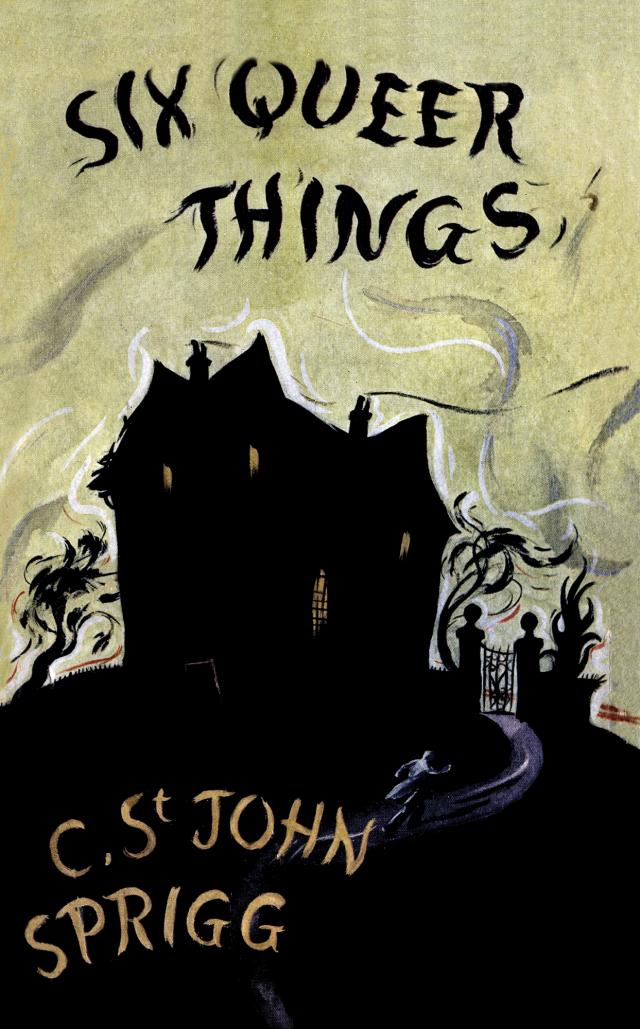
The Six Queer Things, page 20


“Right. I’ll do that. But there is one entry, which struck me as being out of the way. It refers to one ‘J.L.’, and there is a note towards the end ‘Escaped’, then a date, and then a little later ‘Recaptured.’ This escape took place fairly recently.”
“That is certainly interesting! ‘J.L.’, eh? I begin to have a suspicion of who ‘J.L.’ is!”
“What, you mean you know him?”
“No, but I think that I can guess what his relation to Doctor Wood was.”
So sure was the policeman of this, that he went at once to call on Dr Wood’s solicitor whose name was among the doctor’s papers, but who, according to various sources of police information, was an eminently respectable solicitor.
He regarded Morgan at first with mild disapproval, which became a kind of nervous fluttering when the detective began to hint at the dubious nature of Wood’s main source of income when alive.
“But I always understood that my client had a very fashionable practice!” he fluttered.
“It was very remunerative, and he may have had some fashionable clients, but that does not prevent it from being shady. That frankly was what it was. Shady, beastly—devilish, to be precise.”
“Devilish! Dear, dear.” The solicitor blinked. “I can only say it is very regrettable, and surprising. It was not a side of his nature he showed to me.”
“So I should imagine. Anyway, I come here for a definite purpose. Did you at any time help Doctor Wood in taking out a Commission of Lunacy for anyone with the initials ‘ J.L.’ ”
The solicitor turned a little greenish about the gills. “I did indeed. I trust there was nothing wrong with that case. Everything was signed and perfectly in order. I saw the man myself, and though I am not an expert, he was certainly non compos.”
“We don’t dispute that,” replied Morgan grimly. “And you have not anything to regret, I imagine. Wood would not have employed you unless he was sure of himself. Who was the man?”
“John Lambert was the name!”
“And I suppose Doctor Wood was made his guardian?”
“Dear me, no. It was a relation of his. It would not have been in order for Wood to have been appointed guardian. Not as his medical man. No, Sir Timothy is a close relation. Everything was quite in order. Lambert was certified independently, and he was taken away to some institution at once.”
“Well, I want all the details you can give me about Lambert and his relation, and this institution.”
“I will see what we can find, Inspector.”
The solicitor bustled out to a kind of anteroom, stacked high with deed boxes and bundles of documents. The floor was spread with letters, and two grey-headed women were crawling about the floor on their hands and knees, apparently engaged in some form of filing activity. They seemed rather pathetic—slowly being engulfed in a deluge of documents.
“Miss Gorringe,” said the solicitor sharply, “please find the documents relating to John Lambert, Ward in Lunacy, and bring them to the inspector here at once.”
In spite of the sharpness of tone, it took the elderly ladies an hour to find the documents. The records were scanty, but they were still sufficient to enable Inspector Morgan, that evening, to visit a white-faced Sir Timothy Lambert and give him the fright of his life.
“We’ll see that this deed is set aside, of course,” Morgan warned him. “Relative or not, there’s an old legal maxim that no man can profit from his wrongdoing. And that’s retrospective. You’ll have to render an account of all your stewardship!”
Sir Timothy remained silent for some time before replying.
“All this comes as a very great shock to me . . .” he began pitifully.
“I’ve no doubt it does,” interjected Morgan abruptly. “It was meant to.”
“I mean, if I could have given my right hand to save John’s reason I would have done it. You don’t know the distress——”
His voice died away before the contempt in Morgan’s face, and he got shakily to his feet.
“Are you going to arrest me?” he said weakly.
“Not at the moment. I have come for an exact description of John Lambert.”
The man gave it to him and Morgan departed, not without a last contemptuous cut.
“Please remain available for the next few days. If you have a passport you’d better let me have it.”
Lambert surrendered it without a protest. . . .
Six hours later a man was taken by the police from a Salvation Army Hostel in the Commercial Road. He wore a light mackintosh and his boots were dirty. His eyes were red rimmed from lack of sleep, and there were several bloodstains on the front of his coat. He had refused to go to sleep, but had sat up all night on his bed, occasionally groaning, but most of the time sunk in a kind of daze.
He was charged with the murder of Dr Wood under the name of John Lambert, and, considering he had committed a brutal homicide, there was something curiously gentle in his treatment by the police.
CHAPTER XIV: The Bond of Release
From the very moment that Ted Wainwright drove down to Nightingale’s Roost with Dr Wood, he had a feeling that he was losing his grip on events, that he was being simply whirled along like a leaf in the breeze.
This is an uncomfortable feeling for a young man of fairly stolid temperament and normal upbringing. It made him, in spite of his gratitude to Dr Wood, somewhat surly company on the drive down.
When they got to the little bungalow, they found there was no one in.
“I’m afraid I can’t wait,” Dr Wood told him, “but don’t worry. I’ll scribble a note for you to give to Harness.”
Ted Wainwright waited for some time in the garden of Nightingale’s Roost for Harness to return.
He came back soon after ten, and jumped perceptibly when Ted rose out of the shadows of the garden to speak to him.
“It’s all right. I’ve been sent down by Doctor Wood,” Wainwright told him. “Here’s a letter from him.”
“What’s all this about?” grumbled Harness. Striking a match, he held the flame near Ted’s face. The match also illuminated his own not very prepossessing features—florid, bull necked and sloppy. The inspection seemed to satisfy Harness, for he grunted.
“Come inside.”
A wave of alcohol came with the words.
“Closing time must be ten o’clock round here,” thought Wainwright.
By the light of an old lamp Harness inspected the doctor’s letter. As he read it, he made a half turn away from Wainwright, which for a moment made the young man suspicious. Why did Harness not want Wainwright to see the doctor’s letter? Perhaps it was merely a natural caution, however. Ted dismissed it from his mind, for Harness turned back cordially enough, after reading the letter.
“I’m glad to do anything for the doctor. I owe a lot to him, as I expect he told you!”
“It seems a bit thick, parking myself here!” said Ted diffidently.
“Nonsense, lad,” answered Harness heartily, slapping him on the shoulder. “It gets damned lonely here, I can tell you, and I’m glad of company! I’ll show you where I can fix up a bed for you. It won’t be much of one, but I expect it will be better for your health than staying at home—from what I can gather from Doc’s letter.”
He gave Wainwright a knowing wink.
The days that followed were almost unbearable. On the one hand he had no news of Marjorie beyond the papers, which announced that she still was missing. On the other hand he was concerned about his mother. Early on the morning after his flight, he had posted her a note from a neighbouring village, saying that he was safe and she must keep quiet. He knew it was dangerous to write to her, but could not bear to think of her worrying about him without news.
Fortunately he had been putting by a little money in the Savings Bank for her, against the day when he could get a better job and think of marriage, and so there was no anxiety on that score. Even so, he knew that his flight would be a shock to her. That, coupled with his anxieties for Marjorie and his own terrible position, made the days seem endless. Above all, the inaction nearly drove him frantic.
True, he was able to work in the garden, and he did so in a way that called forth Harness’ admiration and surprise. He tired himself out physically during the day, and at night he went down to the pub and tried to forget his pressing anxieties.
But he did not like Harness. There was something unpleasant and soft in the man’s manner that repelled Wainwright. Harness was a slacker; that is to say, he was weak willed and lazy. He affected a great friendliness and consideration for Wainwright, but the young man was easily able to see that a good deal of it was put on. Once or twice he had caught Harness’ eye resting on him in a manner that made him positively uneasy. Harness, he felt, had some odd ideas about him in his mind.
Wainwright never discussed with Harness who he was or why he was in hiding. He did not even know whether Harness was aware what his real name was, or for what offence he was wanted by the police. It seemed to him odd that Harness never questioned him about his past life, or even referred to it. It suggested that Harness knew the truth; and in some way Ted disliked the idea of his secret’s being in the keeping of this loud-voiced, loose-lipped man.
One day Wainwright happened to go into Harness’ private study in Nightingale’s Roost to find some matches. He routed about in several places and eventually searched in the man’s desk. He was about to turn unsuccessfully away, when his own name caught his eye. It was in a letter signed by Wood. His curiosity was at once aroused and he picked up the letter and read it. At first he could hardly believe his eyes. The wording indicated a bland betrayal of himself, in a phraseology which he could hardly believe had come from the doctor’s pen. Yet there it was:
Dear Bill,
This is brought by Ted Wainwright, who is wanted by the police for murder. It suits us to keep him out of the way for the moment, but it may be necessary soon to hand him over. Wait till I give you the tip by wire with the words, ‘‘Uncle ill. Please come at once.” As soon as you receive this, get in touch with the Yard. Of course you must do it in such a way that no suspicion attaches to either of us, and particularly not to yourself.
G. Wood.
Ted’s first reaction to this was one of overwhelming fury, and he wanted to go straight back to London and settle accounts with Wood. But almost immediately he saw the folly of this. He was in a corner. The police were after him, with a first-class case, and he had to lie low. Even the temporary shelter given him by Harness was something.
The question was, where could he go from here without exciting suspicion? He was a wanted man, and although it was possible to dodge suspicion in a country retreat by staying with someone who was known locally, it would be different when he turned up as a complete stranger, without money or any apparent reason for his arrival. That would excite suspicion at once.
Ted happened to be going down the garden path next day when he heard his own name called in a low voice. He turned to see who it was and saw a woman standing on the other side of the hedge, indistinctly visible through it. As he caught sight of her she made a signal to him to be quiet. Puzzled and a little alarmed by this, he went round the hedge.
As he came nearer, he saw to his surprise that the woman was Miss Crispin.
“Good heavens, where have you been?” he asked her, “and what on earth are you doing here?”
“Don’t talk, but follow me to the village,” she whispered. “We must have a word together. You are in great danger.”
“I know that all right! What’s the idea, anyway?”
“I’ll tell you there. I’ll go on ahead, and you’d better keep fifty yards or so behind me, so that if Harness comes there will be nothing to connect us. Meet me at the end of Rook Lane.”
Rook Lane was a little byway leading out of the village, and not much used. Evidently Miss Crispin had chosen it because it would be out of the way, and her choice proved that she knew something about the village. Ted felt suspicious. Was Miss Crispin in on the plot, and was this the first move to tip him off? Further reflection made this seem unlikely. No telegram had arrived for Harness, and in any case there would have been no need to choose so dramatic a method to betray him. A word to any policeman would be enough.
Miss Crispin seated herself on a broken-down fence in one of the nooks off Rook Lane and Ted sat down beside her. He had seen a fair amount of Miss Crispin (if that was her real name) during his visits to Belmont Avenue, but her colourless personality had not left much trace on his memory.
She had merely given him the vague impression of a woman who, although not old, was no longer in her first youth, and had accepted from life the role of benevolent self-effacement.
Now, looking at her sideways, he could not help noticing a new quality which, had he been inclined to romantic phraseology, would have drawn from him the adjective “tigerish.” It was the kind of tigerishness that meek and gentle beasts show when they are trapped in a corner and their lives are at stake, or when something is threatened which is at least as dear to them as their lives—their offspring, for example. So far as Wainwright knew, neither of these things was true of Miss Crispin, and he was therefore surprised at his sideways glimpse of her pinched, determined face.
“Mr Wainwright, I don’t think you know in what danger you are!” began Miss Crispin in a hurried monotone. “You are in the grip of a most unscrupulous man. You think he is helping you, but in fact he is doing just the opposite. At any moment, he may betray you to the police, and you yourself know how little hope you have once you get into their hands!”
“Are you suggesting that I killed your sister—if she was your sister?”
“Yes, she was my sister,” confessed Bella Crispin in a low voice. “But I do not suggest you killed her. I am sure you did not.”
“You know who really did?”
Bella Crispin hesitated.
“There is no reason why you should not know. Doctor Wood killed her!”
“Wood! But what was his motive?”
“That would take too long to go into now. Indeed, in simple fairness to my poor sister, I do not know whether I shall ever be prepared to tell the whole story!”
“But you must! That is the only thing that will save me,” insisted Wainwright eagerly.
Bella Crispin shook her head.
“I’m afraid it’s not as easy as that. It’s only suspicion, and not the kind of proof the police would accept. How or why he did it, I do not know. Superficially, everything looks as if you killed her. The police have a perfect case. But just as you are sure you did not kill her, I am sure that Wood did.”
“Well, that leaves me in as great a jam as ever. Once the police catch me, I’m done. But tell me, if you know so much, do you know where Marjorie is?”
Bella Crispin nodded.
“Yes, I do know.”
Ted leaped to his feet in his excitement and gripped her arm fiercely.
“What? Is she safe?”
“Yes, she is safe. That is, she is at present physically unharmed.”
“What exactly do you mean by that?”
“Just what I say. She is at present unharmed. But she is in danger—grave danger!”
“How? Where is she?”
“At present,” replied Bella Crispin slowly, “she is in a bogus lunatic asylum. The director of it is at this moment engaged in trying to drive her mad.”
Ted felt a chill travel down his spine as Miss Crispin said these words in a casual, almost callous way.
“What do you mean?” he said, shaking her arm violently. “Are you serious? For God’s sake, explain what you mean.”
“What I say. Didn’t you understand the meaning of my sister’s relations with Marjorie and the help given by Wood?”
“It was all deliberately designed to send her off her head?”
“Certainly. Wood would put it in more technical phraseology, of course, but that was the intention.”
Ted stared at her as she said this with the utmost coolness.
“You knew this, and yet could help in it?”
“Yes, I knew it,” she said wearily. “For God’s sake don’t start trying to make me repent. You’ll ask: how could I stand it? I’ve been through all those agonies years ago, when my sister first started her career, and I tell you my conscience is dead, dead!”
Miss Crispin’s cheeks flushed, and her voice rose to a scream as she beat her hands spasmodically on her skinny knees. “Dead! Rotten! Stinking!” she repeated.
There was a pause and then she went on more normally, with a defiant air.
“I’m prepared to help Marjorie now; that ought to be enough for you! And I can help you too.”
“Can you really find Marjorie and get her out?”
Miss Crispin nodded.
“I can take you there, and help you get in. You’ll have to do the rest.”
“Thank you for that. I take back what I said.” He clasped her hand, without realising what he was doing, in his excitement.
She interrupted him brusquely, snatching back her hand.
“Keep your thanks. This isn’t kindness—I lost any heart I had years ago. It isn’t a sudden awakening of my conscience. I told you my conscience was dead. I’m going to do this for a consideration. I shall charge a fee, and a stiff one!”
“But I haven’t any money, at least not to speak of. I’m out of a job even.”
“It will have to be paid jointly by you and Marjorie.”
“But she hasn’t any either.”
“No, but you’re young. You may get on. Pay me when you have some.”
Ted Wainwright laughed, relieved.
“If you’ll do it on tick, that’s all right! I call that sporting, for I don’t see much chance of your ever getting it!”
“It’s not so sporting as you think. The fee will be a stiff one.”
“That makes the chance of getting it all the less likely.”
Miss Crispin smiled for the first time since they had been speaking.
“I’ll take the chance of that. Here is a document I have prepared.”
She opened her handbag and took out a folded paper.
“That is certainly interesting! ‘J.L.’, eh? I begin to have a suspicion of who ‘J.L.’ is!”
“What, you mean you know him?”
“No, but I think that I can guess what his relation to Doctor Wood was.”
So sure was the policeman of this, that he went at once to call on Dr Wood’s solicitor whose name was among the doctor’s papers, but who, according to various sources of police information, was an eminently respectable solicitor.
He regarded Morgan at first with mild disapproval, which became a kind of nervous fluttering when the detective began to hint at the dubious nature of Wood’s main source of income when alive.
“But I always understood that my client had a very fashionable practice!” he fluttered.
“It was very remunerative, and he may have had some fashionable clients, but that does not prevent it from being shady. That frankly was what it was. Shady, beastly—devilish, to be precise.”
“Devilish! Dear, dear.” The solicitor blinked. “I can only say it is very regrettable, and surprising. It was not a side of his nature he showed to me.”
“So I should imagine. Anyway, I come here for a definite purpose. Did you at any time help Doctor Wood in taking out a Commission of Lunacy for anyone with the initials ‘ J.L.’ ”
The solicitor turned a little greenish about the gills. “I did indeed. I trust there was nothing wrong with that case. Everything was signed and perfectly in order. I saw the man myself, and though I am not an expert, he was certainly non compos.”
“We don’t dispute that,” replied Morgan grimly. “And you have not anything to regret, I imagine. Wood would not have employed you unless he was sure of himself. Who was the man?”
“John Lambert was the name!”
“And I suppose Doctor Wood was made his guardian?”
“Dear me, no. It was a relation of his. It would not have been in order for Wood to have been appointed guardian. Not as his medical man. No, Sir Timothy is a close relation. Everything was quite in order. Lambert was certified independently, and he was taken away to some institution at once.”
“Well, I want all the details you can give me about Lambert and his relation, and this institution.”
“I will see what we can find, Inspector.”
The solicitor bustled out to a kind of anteroom, stacked high with deed boxes and bundles of documents. The floor was spread with letters, and two grey-headed women were crawling about the floor on their hands and knees, apparently engaged in some form of filing activity. They seemed rather pathetic—slowly being engulfed in a deluge of documents.
“Miss Gorringe,” said the solicitor sharply, “please find the documents relating to John Lambert, Ward in Lunacy, and bring them to the inspector here at once.”
In spite of the sharpness of tone, it took the elderly ladies an hour to find the documents. The records were scanty, but they were still sufficient to enable Inspector Morgan, that evening, to visit a white-faced Sir Timothy Lambert and give him the fright of his life.
“We’ll see that this deed is set aside, of course,” Morgan warned him. “Relative or not, there’s an old legal maxim that no man can profit from his wrongdoing. And that’s retrospective. You’ll have to render an account of all your stewardship!”
Sir Timothy remained silent for some time before replying.
“All this comes as a very great shock to me . . .” he began pitifully.
“I’ve no doubt it does,” interjected Morgan abruptly. “It was meant to.”
“I mean, if I could have given my right hand to save John’s reason I would have done it. You don’t know the distress——”
His voice died away before the contempt in Morgan’s face, and he got shakily to his feet.
“Are you going to arrest me?” he said weakly.
“Not at the moment. I have come for an exact description of John Lambert.”
The man gave it to him and Morgan departed, not without a last contemptuous cut.
“Please remain available for the next few days. If you have a passport you’d better let me have it.”
Lambert surrendered it without a protest. . . .
Six hours later a man was taken by the police from a Salvation Army Hostel in the Commercial Road. He wore a light mackintosh and his boots were dirty. His eyes were red rimmed from lack of sleep, and there were several bloodstains on the front of his coat. He had refused to go to sleep, but had sat up all night on his bed, occasionally groaning, but most of the time sunk in a kind of daze.
He was charged with the murder of Dr Wood under the name of John Lambert, and, considering he had committed a brutal homicide, there was something curiously gentle in his treatment by the police.
CHAPTER XIV: The Bond of Release
From the very moment that Ted Wainwright drove down to Nightingale’s Roost with Dr Wood, he had a feeling that he was losing his grip on events, that he was being simply whirled along like a leaf in the breeze.
This is an uncomfortable feeling for a young man of fairly stolid temperament and normal upbringing. It made him, in spite of his gratitude to Dr Wood, somewhat surly company on the drive down.
When they got to the little bungalow, they found there was no one in.
“I’m afraid I can’t wait,” Dr Wood told him, “but don’t worry. I’ll scribble a note for you to give to Harness.”
Ted Wainwright waited for some time in the garden of Nightingale’s Roost for Harness to return.
He came back soon after ten, and jumped perceptibly when Ted rose out of the shadows of the garden to speak to him.
“It’s all right. I’ve been sent down by Doctor Wood,” Wainwright told him. “Here’s a letter from him.”
“What’s all this about?” grumbled Harness. Striking a match, he held the flame near Ted’s face. The match also illuminated his own not very prepossessing features—florid, bull necked and sloppy. The inspection seemed to satisfy Harness, for he grunted.
“Come inside.”
A wave of alcohol came with the words.
“Closing time must be ten o’clock round here,” thought Wainwright.
By the light of an old lamp Harness inspected the doctor’s letter. As he read it, he made a half turn away from Wainwright, which for a moment made the young man suspicious. Why did Harness not want Wainwright to see the doctor’s letter? Perhaps it was merely a natural caution, however. Ted dismissed it from his mind, for Harness turned back cordially enough, after reading the letter.
“I’m glad to do anything for the doctor. I owe a lot to him, as I expect he told you!”
“It seems a bit thick, parking myself here!” said Ted diffidently.
“Nonsense, lad,” answered Harness heartily, slapping him on the shoulder. “It gets damned lonely here, I can tell you, and I’m glad of company! I’ll show you where I can fix up a bed for you. It won’t be much of one, but I expect it will be better for your health than staying at home—from what I can gather from Doc’s letter.”
He gave Wainwright a knowing wink.
The days that followed were almost unbearable. On the one hand he had no news of Marjorie beyond the papers, which announced that she still was missing. On the other hand he was concerned about his mother. Early on the morning after his flight, he had posted her a note from a neighbouring village, saying that he was safe and she must keep quiet. He knew it was dangerous to write to her, but could not bear to think of her worrying about him without news.
Fortunately he had been putting by a little money in the Savings Bank for her, against the day when he could get a better job and think of marriage, and so there was no anxiety on that score. Even so, he knew that his flight would be a shock to her. That, coupled with his anxieties for Marjorie and his own terrible position, made the days seem endless. Above all, the inaction nearly drove him frantic.
True, he was able to work in the garden, and he did so in a way that called forth Harness’ admiration and surprise. He tired himself out physically during the day, and at night he went down to the pub and tried to forget his pressing anxieties.
But he did not like Harness. There was something unpleasant and soft in the man’s manner that repelled Wainwright. Harness was a slacker; that is to say, he was weak willed and lazy. He affected a great friendliness and consideration for Wainwright, but the young man was easily able to see that a good deal of it was put on. Once or twice he had caught Harness’ eye resting on him in a manner that made him positively uneasy. Harness, he felt, had some odd ideas about him in his mind.
Wainwright never discussed with Harness who he was or why he was in hiding. He did not even know whether Harness was aware what his real name was, or for what offence he was wanted by the police. It seemed to him odd that Harness never questioned him about his past life, or even referred to it. It suggested that Harness knew the truth; and in some way Ted disliked the idea of his secret’s being in the keeping of this loud-voiced, loose-lipped man.
One day Wainwright happened to go into Harness’ private study in Nightingale’s Roost to find some matches. He routed about in several places and eventually searched in the man’s desk. He was about to turn unsuccessfully away, when his own name caught his eye. It was in a letter signed by Wood. His curiosity was at once aroused and he picked up the letter and read it. At first he could hardly believe his eyes. The wording indicated a bland betrayal of himself, in a phraseology which he could hardly believe had come from the doctor’s pen. Yet there it was:
Dear Bill,
This is brought by Ted Wainwright, who is wanted by the police for murder. It suits us to keep him out of the way for the moment, but it may be necessary soon to hand him over. Wait till I give you the tip by wire with the words, ‘‘Uncle ill. Please come at once.” As soon as you receive this, get in touch with the Yard. Of course you must do it in such a way that no suspicion attaches to either of us, and particularly not to yourself.
G. Wood.
Ted’s first reaction to this was one of overwhelming fury, and he wanted to go straight back to London and settle accounts with Wood. But almost immediately he saw the folly of this. He was in a corner. The police were after him, with a first-class case, and he had to lie low. Even the temporary shelter given him by Harness was something.
The question was, where could he go from here without exciting suspicion? He was a wanted man, and although it was possible to dodge suspicion in a country retreat by staying with someone who was known locally, it would be different when he turned up as a complete stranger, without money or any apparent reason for his arrival. That would excite suspicion at once.
Ted happened to be going down the garden path next day when he heard his own name called in a low voice. He turned to see who it was and saw a woman standing on the other side of the hedge, indistinctly visible through it. As he caught sight of her she made a signal to him to be quiet. Puzzled and a little alarmed by this, he went round the hedge.
As he came nearer, he saw to his surprise that the woman was Miss Crispin.
“Good heavens, where have you been?” he asked her, “and what on earth are you doing here?”
“Don’t talk, but follow me to the village,” she whispered. “We must have a word together. You are in great danger.”
“I know that all right! What’s the idea, anyway?”
“I’ll tell you there. I’ll go on ahead, and you’d better keep fifty yards or so behind me, so that if Harness comes there will be nothing to connect us. Meet me at the end of Rook Lane.”
Rook Lane was a little byway leading out of the village, and not much used. Evidently Miss Crispin had chosen it because it would be out of the way, and her choice proved that she knew something about the village. Ted felt suspicious. Was Miss Crispin in on the plot, and was this the first move to tip him off? Further reflection made this seem unlikely. No telegram had arrived for Harness, and in any case there would have been no need to choose so dramatic a method to betray him. A word to any policeman would be enough.
Miss Crispin seated herself on a broken-down fence in one of the nooks off Rook Lane and Ted sat down beside her. He had seen a fair amount of Miss Crispin (if that was her real name) during his visits to Belmont Avenue, but her colourless personality had not left much trace on his memory.
She had merely given him the vague impression of a woman who, although not old, was no longer in her first youth, and had accepted from life the role of benevolent self-effacement.
Now, looking at her sideways, he could not help noticing a new quality which, had he been inclined to romantic phraseology, would have drawn from him the adjective “tigerish.” It was the kind of tigerishness that meek and gentle beasts show when they are trapped in a corner and their lives are at stake, or when something is threatened which is at least as dear to them as their lives—their offspring, for example. So far as Wainwright knew, neither of these things was true of Miss Crispin, and he was therefore surprised at his sideways glimpse of her pinched, determined face.
“Mr Wainwright, I don’t think you know in what danger you are!” began Miss Crispin in a hurried monotone. “You are in the grip of a most unscrupulous man. You think he is helping you, but in fact he is doing just the opposite. At any moment, he may betray you to the police, and you yourself know how little hope you have once you get into their hands!”
“Are you suggesting that I killed your sister—if she was your sister?”
“Yes, she was my sister,” confessed Bella Crispin in a low voice. “But I do not suggest you killed her. I am sure you did not.”
“You know who really did?”
Bella Crispin hesitated.
“There is no reason why you should not know. Doctor Wood killed her!”
“Wood! But what was his motive?”
“That would take too long to go into now. Indeed, in simple fairness to my poor sister, I do not know whether I shall ever be prepared to tell the whole story!”
“But you must! That is the only thing that will save me,” insisted Wainwright eagerly.
Bella Crispin shook her head.
“I’m afraid it’s not as easy as that. It’s only suspicion, and not the kind of proof the police would accept. How or why he did it, I do not know. Superficially, everything looks as if you killed her. The police have a perfect case. But just as you are sure you did not kill her, I am sure that Wood did.”
“Well, that leaves me in as great a jam as ever. Once the police catch me, I’m done. But tell me, if you know so much, do you know where Marjorie is?”
Bella Crispin nodded.
“Yes, I do know.”
Ted leaped to his feet in his excitement and gripped her arm fiercely.
“What? Is she safe?”
“Yes, she is safe. That is, she is at present physically unharmed.”
“What exactly do you mean by that?”
“Just what I say. She is at present unharmed. But she is in danger—grave danger!”
“How? Where is she?”
“At present,” replied Bella Crispin slowly, “she is in a bogus lunatic asylum. The director of it is at this moment engaged in trying to drive her mad.”
Ted felt a chill travel down his spine as Miss Crispin said these words in a casual, almost callous way.
“What do you mean?” he said, shaking her arm violently. “Are you serious? For God’s sake, explain what you mean.”
“What I say. Didn’t you understand the meaning of my sister’s relations with Marjorie and the help given by Wood?”
“It was all deliberately designed to send her off her head?”
“Certainly. Wood would put it in more technical phraseology, of course, but that was the intention.”
Ted stared at her as she said this with the utmost coolness.
“You knew this, and yet could help in it?”
“Yes, I knew it,” she said wearily. “For God’s sake don’t start trying to make me repent. You’ll ask: how could I stand it? I’ve been through all those agonies years ago, when my sister first started her career, and I tell you my conscience is dead, dead!”
Miss Crispin’s cheeks flushed, and her voice rose to a scream as she beat her hands spasmodically on her skinny knees. “Dead! Rotten! Stinking!” she repeated.
There was a pause and then she went on more normally, with a defiant air.
“I’m prepared to help Marjorie now; that ought to be enough for you! And I can help you too.”
“Can you really find Marjorie and get her out?”
Miss Crispin nodded.
“I can take you there, and help you get in. You’ll have to do the rest.”
“Thank you for that. I take back what I said.” He clasped her hand, without realising what he was doing, in his excitement.
She interrupted him brusquely, snatching back her hand.
“Keep your thanks. This isn’t kindness—I lost any heart I had years ago. It isn’t a sudden awakening of my conscience. I told you my conscience was dead. I’m going to do this for a consideration. I shall charge a fee, and a stiff one!”
“But I haven’t any money, at least not to speak of. I’m out of a job even.”
“It will have to be paid jointly by you and Marjorie.”
“But she hasn’t any either.”
“No, but you’re young. You may get on. Pay me when you have some.”
Ted Wainwright laughed, relieved.
“If you’ll do it on tick, that’s all right! I call that sporting, for I don’t see much chance of your ever getting it!”
“It’s not so sporting as you think. The fee will be a stiff one.”
“That makes the chance of getting it all the less likely.”
Miss Crispin smiled for the first time since they had been speaking.
“I’ll take the chance of that. Here is a document I have prepared.”
She opened her handbag and took out a folded paper.