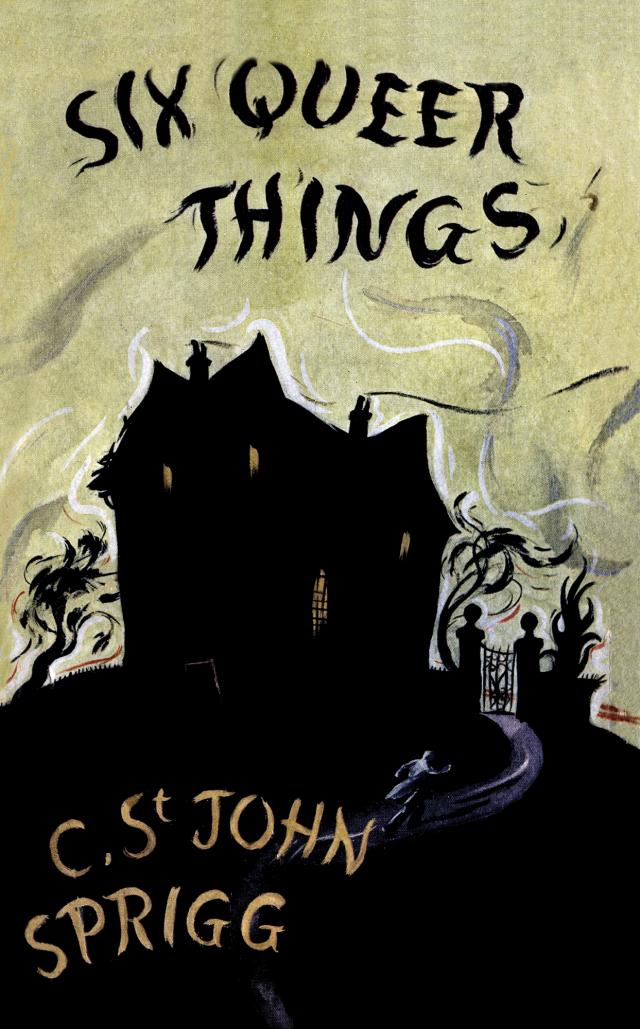
The Six Queer Things, page 15


“What do you mean?” asked Marjorie, puzzled. “Why am I being kept here against my will?”
“It is necessary, I’m afraid. In any case, may I suggest it is not very polite to try and kick down the door.”
“Well, how else could I call somebody?”
“There is a bell over there by the fireplace,” answered the man gravely, pointing to a bell push on the right-hand side of the mantelpiece.
“Well, anyway, now you are here, you can at least answer my question. I demand to know why I have been brought here. What happened to me last night? I’m certain I was drugged!”
“It is usual to give drugs to patients! In any case, you must excuse me, Miss Easton. I had just been called to another part of the building when I passed here. If I had not heard so much noise and come in, I should be with my patient now. I hate keeping anyone waiting. It may be serious. A haemorrhage, perhaps! Excuse me.”
With a bow, the man closed the door abruptly. She heard the key turn in the lock.
Marjorie pressed the bell and waited. There was no response. She kept her finger on it for several minutes, but still there was no answer. After an hour of futile ringing, Marjorie decided to repeat the expedient by which she had attracted attention, and set up a thundering noise on the door.
After a few minutes of banging, the door was thrown violently open. A brawny middle-aged woman in nurse’s uniform burst in, annoyance written all over her hard face.
“What the hell do you think you’re doing?” asked this woman, glaring at her.
“I rang the bell and couldn’t get any answer, so I had to try another way of attracting attention.”
“Rang the bell!” exclaimed the woman, astonished. “Do you think this is a hotel? I’ve never heard such cheek. Those bells haven’t worked since we took over the house, ten years ago.”
“I want to know why I am being kept here,” Marjorie asked defiantly. “I want to go back to my uncle at once! I warn you it will be the worse for you if you don’t let me out. I insist that you get into touch either with my uncle, Mr Michael Crispin or Dr Wood without delay.”
The woman stared at her angrily, without troubling to answer her appeal.
“Shut up! Go on, sit down and keep your mouth shut.”
“Don’t you dare tell me to shut up!” said Marjorie, losing her temper.
“Shut up!” repeated the woman cruelly, striking Marjorie a violent blow across the mouth with one hard fist. She seized the girl’s hands and flung her forcibly on the bed.
“We soon tame pernickety people like you here! Any more of this nonsense, and you’ll go on starvation diet and castor oil for a month. That’ll soon stop your airs and graces. If you behave yourself properly and do as you’re told, you’ll be all right. We don’t want trouble for trouble’s sake. But if you ask for it—well, we always win at that game!”
The woman turned and walked out, again locking the door behind her. Marjorie lay on the bed trembling with indignation and shock.
About an hour later, the door opened, and the hard-faced woman brought a cup of tea and two thick slabs of bread and butter. She banged the tray down beside Marjorie. The girl took them without a word.
“Thank you!” prompted the woman warningly.
“Thank you,” repeated Marjorie, half choking.
The woman nodded approvingly.
“That’s right. You’ll soon fall into the way of it.”
She seemed to be hesitating for a moment, but then left the room without saying more. Marjorie ate the bread and butter slowly. Her lips had swollen painfully where the woman had struck her, and this made eating awkward. Why was she being kept a prisoner in this house? Where was it? What was the meaning of the events leading up to it—if indeed they had really occurred, and had not been part of some strange, drugged dream. They certainly seemed queerly unreal.
After she had eaten there seemed nothing to do but sit by the window and look out. She watched the birds soaring and swooping above the black waters, which were now faintly rippled here and there by the wind. She envied them their freedom. They were the only living things on the huge landscape in front of her—except for the cat which, a moment ago, she had seen cross the lawn up to the high wall that divided the grounds of the house from the bank of the lake. It had scrambled up a buttress and over the wall. Only a cat could climb that wall, she realised. It was about twelve feet high and was topped with spikes.
Then, as she watched, she noticed a black blur. Was it a log or a floating patch of reeds? It gradually became more distinct. It was a small rowboat with two men inside.
She hoped desperately that they would come within hailing distance of the house. For about a quarter of an hour the boat was hidden from sight by a tall island of reeds, behind which it had pulled. Then it was visible again, now appreciably nearer.
It was coming straight to the house.
Twenty minutes later, it had moored to the same post to which the old rotting black boat was attached. They began to fish. Her chance had come. She went to the window and tried to open it.
She found, however, that it was firmly secured by screws in such a position that there was just enough opening at the top for a draught of air to enter, but that it was too narrow to do more than thrust a hand through.
She was determined not to be baulked of her chance of freedom. Seizing a chair, and holding one arm before her eyes, she hurled it through the window. The glass shattered in all directions, and at once the men looked towards the house. She leaned out of the window as far as she could, and began shouting at the top of her voice.
“Help! I’m imprisoned here against my will!”
To her surprise the men, instead of becoming concerned at her appeal, stared at her for a moment. She could distinctly see one laugh and nudge the other, who made a mocking gesture towards her. She had a conviction that they were foreigners and did not understand her. The next moment she was seized violently from behind, and flung on the bed. The same woman who had brought in her meal began to rain blows on her face and body with concentrated fury.
“I’ll teach you, you little bastard! Trying to make trouble! Just you try that on again!”
Taking some rope from her pocket, the woman began to tie the girl firmly to her bed.
“That’ll teach you to try any nonsense. There’ll be worse to come next time!”
Unable to move hand or foot, and aching from the blows, Marjorie lay on the bed for two or three hours. Meanwhile her window was roughly patched up with newspaper by the woman. After the lapse of this time, the woman came to her bed.
“I’ll let you go now if you promise not to try to attract attention again!”
There was nothing else Marjorie could do but promise, and she was released from her bonds.
The sun set in a blaze, whose colours, reflected in the lake, for a moment relieved its gloom. Then, as it faded, it seemed to leave the scene with a double dose of melancholy. A wind had sprung up, and Marjorie could hear the steady ripple of the water on the lake edge. These sobbing, gurgling noises added to the despair in the girl’s heart.
There seemed nothing to do but to go to bed. She got into her night things and was just getting into bed, when she heard a man’s voice, followed by a knock on the door.
“Can I come in?”
“No,” said Marjorie. “What do you want? I’m in bed.”
In spite of her answer, the man opened the door. It was the same little man who had answered her frantic knocking this afternoon.
“There is no need to be embarrassed,” he said, with that flickering smile, as he saw her awkwardness. “I am a doctor. I am just making my evening round of inspection to see that all my patients are happy and getting on as well as can be expected.”
“I’m not a patient!” protested Marjorie.
“Really, you must allow us to be the judge of that. It’s our business to decide, after all. You certainly don’t look well. You must admit that! In any case, the reason I came round was to find out if everything was to your satisfaction.”
“Apart from the fact that I’ve been brutally attacked by the woman who brings me my food,” replied Marjorie sarcastically, “and that I’m being forcibly kept here, I have nothing to complain of.”
“Brutally attacked!” exclaimed the doctor in a surprised tone. “But that’s impossible! We treat our patients with the greatest care and consideration. Our staff is carefully chosen for their gentleness and patience.”
“Look at these bruises,” cried the girl indignantly, showing the marks on her arms and face.
The man examined the places she indicated with care. Then he shook his head.
“I’m afraid I can’t see anything. It may of course be the light—or my eyesight. May I suggest that you look at them again in the morning—then perhaps you, too, will change your opinion? At present you are a little overwrought and need sleep.”
“Do you suggest I imagined this attack?” she asked.
The doctor shrugged his shoulders.
“I leave you to draw your own conclusion. Is there anything else? I have several other rooms to visit. If you have any complaints, I will have them looked into, and see that whoever is responsible is reprimanded; but I must beg of you not to waste time.”
“Since I am not allowed out of this room, can I have something to read? Or a pack of cards?”
“I am afraid anything of that nature is strictly against the rules. It is liable to excite the patient’s mind.”
“Do you mean I’m to be kept here without any distraction? Why, I shall go mad!”
“Impossible,” said the doctor with an ironic smile. “Good night, Miss Easton! I will call again tomorrow morning and trust you will be able to say you have had a good night’s sleep.”
CHAPTER X: Disappearance of a Suspect
Marjorie went to sleep that night after two or three hours’ restless tossing. It had seemed to her at first that she would never be able to sleep until she got out of this abominable place; but this first mood gave way to a feeling of resigned helplessness during which she drifted imperceptibly into slumber. She was physically and mentally tired. Her very bones ached.
During the hours of restlessness her mind continually returned to one outstanding question: how had it been possible for these people to do all this to her? She had been kidnapped, taken on that appalling drive, and forcibly imprisoned. Surely those things were not possible in twentieth-century England—if indeed she was in England! More and more this seemed doubtful to Marjorie. It was not merely the quality of the scenery and the behaviour of the two men to whom she had appealed, but the very fact that she was being treated as she was.
Where could help come from? From Michael Crispin? He certainly would be the first to make a move when he found she was gone. And yet now, as she lay there, in some strange way Michael Crispin’s figure seemed to take a different shape. It became menacing, acquired a touch of horror, as if it were a piece with all the other horrible experiences of the last few hours. She pressed her hands against her burning forehead. She was becoming confused. Of course this was wrong. Michael Crispin had transformed her life. He was a good influence. Through him she had got into touch with her mother. How confused she was becoming!
And then as soon as Dr Wood heard of her disappearance he would help her. He would get in touch with the police. Then, surely, they would not be long in tracing her! She wished she had been able to leave some indication behind of what had happened to her. But what had happened to her? In some moods the people who were her captors seemed hardly human—they seemed all of a piece with her nightmares of the past few days. It was as if she were still dreaming.
What about her uncle? She knew that directly he heard of her disappearance his first reaction would be “I told you so.” But still, she was his niece. He would certainly do his utmost to get her back, if only to have the pleasure of saying to her face, “I told you so!”
Yet, strangely enough, she found no comfort in thinking about these people, who would be sure to be worried by her absence. Her only comfort was in thinking of Ted Wainwright. She had treated him abominably, she thought, tossing restlessly on her bed. Almost certainly he had ceased to love her! Perhaps he had forgotten her existence!
Yet at the same time she had a queer presentiment that he might be able to come to her assistance. She felt that if she thought of him with concentration, he could not fail to know her need. She sent out a desperate mental SOS.
The days she had spent with Ted—her old simple humdrum life—all at once seemed vividly attractive. She must have been mad to give it up. And so, thinking of Ted and the quiet past, and somehow comforted by these thoughts, she fell asleep.
In the morning she got up and dressed herself quickly. As she sat in front of her mirror, she could see the grounds of the house through the window, round the edge of the paper which had been stuck over it to mend it. The garden was not deserted this morning. There were several people out on the lawn, and she was struck by their appearance.
There was something odd about the way they went on. There seemed to be two lots—some behaved strangely and were always on the move; others watched these, sitting round on chairs or standing in different parts of the grounds. One or two of the active walked round at a slouching gait with their heads bent. They seemed lost in thought. Occasionally their lips moved, but apart from this they were in a daze, and it seemed a miracle when they succeeded in avoiding flower beds and trees.
Others were just the opposite—they were continually looking round slyly to see whether other people were watching, and grimacing or making queer gestures. One was standing on a seat shouting, but as she looked, one of the watching men came up to him, took him roughly by the arm and made him step down. The shouter cowered away, and Marjorie now recognised the other as the man who had accompanied her in the car.
The full truth sank into Marjorie’s mind. The horror of it made her for a moment feel weak. She was in an asylum!
This explained everything. Now she became fully aware of it, she realised that all this time she had half suspected it, but had fought blindly to keep it out of her mind.
She was being kept captive as a lunatic.
Her first and most awful thought was that perhaps she was a lunatic. Dr Wood had told her that her symptoms pointed to a mental breakdown. Had this occurred without her realising it? Were all the ghastly events of that night in Belmont Avenue mere lunatic delusions? Was it a fact that she had been taken to the seaside to recover and had forgotten it?
Marjorie felt her whole being shaken. Horrible suspicions reared their heads everywhere. She clung desperately to the slightest shred that proved her sanity.
Wasn’t it the case that insane people never queried their own sanity? And wasn’t the fact that she was querying hers a sign of her own sanity? Yes, she might be mentally shaken, but not insane!
Insane—the very word sent a cold thrill down her spine. It was some plot; she was the victim of some diabolical conspiracy! A feeling of loneliness and weakness for a time overcame Marjorie, and she burst into tears. A few minutes later she pulled herself together. The only way to prove her sanity was to fight. She must fight to be the Marjorie she had been before she met Crispin. She must fight to be the Marjorie who had loved Ted and whom Ted had loved. She must fight to be herself. . . .
Soon there was a knock on the door and the doctor—if he really was what he claimed to be—came in. He looked at her critically.
“Ah, you look very well this morning, Miss Easton! I can see this régime suits you—quiet, fresh air and a complete change! There’s nothing like it for building up the constitution!”
“Is there any need to go on with this joke?” replied Marjorie bitterly. “I am in an asylum. That’s so, isn’t it?”
“You are in the hands of friends!” answered the doctor.
“I insist that my uncle be told that I am here. He’s my legal guardian and must be told.”
“I agree. He was told yesterday.”
Marjorie was startled.
“Why, what did he say? What did you tell him?”
“He was told the truth, of course,” replied the little doctor, balancing himself gently on the tips of his toes, with his hands clasped behind his back. “What else do you expect? He was told that you were found wandering the streets in a condition of mental confusion, and that this became so serious that you were certified insane by a magistrate, on the advice of two doctors. We have given him your address, but have told him that it will not be possible for him to see you, as your state of mind is such that it would be dangerous for you to see any near relative. We have told him you are suffering from delusions of persecution. I am sure you will admit, Miss Easton, you have those ideas, even if you do not regard them as delusions. Hence your state of mind would be antagonistic towards him. He quite understands.”
“You devils! You’ve thought of everything, haven’t you?”
“However, in fairness to him and yourself,” went on the doctor, ignoring her interruption, “and to set his mind at rest, it might be as well if you wrote to him. I will have some ink and paper sent up as soon as I go downstairs.”
“How do I know you will really post the letter?”
“My dear Miss Easton,” exclaimed the doctor deprecatingly, “what a very suspicious attitude to adopt. I assure you we will post a letter to your uncle from you. If you like, you can hand it to the postman yourself.”
Soon after he had gone out, the hard-featured woman returned with ink and paper, and Marjorie wrote a desperate appeal to her uncle, insisting that she was sane, and asking him to get her out of the place at all costs. She put it in an envelope, sealed it carefully and put it on the breakfast tray. The doctor returned before the tray had been collected, and she handed him the letter.
He took it with a bow.
“Excuse me,” he said, and without waiting for her assent, tore open the envelope and read the letter. “Dear me, Miss Easton. This won’t do at all. Really it won’t. This is terribly misleading. You cannot expect us to be a party to this kind of fabrication. It will upset your uncle and give him a totally false conception of your condition and of this establishment!”