The Six Queer Things, page 18


“A message?” she said in surprise.
“Yes, some friends of yours were expecting you. The message is, not to worry, you’ll be in good hands soon. They’ve arranged to send someone along with the fare, but as a matter of formality, we have to ask you to wait until the money actually comes into our hands.”
This amazed Marjorie. How was it that someone had discovered her difficulty. Could it be Ted—or her uncle? Or perhaps Dr Wood had somehow heard of it? Apparently just as she had, for no reason, unknown enemies, without motives, she had equally unknown friends.
She was taken into a room in the stationmaster’s office and given some magazines to read. Someone sent up a meal for her. They refused to answer her question, however, as to who the friend was who had sent the message. She was puzzled a little by this air of mystery. Could it be that Ted had sent the message and had not dared to give his name?
Hours passed. She began to get a little uneasy as she waited alone in the office. She went to the door, and found it was locked. Evidently then, in spite of their friendly attitude, they did not trust her until the money had arrived!
Then she heard voices outside. The door opened, and she had a moment of stark horror. For the man who came in with the stationmaster, and who stepped forward with a friendly greeting, was Marsden, his sallow face and scarlet lips one hypocritical look of welcome. She gave a cry, and moved backwards. As she did so she saw the expression on the stationmaster’s face, and now realised the whole meaning of her ambiguous treatment. Marsden had obviously telephoned to the station, directly they had discovered her escape, saying that an escaped lunatic might have got on the train, and asking him to hold her.
She appealed to the stationmaster.
“That man has been keeping me against my will. I am perfectly sane, and I demand that the police be called at once. I shall lay a charge against him for kidnapping me.”
Even as she said it, she felt the extraordinary difficulty of proving her sanity to someone who already suspected it. There was an obvious scepticism on the stationmaster’s face, and her bedraggled look was no recommendation. If only she were tidy, and not wearing this dreadful dress!
“My dear young lady,” said Dr Marsden, “it is very foolish of you to take up this attitude! You know we have your best interests at heart. We have a legal document, signed by a magistrate, which I have shown to the stationmaster, and which proves that it is our duty to look after you. Please be reasonable. You must admit that we have done our best for you.”
She refused to answer him and appealed to the stationmaster. “I insist that you get in touch with the police. My name is Marjorie Easton, and I am sure they must be looking for me by now. I was forcibly taken from home.”
Marsden whispered something to the stationmaster, and he smiled. She realised that, with diabolical cleverness, Marsden was insinuating that this was one of her delusions. Perhaps he had already warned the stationmaster of it.
“I beg of you to get in touch with my uncle. Surely it is not too much to ask. You have only to send a messenger to him.”
“Really, this is only a waste of time,” said Marsden impatiently. “I have already phoned your uncle, warning him that you may try to see him, and explaining the danger of this; and he has asked me to plead with you to be reasonable, and to understand that you must put yourself in the hands of your medical advisers.”
“There, you see how it is!” answered the stationmaster, a little uneasily. “You take your uncle’s advice and go home, like a good girl!”
“Don’t treat me like a little child,” burst out Marjorie. “Can’t you see he is bluffing you? I warn you I will only go back with this man by force. I swear to you that he is keeping me there against my will, in spite of the fact that I am perfectly sane. If he has obtained a legal document it is only by trickery. I make one last appeal to you. Ring up Dr Wood. I’ll give you his phone number. Ask him whether he knows a Marjorie Easton, and ask him to come down at once and identify me and testify to my sanity.”
The stationmaster hesitated, and then turned to the doctor as if in doubt.
“All this puts me in a very difficult situation,” he explained.
“There should be no difficulty,” said Marsden brusquely. “The legal position is clear. We are legally responsible for this young girl. However, if it will satisfy your mind, I have no objection to any doctor’s coming down to have a talk with her, for, he will confirm that she is insane to put it bluntly.”
The stationmaster went away and returned with a report to the effect that Dr Wood was coming down at once. He arrived about half an hour later.
A tremendous feeling of relief came over Marjorie when she saw the well-known face. She ran up to him and clasped his hand.
“Thank God, you’ve come! Tell these people I’m not mad! They’ve been keeping me prisoner in an asylum.”
Now that safety was so near, she was about to break down.
To her surprise Dr Wood looked at her curiously and withdrew his hand.
“What is all this? Excuse me, but all this is a surprise to me. What exactly is happening, and why precisely have I been called in?”
Marjorie gave a hurried account of her adventures, and at the close of it Dr Wood looked significantly at the stationmaster.
“This is an astounding accusation against a brother doctor, and, frankly, I find it difficult to believe. You claim to be Marjorie Easton, whom of course I knew quite well. While I must admit there is a strong resemblance, I am positive you are not the Marjorie Easton I knew. Quite positive.”
The whole world seemed to collapse round Marjorie.
“Do you mean to suggest that I am impersonating her? You, who know me so well!”
Dr Wood shrugged his shoulders.
“I cannot say. There is the other explanation of your claim, which Marsden gives.”
“Well, that’s clear enough,” interrupted the stationmaster sternly. “You’ve taken up enough of our time. I don’t want to have anything more to do with you.”
He turned to Marsden.
“Please take her away as quietly as possible. We don’t want to have a fuss!”
The betrayal of Dr Wood, which revealed that he, too, was a party to the conspiracy, produced a wave of indignation in Marjorie. She felt like some trapped animal, hemmed in, who suddenly gains courage and turns on her tormentors.
Without any preliminary sign, she made a dash for the door. So sudden was the dash that she had got by them before they realised what she was doing. The next moment she had darted out of the offices on to the platform.
In spite of the shouts of “Stop her”, she managed to run out into the courtyard and lose herself among the hurrying throng of people. She passed through a small door and found herself on the main road, near a rank of taxis.
Where could she go to? Mrs Threpfall passed through her mind as the only hope. Her uncle seriously believed she was mad. Ted was in hiding. Dr Wood had betrayed her. The police would believe the doctor’s testimony and accept the certificate of her insanity.
Mrs Threpfall was her only hope.
She jumped into a taxi and gave Mrs Threpfall’s address. As the taxi moved off, she saw one of the asylum attendants come out of the exit and look round. To her relief, just as the taxi turned the corner, he went in again, evidently satisfied that she had not gone that way.
She was still free. . . .
2
Meanwhile the inspector had received the report of Yard experts on the mat and the bottle of water from the tap in the room where Crispin had died. The report stated that the mat showed traces of considerable quantities of strychnine. The water from the tap was normal in composition, nor indeed had the inspector imagined it would be anything else. What was puzzling was that the mat should have had on it quantities of strychnine. This must be connected with the way in which Wainwright had introduced the strychnine into the glass when he filled it. How could this have resulted in spilling large quantities of the poison on the mat—so large that many days afterwards there had been enough to kill the dog who, presumably, had lapped some up off the mat? Surely this pool of poison would have been noticed and cleaned up? It was an odd circumstance that it hadn’t, and it worried the inspector.
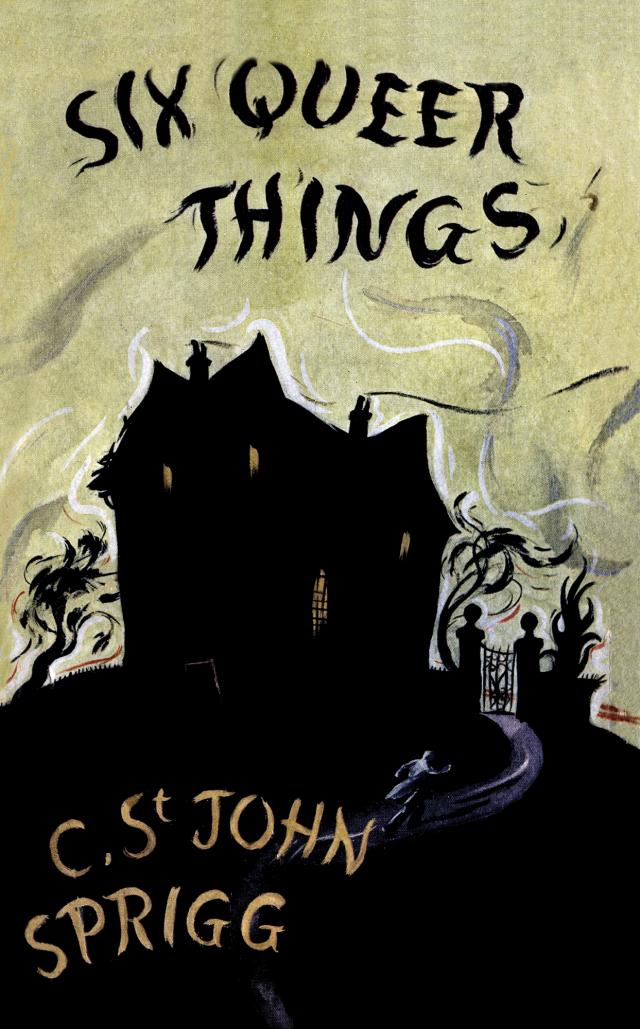
Once again he examined the Six Queer Things for inspiration. In spite of their amazing heterogeneity, these had, in actual practice, already proved to have some meaning and some inner connection. He could not see as yet what was the role played by all of them, but he was already becoming increasingly clear as to the sinister nature of the drama in which the snake-charming impedimenta, the balloons and the photograph had each played a part. The sheet had a most unpleasant significance in his eyes. And he had soon grasped the purpose of the chart of coloured wools.
What about the little textbook on “Forensic Medicine”? He took this out of the case and examined it carefully. There was a section on “toxicology”, and he turned to the entry relating to strychnine. To his disappointment, he found the leaves had not even been cut.
He was about to put the book away again, when he decided to look up the reference to “hydrocyanic acid.” Here he struck oil. Not only were the leaves cut, but the paragraphs outlining the symptoms of hydrocyanic-acid poisoning had been marked with pencil.
The inspector found this a tough nut to crack. An empty phial of hydrocyanic acid had been found on Ted Wainwright, but Crispin had quite definitely died of strychnine poisoning. Crispin none the less had a copy of “Forensic Medicine” in which the section on prussic acid had been carefully underlined and studied. What could be the sense of this?
He turned over the page. At the end of the chapter were two or three words of what seemed gibberish to the inspector, but, after consultation with Tremayne, he found they described certain drugs. He asked what their effect would be.
“Very much the same as the effects of mild hydrocyanic-acid poisoning, except that the symptoms would pass off sooner and would be less harmful. Evidently that is a note of some kind by a doctor, perhaps to remind him not to confuse the two, although I can’t imagine anyone taking the drugs in question, unless it were to simulate prussic-acid poisoning.”
“That’s rather interesting!” commented Morgan truthfully. It was not only interesting, it was revelatory.
“By the way,” went on Tremayne, unconscious of the effect of his remarks, “I was able to speak to one of my old colleagues and I mentioned our friend Wood to him. It may interest you to know that Wood left under a bit of a cloud. He was recognised as a clever doctor—indeed if he hadn’t been so clever the cloud might have been denser than it was. It was a matter of unethical behaviour—not exactly taking bribes, but something near it. Apparently Wood had the notion that his wealth ought to be commensurate with his brains, and as he started life with none of the former and a good deal of the latter, the idea was bound to lead to trouble!”
This disclosure did not come as a complete surprise to Morgan. As a result of Tremayne’s words he looked up his files and compared the handwriting in “Forensic Medicine” with Dr Wood’s handwriting.
There was no doubt they were the same. Here was a link, goodness knows what, between the doctor, Crispin, the little book, and the bottle of poison found in Wainwright’s pocket. The difficulty was to see how it connected with the actual murder of Crispin.
Morgan decided to go round and see Wood. He phoned him, and thought he detected a certain amount of constraint in the doctor’s voice. Did he realise things were getting a little dangerous? However, Wood emphasised that he would be glad to see Morgan immediately.
Morgan had decided to be frank with the doctor. He came straight to the point.
“Look here, Doctor Wood, I have made certain discoveries that demand a further explanation from you. As you know, a bottle of prussic acid was found in Wainwright’s pocket. Crispin was found when dead to have a book on ‘Forensic Medicine’ in her possession. That book belonged to you, and I have discovered that not only was the section dealing with hydrocyanic acid underscored, but you had actually added, as a footnote, the names of certain drugs which would simulate the effect of prussic acid. I want some explanation of these facts.”
Dr Wood did not hurry about answering. He took out his cigar box from the drawer and handed one to the inspector, who decided he was justified in taking one. The two men lit up in silence. Only when a dense cloud hung above Dr Wood’s rosy features and silvery hair did he decide to answer.
“All things considered, Inspector, I feel I ought perhaps to have been franker with you at an earlier date!”
“That’s a remark we often hear in our profession, Doctor,” replied Morgan, mellowed by the cigar, “and I can tell you it is invariably correct.”
“So I can believe! Well, in this particular case, had I been franker, I would have told you that Wainwright was frantically jealous of Crispin’s influence over Marjorie, with whom, as you may or may not know, he was at one time engaged. I did not tell you about this incident earlier, because I felt certain in my own mind, on questions purely of character and personality, that Wainwright was innocent; but I knew that if I told you this story, it might increase what I regard as your stupid prejudice against Wainwright.”
The inspector nodded.
“Actually, your action has probably increased what you call my prejudice against Wainwright. But go on.”
“Well, what happened was this: Wainwright at one time tried to get hold of some poison, with some absurd excuse about killing a pet dog. He did not approach me, but asked Mrs Threpfall to secure it for him. Mrs Threpfall naturally came to me for advice and, in conjunction with Crispin, we hatched a little plot. Mrs Threpfall actually got the poison, and I exchanged it for a drug which would produce all the effects of hydrocyanic acid. I gave Crispin the book so that she would be thoroughly familiar with what was about to happen to her. I counted on the psychological effect of what would follow to clear up the whole tangle in which Wainwright was involved.”
“I don’t quite see why it should clear matters up. Surely it would make them worse?”
“Minds in a certain condition bend themselves to an act, and the whole psychic energy gets so concentrated on this act, that it is impossible to divert them from it by any outside force. That was the state of Wainwright’s mind in relation to Crispin’s death.
“Directly the crucial act is performed, however, the tension is released, and the psychic energy flows slowly back into its normal channels. This accounts for the common phenomenon of the criminal who repents of his crime directly he has committed it, although no amount of argument could prevent his committing it beforehand. In the same way the obstinate suicide who has just been snatched back from death’s door after an attempt at self murder is often completely cured.”
“Yes, I’ve met plenty of cases like that, I must admit.”
“Well, that was the type of cure I attempted in Wainwright’s case. I knew that after he had apparently poisoned Crispin, and was confident she was dying, he would experience a great emotional upheaval, in which he would be cured of his obsession against Crispin. This obsession had become so closely interwoven with his love for Marjorie, that I believed it might also alter his attitude to Marjorie, and transform it into a state which would be much more helpful in her then condition. Of course I have not the faintest idea who did ultimately kill Crispin and so upset our plan. That is your problem, Inspector!”
Morgan contemplated the glowing tip of his cigar for some time, before he felt ready to make any comment. Then he said quietly:
“That certainly gives an explanation of the incident, Doctor Wood, although I need hardly emphasise how much unnecessary trouble has been caused by your withholding of it until this date.”
“Yes, it was rather an unethical action! To be even more candid, Inspector, although I am a doctor, I am by nature not a very law-abiding person. You may not think it to look at me—I fancy I look respectable—but I have always had a certain contempt for the verbal constructions we human beings externalise and worship, and call Moral Laws, or Right and Wrong. I suppose being a psychologist, and understanding exactly how these gods originate in the subconscious, determined by the experience and objective surroundings of the person who accepts them, breeds a certain nihilism in this respect.
“My brother doctors themselves regard me as a bit of an enfant terrible. Some might even call me a charlatan, which, in case you do not know it, Inspector, is the term the rank and file of my profession have always applied to anyone who deviates by an inch from current tradition, and which has therefore been applied to such great pioneers as Lister, Pasteur and Freud. In my own case it led to my being asked to leave the only establishment I have been connected with. However, I don’t suppose all this interests you.”
“What would really interest me,” said the inspector, watching him closely, “would be to know where Wainwright is at the moment.”
“You surely don’t expect me to know that, do you?” asked Dr Wood earnestly. “I’m afraid you’ve got hold of the wrong end of the stick somehow. I honestly haven’t the faintest idea!”
“Or where Marjorie Easton is?”
“Still less her!”
“Why still less? Either you know something about the whereabouts of one or the other, or you don’t.”
“Well, there’s no use our fencing. I did know for a time the whereabouts of Ted Wainwright after his disappearance. I admit it freely. In fact, I was largely responsible in helping him evade arrest. I am aware this renders me liable to prosecution, but of course if prosecuted I should deny ever making this admission to you.
“I do not regret having helped him to escape, for I am absolutely convinced he is innocent. But I must also admit that he has disappeared even from the sanctuary I gave him. You know that as well as I do, Inspector. You know even the date on which he disappeared. But where he is now, I haven’t the faintest idea. But as for Marjorie Easton, in her case I have never had the remotest idea where she has been from the moment of her disappearance, and so in her case, still less do I know her whereabouts. You are certainly uncommonly sharp in noticing these turns in phrase. You are more of a psychologist than I thought.”