

Sidelines, page 1


Praise for Karen Viggers
Sidelines
‘Football may be the world game, but sport starts in the family. Compelling and heartfelt, with all the drama of game day—on and off the field—Viggers shines a light on the ways competition can pull us together or drive us apart.’—Inga Simpson, author of Willowman
‘A stinging parable for any of us who have projected our inadequacies on our children. Empathetic and highly perceptive, this novel reaches well beyond the boundaries of junior sport. Like the best novels often do, Sidelines points out the failings we refuse to see.’—Jock Serong, author of The Settlement
‘Sidelines takes us into the world of kids’ sports and the games that are played on and off the field. Viggers examines the cost of high-stakes competition and the pressure it places on families, communities and relationships. With tension that builds like a well-paced match, Sidelines will leave you wondering if perhaps winning and losing are one and the same thing.’—Gabbie Stroud, author of Teacher
‘Sometimes a novel comes along that says what you’ve been thinking. Sidelines is one of those books: keen-eyed, relevant, urgent, plugged into the zeitgeist, and rendered with enviable skill. If you want to know what’s going on in Australian families, maybe even your own, Karen Viggers will bring you the news.’—Malcolm Knox, author of Bluebird
‘Timely, engaging and illuminating, Sidelines is a powerful exploration of team sport and the teenagers pressured to be part of it.’—Suzanne Leal, author of The Teacher’s Secret and The Watchful Wife
‘Viggers pulls no punches in this fast-paced narrative reminiscent of Moriarty and Picoult at their best. Ambition, sport, competition, gender, class, parents behaving badly—this is a novel totally of the moment. Viggers writes the stories of this kids’ sporting community with heart and rage. Essential—and thrilling—reading for all parents. I’ll be pushing this novel into the hands of everyone I know.’—Kate Mildenhall, author of The Mother Fault and The Hummingbird Effect
‘Sidelines is a riveting novel. It looks at a kid’s soccer team from many different points of view. The parents living out their own thwarted dreams and the children led into self-hatred and bad behaviour by the pressure of parental expectations. It takes our jittery, intensely competitive era and unpicks our self-deceptions until they bleed. Yet, such is Viggers’ skill and empathy, we can identify with them all—ambitious fathers, damaged mothers, bullying coaches and players, the depressed, the self-obsessed and, especially, the sulky, rebellious, desperate young.’—Jane Caro, author of The Mother
The Orchardist’s Daughter
‘A special tale of courage, resilience, loyalty and friendship … Viggers draws these conflicts together to show how ordinary lives can produce an emotional and extraordinary tale.’—Herald Sun
‘The landscape descriptions are stunning, vividly evoking the majesty of old-growth forests. For Miki and Leon, the forest offers a connection with the land and its ancient past … Tension builds to a dramatic, satisfying conclusion.’—Good Reading
‘In The Orchardist’s Daughter, Viggers paints a vivid picture of a small timber town and the people who find themselves there … This is a well-crafted novel that also shines a light on the everyday violence that thrives where eyes are averted and silence prevails. Against the dazzling backdrop of the Tasmanian forests, Viggers brings hope by showing how, when such silence is shattered, lives can be transformed.’—Weekend Australian
‘The Orchardist’s Daughter is a strong work of fiction that could be used to start conversations about all forms of abuse, and how we can rethink the veil of silence that so often surrounds it. With the celebration of stories and an exploration of the refuge they can provide, it is also an engaging read for lovers of contemporary Australian fiction.’—Sydney Morning Herald
‘A captivating story about finding freedom and independence … Viggers describes the Tasmanian surrounds with such skill that the reader can almost see it, and it is clear from her writing that she has an understanding and love for creatures.’—Style Magazine
‘Tasmania truly comes alive through the stunning mode of storytelling … The Orchardist’s Daughter is a novel I would recommend without reservation, a remarkable yarn that left a strong mark on my heart.’—Mrs B’s Book Reviews
‘a story that aims to reduce our separation from the natural world, and perhaps in doing so from each other.’—Stephen Romei, The Australian
‘honest and brutal, gentle and poetic, a real joy to read and linger over’—Theresa Smith Writes
‘An empowering novel’—The Chronicle
‘a vital, honest look at community, the environment and courage that you won’t regret picking up … Viggers beautifully captures the pressures, perks and quirks of small-town life with the same natural ease as Chris Hammer in Scrublands—the town and its inhabitants feel impressively real.’—Where The Books Go
The Lightkeeper’s Wife
‘Absolutely sublime. One of the top ten books of the year.’—Le journal de la santé
‘heart-wrenching and absorbing … The Lightkeeper’s Wife is a story of love versus passion, right versus wrong, and ultimately, a story of forgiveness.’—Bookseller & Publisher
‘Nature can both isolate and enlighten. Battling the elements can be as much about battling the storms within yourself. In The Lightkeeper’s Wife … Viggers sets the scene in a family dynamic filled with regret, loss and love.’—Australian Women’s Weekly
‘a triumph’—Le Figaro
‘This is a moving story of loss and love, and acceptance of the hand life deals us. It is truly unforgettable reading.’—Woman’s Day
‘Viggers shines in her descriptions of the wilds of Bruny Island and Antarctica.’—Daily Telegraph
‘a song in two voices … Arguably the book of the summer’—Femme actuelle
‘an emotional, engrossing read, gently but passionately told.’—Sunday Herald Sun
‘Each page is impregnated with salty sea air, wild waves and rocky coasts, a thousand shades of grey. In the folds of the surf, Karen Viggers has written a beautiful story of loss, memory and the effect of time on our aching souls.’—Lire Magazine
The Stranding
‘a poignant anatomy of loss. It is a memorable story of broken hearts trying to mend, of personal discovery and recovery. Her writing creates seductive land-edge experiences, light off the ocean, wind over sand, weather coming in.’—The Australian
‘There is a raw saltiness to the writing that vividly conveys the wild moods of the ocean, the crippling nature of emotional baggage and the challenges of a whale rescue.’—The Age
‘The Stranding aptly demonstrates how fiction plays a part in revealing the intricate and sometimes fragile bond that we share with nature.’—Wild Melbourne
‘Steeped in natural beauty, it will have you longing for coastal sunsets and afternoons lost wandering empty beaches.’—Laurie Steed, Readings Carlton
The Grass Castle
‘a story that will return to you time and time again’—Sydney Morning Herald
‘quality commercial fiction for which Viggers deserves a strong following.’—Books + Publishing
‘Karen Viggers weaves her tale against the backdrop of our love of the land.’—Yours Magazine
‘Evocative and thought-provoking.’—Newcastle Herald
‘a breath of fresh air that teaches us humility in the face of nature and the courage to face fears. Live rather than survive.’—Le petit crayon
Also by Karen Viggers
The Stranding
The Lightkeeper’s Wife
The Grass Castle
The Orchardist’s Daughter
This is a work of fiction. Names, characters, places and incidents are products of the author’s imagination or are used fictitiously. Any resemblance to actual events, locales or persons, living or dead, is entirely coincidental.
First published in 2024
Copyright © Karen Viggers 2024
All rights reserved. No part of this book may be reproduced or transmitted in any form or by any means, electronic or mechanical, including photocopying, recording or by any information storage and retrieval system, without prior permission in writing from the publisher. The Australian Copyright Act 1968 (the Act) allows a maximum of one chapter or 10 per cent of this book, whichever is the greater, to be photocopied by any educational institution for its educational purposes provided that the educational institution (or body that administers it) has given a remuneration notice to the Copyright Agency (Australia) under the Act.
Allen & Unwin
Cammeraygal Country
83 Alexander Street
Crows Nest NSW 2065
Australia
Phone: (61 2) 8425 0100
Email:info@allenandunwin.com
Web:www.allenandunwin.com
Allen & Unwin acknowledges the Traditional Owners of the Country on which we live and work. We pay our respects to all Aboriginal and Torres Strait Islander Elders, past and present.
ISBN 978 1 76147 071 4
eISBN 978 1 76118 825 1
Author photograph by Zhenshi van der Klooster
Typeset by Midland Typesetters, Australia
Cover design: Luke Causby/Blue Cork
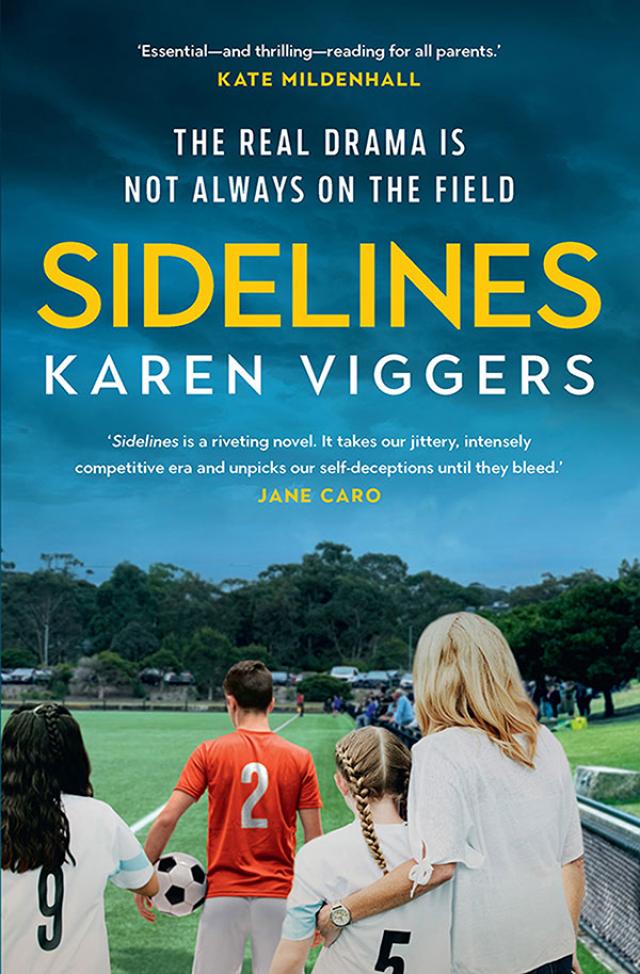
Cover illustrations: Thomas Barwick/Getty Images (mother and daughter); Alamy (young soccer player); Luke Causby (backgrounds)
For David, Ryan and Nina,
who introduced me to life on the sidelines of a football field.
And for my dear sister, Fiona Ander
(29 October 1970—6 July 2023),
who never had an opportunity to read this book.
‘If there was a game of football that went forever, I would play until I died.’
Kai Trewin at age 11 (2012)
Please remember
These are children
This is a game
The coaches are volunteers
The referees are human
This is not the World Cup
Sign at a junior club football field
CONTENTS
PROLOGUE
NINE MONTHS AGO
SUPPORT
JONICA
GOAL POACHER
CARMEN
OFFSIDE
AUDREY
OWN GOAL
KATERINA
POSSESSION
BEN
FOUR MONTHS LATER
UNLUCKY
GRIFFIN
ACKNOWLEDGEMENTS
ABOUT THE AUTHOR
PROLOGUE
Siren wailing, lights flashing, the ambulance threads its way through traffic. Cars veer, swerve, try to pull out of the way. But it’s gridlock, three packed lanes all the way to the intersection.
‘Take her up on the footpath,’ says the senior paramedic.
The rig rocks as it climbs the kerb. Wild eyes peer through car windows as they pass. At the lights, they drop back onto the road and roar through.
The paramedic squints at the GPS. ‘Turn left here.’
They round the corner and accelerate along a side street. The field is straight ahead: a patchwork quilt of pitches fringed by orange cones. Imposing concrete clubhouse. Tiered spectator seating. Large car park lined by pine trees.
The other paramedic, driving, kills the siren as they draw near.
A man stands by an open gate and waves them through.
They bump across pock-marked grass, bypassing a stalled game, gaping faces, a bloke videoing on his phone.
In the middle of the field, an official in a fluoro-orange vest directs them to a gathering of long-faced people huddled in small groups. Adults and kids, some in tracksuits, some in coats. Players in blue-and-white vertical stripes, others in red jerseys and filthy white shorts. All watching.
The man in the vest yells at everyone to make room.
The crowd parts.
The driver eases the ambulance through. All around, anxious faces. Kids with tear-streaked cheeks. Drooping shoulders. Heads hanging.
On the ground, someone in recovery position beneath a grey woollen blanket.
They pull up as close as possible, grab their gear and leap out.
The paramedic sets down his bag and drops to his knees on the damp grass, takes a quick look at the patient. Pale skin, slow breaths, fluttering lids. Crooked face. Bruising and swelling already emerging on the jaw. Undoubtedly, a significant fracture.
He checks the eyes. Lifts the lip. Assesses the neck carefully. Takes the pulse and blood pressure while his partner tugs back the blanket and navigates her way along the patient’s prone body, checking for injuries.
No other breaks. But a broken jaw and a serious head injury.
The paramedic can’t work it out. They’re nowhere near the goalpost, which means it wasn’t an encounter with an upright. So how did it happen? An accidental mid-air collision? Or something more sinister? He’s seen bad injuries like this in fist fights in pubs. Surely not here …
He glances around. The crowd has shuffled in close. Air heavy with tension. Guarded looks. Restless feet. The scent of roast lamb and barbecue sausages on the wind.
Across the field, all the way to the clubhouse, people are watching, waiting.
Cockatoos screech in the pine trees.
He exchanges a glance with his partner, sees the quick lift of her eyebrows.
Her face is studiously blank, a polished veneer. But she’s thinking the same thing as him. What the hell happened here?
SUPPORT
Having other team mates nearby to help in attack or defence. A phrase spoken to a team mate to let them know you are there.
JONICA
Jonica swings her black four-wheel-drive Mercedes into the car park beside the football field and checks the time. It’s the first trial for next season, and they’re late. She did her level best to hurry the twins out the door this afternoon, but they were slow. Who wouldn’t be, after a full day at school in this heat? And who in their right mind would hold trials on such a hot day? Only six weeks since last season finished, and here she is again, early November, the end of spring, dropping her kids off to exert themselves in 38-degree heat when they ought to be home in the pool. But football is their passion, as Ben calls it. And this is what you must do if your kids want to play in the Youth Premier League.
Too much soccer, she’d told Ben last night. And he’d laughed. It’s football, not soccer, he’d said. And there’s no such thing as too much, and you know it. You want them to succeed as much as I do. Normally she would agree—she’s fully invested in the twins and their interests. But holding a trial when it’s so hot? The coaches should have cancelled it. Someone might get heat stroke.
Hot air pours in through the doors as Alex and Audrey tip out onto the tarmac. ‘Got your water bottles?’ she calls after them. Audrey waves hers in the air, but Alex is already gone, silver Nike soccer boots flashing as he darts across the car park.
Audrey stops and looks back, face scrunched, shoulders up near her ears. This morning she was all fired up, talking to Ben about trials, but since she got home from school, she’s been quiet. After the Women’s World Cup, she became super-enthused about soccer. Ben had told her that she needed to play with boys to go the next step—that’s why she’s trying out for this team. As far as Jonica’s concerned, the presence of a bunch of adolescent boys simply adds extra pressure. She tried to raise this with Ben, but he’s from a family where it was just him and his brother and he has no idea what it’s like to be a teenage girl in a transforming body.
She lowers her window and summons a bright smile. ‘You’ll be fine,’ she calls. ‘How many other girls can do two thousand juggles? Only girls headed for the Matildas!’
A small grin from Audrey. She’s worked hard on her juggling; it sets her apart from other players.
‘Go on,’ Jonica says. ‘Remember everything Dad told you.’
Audrey hurries off.
Jonica reminds herself that it’s natural for her daughter to be anxious. She’ll be right once she’s out there. Ben says it works like that for him in front of a jury: a few nerves can enhance performance, get the neurons firing. He was the one who insisted that the twins play soccer. Apparently, all of life is to be had out there on the field. Jonica is yet to see anything in it other than stress and anxiety.
She performs a contortionist back-seat inspection to check for Alex’s water bottle. There it is, on the floor. She’ll have to take it to him—he’s going to need it in this heat. She grabs the bottle and swings out of the car, plodding across the car park under a cloudless sky. She can smell the baking tarmac, the tangy pine trees alongside the field. Maybe they’re in for a stinker of a summer. Maybe it’s climate change.
At the Minotaurs clubhouse, Dominik the coach, his assistant, Kyle, and a few of the parents, are helicopters hovering in the shade. They turn to look at her as she arrives. All the usual faces. It’s the same out on the field: the same kids trying out all over again. Most were in the team last year and they’ll probably get in again. But a few players have left, so there are vacancies. Even so, you have to wonder why the coaches have scheduled so many trials—five in a row from tonight, one each week from now into December. Jonica doesn’t understand it. Surely it will only take a couple of sessions to detect any new talent—it’s pretty obvious.
Alex has been with this team for three years now, ever since he and his mate Noah decided the school team wasn’t good enough. The school wasn’t happy, of course—private schools think they own you these days. But Ben had argued that the school couldn’t hold kids back unless they could provide the same level of coaching as an external club, so Alex and Noah were allowed to go. Ben chose the Minotaurs because it’s a highly ranked club with a good reputation and a program that goes from youth to adults. Most of the teams finish high on the ladder, which is important to Ben—he likes winning. For a Greek club, it’s more diverse than you’d think, with kids coming from suburbs up to an hour’s drive away, all over north-western Sydney.


