

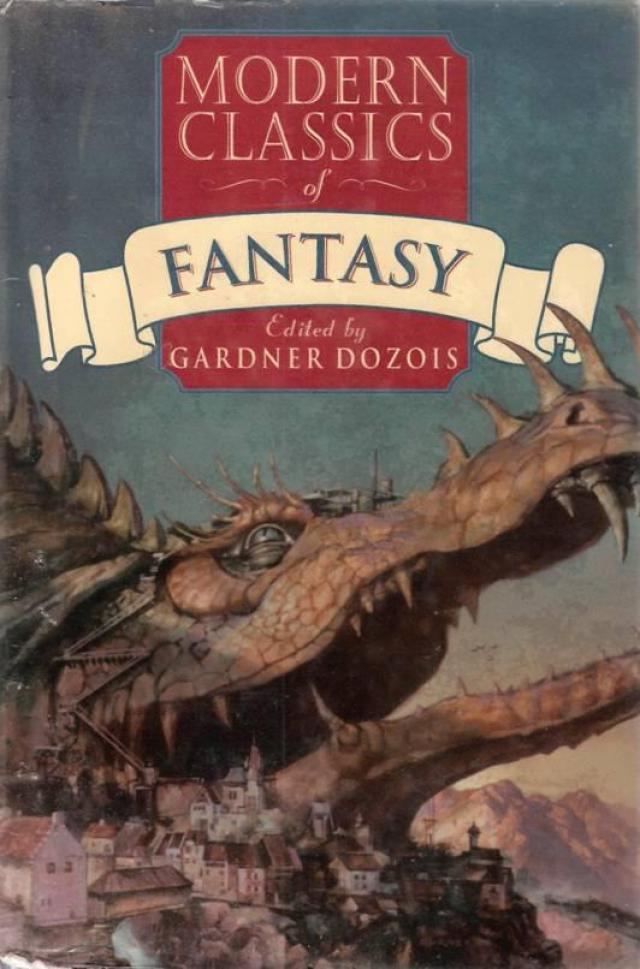
Modern Classics of Fantasy, page 8


“I’m Gafiney,” he growled between gasps. “Remember me? I think they followed me down here. They’ll be up any minute. I want your help.”
“They? Who’s they?” Robinette winced at the impact of that damned perfume.
The gnarly man launched into his misfortunes. He was going well when there were more protests from Miss Spevak, and Dr. Dunbar and four assistants burst into the office.
“He’s ours,” said Dunbar, his glasses agleam.
“He’s an apeman,” said the assistant with the black eye.
“He’s a dangerous lunatic,” said the assistant with the cut lip.
“We’ve come to take him away,” said the assistant with the torn pants.
The gnarly man spread his feet and gripped his stick like a baseball bat.
Robinette opened a desk drawer and got out a large pistol. “One move toward him and I’ll use this. The use of extreme violence is justified to prevent commission of a felony, to wit, kidnapping.”
The five men backed up a little. Dunbar said, “This isn’t kidnapping. You can only kidnap a person, you know. He isn’t a human being, and I can prove it.”
The assistant with the black eye snickered. “If he wants protection, he better see a game warden instead of a lawyer.”
“Maybe that’s what you think,” said Robinette. “You aren’t a lawyer. According to the law he’s human. Even corporations, idiots, and unborn children are legally persons, and he’s a damn sight more human than they are.”
“Then he’s a dangerous lunatic,” said Dunbar.
“Yeah? Where’s your commitment order? The only persons who can apply for one are (a) close relatives and (b) public officials charged with the maintenance of order. You’re neither.”
Dunbar continued stubbornly. “He ran amuck in my hospital and nearly killed a couple of my men, you know. I guess that gives us some rights.”
“Sure,” said Robinette. “You can step down to the nearest station and swear out a warrant.” He turned to the gnarly man. “Shall we slap a civil suit on ‘em, Gaffney?”
“I’m all right,” said the individual, his speech returning to its normal slowness. “I just want to make sure these guys don’t pester me anymore.”
“Okay. Now listen, Dunbar. One hostile move out of you and we’ll have a warrant out for you for false arrest, assault and battery, attempted kidnapping, criminal conspiracy, and disorderly conduct. We’ll throw the book at you. And there’ll be a suit for damages for sundry torts, to wit, assault, deprivation of civil rights, placing in jeopardy of life and limb, menace, and a few more I may think of later.”
“You’ll never make that stick,” snarled Dunbar. “We have all the witnesses.”
“Yeah? And wouldn’t the great Evan Dunbar look sweet defending such actions? Some of the ladies who gush over your books might suspect that maybe you weren’t such a damn knight in shining armor. We can make a prize monkey of you, and you know it.”
“You’re destroying the possibility of a great scientific discovery, you know, Robinette.”
“To hell with that. My duty is to protect my client. Now beat it, all of you, before I call a cop.” His left hand moved suggestively to the telephone.
Dunbar grasped at a last straw. “Hmm. Have you got a permit for that gun?”
“Damn right. Want to see it?”
Dunbar sighed. “Never mind. You would have.” His greatest opportunity for fame was slipping out of his fingers. He drooped toward the door.
The gnarly man spoke up. “If you don’t mind, Dr. Dunbar. I left my hat at your place. I wish you’d send it to Mr. Robinette here. I have a hard time getting hats to fit me.”
Dunbar looked at him silently and left with his cohorts.
The gnarly man was giving the lawyer further details when the telephone rang. Robinette answered: “Yes … Saddler? Yes, he’s here. Your Dr. Dunbar was going to murder him so he could dissect him … Okay.” He turned to the gnarly man. “Your friend Dr. Saddler is looking for you. She’s on her way up here.”
“Herakles!” said Gaffney. “I’m going.”
“Don’t you want to see her? She was phoning from around the corner. If you go out now you’ll run into her. How did she know where to call?”
“I gave her your number. I suppose she called the hospital and my boarding house, and tried you as a last resort. This door goes into the hail, doesn’t it? Well, when she comes in the regular door I’m going out this one. And I don’t want you saying where I’ve gone. Nice to have known you, Mr. Robinette.”
“Why? What’s the matter? You’re not going to run out now, are you? Dunbar’s harmless, and you’ve got friends. I’m your friend.”
“You’re durn tootin’ I’m gonna run out. There’s too much trouble. I’ve kept alive all these centuries by staying away from trouble. I let down my guard with Dr. Saddler, and went to the surgeon she recommended. First he plots to take me apart to see what makes me tick. If that brain instrument hadn’t made me suspicious I’d have been on my way to the alcohol jars by now. Then there’s a fight, and it’s just pure luck I didn’t kill a couple of those internes or whatever they are and get sent up for manslaughter. Now Matilda’s after me with a more than friendly interest. I know what it means when a woman looks at you that way and calls you ‘dear.’ I wouldn’t mind if she weren’t a prominent person of the kind that’s always in some sort of garboil. That would mean more trouble sooner or later. You don’t suppose I like trouble, do you?”
“But look here, Gaffney, you’re getting steamed up over a lot of damn-”
“Ssst!” The gnarly man took his stick and tiptoed over to the private entrance. As Dr. Saddler’s clear voice sounded in the outer office, he sneaked out. He was closing the door behind him when the scientist entered the inner office.
Matilda Saddler was a quick thinker. Robinette hardly had time to open his mouth when she flung herself at and through the private door with a cry of “Clarence!”
Robinette heard the clatter of feet on the stairs. Neither the pursued nor the pursuer had waited for the creaky elevator. Looking out the window he saw Gaffney leap into a taxi. Matilda Saddler sprinted after the cab, calling, “Clarence! Come back!” But the traffic was light and the chase correspondingly hopeless.
* * * *
They did hear from the gnarly man once more. Three months later Robinette got a letter whose envelope contained, to his vast astonishment, ten ten-dollar bills. The single sheet was typed even to the signature.
Dear Mr. Robinette:
I do not know what your regular fees are, but I hope that the enclosed will cover your services to me of last July.
Since leaving New York I have had several jobs. I pushed a hack (as we say) in Chicago, and I tried out as pitcher on a bush-league baseball team. Once I made my living by knocking over rabbits and things with stones, and I can still throw fairly well. Nor am I bad at swinging a club like a baseball bat. But my lameness makes me too slow for a baseball career.
I now have a job whose nature I cannot disclose because I do not wish to be traced. You need pay no attention to the postmark; I am not living in Kansas City, but had a friend post this letter there.
Ambition would be foolish for one in my peculiar position. I am satisfied with a job that furnishes me with the essentials and allows me to go to an occasional movie, and a few friends with whom I can drink beer and talk.
I was sorry to leave New York without saying good-bye to Dr. Harold McGannon, who treated me very nicely. I wish you would explain to him why I had to leave as I did. You can get in touch with him through Columbia University.
If Dunbar sent you my hat as I requested, please mail it to me, General Delivery, Kansas City, Mo. My friend will pick it up. There is not a hat store in this town where I live that can fit me.
With best wishes, I remain,
Yours sincerely,
Shining Hawk
alias Clarence Aloysius Gaffney
* * * *
AVRAM DAVIDSON
The Golem
For many years, the late Avram Davidson was one of the most eloquent and individual voices in science fiction and fantasy, and there were few writers in any literary field who could match his wit, his erudition, or the stylish elegance of his prose. He deserves to be ranked, at the very least, with Collier and Saki and Thurber, and to be taught in the same kind of academic anthologies in which they are taught—and no doubt would be if he had not spent his entire forty-year career laboring in the obscurity of genre pulp magazines. The fact is that, at his finest, Davidson was simply one of the best short-story writers of modern times, in any genre.
Davidson was one of two authors (the other was Fritz Leiber) whose work spanned such a broad range of different kinds of fantasy, and was so deeply influential all the way across that range, that I was unable to limit myself to using just one story by them; even devoting two stories apiece to them only begins to hint at the variety and eclecticism of their work. Later in this anthology I’ll bring you one of Davidson’s Jack Limekiller stories, a work from near the end of his career, but, even though it’s one of Davidson’s most-reprinted stories, no book calling it self Modern Classics of Fantasy could afford to omit the story that follows, a tale from the very beginning of Davidson’s career, a near-perfect little masterpiece called “The Golem.”
During his long career, Davidson won the Hugo (for that other mad little classic, “Or All the Seas with Oysters,” which detailed the sex cycles of coat hangers and safety pins), the Edgar, and the World Fantasy Award, including the prestigious Lifetime Achievement Award. Although all of his novels are erudite and entertaining, and a few are memorable (including one of the most influential of modern fantasy novels, The Phoenix and the Mirror—sometimes claimed as the first work of “Hard Fantasy,” because although the technology in the book is as rigorously worked out and as self-consistency utilized as in any “hard science” story, that “technology” is the technology of the Middle Ages, namely alchemy … and so, to us, reads as Magic), Davidson’s talents found their purest expression in his short fiction. He sold his first story in 1954, and by only the next year had written the classic story “The Golem,” which appeared, as much of his output would over the following decades, in The Magazine of Fantasy & Science Fiction … a magazine that he edited for several years in the early 1960s. (In some ways, in fact, Davidson can be thought of as the ideal or archetypical F&SF author, much as critics discussing H. L. Gold’s reign sometimes cite Damon Knight or Alfred Bester or Theodore Sturgeon as quintessential Galaxy writers, or as L. Sprague de Camp is sometimes cited as the quintessential Unknown writer.) After a silence of several years in the middle sixties, Davidson returned to writing toward the end of that decade, and by the mid-seventies he was engaged in turning out a long series of stories about the bizarre exploits of Doctor Engelbert Eszterhazy (later gathered in one of the best fantasy collections ever published, the marvelous The Adventures of Doctor Eszterhazy) and another series detailing the strange adventures of Jack Limekiller (inexplicably, as yet uncollected—alas) that are Davidson at the height of his considerable powers, and that must be counted as some of the very finest work produced in the final decades of the century.
Davidson’s short work has been assembled in landmark collections such as The Best of Avram Davidson, Or All the Seas with Oysters, The Redward Edward Papers, What Strange Stars and Shore, Collected Fantasies, and The Adventures of Doctor Eszterhazy. His novels include Masters of the Maze, Rogue Dragon, Peregrine: Primus, Rork!, Clash of Star-Kings, and Vergil In Averno. His most recent books are a novel in collaboration with Grania Davis, Marco Polo and the Sleeping Beauty, and a posthumously released collection of his erudite and witty essays, Adventures in Unhistory. Coming up is a mammoth retrospective collection, a new version of The Best of Avram Davidson.
* * * *
The grey-faced person came along the street where old Mr. and Mrs. Gumbeiner lived. It was afternoon, it was autumn, the sun was warm and soothing to their ancient bones. Anyone who attended the movies in the twenties or the early thirties has seen that street a thousand times. Past these bungalows with their half-double roofs Edmund Lowe walked arm-in-arm with Leatrice Joy and Harold Lloyd was chased by Chinamen waving hatchets. Under these squamous palm trees Laurel kicked Hardy and Woolsey beat Wheeler upon the head with a codfish. Across these pocket-handkerchief-sized lawns the juveniles of the Our Gang comedies pursued one another and were pursued by angry fat men in golf knickers. On this same street—or perhaps on some other one of five hundred streets exactly like it.
Mrs. Gumbeiner indicated the grey-faced person to her husband.
“You think maybe he’s got something the matter?” she asked. “He walks kind of funny, to me.”
“Walks like a golem,,” Mr. Gumbeiner said indifferently.
The old woman was nettled.
“Oh, I don’t know,” she said. “I think he walks like your cousin Mendel.”
The old man pursed his mouth angrily and chewed on his pipestem. The grey-faced person turned up the concrete path, walked up the steps to the porch, sat down in a chair. Old Mr. Gumbeiner ignored him. His wife stared at the stranger.
“Man comes in without a hello, goodbye, or howareyou, sits himself down, and right away he’s at home … The chair is comfortable?” she asked. “Would you like maybe a glass of tea?”
She turned to her husband.
“Say something, Gumbeiner!” she demanded. “What are you, made of wood?”
The old man smiled a slow, wicked, triumphant smile.
“Why should I say anything?” he asked the air. “Who am I? Nothing, that’s who.”
The stranger spoke. His voice was harsh and monotonous.
“When you learn who—or, rather, what—I am, the flesh will melt from your bones in terror.” He bared porcelain teeth.
“Never mind about my bones!” the old woman cried. “You’ve got a lot of nerve talking about my bones!”
“You will quake with fear,” said the stranger. Old Mrs. Gumbeiner said that she hoped he would live so long. She turned to her husband once again.
“Gumbeiner, when are you going to mow the lawn?”
“All mankind—” the stranger began.
“Shah! I’m talking to my husband … He talks eppis kind of funny, Gumbeiner, no?”
“Probably a foreigner,” Mr. Gumbeiner said complacently.
“You think so?” Mrs. Gumbeiner glanced fleetingly at the stranger. “He’s got a very bad color in his face, nebbich, I suppose he came to California for his health.”
“Disease, pain, sorrow, love, grief—all are nought to—”
Mr. Gumbeiner cut in on the stranger’s statement.
“Gall bladder,” the old man said. “Guinzburg down at the shule looked exactly the same before his operation. Two professors they had in for him, and a private nurse day and night.”
“I am not a human being!” the stranger said loudly.
“Three thousand seven hundred fifty dollars it cost his son, Guinzburg told me. ‘For you, Poppa, nothing is too expensive—only get well,’ the son told him.”
“I am not a human being!”
“Ai, is that a son for you!” the old woman said, rocking her head. “A heart of gold, pure gold.” She looked at the stranger. “All right, all right, I heard you the first time. Gumbeiner! I asked you a question. When are you going to cut the lawn?”
“On Wednesday, odder maybe Thursday, comes the Japaneser to the neighborhood. To cut lawns is his profession. My profession is to be a glazier—retired.”
“Between me and all mankind is an inevitable hatred,” the stranger said. “When I tell you what I am, the flesh will melt—”
“You said, you said already,” Mr. Gumbeiner interrupted.
“In Chicago where the winters were as cold and bitter as the Czar of Russia’s heart,” the old woman intoned, “you had strength to carry the frames with the glass together day in and day out. But in California with the golden sun to mow the lawn when your wife asks, for this you have no strength. Do I call in the Japaneser to cook for you supper?”
“Thirty years Professor Allardyce spent perfecting his theories. Electronics, neuronics—”
“Listen, how educated he talks,” Mr. Gumbeiner said admiringly. “Maybe he goes to the University here?”
“If he goes to the University, maybe he knows Bud?” his wife suggested.
“Probably they’re in the same class and he came to see him about the homework, no?”
“Certainly he must be in the same class. How many classes are there? Five in ganzen: Bud showed me on his program card.” She counted off on her fingers. “Television Appreciation and Criticism, Small Boat Building, Social Adjustment, The American Dance … The American Dance—nu, Gumbeiner—”





