

Modern Classics of Fantasy, page 22


The Mouser, sawing ceaselessly at the third loop, chanced to note Skwee’s muzzle at that moment. The small white captain had come down from the after-deck at Hisvet’s summoning along with eight white comrades, two bandaged, and now he shot Hisvet a silent look that seemed to say there might be doubts about the last item of her boast, once the rats ruled Lankhmar.
Hisvet’s father Hisvin had a long-nosed, much wrinkled face patched by a week of white, old-man’s beard, and he seemed permanently stooped far over, yet he moved most briskly for all that, taking very rapid little shuffling steps.
* * * *
NOW he answered his daughter’s bragging speech with a petulant sideways flirt of his black glove close to his chest and a little impatient “Tsk-tsk!” of disapproval, then went circling the deck at his odd scuttling gait while the Mingols waited by the ladder-top. Hisvin circled by Fafhrd and his black tormenter (“Tsk-tsk!”) and by the Mouser (another “Tsk!”) and stopping in front of Hisvet said rapid and fumingly, still crouched over, jogging a bit from foot to foot, “Here’s confusion indeed tonight! You catsing and romancing with bound men!—I know, I know! The moon coming through too much! (I’ll have my astrologer’s liver!) Shark oaring like a mad cuttlefish through the foggy white! A black balloon with little lights scudding above the waves! And but now ere we found you, a vast sea monster swimming about in circles with a gibbering demon on his head—it came sniffing at us as if we were dinner, but we evaded it!
“Daughter, you and your maid and your little people must into the cutter at once with us, pausing only to slay these two and leave a suicide squad of gnawers to sink Squid!”
“Sink Squid?” Hisvet questioned. “The plan was to slip her to Ilthmar with a Mingol skeleton crew and there sell her cargo.”
“Plans change!” Hisvin snapped. “Daughter, if we’re not off this ship in forty breaths, Shark will ram us by pure excess of blundering energy or the monster with the clown-clad mad mahout will eat us up as we drift here helpless. Give orders to Skwee! Then out with your knife and cut me these two fools’ throats! Quick, quick!”
“But Daddy,” Hisvet objected, “I had something quite different in mind for them. Not death, at least not altogether. Something far more artistic, even loving—”
“I give you thirty breaths each to torture ere you slay them!” Hisvin conceded. “Thirty breaths and not one more, mind you! I know your somethings!”
“Dad, don’t be crude! Among new friends! Why must you always give people a wrong impression of me? I won’t endure it longer!”
“Chat-chat-chat! You pother and pose more than your rat-mother.”
“But I tell you I won’t endure it. This time we’re going to do things my way for a change!”
“Hist-hist!” her father commanded, stooping still lower and cupping hand to left ear, while his white rat Grig imitated his gesture on the other side.
Faintly through the fog came a gibbering. “Gottverdammter Nebel! Freünde, wo sind Sie?”*
*”Goddam fog! Friends, where are you!” Evidently Karl Treugerz’ Lankhmarese dictionary was unavailable to him at the moment.
“‘Tiz the gibberer!” Hisvin cried under his breath. “The monster will be upon us! Quick, daughter, out with your knife and slay, or I’ll have my Mingols dispatch them!”
Hisvet lifted her hand against that villainous possibility. Her proudly plumed head literally bent to the inevitable.
“I’ll do it,” she said. “Skwee, give me your crossbow. Load with silver.”
The white rat captain folded his forelegs across his chest and chittered at her with a note of demand.
“No, you can’t have him,” she said sharply. “You can’t have either of them. They’re mine now.”
Another curt chitter from Skwee.
“Very well, your people may have the small black one. Now quick with your crossbow or I’ll curse you! Remember, only a smooth silver dart.”
Hisvin had scuttled to his Mingols and now he went around in a little circle, almost spitting. Frix glided smiling to him and touched his arm but he shook away from her with an angry flirt.
Skwee was fumbling into his cannister rat-frantically. His eight comrades were fanning out across the deck toward Fafhrd and the black kitten, which leaped down now in front of Fafhrd, snarling defiance.
Fafhrd himself was looking about bloody-faced but at last lucid-eyed, drinking in the desperate situation, poppy-langour banished by nose-bite.
Just then there came another gibber through the fog. “Gottverdammter Nirgendswelt !”*
*”Goddam Nowhere-World!”
Fafhrd’s blood-shot eyes widened and brightened with a great inspiration. Bracing himself against his bonds, he inflated his mighty chest.
“HOONGK!” he bellowed. “HOONGK!”
Out of the fog came eager answer, growing each time louder: “Hoongk! Hoongk! HOONGK!”
* * * *
SEVEN of the eight white rats that had crossed the deck now returned carrying stretched between them the still-snarling black kitten spread-eagled on its back, one to each paw and ear while the seventh tried to master but was shaken from side to side by the whipping tail. The eighth came hobbling behind on three legs, shoulder paralyzed by a deep-stabbing cat-bite.
From cabin and forecastle and all corners of the deck, the black rats scurried in to watch gloatingly their traditional enemy mastered and delivered to torment, until the middeck was thick with their bloaty dark forms.
Hisvin cracked a command at his Mingols. Each drew a wavy-edged knife. One headed for Fafhrd, the other for the Mouser. Black rats hid their feet.
Skwee dumped his tiny darts on the deck. His paw closed on a palely gleaming one and he slapped it in his crossbow, which he hurriedly handed up toward his mistress. She lifted it in her right hand toward Fafhrd, but just then the Mingol moving toward the Mouser crossed in front of her, his kreese point-first before him. She shifted crossbow to left hand, whipped out her dagger and darted ahead of the Mingol.
Meanwhile the Mouser had snapped the three cut loops with one surge. The others still confined him loosely at ankles and throat, but he reached across his body, drew Cat’s Claw and slashed out at the Mingol as Hisvet shouldered the yellow man aside.
The dirk sliced her pale cheek from jaw to nose.
The other Mingol, advancing his kreese toward Fafhrd’s throat, abruptly dropped to the deck and began to roll back across it, the black rats squeaking, and snapping at him in surprise.
“HOONK!”
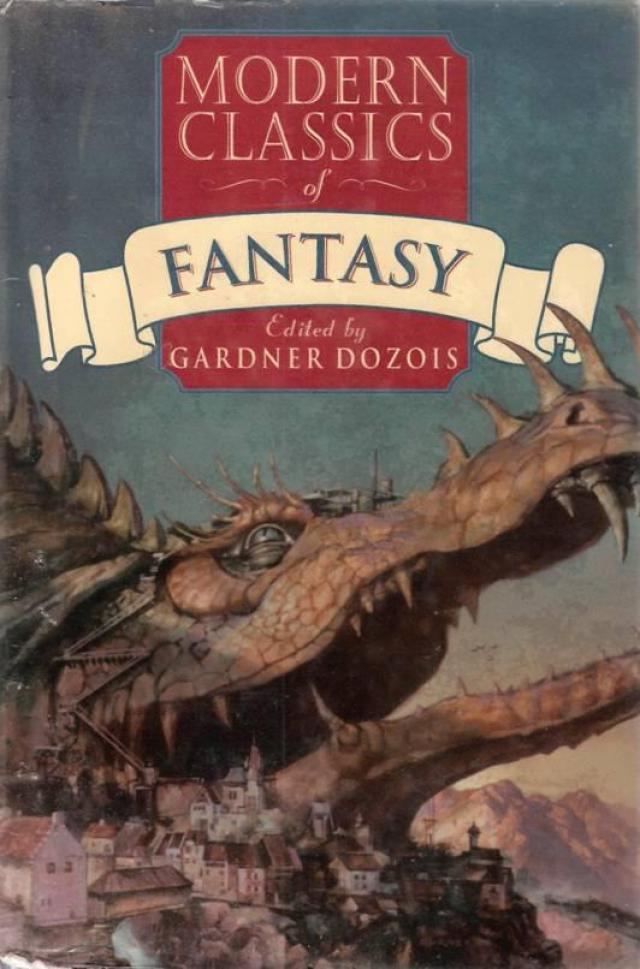
A great green dragon’s head had loomed from the moon-mist over the larboard rail just at the spot where Fafhrd was tied. Strings of slaver trailed on the Northerner from the dagger-toothed jaws.
Like a ponderous jack-in-the-box, the red-mawed head dipped and drove forward, lower jaw rasping the oaken deck and sweeping up from it a swathe of black rats three rats wide. The jaws crunched together on their great squealing mouthful inches from the rolling Mingol’s head. Then the green head swayed aloft and a horrid swelling travelled down the greenish yellow neck.
But even as it poised there for a second strike, it shrank in size by comparison with what now appeared out of the mist after it —a second green dragon’s head fourfold larger and fantastically crested in red, orange and purple (for at first sight the rider seemed to be part of the monster). This head now drove forward as if it were that of the father of all dragons, sweeping up a black-rat swathe twice as wide as had the first and topping off its monster gobble with the two white rats behind the rat-carried black kitten. It ended its first strike so suddenly (perhaps to avoid eating the kitten) that its parti-colored rider, who’d been waving his pike futilely, was hurled forward off its green head. The rider sailed low past the mainmast, knocking aside the Mingol striking at the Mouser, and skidded across the deck into the starboard rail.
The white rats let go of the kitten, which raced for the mainmast.
Then the two green heads famished by their two days of small fishy pickings since their last real meal at the Rat Rocks began methodically to sweep Squid’s deck clean of rats, avoiding humans for the most part, though not very carefully. And the rats, huddled in their mobs, did little to evade this dreadful mowing. Perhaps in their straining toward world-dominion they had grown just human and civilized enough to experience imaginative, unhelpful, freezing panic and to have acquired something of humanity’s talent for inviting and enduring destruction, Perhaps they looked on the dragons’ heads as the twin red maws of war and hell, into which they must throw themselves willy-nilly. At all events they were swept up by dozens and scores. All but three of the white rats were among those engulfed.
* * * *
MEANWHILE the larger people aboard Squid faced up variously to the drastically altered situation.
Old Hisvin shook his fist and spat in the larger dragon’s face when after its first gargantuan swallow it came questing toward him, as if trying to decide whether this bent black thing were (ugh!) a very queer man or (yum!) a very large rat. But when the stinking apparition kept coming on, Hisvin rolled deftly over the rail as if into bed and swiftly climbed down the rope ladder, fairly chittering in consternation, while Grig clung for dear life to the back of the black leather collar.
Hisvin’s two Mingols picked themselves up and followed him, vowing to get back to their cozy cold steppes as soon as Mingolly possible.
Fafhrd and Karl Treuherz watched the melee from opposite sides of the middeck, the one bound by ropes, the other by out-wearied astonishment.
Skwee and a white rat named Siss ran over the heads of their packed apathetic black fellows and hopped on the starboard rail. There they looked back. Siss blinked in horror. But Skwee, his black-plumed helmet pushed down over his left eye, menaced with his little sword and chittered defiance.
Frix ran to Hisvet and urged her to the starboard rail. As they neared the head of the rope ladder, Skwee went down it to make way for his empress, dragging Siss with him. Just then Hisvet turned like someone in a dream. The smaller dragon’s head drove toward her viciously. Frix sprang in the way, arms wide, smiling, a little like a ballet dancer taking a curtain call. Perhaps it was the suddenness or seeming aggressiveness of her move that made the dragon sheer off, fangs clashing. The two girls climbed the rail.
Hisvet turned again. Cat’s Claw’s cut a bold red line across her face, and sighted her crossbow at the Mouser. There was the faintest silvery flash. Hisvet tossed the crossbow in the black sea and followed Frix down the ladder. The boathooks let go, the flapping black sail filled, and the black cutter faded into the mist.
The Mouser felt a little sting in his left temple, but he forgot it while whirling the last loops from his shoulders and ankles. Then he ran across the deck, disregarding the green heads lazily searching for last rat morsels, and cut Fafhrd’s bonds.
* * * *
ALL the rest of that night the two adventurers conversed with Karl Treuherz, telling each other fabulous things about each other’s worlds, while Scylla’s sated daughter slowly circled Squid, first one head sleeping and then the other. Talking was slow and uncertain work, even with the aid of the little Lankhmarese-German Dictionary for Space-Time Travelers, and neither party really believed a great deal of the other’s tales, yet pretended to for friendship’s sake.
“Do all men dress as grandly as you do in Tomorrow?” Fafhrd once asked, admiring the German’s purple and orange garb.
“No, Hagenbeck just has his employees do it, to spread his monster zoo’s fame,” Karl Treuherz explained.
The last of the mist vanished just before dawn and they saw, silhouetted against the sea silvered by the sinking gibbous moon, the black ship of Karl Treuherz hovering not a bowshot west of Squid, its little lights twinkling softly.
The German shouted for joy, summoned his sleepy monster by thwacking his pike against the rail, swung astride the larger head, and swam off calling after him, “Auf Wiedersehen!”
Fafhrd had learned just enough Gibberish—German, during the night to know this meant, “Until we meet again.”
When the monster and the German had swum below it, the space-time engine descended, somehow engulfing them. Then a little later the black ship vanished.
“It dove into the infinite waters toward Karl’s Tomorrow bubble,” the Gray Mouser affirmed confidently. “By Ning and by Sheel, the German’s a master magician!”
Fafhrd blinked, frowned, and then simply shrugged…
The black kitten rubbed his ankle. Fafhrd lifted it gently to eye level, saying, “I wonder, kitten, if you’re one of the Cat’s Thirteen or else their small agent, sent to wake me when waking was needful?” The kitten smiled solemnly into Fafhrd’s cruelly scratched and bitten face and purred.
Clear gray dawn spread across the waters of the Inner Sea, showing them first Squid’s two boats crowded with men and Slinoor sitting dejected in the stern of the nearer but standing up with uplifted hand as he recognized the figures of the Mouser and Fafhrd; next Lukeen’s war galley Shark and the three other grain ships Tunny, Carp and Grouper; lastly, small on the northern horizon, the green sails of two dragon-ships of Movarl.
The Mouser, running his left hand back through his hair, felt a short, straight, rounded ridge in his temple under the skin. He knew it was Hisvet’s smooth silver dart, there to stay.
* * * *
JACK VANCE
The Overworld
Although Jack Vance is perhaps best known as a science-fiction writer—author of such famous novels as The Dragon Masters, Emphyrio, The Last Castle, The Blue World, and the five-volume “Demon Princes” series, among many others—he has also been a seminal figure in the development of modern fantasy as well. Born in San Francisco in 1920, Vance served throughout World War II in the U.S. Merchant Navy. Most of the individual stories that would later be melded into his first novel, The Dying Earth, were written while Vance was at sea—he was unable to sell them, a problem he would also have with the book itself, the market for fantasy being almost non-existent at the time. The Dying Earth was eventually published in an obscure edition in 1950 by a small semi-professional press, went out of print almost immediately, and remained out of print for more than a decade thereafter. Nevertheless, it became an underground cult classic, and its effect on future generations of writers is incalculable: for one example, out of many, The Dying Earth—along with Clark Ashton Smith’s Zothique, which probably influenced it—is one of the most recognizable influences on Gene Wolfe’s The Book of the New Sun tetralogy (Wolfe has said, for instance, that The Book of Gold which is mentioned by Severian is supposed to be The Dying Earth). Vance returned to this milieu in 1965, with a series of stories introducing the sly and immoral trickster Cugel the Clever; collected in 1966 as The Eyes of the Overworld, the Cugel stories too had a profound effect on the state of the art of modern fantasy. In the early 1980s, Vance returned yet again with two collections of Cugel stories, Cugel’s Saga and Rhialto the Marvellous. Taken together, The Dying Earth and the three volumes of Cugel stories represent one of the most impressive achievements in fantasy today.
Although almost quintessential “sense of wonder” stuff, marvelously evocative and effortlessly inventive, the Cugel stories are also elegant and intelligent, full of sly wit and subtle touches, all laced with Vance’s typical dour irony and bleak deadpan humor. In “The Overworld”—one of the stories from The Eyes of the Overworld—Cugel earns the enmity of Iucounu the Laughing Magician, and reluctantly sets forth on an arduous and very dangerous mission, in the course of which he learns, to his sorrow, that beauty is most definitely in the eye of the beholder …
Vance has won two Hugo Awards, a Nebula Award, two World Fantasy Awards (one the prestigious Life Achievement Award), and the Edgar Award for best mystery novel. In addition to die Dying Earth/Cugel series, he has written another well-received fantasy series that includes Lyonesse, The Green Pearl, and Madouc. His other books, most of them science fiction, include The Anome, The Star King, The Killing Machine, The Languages of Pao, The Palace of Love, The Face, The Book of Dreams, City of the Chasch, The Dirdir, The Pnume, The Gray Prince, The Brave Free Men, Trullion: Alastor 2262, Marune: Alastor 933, and Wyst: Alastor 1716, among many others. His short fiction has been collected in Eight Fantasms and Magics, The Best of Jack Vance, Green Magic, Lost Moons, The Complete Magnus Ridolph, The World Between and Other Stories, The Dark Side of the Moon, and The Marrow Land. His most recent books are the novels Araminta Station, Ecce and Olde Earth, and Throy, plus an omnibus volume collecting three of his “Alastor” novels, Alastor.
* * * *
ON THE HEIGHTS above the river Xzan, at the site of certain ancient ruins, Lucounu the Laughing Magician had built a manse to his private taste: an eccentric structure of steep gables, balconies, sky-walks, cupolas, together with three spiral green glass towers through which the red sunlight shone in twisted glints and peculiar colors.


