

Modern Classics of Fantasy, page 1


* * * *
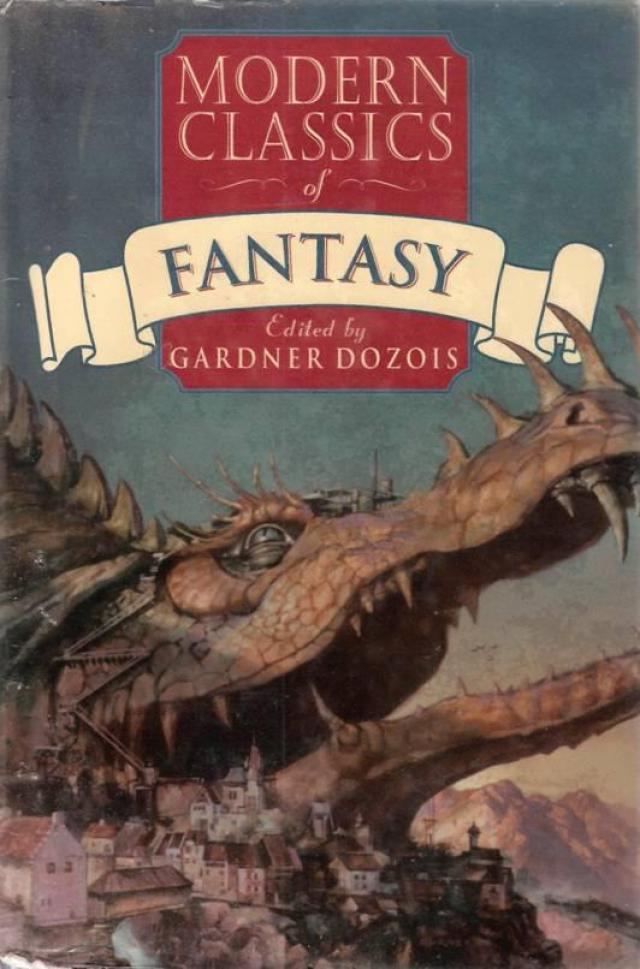
MODERN CLASSICS
OF
FANTASY
EDITED BY
GARDNER DOZOIS
SCANNED & PROOFED BY MADMAXAU
* * * *
CONTENTS
Preface
Trouble with Water Horace L. Gold
The Gnarly Man L. Sprague de Camp
The Golem Avram Davidson
Walk Like a Mountain Manly Wade Wellman
Extempore Damon Knight
Space-Time for Springers Fritz Leiber
Scylla’s Daughter Fritz Leiber
The Overworld Jack Vance
The Signaller Keith Roberts
The Manor of Roses Thomas Burnett Swarm
Death and the Executioner Roger Zelazny
The Configuration of the North Shore R. A. Lqfferty
Two Sadnesses George Alec Effinger
The Tale of Hauk Poul Anderson
Manatee Gal Ain’t You Coming
Out Tonight Avram Davidson
The Troll T.H. White
The Sleep of Trees Jane Yolen
God’s Hooks! Howard Waldrop
The Man Who Painted the
Dragon Griaule Lucius Shepard
A Cabin on the Coast Gene Wolfe
Paper Dragons James P. Blaylock
Into Gold Tanith Lee
Flowers of Edo Bruce Sterling
Buffalo Gals, Won’t You Come
Out Tonight Ursula K. Le Gum
A Gift of the People Robert Sampson
Missolonghi 1824 John Crowley
Bears Discover Fire Terry Bissau
Blunderbore Esther M. Friesner
Death and the Lady Judith Tarr
The Changeling’s Tale Michael Swanwick
Professor Gottesman and the
Indian Rhinoceros Peter S. Beagle
Beauty and the Opera or the
Phantom Beast Suzy McKee Charms
* * * *
PREFACE
Fantasy has probably existed ever since the Cro-Magnons told stories around the fire in the deep caves of Lascaux and Altamira and Rouffignac—and perhaps even for considerably longer than that, for who knows what tales the Neanderthals told around their fires during the long Ice Age nights, thousands of years earlier? By the time that Homer was telling stories to fireside audiences in Bronze Age Greece, the tales he was telling contained recognizable fantasy elements—man-eating giants, spells and counterspells, enchantresses who turned men into swine—that were probably recognized as fantasy elements and responded to as such by at least the more sophisticated members of his audience.
Toward the end of the eighteenth century, something recognizably akin to modern literary fantasy was beginning to precipitate out from the millennia-old body of oral traditions—folktales, fairy tales, mythology, songs and ballads, wonder tales, travelers’ tales, rural traditions about the Good Folk and haunted standing stones and the giants who slept under the countryside. First these came in the form of Gothic stories, ghost stories, and Arabesques, and later, by the middle of the next century, in a more self-conscious literary form in the work of writers such as William Morris and George MacDonald, who reworked the subject matter of the oral traditions to create new fantasy worlds for an audience sophisticated enough to respond to the fantasy elements as literary tropes rather than as fearfully regarded, half-remembered elements of folk beliefs, people who were more likely to be entertained by the idea of putting a saucer of milk out for the fairies than to actually do such a thing.
By the late nineteenth and early twentieth centuries, most respectable literary figures—Dickens, Twain, Kipling, Doyle, Saki, Chesterton, Wells—had written fantasy in one form or another, if only ghost stories or “Gothic” stories, and a few, like Thorne Smith, James Branch Cabell, and Lord Dunsany, had even made something of a specialty of it. But as World War II loomed ever closer over the horizon, fantasy somehow began to fall into disrepute, increasingly being considered as unhip, “anti-modern,” non-progressive, socially irresponsible, even déclassé. By the sterile
[MISSING PAGE – TORN FROM ORIGINAL]
and books” such as Rudyard Kipling’s The Jungle Books (which still remains perhaps my favorite “children’s book”—today it is probably published as Young Adult—of all time, and which is perhaps even more rewarding to the adult reader).
By the early 1960s, this had begun to change. One of the first cracks in the armor, for me, anyway, happened in 1962, when an SF mass-market line named Pyramid Books published a paperback edition of L. Sprague de Camp and Fletcher Pratt’s The Incomplete Enchanter, with a quote on it from Basil Davenport—one of F&SFs back-cover adults—saying that “you never met anything exactly like it in your life.” I agreed—I never had met anything exactly like it in my life, and it made a large impression on me. When Pyramid Books published the sequel, The Castle of Iron, a few months later, I pounced on that as well. In 1963, Pyramid brought out an anthology of stories, edited by D. R. Bensen, from the by-then long extinct fantasy magazine Unknown, where the de Camp and Pratt “Harold Shea” stories that had gone into making up The Incomplete Enchanter had originally appeared; sensitized by this connection, I bought the anthology, one of the first anthologies I can remember buying. In its pages, encountered for the first time Fritz Leiber’s Fafhrd and the Gray Mouser, as well as discovering the work of Manly Wade Wellman and H. L. Gold. A few months later, I came across another Pyramid anthology, this one edited by L. Sprague de Camp and called Swords & Sorcery, a deliberate attempt by de Camp to preserve at least, and perhaps revive, a then-Endangered Literary Species called “sword & sorcery” or “heroic fantasy.” Here was another Gray Mouser story, and here for the first time I also encountered Robert E. Howard’s Conan and C. L. Moore’s Jirel of Joiry, first read the work of Lord Dunsany and H. P. Lovecraft, and first read the fantasy work—I was already familiar with his science fiction—of Poul Anderson; a later de Camp anthology, The Spell of Seven, introduced me to Michael Moorcock’s Elric stories. (D. R. Bensen, who was the editor of Pyramid Books during this period, and who therefore was responsible for bringing all this material back into print, can be seen, in fact, as one of the unsung and forgotten progenitors of the whole modern fantasy revival.)
Inspired by these books, I began to rummage through secondhand bookstores, and soon had come up with yellowing old back copies of Unknown and Weird Tales and The Magazine of Fantasy & Science Fiction. A bit later, I discovered that new copies, current copies, of F&SF were available on a few newsstands. And at about this time I discovered Cele Goldsmith’s Fantastic, just as she succeeded in coaxing Fritz Leiber to contribute a new sequence of Fafhrd and Gray Mouser stories to the magazine—and I was hooked. In fact, although I occasionally picked up a copy of Galaxy or F&SF, Fantastic was the first genre magazine I bought regularly, and I would haunt the newsstands waiting for the new issue to appear with an intense impatience I hadn’t known before and have rarely felt since.
More fantasy books began to squeeze through into print. At Ace, Don Wollheim began to re-issue almost the complete works of Edgar Rice Burroughs in affordable paperback editions with wonderfully evocative covers by Roy Krenkel and Frank Frazetta of sword-swinging heroes, beautiful princesses in diaphanous gowns, and huge glowering Tharks with a sword in each of their four hands, and somehow these books fit in perfectly to the fantasy gestalt that was growing, even though most of them had been published originally as science fiction. Similarly, Mary Renault’s The King Must Die and The Bull from the Sea, although ostensibly historical novels, felt like fantasy, and helped to stoke the growing hunger of the reading audience for fantasy. Somewhere during this period, the success of the Broadway musical Camelot allowed the book which had inspired the play, T. H. White’s The Once and Future King, to come out in an affordable (by my standards) mass-market paperback; it was seized instantly and gladly by me and by thousands of others like me. L. Sprague de Camp began writing new Conan stories and novels, building them from fragments and unfinished drafts by the late Robert E. Howard. The first of the Conan imitators, such as John Jakes’s stories of “Brak the Barbarian,” began to appear. And then we came to Tolkien.
J. R. R. Tolkien’s The Lord of the Rings trilogy is often cited as having single-handedly created the modern fantasy genre, but, while it is certainly hard to overestimate Tolkien’s influence—almost every subsequent fantasist was hugely influenced by Tolkien, even, haplessly, those who didn’t like him and reacted against him—what is sometimes forgotten these days is that Don Wollheim published the infamous “pirated” edition of The Fellowship of the Ring (the opening book of the trilogy) in the first place because he was casting desperately around for something—anything!—with which to feed the hunger of the swelling audience for “sword & sorcery.” The cover art of the Ace edition of The Fellowship of the Ring makes it clear that Wollheim thought of it as a “sword & sorcery” book, and his signed interior copy makes that explicit by touting the Tolkien volume as “a book of sword-and-sorcery that anyone can read with delight and pleasure.” In other words, in the United States at least, the genre audience for fantasy definitely predated Tolkien, rather than being created by him, as the modern myth would have it. Don Wollheim, one of the most canny editors who ever lived, knew very well that there was a genre fantasy audience already out there, a hungry audience waiting to be fed—although I doubt if even he had the remotest idea just how tremendous a response there would be to the tidbit of “sword & sorcery” tha
After Tolkien, everything changed. The audience for genre fantasy may have existed already, but there can be no doubt that Tolkien widened it tremendously. The immense commercial success of Tolkien’s work also opened the eyes of other publishers to the fact that there was an intense hunger for fantasy in the reading audience—and they, too, began looking around for something to feed to that hunger. On the strength of Tolkien’s success, Lin Carter was able to create the first mass-market paperback fantasy line, the “Ballantine Adult Fantasy” line, which brought back into print long-forgotten and long-unavailable works by writers such as Clark Ashton Smith, E. R. Eddison, James Branch Cabell, Mervyn Peake, and Lord Dunsany, as well as somewhat more recent but equally unavailable and long out-of-print books such as de Camp and Pratt’s Land of Unreason and Evangeline Walton’s The Island of the Mighty. A few years later, Lester del Rey took over from Lin Carter, and, aided by the matchless marketing savvy of his wife, Judy-Lynn del Rey, began to search for more commercial, less high-toned stuff that would appeal more directly to an audience still hungry for something just like Tolkien. In 1977, he brought out Terry Brooks’s The Sword of Shannara, and although it was dismissed by most critics as a clumsy retread of Tolkien, it proved hugely successful commercially, as did its many sequels. Del Rey also scored big that year with Lord Foul’s Bane, the beginning of the somewhat quirkier and less derivative trilogy The Chronicles of Thomas Covenant the Unbeliever, by Stephen R. Donaldson, and its many sequels. At about this time, the Ballantine SF and fantasy lines would be renamed Del Rey Books in honor of the unprecedented success of both del Reys in finding and publishing best-sellers, books that were selling better than any SF or fantasy titles had ever sold before; Lester del Rey would remain editor of Del Rey Fantasy, and, for both better and worse, also remain one of the most influential fantasy editors in the business, until his retirement in 1991.
The floodgates had opened. No longer would fantasy books need to be “disguised” as science fiction in order to be sold. Fantasy was becoming a genre, and a separate commercial publishing category, of its own.
“Sword & Sorcery” or “Heroic Fantasy” was probably the most common form of genre fantasy book at first, but by the 1980s that form had faded (although it’s showing signs of revival in the middle 1990s, with publishers such as White Wolf issuing retrospective collections of core “sword & sorcery” work by authors like Fritz Leiber and Michael Moorcock). It was largely replaced by “High Fantasy,” a somewhat less swashbuckling and more mood-oriented form, closer to Tolkien and the pseudo-medieval romances of William Morris than it is to Conan. Ursula K. Le Guin was a pioneer of this form with her “Earthsea” books (originally published as Young Adult fiction, perhaps because at the time no one knew where else to put them), and other writers who have earned reputations in “High Fantasy” include (but are no means limited to) Patricia A. McKillip, Robin McKinley, Guy Gavriel Kay, Jane Yolen, Parke Godwin, Judith Tarr, Marion Zimmer Bradley, Lisa Goldstein, Susan Cooper, Joy Chant, and many others. In its most common form, sometimes referred to sneeringly by critics as “the standard Celtic Fantasy Trilogy,” High Fantasy still dominates bookstore shelves. It fades off into Arthurnalia, fantasy books dealing with The Matter of Britain, into what has been called “Mannerism” (typified by the work of Ellen Kushner, Delia Sherman, Elizabeth Willey, and some of the non-comic work of Esther Friesner), and on into the historical fantasy—and thus also off, sometimes nearly imperceptibly, into both the historical novel and that subcategory of the mystery novel known as the “historical mystery” (sometimes making for works that are very difficult to categorize: to which genre, for instance, does a mystery novel set in ancient Rome which features historical characters tracking down a vampire belong? Are Mary Stewart’s Merlin books such as The Crystal Cave historical novels with fantasy elements, or fantasy novels set in a strongly developed historic milieu?) On the other end, High Fantasy shades off into what has been called “Urban Fantasy” (similar to Unknown-style comic fantasy that deals with the interactions between the mundane world and the worlds of fantasy, but in a different key, more somber and lyrical) and which is represented by the work of authors such as Charles de Lint, Megan Lindholm, Emma Bull, Will Shetterly, Marina Fitch, and others. The work of eccentric, harder-to-classify authors such as Robert Holdstock, Keith Roberts, Mary Gentle, Gene Wolfe, Gwyneth Jones, M. John Harrison, and Tanith Lee is probably related to this central massif in some way, as is the flourishing subcategory of “updated fairy tales” recently popularized by a series of fantasy anthologies such as Snow White, Blood Red edited by Ellen Datlow and Terri Windling. The work of eccentrics such as Tim Powers, James P. Blaylock (Powers and Blaylock are sometimes considered to form a sub-category of their own, and are also identified with—see below— “steampunk”), John Crowley, Jonathan Carroll, Howard Waldrop, Terry Bisson, Rebecca Ore, and Neal Barrett, Jr. probably also fits in somewhere on the Urban Fantasy end of the High Fantasy spectrum … or fits in there as well as it fits in anywhere, at least. On the far end, Urban Fantasy also shades off into the literary territory known as “Magic Realism,” although the distinctions between fantasy and Magic Realism are subjective enough and complex enough to daunt all but the most fearless of critics. (High Fantasy was also the major influence on most fantasy role-playing games such as Dungeons & Dragons, and, later, on fantasy-adventure computer games, and such mediums have diffused the influence of this type of fantasy throughout the culture far beyond the traditional boundaries of the print genre, but also out of our purview here.)
Sometime in the early 1980s, prompted by the unprecedented commercial success of Stephen King, horror began to separate out from fantasy and establish itself as an individual commercial publishing category of its own, with book lines specializing in horror being launched, and with separately labeled shelves set up for horror in most large bookstores. This trend accelerated throughout the 1980s and into the 1990s, and today, while fantasy titles are not always separated from science fiction titles in large bookstores (usually they are not separated, in fact), horror is almost always separated out from both fantasy and science fiction and racked as an individual category of its own. Horror had become a genre in its own right. (Later still, in the early 1990s, horror itself would begin to split, with a variety sometimes called “Dark Suspense” beginning to be differentiated from the more traditional supernatural horror; closer to the “true crime/suspense novel” subgenre of mystery than to the work of earlier horror writers such as Lovecraft, the rapidly growing “Dark Suspense” subcategory is mostly concerned with a seemingly endless parade of serial killers, murderous rapists, and child molesters—horror in the Hitchcockian sense rather than in the supernatural sense—and, since it usually contains no fantastic element, passes quickly beyond our purview here. “Erotic Horror”—sometimes featuring a supernatural element, sometimes not, but almost always blood-soaked, gore-splattered, and escalatingly grotesque, specializing in depictions of rape, murder, sexual violence, S&M, bondage, and mutilation, all described with relishing, hand-rubbing glee—also seems to be calving from the main body of horror as a subgenre of its own. Vampire stories, once to be encountered largely in fantasy, also show signs of becoming a separate subcategory of horror on their own— 22 percent of the horror books published in 1995 were vampire books— but at least they usually retain a fantastic element, almost by definition. Most modern horror, though, has moved so far away from its fantasy roots that it need not be really considered further in this anthology.)
Although horror is increasingly perceived as a separate genre of its own (and mostly feels that way, too), some writers do continue to work both territories, and there is an ambiguous borderland between fantasy and horror, sometimes called “Dark Fantasy”—work that partakes of the qualities of both forms without being clearly distinguishable as either. Much of Tanith Lee’s work fits into this border country, as do novels like James P. Blaylock’s All the Bells on Earth and some of the work of Tim Powers, Elizabeth Hand, Jonathan Carroll, and others.


