

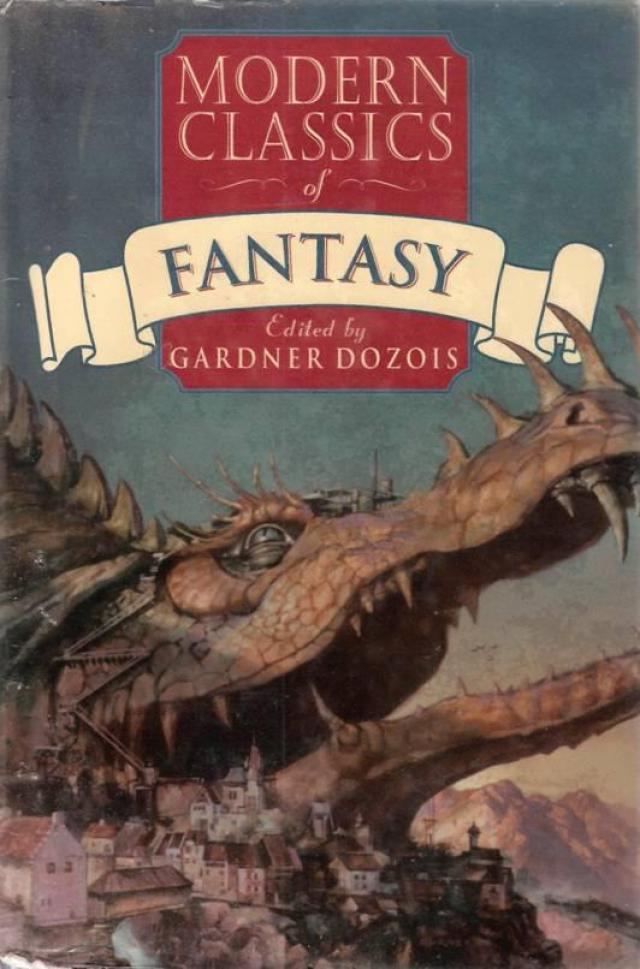
Modern Classics of Fantasy, page 38


But she had no eye for the children. She was watching me. I had seen her several times in the forest. Something of curiosity—no, of awe—distinguished her from the gray, anonymous tribe. Perhaps it was she who had left the crosses around my estate, like charms to affright the devil. She had never threatened me. Once I had run from her. Like a wraith of mist before the onslaught of sunlight, she had wasted into the trees. I had paused and watched her with shame and pity.
Now, I walked toward her, compelled by a need which surpassed my fear. “I won’t hurt you,” I said. I was deathly afraid. Her friends could ooze from the trees and envelop me before I could cry for help. “I won’t hurt you,” I repeated. “I only want to talk.”
The rank vegetable scent of her clogged my nostrils. I had always felt that the rose and the Mandrake represented the antitheses of the forest: grace and crookedness. Strange, though, now that I looked at her closely for the first time, she was like a crooked tree mistreated by many weathers; a natural object unanswerable to human concepts of beauty and ugliness.
Dredging archaic words from memories of old books, I spoke with soft emphasis. “Tell me,” I said. “Why do you watch my house—my mead-hall? Is it treasure-rich to you? Broad-gabled?”
She caught my meaning at once. “Not mead-hall.”
“What then? The roses perhaps? You may pick some if you like.”
“Bantling,”
“Bantling? In my house?”
She knelt and seized my hand and pressed her hairy lips against my knuckles.
“Here,” she said.
I flung my hands to my ears as if I had heard a Mandrake shriek in the night. It was I who had shrieked. I fled … I fled …
His eyes were closed, he rested against a cushion embroidered with children playing Hoodman Blind. He rose from his seat when he heard me enter the room.
“They’re gone?”
“What? What did you say, John?”
“Stephen and Ruth are gone?”
“Yes.”
He came toward me. “You’re pale, Lady Mary. Don’t be sad for me. I wanted to stay.”
I said quietly: “I think you should go with your friends. They asked me to send you after them.”
He blinked his eyes. The lids looked heavy and gray. “But I am staying to protect you. To be your son. You said—”
“It was really Stephen I wanted. You’re only a little boy. Stephen is a young man. I would have taught him to be a gentleman and a knight. But now that he’s gone, what do I need with a skinny child of twelve?”
“But I don’t ask to be loved like Stephen!”
I caught him between my hands, and his lean, hard-muscled shoulders, the manhood stirring within him, belied my taunts.
“Go to him,” I cried. ‘‘Now, John. You’ll lose him if you wait!”
Pallor drained from his face, like pain routed by opium, “Lady Mary,” he whispered. “I think I understand. You do love me, don’t you? Enough to let me go. So much—”
I dropped my hands from his shoulders. I must not touch him. I must not kiss him. “So much. So much …”
Beyond the hedge, he turned and waved to me, laughing, and ran to catch his friends. Before he could reach the woods, Stephen blazed from the trees.
“I waited,” he cried. “I knew you would come!”
The boys embraced in such a swirl of color, of whirling bodies and clattering kettle drums, that the fair might have come to London Town! Then, arm in arm with Ruth, they entered the woods:
Summer is a-comin’ in, Loud sing cuckoo …
I, also, entered the woods. For a long time I knelt before one of the stone crosses left by the Mandrakes— set like a bulwark between enormous oaks to thwart whatever of evil, griffins, wolves, men, might threaten my house. My knees sank through the moss to ache against stone; my lips were dry of prayer. I knelt, waiting.
I did not turn when the vegetable scent of her was a palpable touch. I said: “Would you like to live with me in the mead-hall?”
Her cry was human; anguish born of ecstasy. I might have said: “Would you like to see the Holy Grail?”
“Serve you?”
“Help me. You and your friends. Share with me.”
I leaned to the shy, tentative fingers which loosened my hair and spread my tresses, as one spreads a fine brocade to admire its weave and the delicacy of its figures.
“Bantling,” she said. “Madonna-beautiful.” What had John said? “I love your hair when it’s loose. It’s like a halo …” Roses and I have this in common: we have been judged too kindly by the softness of our petals.
“I must go now. Those in the mead-hall would not welcome you. I shall have to send them away. For your sake—and theirs. Tomorrow I will meet you here and take you back with me.”
Earth, the mother of roses, has many children.
* * * *
ROGER ZELAZNY
Death and the Executioner
Like a number of other writers, the late Roger Zelazny began publishing in 1962 in the pages of Cele Goldsmith’s Amazing. This was the so-called “Class of ‘62,” whose membership also included Thomas M. Disch, Keith Laumer, and Ursula K. Le Guin. Everyone in that “class” eventually achieved prominence, but some of them would achieve it faster than others, and Zelazny’s subsequent career was one of the most meteoric in the history of SF. The first Zelazny story to attract wide notice was “A Rose for Ecclesiastes,” published in 1963 (it was later selected by vote of the SFWA membership as one of the best SF stories of all time). By the end of that decade, he had won two Nebula Awards and two Hugo Awards and was widely regarded as one of the two most important American SF writers of the sixties (the other was Samuel R. Delany). By the end of the 1970s, although his critical acceptance as an important science fiction writer had dimmed, his long series of novels about the enchanted land of Amber—beginning with Nine Princes in Amber—had made him one of the most popular and best-selling fantasy writers of our time, and inspired fan clubs and fanzines worldwide.
Zelazny’s approach to fantasy was similar to the brisk, wisecracking, anachronistic slant of the de Camp and Pratt “Harold Shea” stories such as The Incomplete Enchanter, but in a somewhat different key, with less emphasis on whimsy (very few authors, with the exception of de Camp and Pratt, T. H. White, and Lewis Carroll, were ever really able to use whimsy successfully) and more emphasis on action and on dramatic—and often quite theatrical—showdowns between immensely powerful adversaries. Still, the Zelazny hero (who was often fundamentally the same person, whether he was called Corwin or Conrad or Sam) faces his supernatural foes with genial good sense, unperturbed calm, and a store of self-deprecating humor, always quick with a quip or a wry witticism, and although the Zelazny hero himself is almost always a being of immense power and resources (which must help in maintaining your sangfroid when confronting fearsome demons and monsters), he frequently defeats his enemies by outwitting them rather than by the brute use of either physical might or magical potency. In fact, the typical Zelazny hero, in both fantasy and science fiction, can usually be thought of as a more benign and genial version of the Trickster, a wry, pipe-smoking Coyote, who, although he sometimes admits to being scared or bewildered, is usually several moves ahead of his opponents all the way to the end of the game.
The multivolume Amber series, of course, is probably Zelazny’s most important sustained contribution to fantasy, although it’s worth noting that the first few volumes of the series were published as science fiction novels by an established science fiction line. By the time of Zelazny’s death, however, the Amber books seemed much more centrally categorizable as fantasy, although the story line would occasionally touch bases with our modern-day Earth, or employ some high-tech gadget, almost as though Zelazny was deliberately trying to muddy the waters…which indeed perhaps he was, as there are fantasy elements in almost all of his “science fiction” books and science fictional elements in almost all of his “fantasy” books, and it’s difficult to believe that these weren’t deliberate aesthetic choices on Zelazny’s part. Indeed, Zelazny’s other sustained fantasy series—actually launched before the Amber books—an uncompleted sequence of stories about the adventures of Dilvish the Damned (collected in Dilvish, the Damned), is much more firmly and unambiguously centered at the heart of Sword & Sorcery, but is also, perhaps as a result, considerably less interesting and successful; Zelazny himself seemed to lose interest in it for long stretches at a time, producing only one novel—The Changing Land--and a few stories in the sequence throughout the last few decades of his life. One could argue that Zelazny’s most popular, successful, and influential singleton novel, Lord of Light, although also ostensibly a science fiction novel, functions as well as a fantasy novel as it does as an SF novel; in fact, the book probably makes more logical sense as a fantasy than it does as a plausible science fiction scenario, and I can’t help but wonder if it is an example of an author “disguising” a fantasy book as science fiction in order to make it saleable under the market conditions of the time—although again, this may also be just another example of Zelazny, with his Trickster hat on, deliberately blurring the borderlines between the two genres, perhaps smiling at the thought of some future critic trying to sort things out.
Whatever the truth of that, the vivid, suspenseful, and evocative story that follows, one of a sequence of individually published magazine stories that were later melded into Lord of Light, certainly feels like fantasy—and, considered as fantasy, is a lyrical, inventive, and gorgeously colored one, one that demonstrates that, although we all have an Appointment with Death, some of us are considerably more reluctant to go than others, and put up a good deal more of a fight…perhaps enough of a fight to give even Death himself pause.
Zelazny won another Nebula and Hugo Award in 1976 for his novella “Home Is the Hangman,” another Hugo in 1982 for his story “Unicorn Variation” and one in 1986 for his novella “24 Views of Mt. Fuji, by Hokusai,” and a final Hugo in 1987 for his story “Permafrost.” His other books, in addition to the multi-volume Amber series, include This Immortal, The Dream Master, Isle of the Dead, Jack of Shadows, Eye of Cat, Doorways in the Sand, Today We Choose Faces, Bridge of Ashes, To the in Ilalbar, Roadmarks, Changeling, Madwand, and A Might in the Lonesome October, and the collections Four for Tomorrow, The Doors of His Face, the Lamps of His Mouth and Other Stories, The Last Defender of Camelot, Unicorn Variations, and Frost & Fire. Among his last books are two collaborative novels, A Farce to Be Reckoned With, with Robert Sheckley, and Wilderness, with Gerald Hausman, and, as editor, two anthologies, Wheel of Fortune and Warriors of Blood and Dream. Zelazny died in 1995.
* * * *
There is no disappearing of the true Dhamma
until a false Dhamma arises in the world.
When the false Dhamma arises, he makes the
true Dhamma to disappear.
—Samyutta-nikaya (II, 224)
Near the city of Alandil there was a rich grove of blue-barked trees, having purple foliage like feathers. It was famous for its beauty and the shrinelike peace of its shade. It had been the property of the merchant Vasu until his conversion, at which time he had presented it to the teacher variously known as Mahasamatinan, Tathagatha and the Enlightened One. In that wood did this teacher abide with his followers, and when they walked forth into the town at midday their begging bowls never went unfilled.
There was always a large number of pilgrims about the grove. The believers, the curious and those who preyed upon the others were constantly passing through it. They came by horseback, they came by boat, they came on foot.
Alandil was not an overly large city. It had its share of thatched huts, as well as wooden bungalows; its main roadway was unpaved and rutted; it had two large bazaars and many small ones; there were wide fields of grain, owned by the Vaisyas, tended by the Sudras, which flowed and rippled, blue-green, about the city; it had many hostels (though none so fine as the legendary hostel of Hawkana, in far Mahartha), because of the constant passage of travelers; it had its holy men and its storytellers; and it had its Temple.
The Temple was located on a low hill near the center of town, enormous gates on each of its four sides. These gates, and the walls about them, were filled with layer upon layer of decorative carvings, showing musicians and dancers, warriors and demons, gods and goddesses, animals and artists, lovemakers and half-people, guardians and devas. These gates led into the first courtyard, which held more walls and more gates, leading in turn into the second courtyard. The first courtyard contained a little bazaar, where offerings to the gods were sold. It also housed numerous small shrines dedicated to the lesser deities. There were begging beggars, meditating holy men, laughing children, gossiping women, burning incenses, singing birds, gurgling purification tanks and humming pray-o-mats to be found in this courtyard at any hour of the day.
The inner courtyard, though, with its massive shrines dedicated to the major deities, was a focal point of religious intensity. People chanted or shouted prayers, mumbled verses from the Vedas, or stood, or knelt, or lay prostrate before huge stone images, which often were so heavily garlanded with flowers, smeared with red kumkum paste and surrounded by heaps of offerings that it was impossible to tell which deity was so immersed in tangible adoration. Periodically, the horns of the Temple were blown, there was a moment’s hushed appraisal of their echo and the clamor began again.
And none would dispute the fact that Kali was queen of this Temple. Her tall, white-stone statue, within its gigantic shrine, dominated the inner courtyard. Her faint smile, perhaps contemptuous of the other gods and their worshipers, was, in its way, as arresting as the chained grins of the skulls she wore for a necklace. She held daggers in her hands; and poised in mid-step she stood, as though deciding whether to dance before or slay those who came to her shrine. Her lips were full, her eyes were wide. Seen by torchlight, she seemed to move.
It was fitting, therefore, that her shrine faced upon that of Yama, god of Death. It had been decided, logically enough, by the priests and architects, that he was best suited of all the deities to spend every minute of the day facing her, matching his unfaltering death-gaze against her own, returning her half smile with his twisted one. Even the most devout generally made a detour rather than pass between the two shrines; and after dark their section of the courtyard was always the abode of silence and stillness, being untroubled by late worshipers.
From out of the north, as the winds of spring blew across the land, there came the one called Rild. A small man, whose hair was white, though his years were few—Rild, who wore the dark trappings of a pilgrim, but about whose forearm, when they found him lying in a ditch with the fever, was wound the crimson strangling cord of his true profession: Rild.
Rild came in the spring, at festival-time, to Alandil of the blue-green fields, of the thatched huts and the bungalows of wood, of unpaved roadways and many hostels, of bazaars, and holy men and storytellers, of the great religious revival and its Teacher, whose reputation had spread far across the land—to Alandil of the Temple, where his patron goddess was queen.
* * * *
Festival-time.
Twenty years earlier, Alandil’s small festival had been an almost exclusively local affair. Now, though, with the passage of countless travelers, caused by the presence of the Enlightened One, who taught the Way, of the Eightfold Path, the Festival of Alandil attracted so many pilgrims that local accommodations were filled to overflowing. Those who possessed tents could charge a high fee for their rental. Stables were rented out for human occupancy. Even bare pieces of land were let as camping sites.
Alandil loved its Buddha. Many other towns had tried to entice him away from his purple grove: Shengodu, Flower of the Mountains, had offered him a palace and harem to come bring his teaching to the slopes. But the Enlightened One did not go to the mountain. Kannaka, of the Serpent River, had offered him elephants and ships, a town house and a country villa, horses and servants, to come and preach from its wharves. But the Enlightened One did not go to the river.
The Buddha remained in his grove and all things came to him. With the passage of years the festival grew larger and longer and more elaborate, like a well-fed dragon, scales all a-shimmer. The local Brahmins did not approve of the antiritualistic teachings of the Buddha, but his presence filled their coffers to overflowing; so they learned to live in his squat shadow, never voicing the word tirthika—heretic.
So the Buddha remained in his grove and all things came to him, including Rild.
Festival-time.
The drums began in the evening on the third day.
On the third day, the massive drums of the kathakali began their rapid thunder. The miles-striding staccato of the drums carried across the fields to the town, across the town, across the purple grove and across the wastes of marshland that lay behind it. The drummers, wearing white mundus, bare to the waist, their dark flesh glistening with perspiration, worked in shifts, so strenuous was the mighty beating they set up; and never was the flow of sound broken, even as the new relay of drummers moved into position before the tightly stretched heads of the instruments.
Now, I walked toward her, compelled by a need which surpassed my fear. “I won’t hurt you,” I said. I was deathly afraid. Her friends could ooze from the trees and envelop me before I could cry for help. “I won’t hurt you,” I repeated. “I only want to talk.”
The rank vegetable scent of her clogged my nostrils. I had always felt that the rose and the Mandrake represented the antitheses of the forest: grace and crookedness. Strange, though, now that I looked at her closely for the first time, she was like a crooked tree mistreated by many weathers; a natural object unanswerable to human concepts of beauty and ugliness.
Dredging archaic words from memories of old books, I spoke with soft emphasis. “Tell me,” I said. “Why do you watch my house—my mead-hall? Is it treasure-rich to you? Broad-gabled?”
She caught my meaning at once. “Not mead-hall.”
“What then? The roses perhaps? You may pick some if you like.”
“Bantling,”
“Bantling? In my house?”
She knelt and seized my hand and pressed her hairy lips against my knuckles.
“Here,” she said.
I flung my hands to my ears as if I had heard a Mandrake shriek in the night. It was I who had shrieked. I fled … I fled …
His eyes were closed, he rested against a cushion embroidered with children playing Hoodman Blind. He rose from his seat when he heard me enter the room.
“They’re gone?”
“What? What did you say, John?”
“Stephen and Ruth are gone?”
“Yes.”
He came toward me. “You’re pale, Lady Mary. Don’t be sad for me. I wanted to stay.”
I said quietly: “I think you should go with your friends. They asked me to send you after them.”
He blinked his eyes. The lids looked heavy and gray. “But I am staying to protect you. To be your son. You said—”
“It was really Stephen I wanted. You’re only a little boy. Stephen is a young man. I would have taught him to be a gentleman and a knight. But now that he’s gone, what do I need with a skinny child of twelve?”
“But I don’t ask to be loved like Stephen!”
I caught him between my hands, and his lean, hard-muscled shoulders, the manhood stirring within him, belied my taunts.
“Go to him,” I cried. ‘‘Now, John. You’ll lose him if you wait!”
Pallor drained from his face, like pain routed by opium, “Lady Mary,” he whispered. “I think I understand. You do love me, don’t you? Enough to let me go. So much—”
I dropped my hands from his shoulders. I must not touch him. I must not kiss him. “So much. So much …”
Beyond the hedge, he turned and waved to me, laughing, and ran to catch his friends. Before he could reach the woods, Stephen blazed from the trees.
“I waited,” he cried. “I knew you would come!”
The boys embraced in such a swirl of color, of whirling bodies and clattering kettle drums, that the fair might have come to London Town! Then, arm in arm with Ruth, they entered the woods:
Summer is a-comin’ in, Loud sing cuckoo …
I, also, entered the woods. For a long time I knelt before one of the stone crosses left by the Mandrakes— set like a bulwark between enormous oaks to thwart whatever of evil, griffins, wolves, men, might threaten my house. My knees sank through the moss to ache against stone; my lips were dry of prayer. I knelt, waiting.
I did not turn when the vegetable scent of her was a palpable touch. I said: “Would you like to live with me in the mead-hall?”
Her cry was human; anguish born of ecstasy. I might have said: “Would you like to see the Holy Grail?”
“Serve you?”
“Help me. You and your friends. Share with me.”
I leaned to the shy, tentative fingers which loosened my hair and spread my tresses, as one spreads a fine brocade to admire its weave and the delicacy of its figures.
“Bantling,” she said. “Madonna-beautiful.” What had John said? “I love your hair when it’s loose. It’s like a halo …” Roses and I have this in common: we have been judged too kindly by the softness of our petals.
“I must go now. Those in the mead-hall would not welcome you. I shall have to send them away. For your sake—and theirs. Tomorrow I will meet you here and take you back with me.”
Earth, the mother of roses, has many children.
* * * *
ROGER ZELAZNY
Death and the Executioner
Like a number of other writers, the late Roger Zelazny began publishing in 1962 in the pages of Cele Goldsmith’s Amazing. This was the so-called “Class of ‘62,” whose membership also included Thomas M. Disch, Keith Laumer, and Ursula K. Le Guin. Everyone in that “class” eventually achieved prominence, but some of them would achieve it faster than others, and Zelazny’s subsequent career was one of the most meteoric in the history of SF. The first Zelazny story to attract wide notice was “A Rose for Ecclesiastes,” published in 1963 (it was later selected by vote of the SFWA membership as one of the best SF stories of all time). By the end of that decade, he had won two Nebula Awards and two Hugo Awards and was widely regarded as one of the two most important American SF writers of the sixties (the other was Samuel R. Delany). By the end of the 1970s, although his critical acceptance as an important science fiction writer had dimmed, his long series of novels about the enchanted land of Amber—beginning with Nine Princes in Amber—had made him one of the most popular and best-selling fantasy writers of our time, and inspired fan clubs and fanzines worldwide.
Zelazny’s approach to fantasy was similar to the brisk, wisecracking, anachronistic slant of the de Camp and Pratt “Harold Shea” stories such as The Incomplete Enchanter, but in a somewhat different key, with less emphasis on whimsy (very few authors, with the exception of de Camp and Pratt, T. H. White, and Lewis Carroll, were ever really able to use whimsy successfully) and more emphasis on action and on dramatic—and often quite theatrical—showdowns between immensely powerful adversaries. Still, the Zelazny hero (who was often fundamentally the same person, whether he was called Corwin or Conrad or Sam) faces his supernatural foes with genial good sense, unperturbed calm, and a store of self-deprecating humor, always quick with a quip or a wry witticism, and although the Zelazny hero himself is almost always a being of immense power and resources (which must help in maintaining your sangfroid when confronting fearsome demons and monsters), he frequently defeats his enemies by outwitting them rather than by the brute use of either physical might or magical potency. In fact, the typical Zelazny hero, in both fantasy and science fiction, can usually be thought of as a more benign and genial version of the Trickster, a wry, pipe-smoking Coyote, who, although he sometimes admits to being scared or bewildered, is usually several moves ahead of his opponents all the way to the end of the game.
The multivolume Amber series, of course, is probably Zelazny’s most important sustained contribution to fantasy, although it’s worth noting that the first few volumes of the series were published as science fiction novels by an established science fiction line. By the time of Zelazny’s death, however, the Amber books seemed much more centrally categorizable as fantasy, although the story line would occasionally touch bases with our modern-day Earth, or employ some high-tech gadget, almost as though Zelazny was deliberately trying to muddy the waters…which indeed perhaps he was, as there are fantasy elements in almost all of his “science fiction” books and science fictional elements in almost all of his “fantasy” books, and it’s difficult to believe that these weren’t deliberate aesthetic choices on Zelazny’s part. Indeed, Zelazny’s other sustained fantasy series—actually launched before the Amber books—an uncompleted sequence of stories about the adventures of Dilvish the Damned (collected in Dilvish, the Damned), is much more firmly and unambiguously centered at the heart of Sword & Sorcery, but is also, perhaps as a result, considerably less interesting and successful; Zelazny himself seemed to lose interest in it for long stretches at a time, producing only one novel—The Changing Land--and a few stories in the sequence throughout the last few decades of his life. One could argue that Zelazny’s most popular, successful, and influential singleton novel, Lord of Light, although also ostensibly a science fiction novel, functions as well as a fantasy novel as it does as an SF novel; in fact, the book probably makes more logical sense as a fantasy than it does as a plausible science fiction scenario, and I can’t help but wonder if it is an example of an author “disguising” a fantasy book as science fiction in order to make it saleable under the market conditions of the time—although again, this may also be just another example of Zelazny, with his Trickster hat on, deliberately blurring the borderlines between the two genres, perhaps smiling at the thought of some future critic trying to sort things out.
Whatever the truth of that, the vivid, suspenseful, and evocative story that follows, one of a sequence of individually published magazine stories that were later melded into Lord of Light, certainly feels like fantasy—and, considered as fantasy, is a lyrical, inventive, and gorgeously colored one, one that demonstrates that, although we all have an Appointment with Death, some of us are considerably more reluctant to go than others, and put up a good deal more of a fight…perhaps enough of a fight to give even Death himself pause.
Zelazny won another Nebula and Hugo Award in 1976 for his novella “Home Is the Hangman,” another Hugo in 1982 for his story “Unicorn Variation” and one in 1986 for his novella “24 Views of Mt. Fuji, by Hokusai,” and a final Hugo in 1987 for his story “Permafrost.” His other books, in addition to the multi-volume Amber series, include This Immortal, The Dream Master, Isle of the Dead, Jack of Shadows, Eye of Cat, Doorways in the Sand, Today We Choose Faces, Bridge of Ashes, To the in Ilalbar, Roadmarks, Changeling, Madwand, and A Might in the Lonesome October, and the collections Four for Tomorrow, The Doors of His Face, the Lamps of His Mouth and Other Stories, The Last Defender of Camelot, Unicorn Variations, and Frost & Fire. Among his last books are two collaborative novels, A Farce to Be Reckoned With, with Robert Sheckley, and Wilderness, with Gerald Hausman, and, as editor, two anthologies, Wheel of Fortune and Warriors of Blood and Dream. Zelazny died in 1995.
* * * *
There is no disappearing of the true Dhamma
until a false Dhamma arises in the world.
When the false Dhamma arises, he makes the
true Dhamma to disappear.
—Samyutta-nikaya (II, 224)
Near the city of Alandil there was a rich grove of blue-barked trees, having purple foliage like feathers. It was famous for its beauty and the shrinelike peace of its shade. It had been the property of the merchant Vasu until his conversion, at which time he had presented it to the teacher variously known as Mahasamatinan, Tathagatha and the Enlightened One. In that wood did this teacher abide with his followers, and when they walked forth into the town at midday their begging bowls never went unfilled.
There was always a large number of pilgrims about the grove. The believers, the curious and those who preyed upon the others were constantly passing through it. They came by horseback, they came by boat, they came on foot.
Alandil was not an overly large city. It had its share of thatched huts, as well as wooden bungalows; its main roadway was unpaved and rutted; it had two large bazaars and many small ones; there were wide fields of grain, owned by the Vaisyas, tended by the Sudras, which flowed and rippled, blue-green, about the city; it had many hostels (though none so fine as the legendary hostel of Hawkana, in far Mahartha), because of the constant passage of travelers; it had its holy men and its storytellers; and it had its Temple.
The Temple was located on a low hill near the center of town, enormous gates on each of its four sides. These gates, and the walls about them, were filled with layer upon layer of decorative carvings, showing musicians and dancers, warriors and demons, gods and goddesses, animals and artists, lovemakers and half-people, guardians and devas. These gates led into the first courtyard, which held more walls and more gates, leading in turn into the second courtyard. The first courtyard contained a little bazaar, where offerings to the gods were sold. It also housed numerous small shrines dedicated to the lesser deities. There were begging beggars, meditating holy men, laughing children, gossiping women, burning incenses, singing birds, gurgling purification tanks and humming pray-o-mats to be found in this courtyard at any hour of the day.
The inner courtyard, though, with its massive shrines dedicated to the major deities, was a focal point of religious intensity. People chanted or shouted prayers, mumbled verses from the Vedas, or stood, or knelt, or lay prostrate before huge stone images, which often were so heavily garlanded with flowers, smeared with red kumkum paste and surrounded by heaps of offerings that it was impossible to tell which deity was so immersed in tangible adoration. Periodically, the horns of the Temple were blown, there was a moment’s hushed appraisal of their echo and the clamor began again.
And none would dispute the fact that Kali was queen of this Temple. Her tall, white-stone statue, within its gigantic shrine, dominated the inner courtyard. Her faint smile, perhaps contemptuous of the other gods and their worshipers, was, in its way, as arresting as the chained grins of the skulls she wore for a necklace. She held daggers in her hands; and poised in mid-step she stood, as though deciding whether to dance before or slay those who came to her shrine. Her lips were full, her eyes were wide. Seen by torchlight, she seemed to move.
It was fitting, therefore, that her shrine faced upon that of Yama, god of Death. It had been decided, logically enough, by the priests and architects, that he was best suited of all the deities to spend every minute of the day facing her, matching his unfaltering death-gaze against her own, returning her half smile with his twisted one. Even the most devout generally made a detour rather than pass between the two shrines; and after dark their section of the courtyard was always the abode of silence and stillness, being untroubled by late worshipers.
From out of the north, as the winds of spring blew across the land, there came the one called Rild. A small man, whose hair was white, though his years were few—Rild, who wore the dark trappings of a pilgrim, but about whose forearm, when they found him lying in a ditch with the fever, was wound the crimson strangling cord of his true profession: Rild.
Rild came in the spring, at festival-time, to Alandil of the blue-green fields, of the thatched huts and the bungalows of wood, of unpaved roadways and many hostels, of bazaars, and holy men and storytellers, of the great religious revival and its Teacher, whose reputation had spread far across the land—to Alandil of the Temple, where his patron goddess was queen.
* * * *
Festival-time.
Twenty years earlier, Alandil’s small festival had been an almost exclusively local affair. Now, though, with the passage of countless travelers, caused by the presence of the Enlightened One, who taught the Way, of the Eightfold Path, the Festival of Alandil attracted so many pilgrims that local accommodations were filled to overflowing. Those who possessed tents could charge a high fee for their rental. Stables were rented out for human occupancy. Even bare pieces of land were let as camping sites.
Alandil loved its Buddha. Many other towns had tried to entice him away from his purple grove: Shengodu, Flower of the Mountains, had offered him a palace and harem to come bring his teaching to the slopes. But the Enlightened One did not go to the mountain. Kannaka, of the Serpent River, had offered him elephants and ships, a town house and a country villa, horses and servants, to come and preach from its wharves. But the Enlightened One did not go to the river.
The Buddha remained in his grove and all things came to him. With the passage of years the festival grew larger and longer and more elaborate, like a well-fed dragon, scales all a-shimmer. The local Brahmins did not approve of the antiritualistic teachings of the Buddha, but his presence filled their coffers to overflowing; so they learned to live in his squat shadow, never voicing the word tirthika—heretic.
So the Buddha remained in his grove and all things came to him, including Rild.
Festival-time.
The drums began in the evening on the third day.
On the third day, the massive drums of the kathakali began their rapid thunder. The miles-striding staccato of the drums carried across the fields to the town, across the town, across the purple grove and across the wastes of marshland that lay behind it. The drummers, wearing white mundus, bare to the waist, their dark flesh glistening with perspiration, worked in shifts, so strenuous was the mighty beating they set up; and never was the flow of sound broken, even as the new relay of drummers moved into position before the tightly stretched heads of the instruments.


