

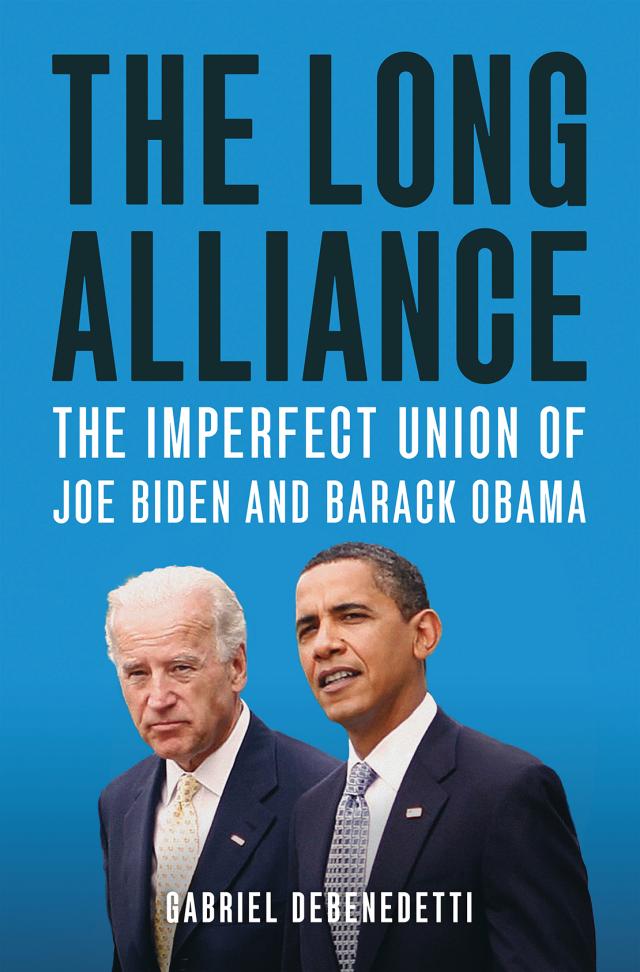
The Long Alliance, page 46


What unsettled Obama, though, was how unavailable one way out of this—focusing on obstreperous Republicans—appeared to be. It was eye-opening how little anyone seemed to care, now that Republican leaders weren’t even pretending to want to compromise on most of what Biden was proposing. This was simply an assumed feature of Washington now. Biden once liked to point out that McConnell had given a tribute to him on the Senate floor about their mutual trust before Biden left the vice presidency, and had even named a cancer research funding provision of a bill after Beau. Four months into Biden’s presidency, though, McConnell had said “one hundred percent of our focus is on stopping this new administration,” an echo of his 2010 pledge to ensure Obama served only one term, but with almost none of the ensuing uproar. There wasn’t much more outrage a few weeks later when John Barrasso, the third-ranking Republican senator, followed up. “McConnell came under a lot of criticism for saying at one point he wanted to make sure that Barack Obama was a one-term president,” he said. “I want to make Joe Biden a one-half-term president. And I want to do that by making sure they no longer have the House, Senate, and the White House.” This was just politics now. You couldn’t really blame Biden for focusing so much on his own party, even when he obviously wanted to keep crossing the aisle, just like he had his whole career.
* * *
After all this time, Biden wasn’t sure if he’d ever quite get used to the trappings of the White House. He loved being president, of course, but he felt self-conscious being waited on so attentively and confined without the ability to roam freely or to easily sit outside. He immediately decided he’d continue his senatorial and vice presidential practice of going home to Wilmington, or to the beach, or, he supposed, to Camp David, most weekends.
His daily life in the office would look little like Obama’s, even if the political patterns were repeating themselves. He took to starting his mornings slightly later, after catching up on the CNN and MSNBC breakfast shows Obama dismissed as insider babble, and to calling aides until later into the night. He preferred a constant stream of advice and debate from an only-slightly-expanded version of his longtime inner circle to the silence Obama often wanted after hours.
Biden relied less obviously on his vice president, too, though internally this was not as dramatic a shock as the dire news coverage that Harris received in her first year made it seem. More conscious than anyone of the VP’s positioning, from the first day of their tenure Biden made sure the White House’s official communications included Harris’s name, and he made a practice of ensuring she got to speak before him at major events. He tried giving her more explicit assignments early on than he’d had, telling her, for example, that when he assigned her the task of tackling the root causes of migration surges from Central American nations that it meant a lot to him, since he’d worked on the matter himself for Obama. And he appreciated that she wasn’t just blindly following his example—she’d had her own conversation with Mondale about the job shortly before he died in April, and she was sitting for weekly meetings with Klain, now the White House chief of staff, to try to keep herself integrated in the West Wing’s operations. She also approached her weekly lunches with Biden as more of a working meeting than he had with Obama; she used one of them to ask for the administration’s voting rights portfolio.
Yet mistrust lingered between some of their aides and they were slower to become genuine friends, in part because it took both longer to adapt to the pressures of their offices and partially because of the even bigger gap in age and experiences. Her assignments were unforgiving, too—progress on voting rights reform was slow, and Central American violence and corruption wasn’t going anywhere anytime soon—and she both found it hard to penetrate Biden’s brain trust at times and didn’t offer him the same immediate experience he’d been able to provide for Obama. As a result, she wasn’t as strategically vital to winning votes, which he thought of as a central part of the job after his own tenure. Yet he insisted she remain the final person in the room with him for big decisions—that was real—even when he was convinced he already knew exactly what he was doing.
This was often when it came to negotiating with lawmakers, a task he predictably gravitated to with far more relish than his old boss had, inviting a parade of Democrats by his new digs to talk strategy. When Jon Tester came through in February, the Montana senator grew emotional, never having been in the Oval Office before, which some people around Biden thought revealed plenty about Obama’s style, considering how politically important Tester was. This was still little help with Manchin and Sinema, though. The negotiations over Biden’s agenda dragged on until he split his proposal into one infrastructure bill that would get wide support and another, bigger plan that would take longer and need whittling down thanks to Manchin’s souring relationship with Biden and Klain. They eventually pegged him as unreasonable, and risked tanking the entire social spending agenda by releasing a furious statement about Manchin when the West Virginian kept expressing doubts.
It was a measure of just how high Biden had set the expectations for his presidency that when he did succeed in signing a years-in-the-making $1 trillion infrastructure law in November 2021, even winning Republican votes in the process, his public image barely budged. Many Americans no longer thought they felt the effects of his initial recovery bill and they gave him no bump for the post-lockdown economic rebound. Neither did he get credit for ending the “forever war” in Afghanistan, or, a year on, for ridding them of Trump. Like Obama had, Biden felt too besieged by the world to spend enough time selling his accomplishments, though he knew he should.
Within a few days of moving into the White House, Biden started confiding to friends that he felt a heavy sense of history following him around the building at all times. This only added to the urgency he’d been feeling since winning the Democratic nomination, a tension he insisted had everything to do with the country’s dire circumstances and nothing to do—as some of his longtime allies nonetheless suspected—with his age and a tacit acknowledgment that he’d waited long enough to make big decisions. This didn’t mean he suddenly learned to make choices quickly, rather that he weighed them that much more carefully and agonizingly, and that he had less patience for the kind of rambling and hobnobbing he once loved. His phone calls with friends were getting shorter and more abrupt, his briefings with policy experts dragging on longer.
Obama started to feel something similar as Biden’s first year as president progressed, but the mood expressed itself more soberly around the ex-president. Both were now thinking less of immediate news cycles and more about the meaning of their legacy and their shared political era. Yet as Obama thought more about the long arc of progress that he often mentioned, the weight of evidence sometimes made it look like it was forbiddingly long and far from bending. He resolved to focus only on the most tectonic of threats these days, reconnecting both with tech industry leaders to consider what their field’s role could be in combating disinformation—he gathered some of them to discuss this issue in Palo Alto in June 2021—and with climate experts to insist on America’s seriousness about the globe’s future, no matter how dismissively Trump had treated it. He made a rare appearance at that November’s international climate conference in Glasgow to make that case.
Back home, though, Obama’s thoughts on the state of the world rarely strayed far from his immediate successor and his antidemocratic threat with Trump remaining in the political picture and keeping the Republican Party wrapped around his finger. Obama calculated, thus, that while he still had no interest in getting involved in daily politics again, lending a loud voice in favor of the voting rights push could only help. He started over the summer, arguing in his first Biden-era appearances for Holder’s redistricting-focused group that passing legislation to protect voting rights should be obvious and a matter of basic American values. He found himself saying things that he didn’t think would need to be said out loud in 2021, they felt so obvious: “As bad as January 6 was, if we had to repeat in future elections, in which, let’s say, the Republican-controlled Pennsylvania legislature decided ‘We’re not going to certify all those votes coming out of Philadelphia because we think that those urban votes are shady,’ imagine what would have happened. We would have had a worse constitutional crisis than we did,” he said at a fundraiser with Pelosi for the organization. If they didn’t change the laws to protect against such manipulations, he continued, “We are going to see a further delegitimizing of our democracy, and not only are we going to see more unfairness in terms of results and who is represented and who isn’t, but we are going to see a breakdown of the basic agreement.”
The fight, in other words, was epochal. Slowly it seemed Biden was coming to agree that this was the horrid outgrowth of the battle he’d waged in 2020—when he’d put it in almost Manichean terms—and that he must address the matter of voting access and election protection after months of pressure from civil rights leaders. He had a closing window to make a politically viable push on the matter before midterm season arrived. There was, however, no realistic way to pass as sweeping a law as he wanted with any Republican votes, which meant he’d need to finally call for the abolition of the sixty-vote filibuster rule on voting legislation so Democrats could pass it themselves. To make the case, he finally directly engaged with the threat of Trump, something he’d avoided doing for a year to fulfill his promise of restoring some degree of normalcy.
On the one-year anniversary of the January 6 attack, Biden visited the Capitol to insist Trump and his associates still held “a dagger at the throat of America” with their comportment over the past year. “The former president of the United States of America has created and spread a web of lies about the 2020 election. He’s done so because he values power over principle, because he sees his own interest as more important than the country’s interest and America’s interest, and because his bruised ego matters more to him than our democracy or our Constitution. He can’t accept he lost.” Less than a week later, he laid out the specifics in Atlanta, arguing for the removal of the filibuster on voting bills before challenging lawmakers: “Do you want to be on the side of Dr. King or George Wallace? Do you want to be on the side of John Lewis or Bull Connor? Do you want to be on the side of Abraham Lincoln or Jefferson Davis?”
But just two days later, as Biden prepared to make his case one more time, Sinema refused to go along with the plan, effectively killing it. He insisted he was undeterred. But it would not have been completely unfair to ask what, at this point, there was left for him to do aside from pivoting to unilateral but perhaps impermanent executive actions, given his political constraints and capabilities.
* * *
The presidency, as a general rule, is not a particularly productive venue for introspection, coming as it does with all the pressures in the world. It does, however, force all of its responsible occupants to reconsider their priorities, theories of effecting change, and conceptions of their role in the country’s broadest arc.
One year into his administration, fourteen years into his partnership with Obama, and forty-nine years into his life in Washington, Biden had contemplated all of the above, and appeared to have encountered a series of familiar walls. The fully polarized end of 2021 and beginning of 2022 were testing the outer bounds of the office and his own political abilities, his triumphant rescuing of the republic from Trump and his hyperproductive first sprint meeting a cynical opposition and a skeptical public unwilling to be won over by his brand of persuasion. The 2022 midterms looked like they offered little hope of a Democratic revival to change any of this; the question of whether Biden, at eighty-one, would run for reelection in 2024—possibly against Trump—loomed over his every move, even as he insisted he would.
Discouragement, thus, might seem to be an obvious response from both the commander in chief and his longtime partner. Obama especially seemed prone to moments of gloom. For years, it had seemed that Obama’s tenure represented the soul of a new political era, a post-Reagan age inching toward progress, interconnectedness, and liberal-minded mutual understanding around the world. But the Trump experience also made it easier to view the recent years as the dawn and maturation of a darker time typified by greed, mistrust, and fractured information ecosystems.
Yet neither the forty-fourth nor the forty-sixth president ever let himself go all the way down that road, both of their political philosophies still rooted in the necessity of long-term optimism even after all of the forty-fifth’s work to destabilize it.
Obama, in the end, had never gone terribly far. He was happy to live in semiretirement, only evaluating the new administration from a distance when he wanted to. But he still sometimes heard from Klain, occasionally as often as every two or three weeks, with asks for advice, White House progress reports, and requests for favors. He was a general advisor, not quite monitoring Biden’s government like a big brother but at times offering help and certainly making his presence felt when he felt like it.
And privately, quietly, without almost anyone knowing, Obama and Biden started calling each other again just about as often.
The conversations were as much political therapy as they were about specific counsel. The chats could be anchors for the president, privileged above his phone calls from anyone else, and reflective moments for his old boss, a solemn responsibility and opportunity to hold the ear of the leader of the free world on anything from Afghanistan to Republicans to voting regulations. They were not always happy catch-ups, or especially nostalgic. Biden didn’t have time for that, though he could make it if he wanted.
But whenever they hung up, it was clear to everyone around both of them that it wasn’t an ordinary call. Each had just spoken with the only other person who could possibly begin to understand.
A NOTE ON SOURCES
This book is primarily the product of hundreds of interviews conducted over the course of 2021 with an array of people who shared with me their firsthand knowledge of, and experience with, the nearly two-decade relationship depicted in these pages. To portray the fullest possible picture, I spoke with colleagues, aides, rivals, confidants, allies, and eyewitnesses from every stage of the presidents’ careers since 2003. Contemporary notes, private correspondences, and campaign files provided by these sources were indispensable, as were publicly available (if sometimes byzantine) government records and newspaper archives.
As indicated in the notes, at times I also relied on the memoirs of actors in the narrative, and occasionally on previously published reported accounts—some of which are invaluable resources if you want to comprehensively understand specific sagas that this book only briefly unwinds through the relatively focused lens of the Biden-Obama interactions. The following stand out: Samantha Power’s The Education of an Idealist (2019), Susan Rice’s Tough Love (2019), Robert Gates’s Duty (2014), and Ben Rhodes’s The World as It Is (2018) for their illumination of impor-tant personalities, internal dynamics, and thought processes in the Obama administration, and Mark Gitenstein’s Matters of Principle (1992) for its detailed reconstruction of Biden’s formative 1987 experiences. Richard Ben Cramer’s classic What It Takes (1992) is also essential for its depiction of Biden at that time. Biden’s own book about the year of Beau’s death, Promise Me, Dad (2017), lays out valuable and underappreciated details of his consideration of the 2016 election. David Mendell’s Obama (2007) offers a rare view of the man as a Senate candidate, Bob Woodward’s Obama’s Wars (2010) painstakingly reconstructs the debates over the war in Afghanistan, Sasha Issenberg’s The Engagement (2021) is unparalleled in its excavation of the administration’s “evolution” on marriage equality (and on the matter more broadly), and Jonathan Cohn’s The Ten Year War (2021) is exhaustive in its reconstruction of the fight to pass a universal health-care law. Finally, John Dickerson’s The Hardest Job in the World (2020), Joel K. Goldstein’s The White House Vice Presidency (2016), and Mark K. Updegrove’s Second Acts (2001) helped shape my understanding of the jobs Obama and Biden have occupied.
The majority of the interviews for this book were conducted using “background” or “deep background” ground rules, usually meaning I could write about the material shared but not attribute it directly to its source. Of course, memory can be fickle, especially when the topic is ten or more years in the past. And politicians can have strategically convenient memories. Whenever possible I have verified facts, stories, exchanges, and context with multiple people who have personal experience with them, and if I’ve quoted something directly then it is publicly discoverable or I have unearthed the words from someone with direct knowledge of them. When someone’s words are rendered in italics, that indicates an approximation based on the memories of sources who did not recall exact wordings.
Neither President Biden nor President Obama agreed to speak with me for this book, but I have tried to re-create their decisions, motivations, beliefs, hopes, and concerns to the most precise and most intimate degree possible using the extensive recollections of their many associates. These people were tremendously generous with their time and memories for the benefit of the historical record and readers’ understanding of the modern presidency.
NOTES
The page numbers for the notes that appeared in the print version of this title are not in your e-book. Please use the search function on your e-reading device to search for the relevant passages documented or discussed.
Epigraphs
“A vice president is totally a reflection”: Julyssa Lopez, “Joe Biden and Walter Mondale Discuss ‘New Modern Vice Presidency,’” GW Today, October 21, 2015, https://gwtoday.gwu.edu/joe-biden-and-walter-mondale-discuss-%E2%80%98new-modern-vice-presidency%E2%80%99.


