

Starling House, page 34


Arthur looks into her eyes—that dangerous gray, sharp and bright as a sickle moon—and she looks into his, and their breathing falls into an easy rhythm. She doesn’t say anything, but Arthur finds she doesn’t have to. He’s already spinning wild stories in his head, an extravagance of dreams: Starling House in bloom, the gates thrown wide; the sword forgotten in the attic, the blade rusted and idle; the two of them like this, curled together in an endless dusk, with nothing to die for and everything to keep living for.
The grass grows high around them. Flowers bloom all out of season, tiger lilies knocking gently against cornflowers, scarlet knots of clover wrapped around bursts of tickseed. They bend gracefully in the breeze, brushing over Opal’s shoulders, her hair, the hard line of her jaw. Arthur thinks there are things moving around them—Beasts, maybe, except their bodies are sleek and lovely, and they leave flowers where they step, instead of rot—but he can’t seem to care.
He watches Opal’s eyes drift slowly closed. He remembers how very tired he is, how long it’s been since he wasn’t tired.
Arthur Starling sleeps, and dreams good dreams.
EPILOGUE
This is the story of Starling House.
There are lots of stories about that house, of course. You’ve heard most of them. The one about the mad widow and her poor husband. The one about the miners who broke into Hell and the monsters at the center of a maze. You’ve even heard the one about the three bad men and the little girl who gave them their comeuppance, although nobody tells that one, not yet. (They will, I swear they will. I’ve broken a lot of promises, but not this one.)
This story is my favorite, because it’s the only one with a happy ending.
It usually starts when somebody mentions the power plant, or the fire last summer. Remember that night back in June, they say. First the motel burns, then the dam breaks.
Somebody else might mention the wreck by the old railroad bridge, or the string of out-of-towners that wound up in the hospital with strange injuries, or the way their dogs stared into the mist with their hackles high, not quite daring to bark.
Bad luck, I guess, someone says, and everybody nods, just like always.
Except it seemed like Eden’s bad luck was all used up in that single night. There was a bad spell right after, of course, and everybody worried about jobs. The ash pond flooded the power plant and took out the lights all the way to Nashville. They said you could see it from the International Space Station, a black stripe cut right out of the country.
But FEMA showed up quick enough, and power got diverted from someplace else. For a week or two the whole county was covered in government officials wearing plasticky suits, collecting groundwater samples, but when the tests came back they said it wasn’t as bad as it could’ve been. They said most of the spill flowed downhill and settled in a low spot. Big Jack, still hard at work, people said.
The out-of-towners got discharged from the county hospital and climbed into their sleek cars. They drove north, their expressions haunted but strangely vacant, as if they didn’t know what they were driving away from but didn’t dare slow down.
The mist rose once or twice more that summer, but it didn’t linger as long, and it didn’t leave new patches of rot and tragedy behind it. People said it smelled sweet, like wisteria, and left flowers blooming behind it. A woman on Riverside Road said she opened her kitchen door and found a luna moth stuck to the screen. She took a picture and showed anyone who asked and several who didn’t. Everyone leaned over her screen and admired it dutifully, the size of it, the pale green of the wings, like fox fire on a dark night.
Don Gravely gave a big interview to The Courier-Journal in July, assuring everyone that the expansion plans were still underway, that they would rebuild stronger and bigger than ever. Except in that very same issue there was an article about a lawsuit being brought against Gravely Power and a newly discovered will. That librarian woman from the eastern side of the state found it tucked in a Bible, Luke 15:32, in Leon Gravely’s own handwriting. Turned out Old Leon hadn’t willed the company and family fortune to his brother, after all, but to that no-good daughter of his. She was long gone, drowned on another one of those bad-luck nights, but her children were still living.
Except nobody could find them. The boy—what was his name? Jason? Jackson?—was rumored to be up in Louisville now, but his sister couldn’t be found. The woman who used to run the Garden of Eden Motel went around the whole town, banging on doors and having herself a good yell at anybody that held still long enough, but nobody’d seen Opal since that night. The constable told the former owner of the Garden of Eden Motel, as kindly as he could, that girls like that never came to good ends, and the former owner of the Garden of Eden invited him to say that again, louder. The constable declined.
Some people said the motel owner even went up to the Starling place and rattled the gates, hollering, but no one answered. She kicked the groceries that were piled at the end of the drive, spraying curdled milk across the road, and left.
Nobody had picked up the groceries in weeks, and the store manager finally stopped delivering them. The rumor was that the Starling boy ran off the night of the fire and the flood, disappeared or maybe died. No one could say for sure, but it was true that there were no more lights seen flickering through the trees.
The house sat still and empty all that summer. Shingles littered the lawn, and the grass grew lavishly long, lying over itself in deep green drifts. Wildflowers straggled over the walls, wild roses and blackberries.
There was some talk about deeds and property rights. Don Gravely kept trying to bully the county surveyor out there, but the surveyor told Don he wasn’t paid enough to set foot on Starling land and that Don no longer had enough money to bribe him, which was perfectly true. With the plant closed and the family accounts all tied up in court because that librarian just would not let the case go, Don was starting to fall behind on his accounts. The mailman reported the delivery of several bills with pink paper visible through the plastic window. People said it was only a matter of time before a Realtor hung their sign up on the front lawn of the big brand-new house.
But by early fall even regular people were starting to wonder about the Starling place. As the leaves shriveled you could make out little slices of the house through the bare branches, and what you saw didn’t look good. The walls were leaning funny, slanting inward, so that it looked like the only thing keeping Starling House upright was wisteria. The county administrator began to mutter about health hazards and seizure rights. The older folks in town told him to hold his horses, that a new Starling always turned up at these times.
No one did. But one night at the end of September, right when summer finally starts showing signs of wear and the occasional dry breeze goes rattling through the woods, there was a light seen at Starling House. A high round window, shining like polished amber through the trees.
Some time after that the front door opened, and two people stepped out. They were looking up at the September sky like they’d woken from a very long sleep and weren’t sure whether they were still dreaming. There was a cat twining quite shamelessly around their ankles, and they were holding hands.
Nobody else will tell you this next part, but I will.
One of the people—a tall, hunched-up man with scraggling hair and a face like a sickly vulture—looked up at the big, ruined house and said, I’m sorry. And then, I know you always wanted a home.
The other person, a girl with red hair and a mean smile, said, Yeah, and I found one.
The man said he was sorry again. (He says that often.)
The girl nudged him in the ribs, good and hard, but she didn’t let go of his hand. She said, I wasn’t talking about the house, fool. She was looking at the ugly man as she said it.
A tiny indentation that might have been a dimple appeared in the man’s jaw. He bent to stroke the cat, which bit him.
They keep to themselves, mostly. The gates open every now and then, and certain people go in or out. A pair of middle-aged women, arms slung over one another’s shoulders. A boy with glossy black curls and a backpack full of expensive cameras and fancy lenses. A whole stream of lawyers and contractors, followed by a few pickups full of lumber and stone, chalky sheets of drywall, bags of concrete.
Those two must have all the deeds and rights in order, people think. They must have money to burn, people say, although they aren’t entirely clear on where it came from. All they know is that Starling House would not rot away after all. No one can say whether they’re sorry or not.
The house is an awful thing, of course, but it’s a familiar awful thing, and it’s nice to have new Starlings to gossip about. Don’t understand what they do up there all day, people say, in tones that suggest it isn’t anything good. There are plenty of theories, suppositions, lewd suggestions, and wild rumors. A few of the theories (and all of the lewd suggestions) are perfectly true, but none of them are the whole truth.
Most people conclude, somewhat mysteriously, that they’re writing a book. The hairdresser heard it was a romance, and the old meter man is hoping for horror. A member of the Historical Society claims it’s a history of the town—that one of their very own founding members is fact-checking it, in the form of footnotes and a bibliography—but that’s dismissed as typical hubris.
Whatever it is, it must be illustrated. Several people have seen the young man on the banks of the Mud River with a sketchbook propped on his overlong legs, sketching in subtle grays and stark whites, a hundred shades of velvet black. A children’s book, then, people say, but there’s only one children’s book they know of that has pictures like that.
Lacey, the new manager at Tractor Supply, claims she’s exchanged texts with the redheaded girl (who does look a bit like the young Gravely girl, it must be admitted, although nobody remembers Opal smiling unless she was committing a crime). Lacey says she asked what they were working on, and Opal said, a story.
what kind of story?
a true one
Lacey found this intentionally obscure, but she was a bighearted person who had always hoped for the best for Opal, so she offered her thoughts and prayers. Opal stopped responding, and eventually the gossip got old and people stopped talking so much about Starling House.
In spring the sycamores bud out and the honeysuckle goes green, so that you can’t even see the house from the road anymore. Just the wrought-iron gates and the long red lick of the drive, maybe a glimpse of limestone crosshatched by honeysuckle and greenbriers.
But there are still the dreams, sometimes. You should be afraid—there are stories about this house, and you’ve heard all of them—but in the dream you don’t hesitate.
In the dream, you’re home.
BIBLIOGRAPHY
Bond, Gemma. Witches, Devils, and Haints: Kentucky’s Haunted History. Lexington, KY: University Press of Kentucky, 2015.
Boone, Calliope. Interview by Charlotte Tucker, July 14, 2016. Interview 13A, transcript and recording, Muhlenberg County Historical Society Archives.
Hagerman, Eileen Michelle. “Water, Workers, and Wealth: How ‘Old Gravely’s’ Coal Barge Stripped Kentucky’s Green River Valley.” The Register of the Kentucky Historical Society 115, no. 2 (2017): 183–221. http://www.jstor.org/stable/44981141.
Higgins, Lyle. Interview by Charlotte Tucker, July 04, 2018. Interview 19A, transcript and recording, Muhlenberg County Historical Society Archives.
hooks, bell. Belonging: A Culture of Place. New York, NY: Routledge, 2009.
Joseph, A. Problems in Paradise: An Environmental History of Kentucky. Chicago: The University of Chicago Press, 2002.
Murray, Robert K., and Roger W. Brucker. Trapped!: The Story of Willy Floyd. Lexington: University Press of Kentucky, 1999.
Olwen, T. and C. Olwen. “E. Starling: Recluse or Revenant?” April 24, 2017, in Bluegrass Mysteries, podcast (Season 2, Episode 1).
Rothert, Otto Arthur. A History of Muhlenberg County: With More than 200 Illustrations and a Complete Index. 1st ed. Louisville, Kentucky: John P. Morton, 1913.
Simmons, Bitsy. Interview by Charlotte Tucker, October 10, 2015. Interview 12B, transcript and recording, Muhlenberg County Historical Society Archives.
Starlings, The. Starling House Record of Incidents, from the private collection of Opal and Arthur Starling.
Winter, E. The Beasts We Could Not Bury: Sin and the Southern Gothic. Chapel Hill, NC: University of North Carolina Press, 2003.
ACKNOWLEDGMENTS
This is the story of Starling House.
It started as a dream, like most houses do. I still lived in Kentucky at the time, but I was getting ready to leave: scrolling real estate sites, boxing up old baby clothes, trying to brainwash our friends into coming with us. I’d left home before—again and again, actually—so the dream I had was a familiar one: that I found a way to stay.
Dreams don’t grow into houses (or books) without the time, talent, labor, love, patience, and sheer will of dozens of people. The unfair thing is that, if they do their work well, it’s mostly invisible by the time guests arrive.
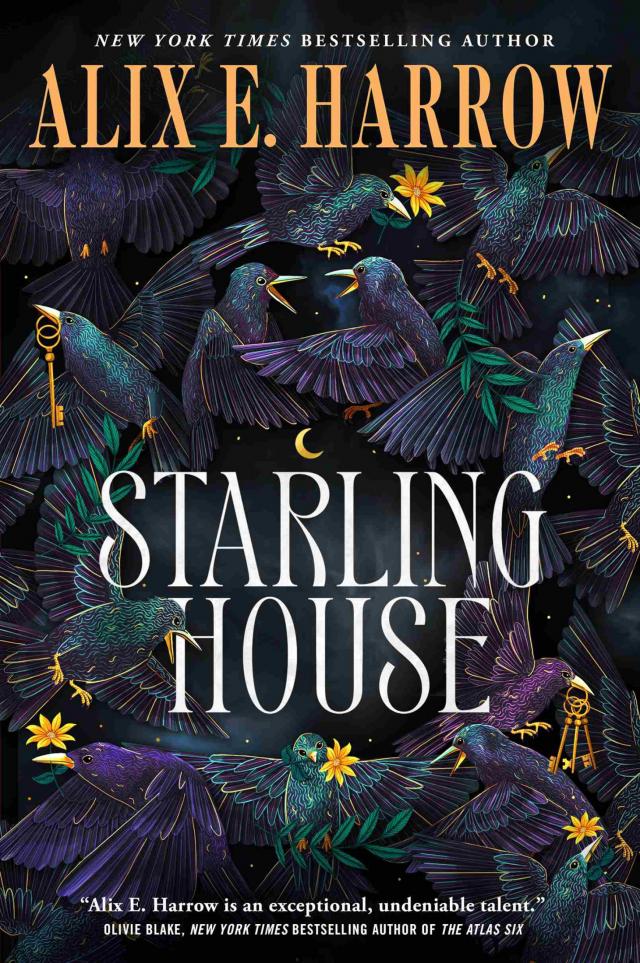
I am grateful to my agent, Kate McKean, who saw the blueprints for this book and not only didn’t burn them, but found the perfect place to start building. To my editor, Miriam Weinberg, who walked through during construction and wondered aloud if we really needed four bedrooms (we did not). To Dr. Rose Buckelew, for her inspection of an early draft, and Dr. Natalie Aviles, for connecting us. To the entire production team—Terry McGarry, Dakota Griffin, Rafal Gibek, Steven Bucsok, Lauren Hougen, and Sam Dauer—who patched all the holes and asked, politely, if I meant to put two kitchen sinks right next to each other. To Isa Caban, Sarah Reidy, and Giselle Gonzalez, the marketing and publicity divinities who are the only reason any of you are here. To the cover artist, Micaela Alcaino, and designer, Peter Lutjen, who made this place something worth seeing, and to the legendary Rovina Cai, who graciously hung her work on the walls. And extra thanks to Tessa Villanueva, editorial assistant, without whom I wouldn’t even know who to thank.
I am grateful, too, for my friends, even though sometimes they asked how the book was coming—Taye and Camille, Sarah and Alli, Corrie and José—and for their beautiful babies, who never did. To the Kentucky writers who still speak to me even though I moved outside the Ale-8 delivery region: Gwenda, Christopher, Lee, Olivia, Sam, Ashley, Z, Alex, Caroline, and Ellie. And to the bunker, which sounds like a doomsday cult but is actually a Discord server.
And I could never have written this book—or any book, really—without my family. My dad, who gave me my grandfather’s toolbox when I was sixteen and took me to see Prine when I was seventeen, and my mom, who read every version of “Beauty and the Beast” with me. I know I moved away from home, but I see you both every day in the mirror.
My brothers, who never needed me half as much as I need them. Finn, who would stand bravely before the beasts, and Felix, who would befriend them.
And Nick, who is my house and hearth, my foundation and my four walls. I haven’t been homesick since the day we met, my love.
ALSO BY ALIX E. HARROW
FRACTURED FABLES
A Spindle Splintered
A Mirror Mended
The Ten Thousand Doors of January
The Once and Future Witches
ABOUT THE AUTHOR
ALIX E. HARROW is the Hugo Award–winning author of The Ten Thousand Doors of January, The Once and Future Witches, and various short fiction, including the Fractured Fables novellas. A former academic, adjunct, and Kentuckian, Harrow now lives in Virginia with her husband and their two semi-feral kids. You can sign up for email updates here.
alixeharrow.wixsite.com/author
Instagram: @alix.e.harrow
Thank you for buying this
Tom Doherty Associates ebook.
To receive special offers, bonus content,
and info on new releases and other great reads,
sign up for our newsletters.
Or visit us online at
us.macmillan.com/newslettersignup
For email updates on the author, click here.
CONTENTS
Title Page
Copyright Notice
Dedication
Chapter One
Chapter Two
Chapter Three
Chapter Four
Chapter Five
Chapter Six
Chapter Seven
Chapter Eight
Chapter Nine
Chapter Ten
Chapter Eleven
Chapter Twelve
Chapter Thirteen
Chapter Fourteen
Chapter Fifteen
Chapter Sixteen
Chapter Seventeen
Chapter Eighteen
Chapter Nineteen
Chapter Twenty
Chapter Twenty-One
Chapter Twenty-Two
Chapter Twenty-Three
Chapter Twenty-Four
Chapter Twenty-Five
Chapter Twenty-Six
Chapter Twenty-Seven
Chapter Twenty-Eight
Chapter Twenty-Nine
Chapter Thirty
Chapter Thirty-One
Chapter Thirty-Two
Epilogue
Bibliography
Acknowledgments
Also by Alix E. Harrow
About the Author
Copyright
This is a work of fiction. All of the characters, organizations, and events portrayed in this novel are either products of the author’s imagination or are used fictitiously.
STARLING HOUSE
Copyright © 2023 by Alix E. Harrow
All rights reserved.
Cover art and design by Micaela Alcaino
Interior illustrations by Rovina Cai
A Tor Book
Published by Tom Doherty Associates / Tor Publishing Group


