

Starling House, page 31
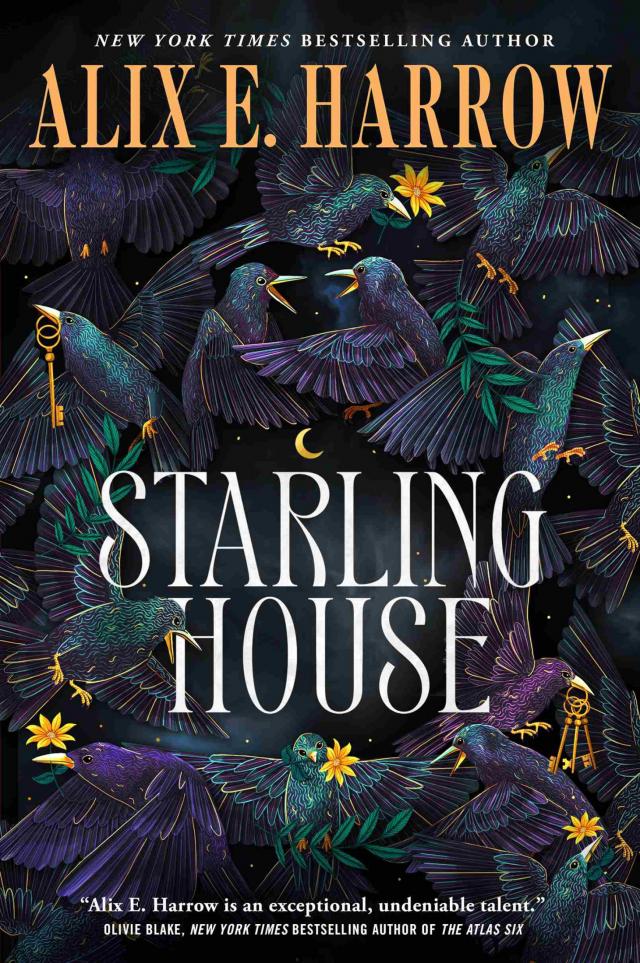


I was born in the spring of 1851. She named me Eleanor, after herself, and never spoke our surname aloud.
My mother died young—a cancer, the doctors said, but I think it was bitterness—and the courts sent me to live with my only living relation. I took the train to Bowling Green and a flatboat to Eden. My father had never seen me before, so he stood on the shore while the passengers stepped off the ramp. Every time a young woman passed by he asked: Eleanor Gravely? It was the first time I heard my own name spoken aloud.
My father lived well off my mother’s money. He and his two younger brothers—my uncles—had started their own company, Gravely Brothers Coal & Power, and now they owned a few hundred acres, a dozen men, five black songbirds imported from Europe, and a big white house on the hill. I thought at first I might make a tolerable life in that house—might spend my days sewing and reading, teaching new songs to the birds—but my uncles and my father were bad, bad men.
(You want to know more. You want every miserable, gruesome, ordinary detail. But surely you can imagine the sorts of sins that hide under the word “bad,” like grubs beneath a stone. Surely the precise shape of the wounds doesn’t matter as much as how much they hurt, and whose hands dealt them.)
They were bad men, and they grew worse as the war worsened and the coal ran dry. They burned through their own profits and dug deep into my mother’s coffers. They drank more and slept less. They came to resent every bite of food I ate at their table, every stale crust I slipped into the birdcage, and they punished me for it.
My father was the worst of them, if only because he was the oldest, and had six more years of practice in cruelty. I took to sleeping as many hours as I could, wrapping myself in dreams of teeth and blood, blades and arsenic. I was sleeping when my uncle came to tell me my father had drowned.
I didn’t do it. Half the town suspected me, and I almost wish they were right—I assure you he deserved it—but the other half of Eden blamed the miners. The mist had risen that night, and when it cleared my father was dead, and there were no more slaves in Eden.
I did not mourn my father, of course. My uncle John stood beside me at the graveside, twisting the flesh at the backs of my arms so viciously it was purple and green the following morning, but I refused to shed a single tear for him. Maybe that’s when the rumors began, about that cold, strange Gravely girl. I heard she killed him, they whispered. I heard she only smiled once, when the first shovel of dirt hit her father’s coffin lid.
If I had been smiling, I soon stopped. In the absence of a will I inherited my father’s remaining fortune, which had belonged first to my mother, and should have belonged to me. But, as I was not yet of age, my circumstances changed very little except that my guardianship transferred from one bad man to another.
John Gravely was the second-oldest brother, and the second-meanest. I thought I might at least survive him, but slowly I became aware that he was watching me more closely than he used to. He studied me as if I were a difficult equation that needed solving. He asked me twice when my birthday was, and drummed his fingers restlessly on the table each time I answered.
That night I counted on my fingers and realized I would turn eighteen in twenty-three days. And on that date my money would be my own, and my uncles would have nothing but a few failing mines, a filthy birdcage, and a wealthy niece who no longer belonged to them. I was a songbird in a den of foxes, and they were so hungry.
I thought he might poison me, or drown me. I thought he might lock me away until I signed everything over to him and his brother, or have me shipped off to an asylum. He wouldn’t even have had to bribe the physicians; I was quite unwell by then. I chewed at my own lips until they scabbed. I never brushed my hair. I no longer sang to the little black birds, but only spoke to them in hoarse, mad whispers. I slept and slept, because even nightmares were preferable to reality.
My uncle John did not poison me or lock me up. He came to a different solution, one which I berated myself for failing to anticipate. It was, after all, the same solution that occurred to my father when he met my mother. He was a poor man and a bad one, and she was a wealthy woman and a weak one; what could be easier, or more obvious?
But, at seventeen, I must still have possessed some childish, idiot faith in the rules of society. Yes, they were bad men. Yes, I had heard the weeping from the mines and seen my uncles return from the cabins late at night. But that was different, that was allowed. I was a young white woman of good breeding, and I still believed there were some lines they would not cross.
So when my uncle John summoned me to breakfast one morning and told me I was not to call him Uncle any longer, I didn’t understand. He picked up my left hand and shoved a cheap tin ring on my second-smallest finger, and I still didn’t understand. I felt heavy and strange, as if I was sleeping. I looked at my uncle Robert, the youngest and least cruel of the Gravely men, and saw the look of faint disgust on his face, and only then did I understand.
Our engagement was announced in three separate papers. My name was listed differently in each one. Eleanor Grand, Eleanor Gallows, Eleanor Gaunt. Perhaps my uncles thought it would help people convince themselves they’d heard my name wrong. That girl was never a Gravely, they could tell themselves. She must have been a foundling, an orphan, some stranger we let into our midst.
Because that’s what they did, of course. They didn’t march up to our big white house and drag my uncle John into the streets. They didn’t damn him or castigate him or even take away his place in the first pew at church. They simply told themselves a different story, one that was easier to believe because they’d heard it before: Once there was a bad woman who ruined a good man. Once there was a witch who cursed a village. Once there was an odd, ugly girl whom everyone hated, because it was safe to hate her.
I kept waiting for someone to object, but the most I got was a pitying glance from the neighbors’ maid, an awkward grimace from my uncle Robert. Everyone else drew away from me, like hands from a hot coal. They averted their eyes from evil and, in so doing, became complicit in it. I watched my uncles’ sin spread over the town like night falling, and finally understood that no one was going to save me.
So, on the morning of my wedding, I took my father’s birdcage into the woods behind Gravely Manor and opened the door. A rush of iridescent feathers and clever black eyes, a few piercing trills, and they were gone. I didn’t know if they’d survive out in the wild, but I’d grown too fond of them to leave them alone with my uncles.
I chose two stones, smooth and heavy, and slipped them into my skirt pockets. Then I walked down to the riverside.
I would have done it, if I hadn’t met the boatman. A hare, I called him later, because he had a sly, sideways manner of regarding a person. He stopped me, and then he listened to me, and then he gave me an even greater gift: he told me how my father died. He told me Hell was real, and so were its demons.
I did not walk into the river that day, after all. I went back to the big white house on the hill and let them dress me in white lace and ribbons. I let my uncle Robert walk me down the aisle of the empty church. I could not make myself say the words, but I let my new husband kiss me, his lips damp and thin.
I don’t remember the rest of the day, but I remember the light changing: noon to dusk, dusk to twilight, twilight to night. My uncle John stood up from the dinner table and held out his hand, as if I would take it, as if I would follow him to his bed like a sow to slaughter.
I ran. He followed.
He followed me to his own mine, and hesitated at the edge of the dark. I heard him calling after me, cajoling, pleading, cursing, demanding, but I did not stop. I went down, and down, and down.
I found the river. I drank the smallest sip, like the boatman told me, and fell into Underland. And there were the creatures from my nightmares, animals made of teeth and claws, fury and justice. They looked at me as if they’d been waiting for me. I wept with joy, with terror, with awful love. I told them about my uncle and showed them the ring on my finger, and they ran into the darkness. When they returned, their muzzles were wet and red. I wiped them clean with the muddy hem of my wedding dress. Then I slept, at peace.
I woke up at the bottom of the river. I crawled to the shore, retching, coughing. I was too frightened to return to the mines—what if it had all been a lovely dream? what if my uncle was still alive, calling for me?—but the boatman had told me there was another way out. A natural cave that twisted up to a sinkhole on the north side of town. I didn’t know till later it was on Gravely land.
It was a hard climb back to the surface. By the time I saw the sun again my palms were raw and my dress was ragged. I crawled out into the dusking light and lay in the wet grass. I saw five birds cross the sky above me. All birds are black at that hour, but I decided they were my birds. Starlings, my father had called them, purchased only because he liked the look of caged things. But they were free now, and so was I.
They say I was laughing when they found me. I don’t recall. I don’t recall much of the court proceedings, either. All of it felt mystical to me, a series of rituals that led to my own metamorphosis. I had been a nameless little girl, and now I was a rich widow. I had been trapped, and now I was not.
I could have gone anywhere in the world, do you know that? I could have run away from Eden and lived off my mother’s stolen fortune until I forgot the sound of the river above and the taste of the river below. But I stayed. God help me, I stayed.
As my uncle’s widow, I had a claim on Gravely land. I let Uncle Robert skulk off with the more valuable half—the mines and the big house—but I kept the acreage on the north side of the river. They made out the deed to my married name first, but the sight of it sickened me, so I tore it up and had them write another. To my maiden name, I said. Eleanor Starling. The name tasted clean in my mouth.
I hired an architect as soon as the deed was signed. I’d never had a home, you see. My mother and I had moved from rented room to wayhouse, dodging rumors and surviving on what little my father left us, and the white house on the hill was merely a place I couldn’t leave. So I built myself everything I’d ever dreamed I would have: drawing rooms and ballrooms, libraries and parlors, hallways full of doors that only I could unlock.
It was more than a home, of course. It was a labyrinth, with the way to Underland at its heart, and high stone walls all around. I couldn’t tell you whether I was more terrified that someone would find their way down there, or that something would come crawling out. All I know is that I dreamed of the Beasts every night, their teeth stained with my uncle’s blood, and that I was often woken by the noises I made in my sleep. I could never tell if I’d been laughing or screaming.
I thought I would be happy there. I had a name and a home of my own, and enough money to keep both for as long as I lived. But instead I was a ghost haunting my own house. I wondered sometimes if I’d drowned that night, and just didn’t know it.
It was the loneliness, I think. The townsfolk hated me and kept hating me, with an intensity that comes from shame. The only company I had was my starlings, who bred and multiplied until they rose sometimes from the sycamores in great black clouds. I used to watch them from the attic window, the flock lifting and falling, writhing like a dark ribbon in the sky, and think of my poor Beasts trapped under the earth.
I was too frightened to go back into Underland and find them, but I loved them too well to leave. So I studied them. I had the twin privileges of time and money, and I poured them all into Underland. I ordered books on history and geography, mythology and monsters, folklore and fable. I taught myself Latin and puzzled through the Cherokee syllabary. I made charms and wards, forged four keys and a sword guided only by myth and mysticism. There was nothing in my library that precisely resembled Underland or the Beasts, but I saw their shadows in every tale of demons or monsters, every story about teeth waiting in the night.
Yet their origins eluded me. Where did they come from? How could I dream them before I even knew they existed? I wouldn’t understand until much later that they existed only because I dreamed them, that all my studies were merely a snake swallowing her own tail.
I began to draw in the evenings, dark, ugly sketches of a girl with dark, ugly dreams. I wrote my story down, softened a little, because I already knew no one cared for the hard facts of it. I don’t remember making a decision to publish it, but I remember sliding the prints into an envelope and mailing them north. Maybe I was a little proud of my work. Maybe I wanted to see my chosen name immortalized in print, to erase my given name like a wrong mark on a chalkboard. Maybe I simply wanted people to know the truth, even if they mistook it for a children’s book.
But no one wanted my story, even with its teeth pulled. The last piece of mail I received from my editor was a notice that they were turning my books back into pulp, to make room in the warehouses.
I was not surprised. My studies carried on as they always had, except I stopped drawing in the evenings.
I grew restless and strange over the years. I took to carrying the sword with me from room to room, as if I thought the Beasts might come for me at any hour of the day.
And then, one evening, one came knocking at my door. This Beast wore a suit and a wide smile, but I knew him too well to be fooled: the youngest Gravely brother, the last of my flesh and blood, come for me at last.
My uncle Robert informed me that the time had come for Gravely Brothers Coal & Power to pursue their claim to the mineral rights to my property. I’d gotten the fortune and the land, he said, but the company owned the coal.
I was not a frightened little girl anymore. I told him I would fight him tooth and nail before I let him touch my land.
And my uncle—the kindest of the Gravelys, the one who used to slip me extra crumbs for the birds, the one I had almost forgotten to fear—smiled at me. Then he told me all the things he could do to me, with nothing but a friendly drink and a firm handshake with the right person.
He could tell the sheriff he saw me murder his brothers in cold blood. He could tell the preacher I was a witch, practicing devilish magics. He could tell the judge I was mad and ought to be locked up.
They would all believe him. Can you imagine it? A world that bent to your every whim, where any story you chose to tell became the truth, simply because you said it?
I felt the floor thinning beneath my feet, the walls turning weak as damp paper. Everything I believed was mine, everything I suffered and killed for, would be taken away from me. My name, my house, my money, my safety.
No one would listen to me. No one would save me. I was damned, well and truly.
But I would take him down to Hell with me. I gave my uncle one final chance. I told him he could leave and swear never to speak of this again, or he could die like his brothers. His smile faltered, but just for a moment. It’s difficult for predators to imagine teeth closing around their own throats. They don’t have the right instincts.
As soon as he left I did three things in quick succession. First I drafted a small addition to The Underland and addressed it to my editor, in the event that a new edition was ever published. Second, I wrote a letter to the boatman. In all of Eden, he was the only one that did not deserve what came next.
Third, I dug the key from around the sycamore roots. I’d buried it years before, perhaps in an effort to avoid the awful temptation to go back to Underland. But hunger always wins, in the end.
I returned to the river deep below everything. I drank and drank and drank, so that I would sleep and never wake.
My Beasts were waiting for me. They were subtly changed, closer to the childish drawings from my book than my memory of them. I understood then that they were my own creations, born of my own desperate nightmares. I found I no longer feared them, but loved them as a mother would love her children, however monstrous.
I let them run in the world above sometimes. When I feel the mist rising off the water, when I sense a crack in the defenses of that damn house and its keepers. When I think of my father and my uncles and the sins they committed against me, and of the town that turned the other cheek instead of giving me an eye for an eye.
I thought Starling House was my home, but I was wrong. This place—where I am never alone, where no one can hurt me, where the truth is what I dream it—this is my home, and always will be.
THIRTY-ONE
Eleanor Starling tells her story, and I listen, and when it’s over I think, numbly: That was it. That was the story I’ve been chasing since I cut my hand on the gates of Starling House, since long before that—since the first night I dreamed of Starling House. I’ve found pieces of it, the details blurred by time, transmuted by each teller, but still legible. I can see them all now, truths and lies all lying one atop the other. The Gravely brothers, who were respected businessmen and enslavers and predators. Eden, which was a good little town and a terrible little town, full of good and terrible people. Eleanor, who was a frightened girl and a murderer and eventually a ghost that haunts us all still.
I thought finding this first, truest story would feel like snapping the last piece into a jigsaw. I thought I would feel satisfied, triumphant, maybe a little proud of myself. But now there’s a vicious, lonely little girl sitting in front of me, her eyes hard and accusatory, and all I feel is sorry.
So I say, inadequately, “I’m sorry.”
Eleanor’s gaze doesn’t falter. “They were, too.”
“Who?”
“Everyone!” The sudden vehemence sends me a half step backward. “The neighbors’ maid, the woman who brought eggs and milk every Tuesday, the preacher who married us and the judge who signed the papers. They looked at the tin ring on my finger and they were all so sorry, but what good did that do me?”


