

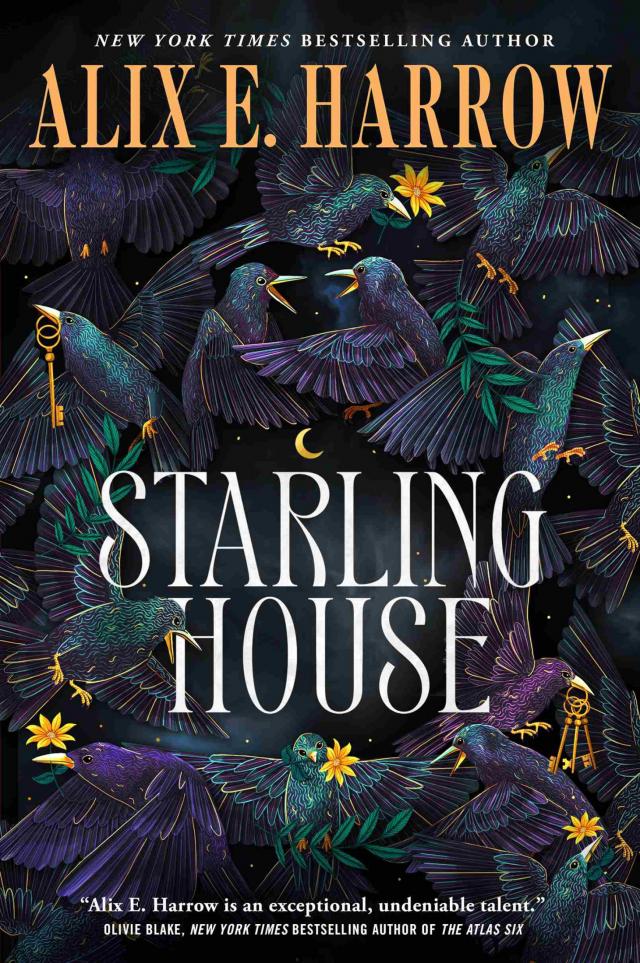
Starling House, page 26


He slides into the passenger seat with his backpack in his lap and I give him a thorough once-over, reassuring myself that he’s really here and whole, unhurt. I can still taste sour black smoke in the back of my throat, still see the gaping mouth where our door used to be.
“Hey,” Jasper says, gently, and I hit the gas rather than look at him.
Neither of us says anything for a while. Jasper rolls his window down and lets the wind un-comb his hair, watching the world pass with an expression of strange nostalgia. It’s like he’s taking mental pictures of the landscape and pasting them into a photo album, converting the present into the past. The tarps stretched over the flea market stalls, blue and frayed. The cluster of boys with flat-brimmed hats in the Dollar General parking lot. The yellow glow of the power plant at night.
I keep my eyes on the white stripe of the road when we pass the Garden of Eden, but I can see the fire truck lights flashing against the clouds like heat lightning.
Jasper swears. “How did it happen?”
My first impulse is to lie—it’s not like the motel was up to code—but I need him to run when I tell him to. So I say, carefully, “I upset someone.”
A tense pause, then: “Was it him?”
“Who?”
“Because if it was, if he was mad at you for leaving him, or trying to destroy the stuff I stole or whatever, I’ll help you hide the body.”
It takes me several seconds to unravel this, at which point I shout “No!” more forcefully than is necessary. “He would never, ever—none of the stories about him are true—he’s”—kind and stupid and desperately driven, tormented by his own stubborn honor—“he’s okay,” I finish, weakly.
“I see,” Jasper says, with such mildness that I feel heat creeping up my neck.
Another mile passes before I recover enough to say, “It was that Baine woman.” Well, mostly. “She wanted something from me. I wouldn’t give it to her.”
“Jesus.” I hear bafflement in his voice, and I get it. Since when have I ever stood up for anything or anyone, other than him? “Wait—was it the notes I took? Because I’m really—”
“No,” I assure him.
I bet it’s even true. They took the notes, but I don’t really think they needed them. I think Baine set fire to the motel, framed me for it, had me sit in handcuffs while my great-uncle threatened Jasper’s whole future, solely because she wanted Arthur Starling to come save me. And he did.
The image of him walking into the room, looking at me like I was something valuable, even vital, like there was nothing on his list but my name, sends another flush of heat through me.
We pass the detention center, and I can’t help looking for a lanky shadow, but the lot is empty. I wonder if he got a ride from Charlotte, or if he walked. I wonder if he took the old railroad bridge, if he paused to wallow in that old, stale guilt.
I turn right just past the detention center and cut the engine. The cab is quiet except for the hum of old neon and the distant screaking of the crickets.
Jasper clears his throat. “I actually ate at Logan’s, so I’m good.” The light from the Waffle House windows has turned his face an eerie, electric gold.
“We’re not here for waffles, bud.” I rest my head briefly on the steering wheel, reminding myself that this is for the best, that I worked very long and hard for it. Then I dig my phone out of my pocket and pull up the Stonewood Academy website.
I pass the phone over to him. “I had a whole brochure thing and an acceptance letter wrapped up, for your birthday, but the fire…”
Jasper’s face is very, very blank. “What is this.”
“Your new school.”
Jasper scrolls down the page, taps twice. “A private high school? A boarding school?”
“It’s all paid for. Tuition, room, board, everything.”
“How the hell did you—actually, don’t answer that. I don’t—why is my face on this website.”
“I—what?” I take the phone back and flick through the images on their slideshow. There—it’s the picture of Jasper leaning against the motel wall, hands in his pockets, hoodie pulled up. But they’ve put it in grayscale and added sans serif font over the image. It doesn’t matter where you come from—it matters where you go next.
“Okay, that’s…” I don’t know what it is. Weird, funny, sweet, awkward? The expression on Jasper’s face suggests it’s none of those things, that I have screwed up on a colossal scale.
I rush forward, trying to skate over it. “The semester starts in August, which is a little ways away, but—”
“So I’m already enrolled. Like, you enrolled me.”
I wet my lips. “Yes?”
“Because you thought I would be happy at”—he takes the phone back—“Stonewood Academy. Where Greatness Grows.” He taps the screen. “Jesus, how did you find someplace whiter than Eden?”
“I didn’t—it won’t be like that—”
“This is like Charlotte shouting at the principal all over again. I know she meant well, but those next few weeks were hell.”
I feel like someone who has just leapt out and shouted “Surprise!” on the wrong date, to the wrong person: defensive, embarrassed, even a little angry.
I take an unsteady breath. “Look, we can talk about all that … later. What matters right now is that you have to get out of here now. Like, tonight. There’s something I should have told you a while ago.” I take a small, bracing breath. “Our mom was Old Leon Gravely’s daughter. So … you and me are Gravelys. Technically.”
The silence that follows is so profound it presses on my eardrums. I can almost hear Jasper’s neurons firing. He says, carefully, “So … did they pay for this? Is that what you’re trying to say?”
“What? Hell no, those vultures don’t give a damn about us!”
“Okay, then why—”
“It’s the curse. Whatever you want to call it. It—they go after Gravelys, they always have—”
“Opal?” Jasper inhales carefully. “I know. I already know all this.”
“You—what?”
“I’ve known for a while. I’m sorry I didn’t tell you, but I wasn’t sure you were ready to hear it.”
Jasper pauses, but I can’t think of anything to say. I may, in fact, never think of anything to say again.
“Okay,” he says. “Okay. Well, thank you, first of all. I don’t know how you paid off a private high school, but it’s … I know you were just trying to help.” He says it earnestly—too earnestly, like a parent thanking their child for a homemade Christmas gift. A sense of foreboding thickens the air.
“Second, I’m sorry, like really sorry, but”—he hands the phone back to me and wraps my limp fingers around the case—“I’m not going.” He’s rarely sounded more sure about anything.
“If you think you’re working at the goddamn power plant you’ve got another think—”
“Because I’m starting at U of L this fall.” Jasper pauses, giving the syllables time to arrange themselves in my head. “I got a scholarship and financial aid, and the counselor says there are loans available, so you don’t have to worry about anything.”
In the original script of this conversation, I’m fairly sure that was my line. I was the one showing him the door out of Eden, handing him the keys to his own future. “You’re sixteen.”
Jasper smiles, a little shy, a little proud. “There’s no age requirements. It’s all test scores and credits and stuff. Charlotte helped me with the application and the SAT”—Charlotte, my former friend, who I now see is a stone-cold traitor—“and Logan’s mom helped with the state aid paperwork, and Mrs. Gutiérrez gave me a ride to the library today. I just met with my advisor. I’m already registered for classes.”
The enthusiasm in his voice falters a little, turns younger. “I know I should have told you, but I wanted it to be a surprise.” He fiddles with the button on his shirt cuff, sliding it in and out of the hole. “I applied for a couple jobs, first. Didn’t even get a reply. I guess I wanted to wait until I had a sure thing. And I wanted to show you I could do it. That you don’t have to take care of me anymore.” He looks back at me, forcing me to turn abruptly away and scrub my sleeve across my cheeks. The smell of my shirt only makes my eyes burn worse.
“Opal, hey, it’s okay. I’m not leaving you for good. I’ve got it all planned: I’ll major in business, get a job straight after graduation. And then it’ll be my turn to take care of you.” His hand lands tentatively on my shoulder, as if he isn’t sure whether I’ll bite it.
I sort of want to. How dare he scheme and sneak behind my back? How dare he tell Logan before he told me? How dare he not need me? Instead, I say, “I didn’t know you liked business.”
He laughs a little, like the question is silly, like I’m naive for asking it. “Guess I’ll find out.”
“You like movies. Film. Art.”
He lifts his shoulder. “So?”
“So, your stuff is really good. You’ve worked really hard on it. Why don’t you—”
“I don’t remember what Mom looked like. Did you know that?” He says it without inflection, like a man sliding the rug neatly out from under his opponent. “When I try to picture her face it goes all blurry in my head, and all I see is you.” He addresses the windshield, eyes fixed on the bulbous amber lights of the diner, voice low. “Opal, you’re bossy and you always think you know best and you have horrific taste in men. But you think I don’t know what I owe you?”
I thought my ribs had healed up, but I must have been wrong, because there’s an awful pain in my chest. My bones themselves feel wrong, chalky and friable, like old plaster.
I wait, breathing carefully around the hurt, until I can say, “You don’t owe me shit, Jasper. Do you hear me?”
“Yeah, sure.”
It’s suddenly vital to me that he understands, that he knows there are no scales balanced between us, no debts; that I’m nothing like our great-uncle, offering kinship only on certain conditions. That I love him, and love wipes every ledger clean. “No, I’m serious. You think I took care of you because I had to, but I didn’t. I could’ve handed you over to the foster system—maybe I should have, for your sake.” Jasper starts to object, but I talk over him. “But I didn’t, because I didn’t want to. You remember you used to sleep in my bed every night?”
An adolescent pain crosses his features, as if the mention of his childhood habits has caused him injury. “Because I had nightmares,” he mutters.
“No, meathead, because I did.” I swallow. “Because we did, I guess.”
It’s true. Every night it was either the house or the river, or sometimes both: rooms full of rushing water, stairs that disappeared into rancid white foam, black water pouring through broken windows. The only way I could sleep was with Jasper’s spine against mine, his breath whistling over the hum of the radiator.
Now he’s the one clutching his rib cage, bent like he’s in pain. I soften my voice. “I’m proud of you. For real.” I’m also pissed and sad and preemptively lonely, unable to conceive of my world without him in it, but he doesn’t need to know that. “You should definitely go to U of L. But please don’t major in business. Major in film or art history or fucking interpretive dance. Make weird art with the nerds from your forums. Scare the shit out of me, okay?”
“Okay.” He sounds uncertain.
“No, promise me. I wanted to give you a gift, remember?” I wave my phone at him, where the Stonewood website is still cycling through its slideshow: ivy creeping up old brick; girls with high blond ponytails; libraries with arched windows; Jasper, standing like the bleak “before” picture of a before-and-after remodel. “But it turns out it was a shitty gift. So just let me give you this, instead.”
“But—”
“Look, I’ve had a really long day, so just shut up and pinky swear that you won’t give up on your dreams for my sake, alright?” I stick out my pinky finger. Jasper looks at it with a helpless half smile on his face and a question in his eyes: Really? I nod once. The smile spreads, wide and young. He looks drunk on his own heady future; he looks happy.
He shakes my pinky with his.
I let go before I burst into tears, and grab Arthur’s wallet from the cupholder. There’s a genuinely upsetting amount of money in it, the bills so crisp and green they must have been withdrawn directly from the bank. I unzip Jasper’s backpack and shove the cash in the top pocket. “Go get yourself a Greyhound ticket to Louisville. You’ll have to stay in a hotel until campus opens, but I’ll get you more cash if you run out—”
“Hold up. You mean now? Like, right now?”
“It’s getting worse.” My voice is entirely without affect, like I’m reading from a newspaper. “Whatever’s under Starling House, it’s getting meaner and stronger. And Elizabeth Baine is probably only one padlock away from setting it loose. Today, when I thought you were in the motel—” I pause to swallow several times. “Yeah. Right now.”
Jasper pulls the backpack into his lap, one hand already reaching for the door. “If that’s true … shouldn’t you come with me?”
I scratch at my collarbone, where sweat and smoke have caked into an itchy gray film. “Probably, yeah.”
“But you’re staying.”
“Yeah.”
“Because of him?”
“No.” Yes.
“But you understand you don’t have to, right? You and me had the same dreams, for years and years, but it doesn’t mean anything unless we decide it does. You can choose.”
“Yeah, I know.” And I do know. I can see Jasper’s choice in every eager line of his body, in the forward tilt of his shoulders, go go go. He was never going to stay, no matter what he dreamed in secret. And I was never going to leave, no matter what I said out loud. “I’m choosing.”
I can feel Jasper wrestling with himself, trying to decide if he should handcuff our wrists together and drag me onto the bus behind him.
I shove him, not gently. “Will you just go already? You’re not my dad.”
He rolls his eyes and holds out his pinky again. “Swear you won’t die in some very stupid and gruesome way.”
I shake it. “Everything will be okay,” I tell him, because I love him.
I tug him toward me and kiss his forehead, like I did when he was little, and he does me the courtesy of not physically combusting from embarrassment, and then he leaves.
I watch him walk up to the counter, where a peeling Greyhound sign hangs above the register, and slide two twenties across the Formica. I watch the cashier soften by degrees, like everyone else who talks to Jasper for more than thirty seconds, until she’s handing him a mug of hot chocolate I suspect is complimentary. I watch him slide into a booth and squint through the window. I don’t know if he can see me past the yellow glare of the glass, but he jerks his chin toward the county road. Go.
I go. It’s only after I’ve pulled back onto the county road that I catch the bronze gleam on the dash, and realize he left Arthur’s stolen penny behind. For luck.
I drive with the windows down, just over the speed limit, wind whipping the tears off my cheeks. I don’t think about the motel, the drifts of ash and glass, the wracked iron bones of the bed frames. I don’t think about Elizabeth Baine or Don Gravely or the long line of Starlings standing between them and the abyss. I don’t even know where I’m going.
Another lie; I know exactly where I’m going.
I cross the river and drive to the place where the streetlights stop and the woods turn wild, where the only light is the faint, amber glimmer of a lit window, shining to me through the trees.
TWENTY-SIX
It’s very late now, but Arthur Starling isn’t sleeping. He tried, briefly, but all he accomplished was ten minutes lying stiffly on the couch, conscious of every bruise pulsing in synchrony across his body, while the House howled with worry.
The mist had thickened so fast, and the Beast had come slithering out the door before he’d even gotten the sword in his hand. The fight had been desperate and ugly, ending only when he clamped his forearm around a sharp-scaled throat. His tattoos had hissed and burned, dispersing the Beast in great gouts of steam.
And then, while he stood there panting and bleeding, the second Beast had emerged, darting past him and slinking over the southern wall.
His hands had been shaking so badly it took him three tries to get the truck keys in the ignition.
But she was alive, and so was her brother.
He’s too busy to sleep, anyway. There’s so much to do—preparations to make, explosives to distribute, a will to write, flowers to water, foolishly, knowing there will be no one to tend them soon—and so little time.
He supposes he might have a few days left, even a week. He’d signed all of Gravely’s miserable little forms, but it will take time for him to assemble all his monstrous machines at the edge of Starling land. He gave Baine three keys—while she smiled up at him with such professional satisfaction that he briefly imagined burying one of them in her eye, the way Opal brought down the Beast—but not the fourth.
The fourth he will claim for himself, as soon as the mist rises again. He has a suspicion it won’t be long, based on nothing more than the weight of the air, the prickle at the base of his spine.
Arthur thinks he should probably feel mournful, but all he feels is relief so strong it resembles euphoria, as a distance runner might feel upon entering the final mile of a very long race. It began the moment his pen touched Gravely’s paperwork, the peaceful sense that he was balancing an invisible scale. Very soon now, Opal will be safe.
And anyway, he likes the symmetry of it: the first Warden of Starling House vanished into Underland never to be seen again, and so will the last. The House might mourn him, but not for long. Gravely’s machines will come for it soon enough and shove it into some sinkhole, where it will rot away, unmarked and unremembered, except for the faint smell of wisteria at the beginning of summer. There won’t even be stories about it, after a while.
He finishes emptying the plastic bag he stole from the strip mine and dusts pink crystals from his palms. The walls shiver around him and he touches the stone gently. “I know. But I can’t have anyone following me.” It seems like terrible hubris to imagine that anyone would try, but he remembers the way she looked at him when he walked into that conference room—teeth bared, eyes scorching in a filthy face—and wonders if he should have stolen more explosives.
“Hey,” Jasper says, gently, and I hit the gas rather than look at him.
Neither of us says anything for a while. Jasper rolls his window down and lets the wind un-comb his hair, watching the world pass with an expression of strange nostalgia. It’s like he’s taking mental pictures of the landscape and pasting them into a photo album, converting the present into the past. The tarps stretched over the flea market stalls, blue and frayed. The cluster of boys with flat-brimmed hats in the Dollar General parking lot. The yellow glow of the power plant at night.
I keep my eyes on the white stripe of the road when we pass the Garden of Eden, but I can see the fire truck lights flashing against the clouds like heat lightning.
Jasper swears. “How did it happen?”
My first impulse is to lie—it’s not like the motel was up to code—but I need him to run when I tell him to. So I say, carefully, “I upset someone.”
A tense pause, then: “Was it him?”
“Who?”
“Because if it was, if he was mad at you for leaving him, or trying to destroy the stuff I stole or whatever, I’ll help you hide the body.”
It takes me several seconds to unravel this, at which point I shout “No!” more forcefully than is necessary. “He would never, ever—none of the stories about him are true—he’s”—kind and stupid and desperately driven, tormented by his own stubborn honor—“he’s okay,” I finish, weakly.
“I see,” Jasper says, with such mildness that I feel heat creeping up my neck.
Another mile passes before I recover enough to say, “It was that Baine woman.” Well, mostly. “She wanted something from me. I wouldn’t give it to her.”
“Jesus.” I hear bafflement in his voice, and I get it. Since when have I ever stood up for anything or anyone, other than him? “Wait—was it the notes I took? Because I’m really—”
“No,” I assure him.
I bet it’s even true. They took the notes, but I don’t really think they needed them. I think Baine set fire to the motel, framed me for it, had me sit in handcuffs while my great-uncle threatened Jasper’s whole future, solely because she wanted Arthur Starling to come save me. And he did.
The image of him walking into the room, looking at me like I was something valuable, even vital, like there was nothing on his list but my name, sends another flush of heat through me.
We pass the detention center, and I can’t help looking for a lanky shadow, but the lot is empty. I wonder if he got a ride from Charlotte, or if he walked. I wonder if he took the old railroad bridge, if he paused to wallow in that old, stale guilt.
I turn right just past the detention center and cut the engine. The cab is quiet except for the hum of old neon and the distant screaking of the crickets.
Jasper clears his throat. “I actually ate at Logan’s, so I’m good.” The light from the Waffle House windows has turned his face an eerie, electric gold.
“We’re not here for waffles, bud.” I rest my head briefly on the steering wheel, reminding myself that this is for the best, that I worked very long and hard for it. Then I dig my phone out of my pocket and pull up the Stonewood Academy website.
I pass the phone over to him. “I had a whole brochure thing and an acceptance letter wrapped up, for your birthday, but the fire…”
Jasper’s face is very, very blank. “What is this.”
“Your new school.”
Jasper scrolls down the page, taps twice. “A private high school? A boarding school?”
“It’s all paid for. Tuition, room, board, everything.”
“How the hell did you—actually, don’t answer that. I don’t—why is my face on this website.”
“I—what?” I take the phone back and flick through the images on their slideshow. There—it’s the picture of Jasper leaning against the motel wall, hands in his pockets, hoodie pulled up. But they’ve put it in grayscale and added sans serif font over the image. It doesn’t matter where you come from—it matters where you go next.
“Okay, that’s…” I don’t know what it is. Weird, funny, sweet, awkward? The expression on Jasper’s face suggests it’s none of those things, that I have screwed up on a colossal scale.
I rush forward, trying to skate over it. “The semester starts in August, which is a little ways away, but—”
“So I’m already enrolled. Like, you enrolled me.”
I wet my lips. “Yes?”
“Because you thought I would be happy at”—he takes the phone back—“Stonewood Academy. Where Greatness Grows.” He taps the screen. “Jesus, how did you find someplace whiter than Eden?”
“I didn’t—it won’t be like that—”
“This is like Charlotte shouting at the principal all over again. I know she meant well, but those next few weeks were hell.”
I feel like someone who has just leapt out and shouted “Surprise!” on the wrong date, to the wrong person: defensive, embarrassed, even a little angry.
I take an unsteady breath. “Look, we can talk about all that … later. What matters right now is that you have to get out of here now. Like, tonight. There’s something I should have told you a while ago.” I take a small, bracing breath. “Our mom was Old Leon Gravely’s daughter. So … you and me are Gravelys. Technically.”
The silence that follows is so profound it presses on my eardrums. I can almost hear Jasper’s neurons firing. He says, carefully, “So … did they pay for this? Is that what you’re trying to say?”
“What? Hell no, those vultures don’t give a damn about us!”
“Okay, then why—”
“It’s the curse. Whatever you want to call it. It—they go after Gravelys, they always have—”
“Opal?” Jasper inhales carefully. “I know. I already know all this.”
“You—what?”
“I’ve known for a while. I’m sorry I didn’t tell you, but I wasn’t sure you were ready to hear it.”
Jasper pauses, but I can’t think of anything to say. I may, in fact, never think of anything to say again.
“Okay,” he says. “Okay. Well, thank you, first of all. I don’t know how you paid off a private high school, but it’s … I know you were just trying to help.” He says it earnestly—too earnestly, like a parent thanking their child for a homemade Christmas gift. A sense of foreboding thickens the air.
“Second, I’m sorry, like really sorry, but”—he hands the phone back to me and wraps my limp fingers around the case—“I’m not going.” He’s rarely sounded more sure about anything.
“If you think you’re working at the goddamn power plant you’ve got another think—”
“Because I’m starting at U of L this fall.” Jasper pauses, giving the syllables time to arrange themselves in my head. “I got a scholarship and financial aid, and the counselor says there are loans available, so you don’t have to worry about anything.”
In the original script of this conversation, I’m fairly sure that was my line. I was the one showing him the door out of Eden, handing him the keys to his own future. “You’re sixteen.”
Jasper smiles, a little shy, a little proud. “There’s no age requirements. It’s all test scores and credits and stuff. Charlotte helped me with the application and the SAT”—Charlotte, my former friend, who I now see is a stone-cold traitor—“and Logan’s mom helped with the state aid paperwork, and Mrs. Gutiérrez gave me a ride to the library today. I just met with my advisor. I’m already registered for classes.”
The enthusiasm in his voice falters a little, turns younger. “I know I should have told you, but I wanted it to be a surprise.” He fiddles with the button on his shirt cuff, sliding it in and out of the hole. “I applied for a couple jobs, first. Didn’t even get a reply. I guess I wanted to wait until I had a sure thing. And I wanted to show you I could do it. That you don’t have to take care of me anymore.” He looks back at me, forcing me to turn abruptly away and scrub my sleeve across my cheeks. The smell of my shirt only makes my eyes burn worse.
“Opal, hey, it’s okay. I’m not leaving you for good. I’ve got it all planned: I’ll major in business, get a job straight after graduation. And then it’ll be my turn to take care of you.” His hand lands tentatively on my shoulder, as if he isn’t sure whether I’ll bite it.
I sort of want to. How dare he scheme and sneak behind my back? How dare he tell Logan before he told me? How dare he not need me? Instead, I say, “I didn’t know you liked business.”
He laughs a little, like the question is silly, like I’m naive for asking it. “Guess I’ll find out.”
“You like movies. Film. Art.”
He lifts his shoulder. “So?”
“So, your stuff is really good. You’ve worked really hard on it. Why don’t you—”
“I don’t remember what Mom looked like. Did you know that?” He says it without inflection, like a man sliding the rug neatly out from under his opponent. “When I try to picture her face it goes all blurry in my head, and all I see is you.” He addresses the windshield, eyes fixed on the bulbous amber lights of the diner, voice low. “Opal, you’re bossy and you always think you know best and you have horrific taste in men. But you think I don’t know what I owe you?”
I thought my ribs had healed up, but I must have been wrong, because there’s an awful pain in my chest. My bones themselves feel wrong, chalky and friable, like old plaster.
I wait, breathing carefully around the hurt, until I can say, “You don’t owe me shit, Jasper. Do you hear me?”
“Yeah, sure.”
It’s suddenly vital to me that he understands, that he knows there are no scales balanced between us, no debts; that I’m nothing like our great-uncle, offering kinship only on certain conditions. That I love him, and love wipes every ledger clean. “No, I’m serious. You think I took care of you because I had to, but I didn’t. I could’ve handed you over to the foster system—maybe I should have, for your sake.” Jasper starts to object, but I talk over him. “But I didn’t, because I didn’t want to. You remember you used to sleep in my bed every night?”
An adolescent pain crosses his features, as if the mention of his childhood habits has caused him injury. “Because I had nightmares,” he mutters.
“No, meathead, because I did.” I swallow. “Because we did, I guess.”
It’s true. Every night it was either the house or the river, or sometimes both: rooms full of rushing water, stairs that disappeared into rancid white foam, black water pouring through broken windows. The only way I could sleep was with Jasper’s spine against mine, his breath whistling over the hum of the radiator.
Now he’s the one clutching his rib cage, bent like he’s in pain. I soften my voice. “I’m proud of you. For real.” I’m also pissed and sad and preemptively lonely, unable to conceive of my world without him in it, but he doesn’t need to know that. “You should definitely go to U of L. But please don’t major in business. Major in film or art history or fucking interpretive dance. Make weird art with the nerds from your forums. Scare the shit out of me, okay?”
“Okay.” He sounds uncertain.
“No, promise me. I wanted to give you a gift, remember?” I wave my phone at him, where the Stonewood website is still cycling through its slideshow: ivy creeping up old brick; girls with high blond ponytails; libraries with arched windows; Jasper, standing like the bleak “before” picture of a before-and-after remodel. “But it turns out it was a shitty gift. So just let me give you this, instead.”
“But—”
“Look, I’ve had a really long day, so just shut up and pinky swear that you won’t give up on your dreams for my sake, alright?” I stick out my pinky finger. Jasper looks at it with a helpless half smile on his face and a question in his eyes: Really? I nod once. The smile spreads, wide and young. He looks drunk on his own heady future; he looks happy.
He shakes my pinky with his.
I let go before I burst into tears, and grab Arthur’s wallet from the cupholder. There’s a genuinely upsetting amount of money in it, the bills so crisp and green they must have been withdrawn directly from the bank. I unzip Jasper’s backpack and shove the cash in the top pocket. “Go get yourself a Greyhound ticket to Louisville. You’ll have to stay in a hotel until campus opens, but I’ll get you more cash if you run out—”
“Hold up. You mean now? Like, right now?”
“It’s getting worse.” My voice is entirely without affect, like I’m reading from a newspaper. “Whatever’s under Starling House, it’s getting meaner and stronger. And Elizabeth Baine is probably only one padlock away from setting it loose. Today, when I thought you were in the motel—” I pause to swallow several times. “Yeah. Right now.”
Jasper pulls the backpack into his lap, one hand already reaching for the door. “If that’s true … shouldn’t you come with me?”
I scratch at my collarbone, where sweat and smoke have caked into an itchy gray film. “Probably, yeah.”
“But you’re staying.”
“Yeah.”
“Because of him?”
“No.” Yes.
“But you understand you don’t have to, right? You and me had the same dreams, for years and years, but it doesn’t mean anything unless we decide it does. You can choose.”
“Yeah, I know.” And I do know. I can see Jasper’s choice in every eager line of his body, in the forward tilt of his shoulders, go go go. He was never going to stay, no matter what he dreamed in secret. And I was never going to leave, no matter what I said out loud. “I’m choosing.”
I can feel Jasper wrestling with himself, trying to decide if he should handcuff our wrists together and drag me onto the bus behind him.
I shove him, not gently. “Will you just go already? You’re not my dad.”
He rolls his eyes and holds out his pinky again. “Swear you won’t die in some very stupid and gruesome way.”
I shake it. “Everything will be okay,” I tell him, because I love him.
I tug him toward me and kiss his forehead, like I did when he was little, and he does me the courtesy of not physically combusting from embarrassment, and then he leaves.
I watch him walk up to the counter, where a peeling Greyhound sign hangs above the register, and slide two twenties across the Formica. I watch the cashier soften by degrees, like everyone else who talks to Jasper for more than thirty seconds, until she’s handing him a mug of hot chocolate I suspect is complimentary. I watch him slide into a booth and squint through the window. I don’t know if he can see me past the yellow glare of the glass, but he jerks his chin toward the county road. Go.
I go. It’s only after I’ve pulled back onto the county road that I catch the bronze gleam on the dash, and realize he left Arthur’s stolen penny behind. For luck.
I drive with the windows down, just over the speed limit, wind whipping the tears off my cheeks. I don’t think about the motel, the drifts of ash and glass, the wracked iron bones of the bed frames. I don’t think about Elizabeth Baine or Don Gravely or the long line of Starlings standing between them and the abyss. I don’t even know where I’m going.
Another lie; I know exactly where I’m going.
I cross the river and drive to the place where the streetlights stop and the woods turn wild, where the only light is the faint, amber glimmer of a lit window, shining to me through the trees.
TWENTY-SIX
It’s very late now, but Arthur Starling isn’t sleeping. He tried, briefly, but all he accomplished was ten minutes lying stiffly on the couch, conscious of every bruise pulsing in synchrony across his body, while the House howled with worry.
The mist had thickened so fast, and the Beast had come slithering out the door before he’d even gotten the sword in his hand. The fight had been desperate and ugly, ending only when he clamped his forearm around a sharp-scaled throat. His tattoos had hissed and burned, dispersing the Beast in great gouts of steam.
And then, while he stood there panting and bleeding, the second Beast had emerged, darting past him and slinking over the southern wall.
His hands had been shaking so badly it took him three tries to get the truck keys in the ignition.
But she was alive, and so was her brother.
He’s too busy to sleep, anyway. There’s so much to do—preparations to make, explosives to distribute, a will to write, flowers to water, foolishly, knowing there will be no one to tend them soon—and so little time.
He supposes he might have a few days left, even a week. He’d signed all of Gravely’s miserable little forms, but it will take time for him to assemble all his monstrous machines at the edge of Starling land. He gave Baine three keys—while she smiled up at him with such professional satisfaction that he briefly imagined burying one of them in her eye, the way Opal brought down the Beast—but not the fourth.
The fourth he will claim for himself, as soon as the mist rises again. He has a suspicion it won’t be long, based on nothing more than the weight of the air, the prickle at the base of his spine.
Arthur thinks he should probably feel mournful, but all he feels is relief so strong it resembles euphoria, as a distance runner might feel upon entering the final mile of a very long race. It began the moment his pen touched Gravely’s paperwork, the peaceful sense that he was balancing an invisible scale. Very soon now, Opal will be safe.
And anyway, he likes the symmetry of it: the first Warden of Starling House vanished into Underland never to be seen again, and so will the last. The House might mourn him, but not for long. Gravely’s machines will come for it soon enough and shove it into some sinkhole, where it will rot away, unmarked and unremembered, except for the faint smell of wisteria at the beginning of summer. There won’t even be stories about it, after a while.
He finishes emptying the plastic bag he stole from the strip mine and dusts pink crystals from his palms. The walls shiver around him and he touches the stone gently. “I know. But I can’t have anyone following me.” It seems like terrible hubris to imagine that anyone would try, but he remembers the way she looked at him when he walked into that conference room—teeth bared, eyes scorching in a filthy face—and wonders if he should have stolen more explosives.


