

Starling House, page 13
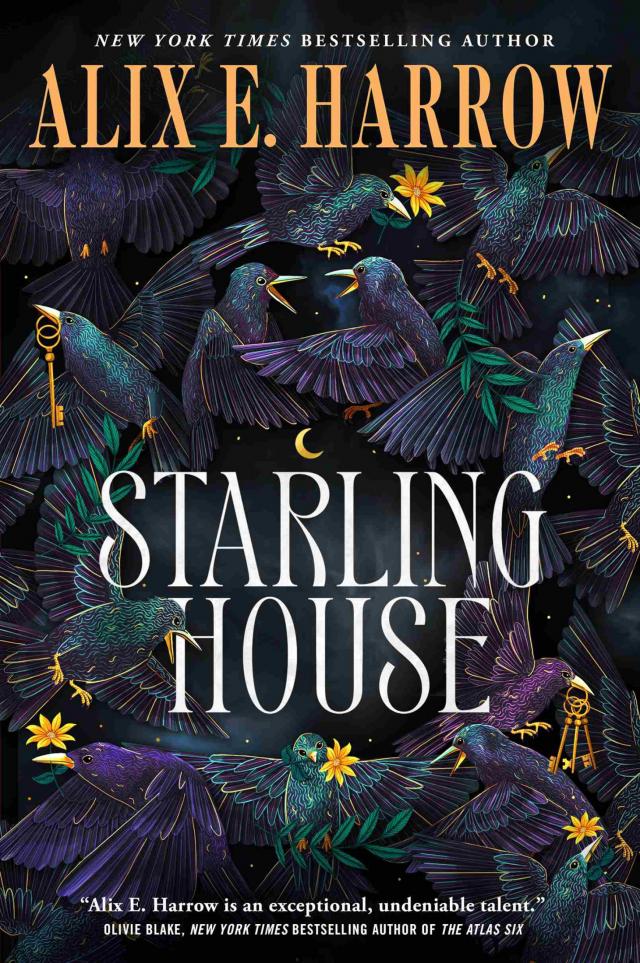


It’s an overcast day, chilling toward evening, and the parking lot is full of birds. Grackles so black they look like bird-shaped holes cut in the pavement, a few crows, the speckled gleam of starlings. Charlotte cuts through them like a boat through dark water.
“Hey!” Charlotte stops but doesn’t turn around, one hand fishing for her keys.
I catch up to her, shooing birds off the hood of her car. “I was just wondering. Do you believe Miss Calliope’s story? Like, do you think there’s really something awful under Starling House? Because I was talking to Ashley Caldwell the other night and she—”
“I don’t know, Opal. Maybe. Not really.” Her Volvo beeps once as she unlocks it. She slides into the front seat and pauses, looking hard at the closed blinds of Bev’s office. “The only awful thing about this town is the people who live here, if you ask me.”
She must mean Bev, and I experience a brief, unnatural urge to defend her. The slam of Charlotte’s door saves me.
I open my new fancy phone and shove the packaging in the dumpster. If I thought about it much—the sleek, expensive shape of it, the weight of it in my palm—I might feel guilty, but I slide it into my pocket without thinking anything at all. The screen scrapes softly against the stolen penny.
THIRTEEN
April in Eden is one long drizzle. Moss sprouts in the sidewalk cracks. The river gets fat and lazy, rising until it licks the belly of the bridge and laps at the mouth of the old mine shaft. The seasonal plant nursery opens in the flea market parking lot and the ants make their annual assault on Bev’s continental breakfast bar.
Starling House creaks and swells, so that every window sticks and every door is wedged tight in its frame. I expect an outbreak of mildew and weird smells, but the house merely acquires a rich, wakeful scent, like a fresh-turned field. I have the fanciful idea that if I dug a knife into the crown molding I would find green wood and sap. If I laid my ear on the floor I would hear a great rushing, like a pair of lungs drawing breath.
Even Arthur seems affected. He’s altered his usual schedule of lurking and scribbling, spending more and more time outdoors. He returns with mud on his shoes and dirt beneath his nails, a healthful flush across his cheekbones that I find obscurely upsetting.
He frowns repressively if I ask what he’s been doing.
“Careful, your face’ll stick that way.” When he doesn’t answer, I make a stricken expression. “Wait, is that what happened to you? I didn’t mean to be insensitive.”
Arthur turns away so abruptly that I suspect the corner of his mouth is misbehaving again. He crosses to the stove to stir a cast-iron pot of something hearty and healthful-smelling. Eventually he asks, reluctantly, “What are you eating?”
I hold up a sleeve of powdered mini doughnuts from the gas station. “A balanced breakfast.”
He makes a small noise of disgust and stalks away with his lunch, leaving the pot on the stove. There’s a clean bowl and spoon set carefully beside it. Looking at the bowl gives me a weird, knotted feeling in my stomach, so I wad the doughnut wrapper in my pocket and get back to work. The next morning there’s half a pot of coffee waiting, velvety and black, and a skillet of fried eggs on the stove. My phone hums against my hip. It’s not poison, you know.
I waver, worrying about debts owed and the food of fairy kings. But would it be so terrible to be trapped forever in Starling House? The banisters gleam, now, and every windowpane winks as I walk by. There are fewer cracks in the plaster, as if they’re sewing themselves shut, and just yesterday I found myself lying in one of the empty bedrooms, pretending it was mine.
I eat until my stomach hurts.
It’s impossible not to feel guilty, then. I’m not used to it—guilt is one of those indulgences I can’t afford, like sit-down restaurants or health insurance—and I find I don’t like it much. It perches heavy on my shoulder, ungainly and unwelcome, a pet vulture I can’t get rid of.
But I can ignore it, because I have to. Because I learned a long time ago what kind of person I am.
I’ve been checking Jasper’s email every night, but there’s been no follow-up from the power company. Just notifications from YouTube videos and promo emails from U of L. Jasper’s been moody and evasive, always checking his phone and curling his lip when I ask him what’s up, but whatever. I can ignore that, too.
I throw myself at my work, instead. By the beginning of May I’ve scrubbed and polished the entire second floor and most of the third, and Starling House is clean enough that I’ve started flinching when Arthur hands me my envelope at the end of each day, wondering if this will be the last time.
I work longer and harder, conscious that I’m inventing new tasks but unable to stop. I bleach yellowed bedsheets and beat rugs; I order polish online and shine all the silver I haven’t stolen yet; I buy two gallons of glossy paint in a color called Antique Eggshell and repaint the baseboards and windows in every room; I watch a YouTube video on window glazing and spend three days fooling with putty and tacks before dumping it all in the garbage and giving the whole thing up. I even ask Bev how to patch plaster, which is a huge tactical error because she drags out a trowel and a bucket of mud and makes me practice by fixing the hole in room 8 where a guest punched through the drywall. She sits in a folding chair and shouts unhelpful advice, like a dad at a kids’ soccer game.
I knock my forehead against the wall, not gently. “If you tell me to feather the edges one more time I swear to Jesus I will put another hole in your wall.”
“Be my guest. Oh wait! You already are, forever.”
“Not my fault you made a bad bet with Mom.”
Bev spits viciously into her empty can, her lips pressed tight. “Yeah.” She nods at the patch on the wall. “I can still see the edges. You have to feather it—” I throw my trowel at her.
* * *
Spring in Kentucky isn’t so much a season as a warning; by the middle of May it’s hot and humid enough to make my hair curl, and there are only two rooms in Starling House left untouched.
One is the attic with the round window—I started up the narrow steps one day with a bucket and broom, and Arthur opened the door with an expression of such profound spiritual alarm that I rolled my eyes and left him to stew in whatever nest he calls a bedroom—and the other is the cellar.
Or at least, I think it’s a cellar—it’s whatever is waiting beneath the trapdoor in the pantry, the creepy one with the big lock and the carved symbols. I haven’t pulled up the rug since that first day I found it, but it tugs at me. It feels magnetic, or gravitational, like I could set a marble down anywhere in the house and it would roll toward it.
Elizabeth Baine seems to surmise its existence somehow.
Is there a basement or crawl space in the house?
I reply with that shrugging emoticon.
A terse silence of several hours, then: Please find out if there is a basement or a crawl space in the house.
I let her stew for a while before writing back, I’m really scared of spiders sorry. I add an emoji shedding a single tear, because if she’s going to blackmail me into selling out a man who quietly doubles all his recipes for me, I’m going to make her regret it.
Baine replies with a string of annoyed texts, which I ignore. She mentions karst topography and ground-penetrating radar and includes several blurry aerial maps of Starling land.19 I turn my ringer off.
The next time I check my phone there’s a picture of the Muhlenberg County High School. It’s an odd angle, taken behind the football field, where the bleachers back up onto a sea of feed corn. It wouldn’t be remarkable at all, except that I know it’s where Jasper eats his lunch every day—and so does she.
I stare at the picture for a long time, feeling that cold place in the middle of me.
The next day I roll back the rug in the downstairs pantry and send her a picture of the trapdoor. She’s thrilled. Exactly where is it located? Is it locked? Do you know where the key is? And then, inevitably: Could you find it?
I’m not surprised by the request—you don’t drug a person and threaten their only family member if all you want from them is a nice conversation and a couple of email attachments—but I’m a little surprised how much I don’t want to do it. I delay as long as I can, backtracking and seesawing, sending back obnoxiously long lists of all the places I’ve looked for the key without finding it. She urges me to try harder and I send even longer lists in response, with footnotes. She suggests that perhaps I could pick the lock, making delicate mention of my school disciplinary reports; I reply that I was a shitty teen who knew how to open cheap doors with a credit card, not an old-timey bank robber.
In the end I receive a text that directs me very simply to open the cellar door by Friday. There are no threats or dire warnings, but I scroll back up to look at that picture of the high school until the chill spreads from my chest across my back, as if it’s pressed against a stone wall.
* * *
The next day I wait until I hear Arthur’s footsteps on the stairs. The sullen scrape of the coffeepot, the squeal of hinges, the squelch of boots on wet ground. Then I put down my paintbrush, thump the lid back on the can with the butt end of a screwdriver, and go up to the attic room.
It seems to take a very long time to get there: the staircase stretches endlessly upward, doubling back on itself more times than is strictly logical, and I make a dozen false turns on the third floor. The fifth time I end up standing in the library I sigh very hard and say, to no one in particular, “You are being a real dick about this.”
When I turn around, the narrow staircase is behind me. I brush my fingers along the wallpaper in silent thanks.
Arthur’s room isn’t messy after all. It’s bright and clean and hot, floorboards baking in the lavish light of May. There’s a desk beneath the window and a bed under the eaves, quilt tucked neatly around the mattress because of course he makes his bed every morning. I consider rumpling his sheets just to be a pill, but the thought makes me feel suddenly sweaty and restless, and anyway the hellcat is curled in the middle of his bed giving me a one-eyed glare. I stick my tongue out at her and look elsewhere.
On the wall at the head of the bed, hanging in a heavy bracket, there’s a sword. It doesn’t look like a toy or a Ren faire prop. The blade is rust-mottled, chipped and scored, but the edge is sharpened to invisibility, like the point of a snake’s tooth. There are symbols running from hilt to point, inlaid in soft silver, and I know with chilled certainty that Elizabeth Baine would have a seizure if I sent her a picture of it. I turn to the desk instead.
The surface is painfully tidy, all the pens nib-down in a coffee cup, all the books stacked and sticky-noted. The top drawer contains an array of overlong needles and pots of ink, a few paper towels stained a watery red. It should have occurred to me before now that the nearest tattoo place is in E-town. That he must sit up here with his sleeves rolled high and his hair hanging in his eyes, pressing the needle into his skin again and again.
I shut the drawer too hard, feeling irritable, overwarm.
The next drawer is full of pencil shavings and little stubs of charcoal. The third drawer is empty except for a ring of keys. There are only two keys on the ring, both old and ornate.
Just as my fingers brush the iron, there’s a muffled thud behind me. I flinch—but it’s just a freckled black bird at the window. It flaps querulously at the glass, as if offended to find an entire house this high in the air, then vanishes. It leaves me with my heart ping-ponging against my ribs and my eyes very wide.
Every inch of the wall around the window is obscured by paper and thumbtacks, as if an entire art museum had been crammed onto an attic wall. At first I think they must be early drafts of the illustrations for Underland and my stomach does a nauseous somersault—but no. Eleanor Starling worked in brutal black-and-white, her lines biting like teeth across the page, and these drawings are all gentle grays and soft shadow. There are Beasts stalking across the pages, but they’re subtly changed. Arthur’s Beasts have an eerie elegance, a terrible beauty that Eleanor’s never did. They step gently through quiet woods and empty fields, obscured sometimes by graphite knots of briar and honeysuckle.
They’re good drawings—so good I can almost hear the rattle of the wind through the branches, feel the give of the loam under my shoes—but the perspective is odd, tilted down instead of straight-on. It takes me a minute to realize this is how the world looks seen from the windows of Starling House.
I remember myself suddenly as I was: walking alone down the county road in my red Tractor Supply apron, looking up at this amber-lit window and hungering for the home I never had. Now I know Arthur was sitting on the other side of the glass, just as alone, dreaming of the world outside.
My throat tightens. I tell myself it’s the dust.
There’s a small sketch pinned just beneath the window, rougher and quicker than the others. It shows the woods in winter, the pale bellies of the sycamores, the doubled ruts of the drive. There’s a figure emerging from the trees, her coat oversized, her face upturned. All the other pictures on the wall are strictly pencil and charcoal, but this one contains a tiny shock of oily color, the only bright thing in a sea of gray: a smear of rich, arterial red. For her hair.
Something small and delicate goes ping in my chest. I snatch the keys and run.
I clatter down the stairs and back into the hall, not thinking about the keys in my hand or the fancy phone in my pocket or the way his face might’ve looked as he drew me: half annoyed, half something else, dangerously intent.
On the first floor I get turned around and find myself in the chilly mudroom behind the kitchen, tripping over cracked rubber boots, and the next door I open takes me out into the humid light of spring.
The sky is hazy blue and the air is spangled gold, as if the sun is shining from everywhere at once. I peel off my tennis shoes—I would peel off my skin if I could—and step away from the shadow of the house, headed nowhere, anywhere.
I walk, following a faint trail worn in the grass, studying the mad pattern of vines up the stone walls. There are leaves on the vines now, still translucent and damp-looking, and fat clusters of flower buds. The honeysuckle by the motel is already a ferocious, man-eating green, so this must be something else.
I turn a corner and stop abruptly, stunned by the sudden riot of color. Flowers. An uneven circle of lilies and daisies, lavender bursts of chicory and pale constellations of Queen Anne’s lace. A hot red riot of poppies, wildly out of place among the gray stone and shadows of Starling House.
Arthur is kneeling among them. There’s a pile of weedy green beside him and his hands are black with earth. Rows of gray stones surround him, stark and sinister among the riotous flowers. It’s only when I see the name STARLING repeated on the stones that I understand what they are.
Arthur is kneeling beside the newest and largest gravestone. It bears two names, two birth dates, and a single date of death.
I should say something, clear my throat or scuff my bare feet on the grass, but I don’t. I just stand there, barely breathing, watching him as he works. All the twist has gone out of his face, gentling the line of his brows and the arch of his nose, unpinching his lips. His hands are tender around the fragile roots of the flowers. The ugly, brooding Beast I met on the other side of the gates has disappeared entirely, replaced by a man who tends his parents’ graves with gentle hands, growing flowers that no one will ever see.
The house exhales at my back. A sweet-smelling breeze pulls the hair out from behind my ear and bends the heads of the poppies. Arthur looks up then, and I know the second he sees me his face will rack and warp, as if someone turned a key in his flesh and locked him against me—except it doesn’t.
He goes very still, the way you do when you see a fox at dusk and don’t want it to disappear just yet. His lips fall open. His eyes are wide and black, and God help me but I know that look. I’ve gone hungry too many times not to recognize a starving man when he kneels in the dirt before me.
I’m not pretty—I’ve got crooked teeth and a chin like a switchblade, and I’m wearing one of Bev’s old T-shirts with the sleeves ripped off and swipes of Antique Eggshell across the front—but Arthur doesn’t seem to know that.
He looks at me just long enough for me to think, in desperate italics: Fuck.
Then he closes his eyes very deliberately, and I recognize this, too; this is what it looks like when you swallow all your hunger. When you want what you can’t have, so you bury it like a knife between your ribs.
Arthur stands. His arms hang wooden and awkward at his sides and his eyes are a pair of sinkholes. The light is still warm and honeyed, but it no longer seems to touch him.
“What are you doing here.” There are no question marks in his sentence, as if all his punctuation has calcified into periods.
“I didn’t mean—are those—” My eyes flick to the gravestones at his back, then away. “I just got turned around in the house and ended up out here somehow.”
The flesh of his face contorts, pulled taut across the bones. It’s that same bitter fury I’ve seen so many times, but I’m no longer sure it’s directed at me.
“I—” I don’t know what I intend to say—I understand, or I don’t understand or maybe I’m sorry—but it doesn’t matter because he’s already striding stiffly past me. He pauses at the wall of Starling House, his silhouette rippling in the window. Then, in a quick, passionless gesture, he puts his fist through the glass.
I flinch. Arthur withdraws his arm from the jagged hole. He stalks around the corner with his shoulders hunched and his left hand a mess of blood and dirt. A door slams, and the wind whistles sadly through the missing tooth of the windowpane.
I don’t follow him. I can’t stand the idea of being in the same room, facing him with the memory of his eyes on my skin and the weight of his stolen keys in my pocket. Betrayal works best when you don’t think about it, and now I can’t think of anything else.


