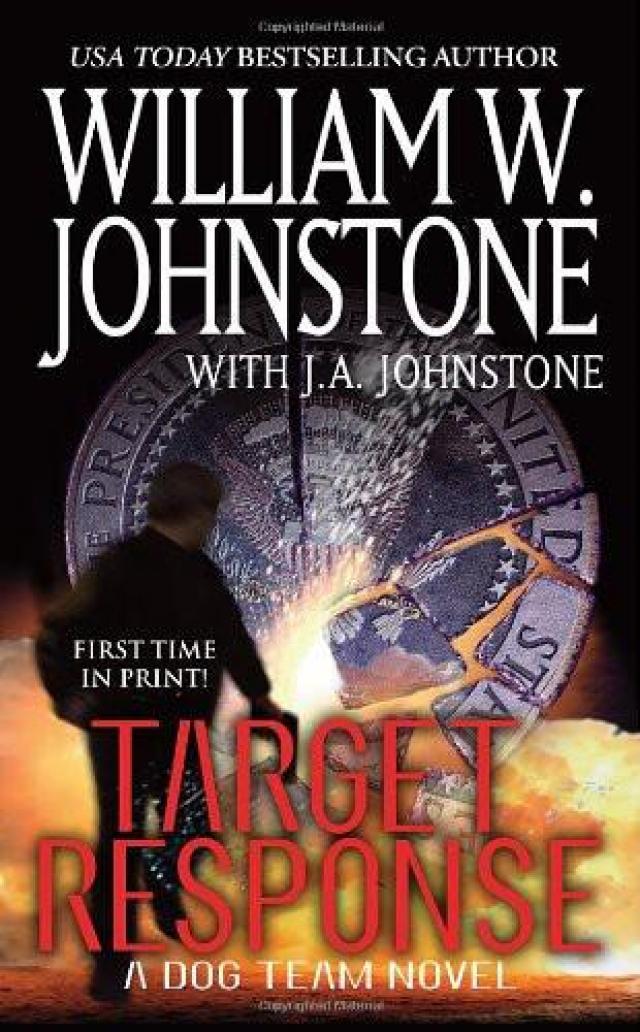
Target Response, page 3


“You won’t,” Kilroy said, but he took the weapon, slinging it over his left shoulder.
Raynor went first, stepping up onto the fallen tree.
“Easy,” Kilroy said. “Take whatever time you need.”
“The longer I stand here dicking around, the more likely I am to fall,” said Raynor.
“Cross it on hands and knees if you have to.”
Raynor shook his head. “My best chance is to scoot across.” He stood sideways, leading with his left side. His legs were spread wider than shoulder width apart. “Here goes nothing,” he said.
He edged across the tree like a basketball player moving sideways downcourt. He lifted his left foot, moving it forward, planting it securely before lifting his right foot and advancing it. A mechanical style but it seemed to be working for him.
He reached the midpoint of the tree before his foot slipped. He cut off a choked cry, fighting for balance. He regained his footing and sidestepped quickly, hurrying to the far side.
Raynor had reached the opposite bank when he pitched forward, falling headfirst toward the serpentine tangle of dirt-encrusted roots that spread umbrella-like from the base of the downed tree.
His right arm flailed around seeking a handhold to arrest his fall, not finding one. He fell heavily on his left side. Gnarled roots cushioned his fall. Still, he shrieked with pain.
His outcry pierced the thick, oppressive air.
A troop of monkeys clustered in a nearby tree fled, startled, loosing a chorus of shrillings and chatterings as they scrambled to the tips of the boughs and flung themselves through empty space to a neighboring treetop.
Kilroy nimbly crossed the tree bridge to the opposite side. Raynor lay still, unmoving, tangled in brownish-white root work. His eyes were squeezed shut; pencil-thick veins stood out on his forehead.
“Bill. Bill!” Kilroy said in a hoarse stage whisper, gripping the other’s right shoulder.
Raynor stirred, groaning. His eyelids fluttered, opening on pain-dulled orbs. “Huh?…Must’ve blacked out for a second,” he muttered.
Kilroy helped Raynor extricate himself from the mass of roots. He held him under the arm, steadying him. Raynor shivered. Kilroy guided him to the tree the monkeys had quitted, easing him down so he sat with his back propped up against the trunk.
The monkeys swarmed the upper boughs of a nearby tree. They were small creatures, each measuring about eighteen inches long from head to toe pads, with long, thin, curling tails. They had short brown fur, black snouts, and gray bellies. Still agitated, they howled and screeched down at the human intruders.
Dusk was falling fast; shadows thickened in the basin’s gloom. In the thinning light Kilroy eyed Raynor.
Raynor’s bitten left arm was grotesquely swollen from fingertips to shoulder. His hand was thick and clumsy as if covered by a gardening glove, with fingers the size of sausage links. Beyond the arm itself, the creeping red flush denoting the poison’s progress had spread to his neck and the top of his chest.
Kilroy started at what sounded like distant shouts. They were hard to distinguish over the monkeys’ clamorings.
Alert, intent, he listened for a repetition of the shouting. None came, and he’d almost convinced himself that his ears had been playing tricks on him when there came the sound of a shot.
A dull, flat cracking report that came from a good distance away, but all the same, a shot. A few beats later, a second shot sounded, as if in response to the first.
With no visual referents it was hard to determine from what direction a sound emanated, but it seemed to Kilroy as though both shots had come from somewhere to the west, beyond the basin.
The reports further stirred up the monkeys, sending them into fresh screams of outrage and abuse.
“We’re in for it now,” Raynor said. “Sorry.”
“Can you walk?” Kilroy asked.
“Sure. Give me a hand up.”
Kilroy gripped Raynor’s right hand and helped him to his feet. Raynor swayed, then recovered his balance.
“I’m useless. Take off while you’ve still got a chance,” Raynor said.
“Don’t talk stupid,” Kilroy said.
“Face the facts—I’m done.”
“Hell, if you can stand, you can walk. If you can’t, I’ll carry you.”
“You’ve already carried me long enough, Kilroy. Too long.”
“Don’t throw in the towel now, Bill, not when we’re so close to the river.”
Raynor shook his head. “Alone, you can make it. Not with me. The poison bite’s getting to me…. It’ll finish me off soon anyway.”
“Guys have lived through worse than that and so will you,” Kilroy said. “Hey, I’m supposed to be bodyguarding you. What’re you trying to do, make me look bad by dying on me?”
Raynor forced a smile. It was pretty ghastly—Kilroy could see the skull behind that smile.
“Do I have to carry you out of here? Because we’ve got to go and I ain’t leaving you behind,” Kilroy said.
“You hardheaded bastard. All right, I’ll stick for now. You can let go of me,” Raynor said.
Kilroy released his grip on the other’s arm, standing ready to catch him if it looked like he was going to fall. Raynor lurched, steadying himself by taking a wider stance. “Okay, I’m all right. I may just be able to do you some good yet. Give me the weapon,” he said.
“Now you’re talking,” Kilroy said, grabbing up the M-16 and handing it to Raynor. Raynor slung it over his right shoulder.
A lot of dead wood littered the ground. Kilroy found a likely-looking branch and picked it up. It was three feet long, solid, mostly straight, with a knob at one end. He tested his weight against it; it seemed sturdy enough.
“Here, use it as a cane,” he said.
Raynor shook his head. “Don’t need it.”
“Maybe you don’t need it now but you might later. What the hell, when you run out of ammo you can throw it at the enemy,” Kilroy said. Raynor took it.
Twigs and pieces of rotten fruit from above began pelting the ground around the two men.
“The monkeys are throwing them at us. Let’s get out of here before they start throwing something else,” Kilroy said.
He and Raynor started up the long, shallow slope leading out of the basin. It was a relatively dry spot of ground, watery mud oozing up to only the tops of their boot soles with every step.
After a few tentative strides Raynor began using the makeshift cane to brace himself. He lurched along like a drunken man but kept moving.
The slope was covered with spindly ten-foot-tall trees whose interlaced boughs formed a thin but more or less continuous canopy. The duo slogged to the crest of the slope, the southern rim of the basin.
It was a low elevation but still provided a vantage point of sorts. Ash-gray shadows pooled in the hollows of the landscape, thickening and thrusting east. Through a gap in the trees a stretch of the river could be seen.
On the far side of the crest, a short downgrade slanted into a broad valley whose low point was cut by a sluggish blackwater channel that ran roughly east–west.
At the west end of the valley it joined the river bordering the rim of the basin, the Rada River, upon which Kilroy had earlier seen the barge and on its far bank a column of troops. Neither were now in view.
“We’ll go downhill and follow the creek to the river,” Kilroy said. Raynor grunted assent. He was saving his breath for walking.
He and Kilroy descended into the valley. The hillside was covered with the same type of spidery, stunted trees that covered the inner wall of the basin.
At the bottom of the hill the ground leveled off into a muddy field thick with knee-high weeds. The spidery trees thinned here, giving way to tangles of scrub brush that screened off much of the surroundings, forming a kind of maze.
The foliage ended near the channel, leaving a five-foot-wide strip of bare earth bordering the edge of the north bank. The strip was a game trail, its muddy surface marked by the hoofprints and paw marks of the creatures that used it.
The bank ended suddenly, dropping three feet straight down to the water below. That explained why the trail was bare of the basking crocodiles that sunned themselves on riverbanks where the water was easier to access.
Kilroy and Raynor paused under the foliage at the edge of the tree line. Shadowy stillness was broken by the gurgling sounds of slow-running water.
Kilroy reached out to part the bushes. Raynor’s good hand clutched the other’s shoulder. “Kilroy,” he began, soft-voiced, “if I don’t make it—”
“You will,” Kilroy said.
“If I don’t, when you reach Lagos, don’t trust Thurlow,” Raynor said.
Ward Thurlow was the CIA agent who’d been the primary liaison with the Pentagon’s investigative unit, the team of which Kilroy and Raynor were now the only two survivors.
“You’ll make it. But why Thurlow?” Kilroy asked.
“I’ve done plenty of thinking since we took it on the run, turning the facts over in my head and trying to make sense of them. I keep coming to one conclusion: it had to be Thurlow who fingered the team to Tayambo,” Raynor said.
“I never had much use for the guy, but how do you figure him for the Judas?”
“Process of elimination. That the others were flying back to Washington yesterday was a closely held secret. So was the fact that you and I were nosing around at the Vurukoo fields. But only Thurlow was in a position to know both.”
“Well…” Kilroy was doubtful.
“There’s more,” Raynor said quickly. “I was suspicious of the extent of Thurlow’s contacts in the Lagos power structure. He was too chummy with the Tayambo crowd at the Ministry of Defense, always trying to steer the investigation away from them,” Raynor said, sounding short of breath.
“You’re the detective. I’m just a trigger-puller. If that’s your theory, I’ll buy it.”
“Listen, Kilroy. When you get clear of this mess, drop out of sight. Don’t use any of the usual channels to get out of the country. Our system here is compromised, rotten. Drop off the radar and go black. Not just the agency’s radar, the Pentagon’s radar, too. That way you might have a chance of getting out alive.”
“I’ve got contacts in Lagos and alternate ways out. We’ll use ’em both,” Kilroy said. “But first we’ll roast Thurlow over a slow fire and get some answers out of him before feeding him to the crocs.”
“I’m looking forward to it,” Raynor said, smiling wanly.
“I’ll go first, scout along the trail. Wait here till I tell you it’s all clear,” Kilroy said.
He parted a couple of leafy branches, stepping out onto the trail. He stood in a half crouch, rifle leveled, looking, listening. He nodded to Raynor, who was watching him from behind the screen of brush.
Kilroy faced west and began moving forward. The valley was thick with gray gloom, giving it a feeling of unreality. A ribbon of open sky showed above the channel. Heavy clouds hung low over the treetops.
Kilroy advanced twenty, thirty yards. The hush was intense. Even the insects had momentarily fallen silent.
A flock of flying things suddenly burst out of the trees, the flapping of their wings seeming unnaturally loud as they broke the silence.
They flew in a rising spiral, winged shapes swirling upward in a rushing whirlwind toward the open sky above the channel. Jagged black silhouettes were outlined against the backdrop of gray clouds.
They were not birds but bats. Bats! Hundreds of them. Something had spooked them from the boughs they clung to while waiting for the coming night.
Gunfire crackled on the trail behind Kilroy. Raynor shouted, “It’s a trap!”
Kilroy threw himself into the foliage bordering the path. His limbs got tangled up in a mess of vines, hampering his freedom of movement. Writhing, thrashing, he fought to break free and bring his weapon into play.
The scene came alive with shots, shouts, action.
Across the channel, on the south bank, a flashlight beam blazed into being. It lanced through the dusk, sweeping along the trail Kilroy had just quitted, searching for him. It swept east along the trail where a fusillade of gunfire sounded.
The beam picked out the scene of a deadly confrontation. A band of armed men maybe a dozen strong materialized on both sides of the creek about twenty yards east back of where Kilroy had left Raynor.
Ambushers!
Raynor’s cry of pain when he had fallen earlier must have alerted the troops scouring the riverbank to the west. They’d sent an advance guard east into the valley to close it off.
Now they were in motion, sealing the trap. But they’d moved too soon, alerting Raynor, who opened fire on them.
Raynor stepped out into the open on the north bank, facing east. He stood swaying, holding the butt of the M-16 braced against his right hip, firing it one-handed at the soldiers charging at him on his side of the channel.
A round tagged a Nigerian trooper in the middle, chopping him down. Several more rushed forward to take his place, firing wildly. Their assault rifles were on autofire, racketing like jackhammers.
Raynor pumped out single shots from his M-16 into them, one by one.
Another soldier shrieked and fell sideways, toppling off the bank and falling into the water with a splash.
Troopers on the far side of the creek opened fire on Raynor. Raynor’s form jerked and shuddered as rounds ripped into him.
He turned toward them, squeezing off more shots. His weapon fell silent—out of ammo. Empty.
Muzzle flares sparked on both sides of the creek as more ambushers got Raynor into their sights, streaming lead into him.
He jerked this way and that as the slugs impacted him. The M-16 fell from his hand. He fell to his knees, head bowed.
There was a lull in the shooting as three troopers closed on him. The flashlight beam fell on the tableau like a spotlight, illuminating it.
One of the Nigerians wielded a panga, the local equivalent of a machete. With a wordless shout of triumph he raised it high over his head, swordlike blade poised for a vicious decapitating downstroke.
Kilroy, now free of the weblike vines that had netted him, thrust the muzzle of his assault rifle through the bushes and shot the panga wielder.
The meaty thud of a round drilling flesh was accompanied by the sight of the panga man falling over backward out of sight.
Kilroy’s shot suddenly set the west side of the valley boiling with the figures of a horde of armed men pouring into it, racing east along both sides of the channel. They were part of the main body of the troop column, of which the dozen ambushers east of Raynor had been an advance guard.
Many booted feet stamped and thundered over the ground in double time. Branches broke and brush rustled as hidden lurkers poured out of their places of concealment.
Where Raynor knelt, the panga wielder had been closely trailed by a pair of riflemen. They had fallen back in alarm as their fellow had been cut down by Kilroy’s snap shot. Recovering from the sudden fright, they now swung their rifle muzzles toward Kilroy.
Raynor’s good right hand moved, drawing his 9mm Beretta from its holster and firing into the duo looming over him. The pistol barked, its muzzle flares underlighting the agonized faces of the two troopers as bullets opened up their middles.
The remnants of the advance guard, seven shooters, all let rip at once at Raynor. Slugs poured into him, shredding him ragged.
Raynor fell down dead.
The flashlight beam now swept west over the trail, searching for Kilroy. The light was held by a trooper on the other side of the channel not far opposite from Kilroy. Several riflemen were grouped around him, ready to open fire when the beam picked out Kilroy.
Kilroy shot first, firing in the prone position from behind a fallen log. A howl of pain sounded from across the channel as the light-bearer was tagged. The flashlight dropped, falling to his feet. It did not break but remained lit, rolling on its side back and forth in a small, tight arc.
Gunfire erupted from the riflemen grouped nearby as they sprayed the woods in Kilroy’s direction.
The Nigerian troops pouring into the valley from the west began shooting, too. Many guns fired, yellow spear blades of light stabbing from rifle muzzles. Bursts of automatic fire crackled, tearing into tree trunks and branches. The attackers couldn’t see what they were shooting at but that didn’t stop them.
The valley was an arena of mass chaos. Soldiers shot without looking. Some of them shot at each other.
A nasty little firefight broke out between skirmishers from the main body of troops and the handful of the ambushers still left alive in the east. Bodies piled up before the combatants realized they were trading shots with their comrades in arms.
The confusion suited Kilroy just fine. It turned what could have been a death trap into a first-class clusterfuck. Noise, gunfire, squads of troops running this way and that—all combined to hide him from his pursuers.
As silent as smoke Kilroy faded back into the brush, slipping away from the hunters. The deepening darkness of oncoming night was his ally, cloaking him with its sheltering shadows.
Raynor? Nothing to be done for him. No man could have survived the merciless final fusillade that had all but shot him into pieces.
Kilroy was alone now. The western end of the valley was filled with troops. He went northeast across the basin’s outer slope, swinging a wide detour around the few ambushers still alive in that area. Unaware of his passage and concentrating on not being shot by their fellow troops, they were easily evaded.
Leaving them far behind, Kilroy crossed the creek, wading through listless, waist-high waters that were as warm as blood. After climbing up onto the south bank, he followed its winding course due east, into the recesses of the flooded forest.
In the distance, bursts of gunfire still sounded.
“Joseph Kilroy” was a war name assumed by he whose birth name was Sam Chambers. He’d never known his real father but he knew of him.
He was the bastard son of Terry Kovack, the supreme warrior in the Vietnam-era Dog Team. That particular cadre of elite Army assassins had been disbanded in the war’s sorry aftermath of national defeatism and antimilitary agitation.