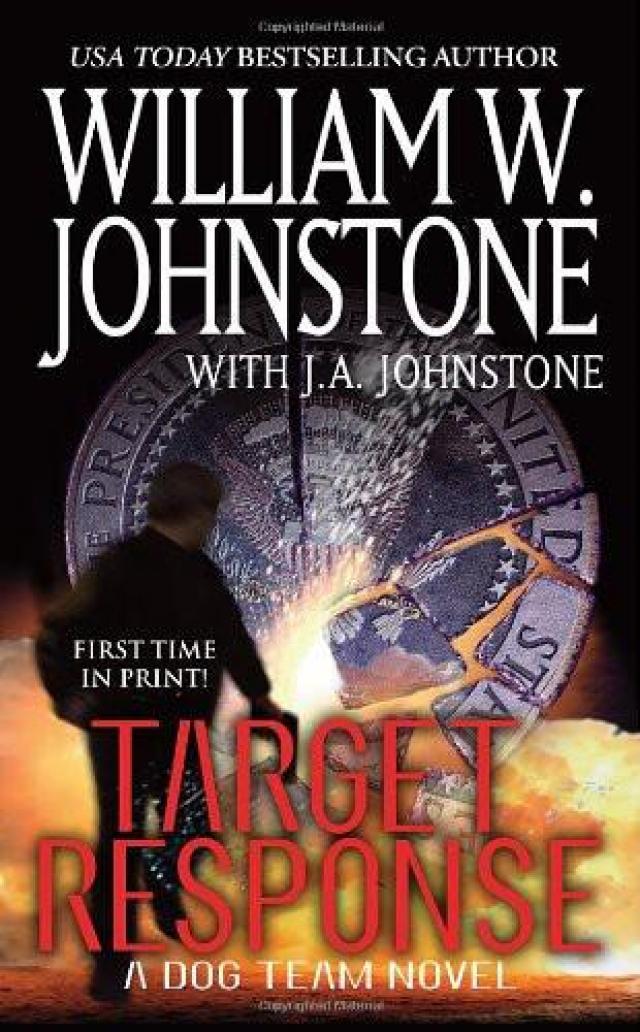
Target Response, page 19


“George Knight. I used to work for Gunther, but I quit.”
No need for Kilroy or Osgood to inquire the identity of Knight’s prisoner. They knew him all too well.
Emerging from the stairwell, Steve entered. He stopped in amazement when he saw the captive.
“Doc Wenzle!” he gasped.
Wenzle stood there with a hangdog look on his face, eyes downcast, mustache drooping, the corners of his mouth turned down.
“I saw you die,” Steve said, amazed.
“You saw a look-alike,” Kilroy said. “I thought something wasn’t kosher about the setup at the Gall Building. The ambushers could have killed you, but instead they went to great pains to take you alive. Why?
“It all makes sense now. You were going to be turned over to the authorities so you could testify that you’d seen ol’ Doc here die. If he was thought dead he wouldn’t have to worry about the Dogs or anybody else looking for him. That’s the way you worked it, eh, Doc?”
“Pretty much,” Wenzle admitted.
“He’s been stooging for Gunther and Carrollton all along, feeding them inside information,” Knight confirmed.
“We’ll take him from here,” Kilroy said. “You go downstairs and report to General Vickery—and tell him Kilroy sent you.”
“Will do, and thanks,” Knight said.
Kilroy, Osgood and Steve, along with their prisoner, Wenzle, climbed the stairs to the rooftop helipad and boarded the black helicopter. It lifted off, flying out to sea.
When it was a couple of miles out and a thousand feet above the ocean, it hovered in place, waiting.
“I trusted you, Doc. Why’d you do it?” asked Steve.
“It was that damned investment tipsheet I was running as part of my cover. Everybody was making money on it and I fooled myself into believing my own bullshit. I invested everything I had and lost it all when the stock market crashed. I would have had to retire with nothing but my Army pension, to live in some trailer park eating off food stamps,” Wenzle said, as if that explained it all.
“Millions of people live in trailer parks with little money without betraying their friends, teammates, and country,” Steve said.
“But you won’t be one of them, Doc,” Kilroy added.
Wenzle shrugged. He didn’t start pleading for his life until Kilroy opened the helicopter’s side hatch, unsealing an exit to empty air, a black sea, and oblivion.
Wenzle babbled, sobbing and shrieking, shouting that he knew plenty about Gunther’s dirty deals and hidden assets and how they could all be rich if only they’d spare his life.
Kilroy, tiring of his noise, stuffed a grenade in Wenzle’s mouth. He had to shout to be heard over the rotor’s propwash.
“Go to hell, Doc! And tell ’em Kilroy sent you!”
Kilroy pulled the pin of the grenade crammed between Wenzle’s jaws and kicked him out of the hatch into eternity.
It was a long way down but Wenzle blew up before hitting the water.
The black helicopter flew west.
The battle was over, but the war against America’s enemies abroad—and, more dangerously, at home—will never end as long as the republic endures.
Eternal vigilance, and death to the foe!
There’s a new President of the United States…a virulent left-wing socialist who’s dismantling the military…decommissioning America’s anti-missile system and our nuclear weapons….
He orders all domestic drilling and refining of oil to stop…. He also orders that no oilcan be imported so as to “force scientists to develop a new source of green energy….”
His plan is a massive failure. The United States is plunged into darkness…. Airplanes, cars, trucks, trains are idled. Supermarkets are empty. Three quarters of Americans are facing starvation.
But the worst is yet to come.
Islamic terrorists, exploiting the republic’s weakness, detonate three nukes. When the government totally collapses, the extremists take over, renaming America the “Islamic Republic of Enlightenment.” The people’s choice is simple: submit to radical Islam or die.
Army major and helicopter pilot Jake Lantz is not going down without a fight. With a band of eight loyal soldiers, Lantz will fight off bands of roving thugs and an “Army of Allah” who attack them by land and by sea.
Jake Lantz is going to take back America.
No matter what the cost.
From William W. Johnstone, USA Today best-selling author of The Ashes, and J. A. Johnstone comes an exciting—and timely—new series:
PHOENIX RISING
Read on for an exciting preview.
PHOENIX RISING.
On sale soon, wherever Pinnacle Books are sold.
ONE
Tuesday, January 10
Major Jake Lantz was thirty years old. A helicopter pilot and flight instructor in the Army Aviation School at Fort Rucker, Alabama, he was in the peak of physical condition, recently scoring a perfect 300 on his latest PT test, maxing out on the three required events: push-ups, sit-ups, and two-mile run. A not too prominent scar on his right cheek, the result of a shrapnel wound in Afghanistan, ran like a bolt of lightning from just below his eye to the corner of his mouth. He had blue eyes, and he wore his light brown hair closely cropped, in the way of a soldier.
Jake, who was a bachelor, lived alone in a three-bedroom ranch-style house on Baldwin Court in Ozark, Alabama, the town that proudly bills itself as the “Home of Fort Rucker.” He had kept the heat down during the day to save on his gas bill. Now he shivered as he turned it up.
After stripping out of his flight suit, Jake pulled on a pair of sweatpants and a red sweatshirt, emblazoned with the word ALABAMA across the front. He had not gone to school at Alabama but had become a big fan of University of Alabama football.
Checking the digital clock on his dresser, he saw that he had but one minute left until the program he wanted to watch came on, so he hurried into the living room, settled down on the couch, picked up the remote, and clicked it toward the TV.
The initials GG appeared on the screen, and then the voice-over introduced the show.
From New York! It’s the George Gregoire show! And now, here is your host, George Gregoire!
The GG monogram moved into the background and George Gregoire, with his signature crew-cut blond hair, slightly chubby face, and toothy smile, greeted his television audience.
Hello, America!
You are not going to want to miss the show today. I have information that—if I had been able to verify before the election last November—might have saved our country the anguish, turmoil, and trouble we are going to go through over the next four years under President-elect Mehdi Ohmshidi.
In fact, I will say it here and now, this could be grounds for impeachment. Can a president be impeached, even before he assumes office? I don’t know, but if the men and women in the House and Senate would put our country ahead of party, they might just want to think about this.
Here is a video, recently surfaced, of President-elect Mehdi Ohmshidi giving an address to the OWG. The OWG stands for One World Government. Ohmshidi is—well, let’s just let the video speak for itself.
The video was somewhat grainy, obviously taken not by a camera for broadcast, but by a small, personal camera. Nevertheless, it was quite clearly President-elect Mehdi Ohmshidi standing at a podium addressing a rather sizeable crowd. Many in the crowd were holding signs, saying such things as:
U.S. Is an Obsolete Concept
One People, One World, One Government
No More Flags, No More Wars
Patriotism Is Jingoistic.
Ohmshidi began to speak and because the sound wasn’t of the best quality, his words were superimposed in bright yellow, over the picture.
I see a world united! A world at peace! A world where there are no rich and there are no poor, a world of universal equality and brotherhood.
Such a world will surely come, my friends, but it will never be as long as we are divided by such things as religion, patriotism, the greed of capitalism, and the evil of so-called honorable military service. There is nothing honorable about fighting a war to advance one nation’s principles over another’s. One people, one world, one government!
Ohmshidi’s closing shout was met by thunderous applause and cheers from the audience.
The picture returned to George Gregoire on his New York set.
The question of Ohmshidi’s membership in the OWG was raised during the election, but spokesmen for Ohmshidi said that it was merely a flirtation he had entered into when he was in college.
Really?
Ohmshidi graduated from UC Berkeley twenty-one years ago. I’m going to bring the video up again, in freeze-frame. I want you to look at the sign on the curtain behind him.
In freeze-frame, on the curtain behind the speaker’s stand were the words WELCOME TO THE GOVERNMENT CONVENTION.
Beneath the welcome sign were the opening and closing dates of the convention, June 6–-June 10. The year was two years ago.
“Jake, are you in here?” a woman’s voice called from the front door.
Jake picked up the remote and muted the TV. “In here, Karin,” he called back.
Karin Dawes was a captain, an Army nurse, who was still wearing her uniform. She had short black hair, brown eyes, an olive complexion, and the same body she had when she was a college cheerleader. She was also a world-class marathoner who had just missed qualifying to represent the United States in the last Olympics. Seeing George Gregoire on the silent TV screen, Karin chuckled.
“You’re watching Gregoire. Of course, it’s six o’clock. What else would you be watching?”
“You should watch him,” Jake said. “Maybe you would learn something.”
“I do watch him,” Karin said. “As much time as I spend over here with you, how can I help but watch him?”
“Ha! Now I know why you spend so much time over here. Here I thought it was my charm. Now I find out it’s just so you can watch George Gregoire.”
“I confess, you are right,” she said. She leaned over to kiss him, the kiss quickly deepening.
“Damn,” Jake said, when they separated. “That’s what I call a greeting. Do I sense a possibility that this could go further?”
“How can it go any further?” Karin asked. “It’s at least half an hour before Gregoire is over, isn’t it?”
Jake picked up the remote again, and turned the TV off.
“You’re sure I’m not taking you away from George Gregoire?” Karin teased. “I certainly wouldn’t want to be accused of alienation of affection.”
“Woman, you talk too damned much,” Jake said, kissing her again. “Besides,” he said, “I’ve got a TV in the bedroom. I can always watch him while—”
“You try that, Major, and you’ll have George Gregoire in bed with you before I split the sheets with you again,” Karin said, hitting him playfully on the shoulder. Jake laughed out loud, then put his arm around her as they went into the bedroom.
There was an ease in their coupling, the assurance of being comfortable lovers who knew each other well, and yet their relationship was not so stale that it couldn’t still be fresh with new discovery. Outside, the wind was blowing hard, and Jake could hear the dry rattle of the leafless limbs of an ancient oak.
Afterward they lay together under the covers, her head on his shoulder, his arm around her, his hand resting on her naked thigh. It was, as always, a feeling of total contentment.
“Jake?”
“Yes, my love?”
“Will we always have this? I don’t mean are we going to get married, or anything like that. I just mean, will we always have this sense of joie de vivre?”
“Is there any reason why we shouldn’t?”
“I don’t know,” Karin admitted. “I know I tease you about watching George Gregoire all the time, and about listening to all the right-wing radio shows. But, what if they are right? What if the country has made a big mistake in electing Ohmshidi?”
“There is no what if,” Jake said. “We did make a big mistake. Well, we didn’t. I’m not a part of the we, because I didn’t vote for him.”
“I didn’t either.”
Jake raised his head and looked down at her. “What? You, Miss Liberal Incarnate? You didn’t vote for him?”
“I couldn’t bring myself to vote for him,” she said. “Not when I knew the way you felt about it.”
Jake kissed her on the forehead. “Maybe there is some hope for you yet,” he said.
“But you didn’t answer my question. Will we always have this?”
A sudden gust of wind caused the shutters to moan.
When there was an uncomfortable gap in the conversation that stretched so long that Karin knew Jake wasn’t going to answer, she changed the subject.
“I wonder if it’s going to snow.”
“Don’t be silly,” he said. “It never snows in Ozark, Alabama.”
There were three inches of snow on the ground the next morning as Jake drove the ten miles into Fort Rucker. Because snow was so rare here—it had been fifteen years since the last snow—neither Ozark nor Dale County, had the equipment to clean the roads. As a result, Jake drove slowly through the ruts that had been cut in the snow by earlier cars. He returned the salute of the MP at the Ozark gate, then drove down Anderson Road, which, like the streets in Ozark, was still covered with snow.
As Chief of Environmental Flight Tactics, Jake had his own marked parking slot, though the sign was covered with snow. He exchanged salutes with a couple of warrant officer pilots as he covered the distance between his car and the front door of the building, which held not only the offices of the faculty but also classrooms for the ground school.
“Major, I thought you told me that it never snowed in Southern Alabama,” Clay Matthews said. Sergeant Major Matthews was Jake’s right-hand man, the noncommissioned officer in charge of EFT.
“It doesn’t,” Jake said. “Disabuse yourself of any idea that this white stuff you see on the ground is snow. It’s just a little global warming, that’s all.”
“Right,” Clay said with a little chuckle. “Oh, Lieutenant Patterson called from General von Cairns’s office. The general wants you to drop by sometime this morning.”
“What’s my schedule?”
“You don’t have anything until thirteen hundred.”
“All right, maybe I’ll drop by his office now. I’m not surprised he wants to see me. I told him he wouldn’t be able to run this post without my help.”
“Yes, sir, that’s what I tell everyone about Environmental, too,” Clay said. “You couldn’t run the place without me.”
Jake chuckled. “Yeah, well, the difference is, I’m just shooting off my mouth when I say that about the general. But when you say that about me, you’re right.”
Like Ozark, Fort Rucker had no snow removal equipment. But it did have a ready supply of manpower, and there were several enlisted men, under the direction of a sergeant, clearing off the parking lot and shoveling the sidewalks at the post’s headquarters. Because of that, Jake was able to walk from his car to the building without getting his boots wet.
Lieutenant Phil Patterson was on the phone when Jake stepped into the outer office, but he hung up quickly, then stood.
“Good morning, Major,” he said. “Just a moment and I’ll tell the general you are here.”
“Thanks.”
First Lieutenant Phil Patterson was a West Point graduate who had recently completed flight school. Jake remembered him as bright, eager, and well coordinated when he was a student going through the Environmental Flight Tactics phase of his training. Patterson had wanted an overseas assignment out of flight school, and was disappointed when he was chosen to stay at Fort Rucker as the general’s aide de camp. But, he was a first lieutenant in a captain’s slot, so the assignment wasn’t hurting his career any.
Patterson stepped back out of the general’s office a moment later. “The general will see you, sir.”
Jake nodded his thanks, then stepped into the general’s office. Major General Clifton von Cairns was pouring two cups of coffee.
“Have a seat there on the sofa, Jake,” the general said. Jake had served in Iraq with von Cairns when he had been a captain and von Cairns had been a colonel. That was von Cairns’s second time in Iraq; he had also been there during Operation Desert Storm.
“As I recall, you like a little bit of coffee with your cream and sugar,” von Cairns said as he prepared the coffee.
“Yes, sir, thank you.”
Carrying the two cups with him, von Cairns handed the one that was liberally dosed with cream and sugar to Jake. “I’m sorry I don’t have any root beer,” von Cairns said. “That is your drink, isn’t it?”
“I like a root beer now and then,” Jake said.
“Yes, I remember your ‘beer’ run when we were in Iraq,” von Cairns said.
Jake’s preference for root beer was well known by everyone who had ever worked with him. What the general was referring to was the time Jake had made a run to Joint Base Balad for beer and soft drinks. Beer wasn’t actually authorized due to cultural concerns and was officially banned by the military, but the civilian contractors weren’t constrained by such rules and were a ready source of supply for the army. But Jake had come back with only one case of beer and nineteen cases of root beer in the helicopter. He was never asked to make a beer run again.
“How many students do you have in your cycle right now?” the general asked.
“I have twelve.”
“Can you expedite them through? Double up on the flight hours?”
“Yes, sir, I suppose I could. It would mean rescheduling some of the ground schooling.”
“I want you to do that,” von Cairns said. He took a swallow of his coffee before he spoke again.
“Jake, I’m not much for politics—I’ve always thought that as a professional soldier I should leave the politics to others. But I don’t mind telling you, this new man we’re about to swear in scares the hell out of me. I’ve heard some disturbing talk from some of my friends at DA. They’re afraid he’s going to start cutting our budget with a hatchet. If we don’t get this cycle through quickly, we may not get them through at all.”