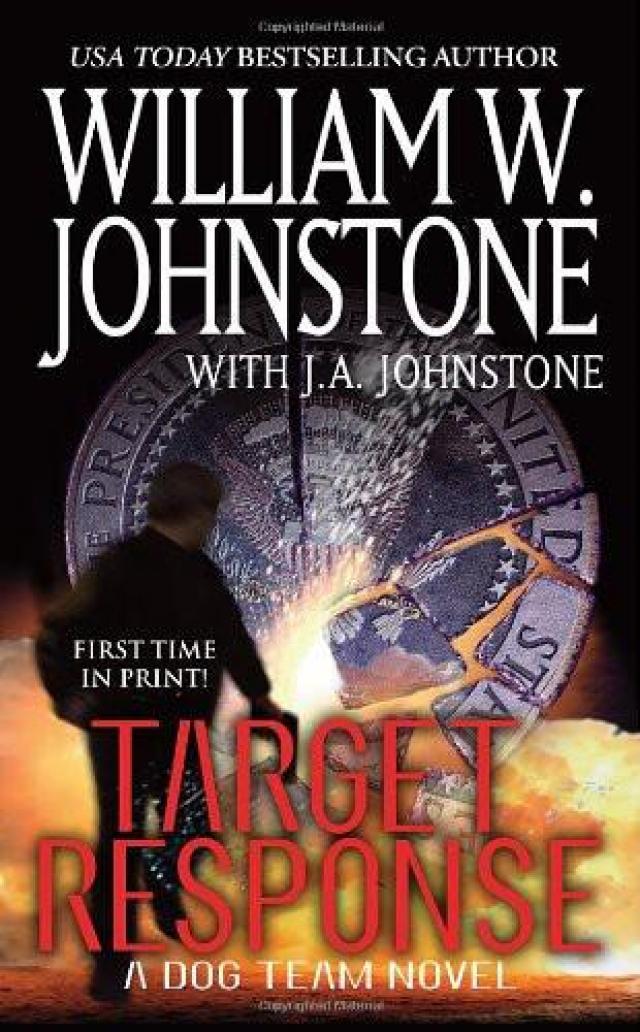
Target Response, page 14


Then he and Pyne rolled her up in the blanket, cocooning her.
Margit came out of the house wearing a winter jacket and gloves. A pickup truck hitched to a horse trailer was parked in the main driveway off the mansion’s southeast corner.
Margit went to it. She got in the truck cab and started it up. She drove the truck and trailer along the driveway, up over the curb, and across the lawn to the back of the house, halting in the yard near the stable.
She switched off the engine and got out. She went around to the rear of the pickup and lowered the tailgate.
Jules and Pyne stood over Skye’s blanket-wrapped body. They hefted her at either end, Pyne wrapping his arms around her chest, Jules gripping her around the ankles. They carried her to the back of the pickup and loaded her into the hopper.
Olcott and Lillian emerged from the house. They had changed their clothes; both now wore outdoor gear: winter jackets, pants, hiking boots. They carried hunting rifles and wore sidearms.
Brett remained inside, tending his scalded flesh.
Olcott and Lillian stood on the lawn below the terrace, conferring briefly with Jules. He did most of the talking, giving them their instructions. He could have used their help to dispose of the bodies but they had a more important task: stop Steve Ireland. Time was of the essence.
Olcott and Lillian went around to the front of the house, got into a black Land Rover with their weapons, and drove off. The Rover went down the driveway, turned right onto Crestline Drive, and proceeded south across the top of Hessian Hill.
Olcott and Lillian were charged with the mission to seek and destroy Steve. With luck they would intercept him on the road en route to his house. If not, they were to go to Steve’s place and lie in wait for him.
Jules, Pyne, and Margit now put their heads together. Jules gave them their orders and went into the house, not looking back.
Margit and Pyne went into the stable. They came out ten minutes later carrying a second blanket-wrapped body: Ludlow’s.
Margit was a big, strong young woman. She showed no signs of strain from her labors. Indeed, she was doing the lion’s share of the carrying, bearing the heavy load of Ludlow’s beefy upper body. Pyne had him by the feet and was huffing and puffing.
They heaved the body up onto the pickup’s tailgate. Margit climbed up in the hopper and dragged the corpse so that it lay lengthwise next to Skye’s. Then she climbed back down again.
Pyne went into the house.
Margit closed the tailgate, got in the truck, and started it up. She drove to the foot of the terrace, stopped the truck with the empty double horse trailer still hitched to it, and got out. She lowered the tailgate.
She climbed the stone steps to the terrace, crossed it, and disappeared inside the house. After a while she emerged with Jules and Pyne.
They were carrying a body: Bertha’s. Bertha wasn’t wrapped; she was too heavy to carry in a blanket. They needed to get a grip on her limbs to haul her away. They could have used Brett’s help, but he had begged off, saying he was hurting too badly from his burns to lend a hand. Jules fixed him with a coldly skeptical eye, but Brett wasn’t budging.
Clan patriarch, butler, and serving maid lugged Bertha across the terrace. Jules and Pyne each gripped an arm, while Margit held each of the cook’s thick ankles tucked under an arm.
Bertha was a heavy load. Her body drooped, hanging down in the middle like an overloaded hammock. The carriers had to pause several times to rest and catch their breath.
Finally, they managed to get her down the stone steps to the truck. They put her on the ground while resting up for the supreme effort of hoisting her body up onto the tailgate.
Margit went into the mansion, then returned with a blanket. She climbed in the hopper and laid the blanket on the truck bed.
She climbed back down. She, Jules, and Pyne each gripped one of Bertha’s limbs and heaved. By dint of massive effort, huffing and puffing, they finally managed to get the body up onto the tailgate.
That was enough for Jules. He went into the house.
Pyne and Margit took a quick break, Margit smoking a cigarette. When she was done she climbed back up on the hopper. She and Pyne managed to wrap Bertha in the blanket. The corpse was moved around so that it lay lengthwise in the hopper. Margit stood at the head, bending over at the waist to take hold of the blanket-wrapped body. Pyne stood on the ground, pushing Bertha’s swaddled feet. Together they managed to position the body alongside those of Skye and Ludlow.
Pyne was sweating. He mopped his forehead with a handkerchief. “This is rough,” he said, wheezing.
He and Margit went into the house and came out bearing Teela’s body. Teela was no lightweight, but compared to Bertha the job was easy. Teela was wrapped in a blanket. Her body joined the others in the truck bed.
Pyne and Margit went into the garage. They emerged carrying a rolled tarpaulin and a length of coiled rope. They unrolled the tarp, dragging it over the four bodies in the back of the pickup.
Margit adjusted it so that it covered all the corpses. Pyne used a knife to cut some smaller lengths of rope. He and Margit ran the lines through eyeletted holes in the edges of the tarp, then tied the ropes down to eyebolts on the truck bed and hopper to secure the tarp in place.
Margit closed the tailgate and locked it. She drove the truck into the driveway, backing it up to the horse trailer. She drove the truck with the trailer attached across the yard to the stable. She could hear the bodies thumping and bumping around in the hopper.
She opened the rear door of the horse trailer and hauled out the loading ramp.
It started to rain. It was full night now, dark and wet. The cold rain fell lightly but steadily.
Margit went into the stable. Presently she came out leading the brown gelding by a halter rope, coaxing the horse up the loading ramp and into one of the dual stalls. The animal seemed eager to be quit of the scene and cooperated without a balk.
Margit put the ramp in the trailer, closed and locked its rear door.
She got in the cab and started the truck. Since it was full dark, she was forced to switch on the headlights. Silver streaks of falling rain slanted through the beams.
She drove across the yard and into the driveway, parked, and went into the house.
Pyne drove a big black Continental out of the garage, then parked it in the driveway in front of the house. He went inside. The Continental, a Cadillac SUV, and the pickup with horse trailer were all parked in front of the mansion.
Pyne came out, carrying a suitcase in each hand. He placed them on the front stone stoop and went inside for more. He and Margit carried out a number of suitcases from the house. Presently the last of the suitcases was loaded into the car and SUV.
Lights in the mansion began going dark as they were systematically shut off, leaving most of the house dark except for the front hall and the exterior lamps mounted over the front entrance.
Jules, Brett, Pyne, and Margit exited through the front door. Margit got in the truck, Pyne in the SUV, and Jules in the Continental.
The Continental pulled out first, going down the driveway and turning left on Crestline Drive, heading for Shunpike Road, the route that would take them off Hessian Hill.
It was followed by Pyne in the SUV and Margit in the pickup with trailer. Red taillights faded in the distance, and then they were gone.
Gone but not forgotten by the unseen watcher who observed their departure.
Steve watched the three-vehicle convoy depart Crestfield.
He sat on the gray mare in the mouth of a trail at the edge of the tree line where the fields began. He was hidden by rain and darkness, able to see without being seen.
Yes, he had fled—but not far. The Morays would have expected him to flee far. Instead, he’d faked flight and quickly doubled back on the trail so he could keep the estate under observation.
He’d returned in time to see Olcott and Lillian load their weapons in the Rover and drive away.
No doubt they were going to his house several miles farther south on the road. If they were waiting for him to show—and he was sure they were—they’d have a long wait.
Steve was currently outnumbered, out-gunned, and wounded. One of the few things—if not the only one—he had working for him was the element of surprise. The Morays wouldn’t be expecting him to return to the scene of the trap.
He was in pretty bad shape. He’d torn a strip from the bottom of his undershirt and used it to bind up his wounded hand. The makeshift bandage was now sticky with dried blood at the site of the entry and exit of the wound.
No jacket protected him against the cold and the wet. All he wore were a sweater, shirt, undershirt, jeans, socks, and boots. The sweater was made of thick black wool.
It provided some warmth but not enough; it was sodden with rain.
Steve was weak from pain, shock, loss of blood, and exposure. The cold drizzle wasn’t helping. Snow was starting to appear in the mix, with big fat wet flakes. He didn’t like that so well; the snow would cause him to leave tracks for the pursuers.
On top of everything else, his tailbone was numb and felt like it was busted. Riding bareback was no picnic. He didn’t dare get off the horse, either. He might still need it for a getaway and he wasn’t sure that he could get back on.
The gun in his belt was a comforting presence, but he had no knife and his cell phone had gotten broken sometime during his escape.
Not that Steve was one to call for help. Dog Team members were by nature self-reliant and used to doing for themselves, getting out of their own jams.
Besides, who could he call? The police? That would raise more questions than he was prepared to answer. The neighbors? Up here on Hessian Hill they were few and far between, and those who were here were mostly passing acquaintances. Steve didn’t dare involve civilians in this mess. They’d be as helpless as toddlers trying to cross a high-speed freeway at rush hour.
His Dog Team handlers and contacts? They would have to be notified, of course, but not yet. Somebody had fingered him for a pro kill, someone who knew his modus operandi, his behavioral quirks, where he lived, what concealed weapons he carried and where, even what made him tick.
Maybe not that last. He was unsure himself of what made him tick, why he did the things he did.
He could take it, though, Steve told himself. This was a picnic compared to taking a bellyful and faceful of hot shrapnel, like he’d done in Somalia.
It looked like the Morays were clearing out. They’d taken their baggage, including their dead, and cleared off the property.
Unless they had another member or members of the group he hadn’t seen and was unaware of staked out inside the house on the chance that he might come back.
That was a risk he would have to take.
As for Olcott and Lillian, what would they do when he failed to appear at his house? He might have escaped and gotten help, or he might have collapsed and fallen off the horse on some woods trail, for all they knew.
A simple plan would be for one to remain at the house in case he showed up and the other to go in search of him. Or both clear out for fear he would return with reinforcements: the police or other Dog Team associates.
Leaving behind a souvenir like a booby trap, in hopes he would be so careless and distracted, so much at the end of his tether, as to blunder into it.
Or would they return here to regroup? Steve somehow doubted the pair would return to Crestfield—the household’s packing up and clearing out had an air of finality to it.
Steve shivered, his teeth chattering. He felt hot and cold. Waves of dizziness swept over him. He was grateful for the pain because it gave him a focus and kept him from blacking out.
The horse sidled nervously. It had been subjected to a great deal of stress. Horses dislike blood and death. More, the gray was surely unused to being ridden bareback. Steve talked to the horse, gentling her, stroking her muscular neck with his good hand. It helped, some, but the horse was still anxious. If it bolted or reared up on its hind legs it would be all he could do to keep from being thrown.
He dared not wait too long to make his move. He had to move while he still had something left.
Time passed. Darkness deepened and the rain increased. To Steve, few things were more miserable and lonesome than the feel of cold rain falling on his bare head.
That decided him.
He gave a touch of his heels to the horse’s flanks, urging it forward. He rode out of the woods and downhill along the north side of the tree line edging the fields.
Eyes alert, scanning, ears pitched to keen alertness, he drew abreast of the north face of the mansion and the curving driveway fronting it.
His Chevy Suburban was where he’d parked it earlier that day. It seemed a lifetime ago, something that had happened to him in another existence.
Common sense said that the Morays had quit the mansion, that it was abandoned, empty. Survival sense told Steve not to play it that way, to expect the unexpected. Survival sense, which the foolish and uninitiated call “paranoia,” won out.
Steve sighed, knowing he was going to have to do it the hard way. Like always, he said to himself sourly with a wry, twisted grin. Even at the best of times, a twisted grin was all the taut flesh of his reconstructed face would allow.
And this sure as hell was a long way off from the best of times.
Steve slid off the horse, getting down on its left side, keeping the reins wrapped around his right hand. He gentled the horse, talking low voiced to it, patting it. The insides of his thighs were raw and aching from having gripped the animal’s flanks so long and so hard to stay on it.
Lights shone from two lamps mounted over the front door, and some footlights scattered along the curve of the driveway illuminated the road. Spotlights were mounted under the eaves on the front corners of the mansion. The big front lawn was thick with shadow, wet with slushy snow.
Steve tied the reins to the branch of a bush at the edge of the lawn. He might need the horse and didn’t want to risk its escaping. Turning, he started across the lawn toward the Suburban.
He kept the big, boxy dark green machine between him and the house, using it for cover. He moved crouched forward, bent almost double.
It was nerve-wracking, though, to be exposed out in the open like this with minimal cover. If there should be an ambusher in the house, or if Olcott and Lillian or any of the others should return—
They’d get their damned heads shot off, Steve told himself. To hell with those bastards!
The gun, a talisman of death-dealing potency, in his fist, he closed unmolested on the Suburban.
At first glance it looked okay. No tires shot out, no bullet holes in the hood, sides, or rear. The Moray group must not have thought he’d be coming back for it.
He’d had the place under observation for a fair amount of time but not always. There was a chance they might have gimmicked it while he wasn’t watching. If so they wouldn’t have had much time to rig a complicated device to the starter or under the hood. The likeliest threat would come from a slap-on magnetic explosive device or tracking apparatus. Something that could be attached behind the bumpers or along the undercarriage.
The driver’s-side door, locked, showed no sign of having been tampered with. Neither did the hood.
Steve sat on his heels beside the Suburban. He eyed the house. No signs of movement in the front windows. No shapes, silhouettes, blurs.
He felt around inside the left front wheel well for a mine, bomb, tracking device, or anything else that shouldn’t be there. Didn’t find any. He did the same for the left rear well, too, with equal lack of results.
He wriggled under the rear of the Suburban on his back and crawled underneath it. Light from the front of the house failed to dispel black darkness along the undercarriage.
He felt around for a bomb or tracking device, not neglecting the right-side wheel wells. His right hand was stiff with cold. He whacked his fingers against his side to restore circulation and rubbed his fingertips against his thigh to warm them and restore some feeling.
The underside of the vehicle seemed clean as far as he could tell.
Steve crawled out from under the Suburban and duckwalked around to the driver’s side, crouching to avoid presenting a target. He dug into his pocket, pulled out his key ring.
Thick, too clumsy fingers went through the keys. He pressed the button of the electronic keying device, automatically unlocking the doors. Steve winced at the telltale boink-boink noise.
There was no worry about triggering the overhead dome light in the cab when he opened the driver’s-side door. He routinely kept the dome light switched off to prevent its lighting automatically and outlining him in the cab at night. A safety precaution.
Steve got behind the driver’s wheel, leaving the door open in case he had to abandon the vehicle in a hurry. He ducked low in the seat, keeping his head below the bottom of the window frames.
The ignition lock and dashboard seemed untampered with. Steve fumbled the key in the ignition to start the engine, half expecting to be blown sky-high by a bomb he hadn’t found.
The engine turned over and came to life.
Steve’s taut nerves vibrated from the strain of being pitched to maximum alertness in the breathless hush of anticipation. Not knowing whether his actions would cue a shattering barrage of gunfire from hidden lurkers.
He threw the machine into gear and stepped on the gas, steering one-handed. He reached reflexively with his left hand to pull the door shut. White-hot agony wired from wounded hand to brain set off fireworks inside his head.
Working mostly right-handed, he wheeled the truck around, driving up over the curb with a double bump onto and across the lawn.
Steve drove in a straight line to where he had tied the horse’s reins to a bush. He halted, engine running, lights dark. He got out, looking back at the house. It looked empty, abandoned.
He got out of the pickup, leaving the engine running. He untied the horse’s reins and slapped its rump. The gray took off running.