

Under a Wild Sky, page 30
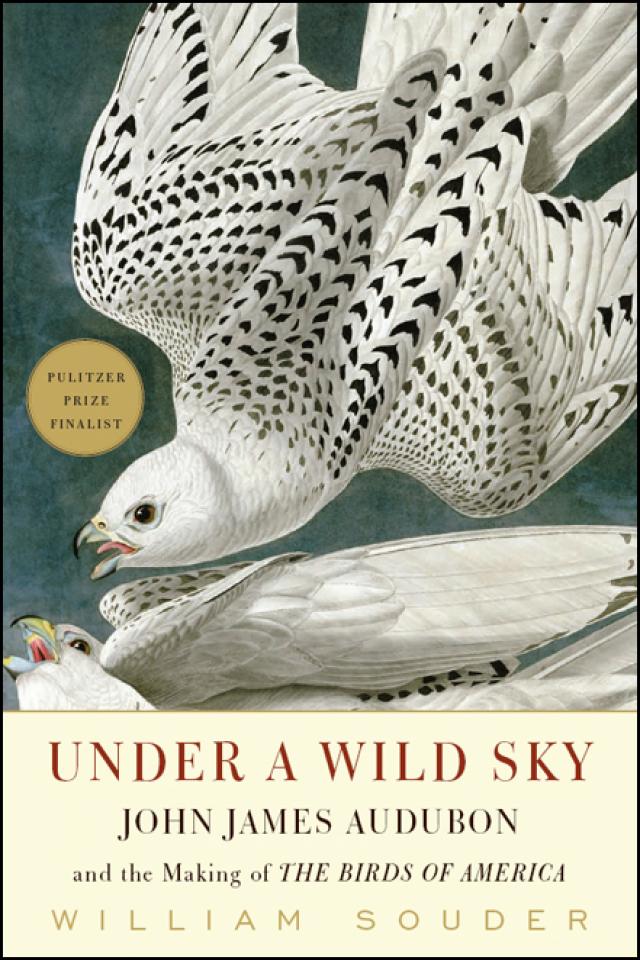


From Edinburgh, Audubon went back to Liverpool—pausing at Twizel House for a couple of days to shoot pheasants with Selby and Jardine. Perhaps less certain of himself after the long and only partially successful collecting trip, Audubon was thinking again about other ways to make money. One idea he had was to limit the number of subscribers to The Birds of America to 150, keeping those proceeds for himself. Additional copies would then be printed and bound for booksellers in London, Paris, and other large markets, with Audubon collecting some sort of royalty on sales. He thought this could work because it was now clear from the reactions of everyone who saw The Birds of America that it was unique. There’d never been anything like it and probably never would be again. In the meantime, Audubon could always earn a little extra by doing small paintings of birds. These sold quickly, he said, now that he knew “the tricks of the trade.” A few weeks later, Audubon changed his mind again, returning to his old idea of finding a permanent position as a resident artist—either with a public institution or a wealthy nobleman. He thought such a job might pay as much as £500 (about $2,250) a year, leaving all the money from The Birds of America as profit. That way, when the last engraving was done he and Lucy could go back to America to live out the rest of their lives at leisure. To Lucy, Audubon’s talk about their joint “return” to America was premature, to say the least.
Audubon reported that his health was fine, and that he walked a good deal and still got up at dawn whenever he could, convinced that keeping to his habits from the woods was beneficial. But now Audubon, who was so often described as “simple” or “authentic,” and who had kept his composure through so many reversals, made a surprising confession to his wife. He admitted that he was a hopeless perfectionist. After trying to paint in oils for years, he said he at last despaired of ever becoming competent in the medium. The only people who bought his oil paintings were friends, acting, he suspected, out of charity. This was so humiliating, he said, that he planned to give up oils for good. He knew he would regret this decision forever, he said, because “Man and Particularly thy husband, cannot easily bear to be outdone.” Audubon said he wished he had “another life to spend.”
Lucy could not have been entirely pleased with the way he was spending the one he had. Audubon signed off saying he was due at Green Banks to see Mrs. Rathbone and Miss Hannah. He told Lucy that he wished very much that she would write to both women. They were kind and gentle ladies, he said, and ought to be “thought of often.” As if that weren’t enough to make Lucy want to throttle him, Audubon added a warning so preposterous that Lucy must have wondered what he had been telling people. Audubon said that Lucy should never intimate to the Rathbones—or to anyone else—that the Audubons were poor. It seemed that everyone in England was under the impression that Audubon was well off.
Audubon did not send for Lucy in January. Back in London and again cozily established on Great Russell Street, Audubon instead bought her a piano, which he had shipped to New Orleans. He said he hoped she would give it to Victor when he at last sent for her to come to England. But now he told Lucy he “dare not yet invite Thee,” even though he continued to make progress with new subscribers and the sixth Number was under way.
Audubon did not send for Lucy in February, or in March. He did mention that he was thinking of going to Paris for a while. He reported selling several subscriptions to The Birds of America on a trip he’d made to Cambridge. Audubon was happy to learn that Victor had visited Lucy. His son had even taken a moment to add a few words to him in one of her letters. Evidently Lucy worried that Victor was too skinny. Audubon assured her that he was only tall, and would soon enough put on weight. In another letter a few days later—addressed once more to “My Dearest Friend”—Audubon said he was still “imperfect in my thoughts” as to Lucy joining him in England. He didn’t send for her in April, either, nor in May, nor all summer long. He had now been gone for more than two years. In August he wrote to say that the Havells were starting on the tenth Number. But although everyone continued to speak glowingly of The Birds of America, Audubon found that he had to spend more and more time replacing subscribers who canceled their orders. Once again, he told his “dearest friend” that he was miserable without her. “My anxiety to have thee with me as thou may well expect is greater every day,” he said. “We are growing older and have been parted so long that I feel as if abandoned to myself.”
About this time, Audubon again mentioned that he needed more drawings to complete his ornithology. But instead of contemplating a return to America for this purpose, he once more implored Lucy to make John Woodhouse practice his drawing. Audubon said he would gladly send money for drawing supplies. He didn’t explain whether he thought Johnny’s drawings could go directly into The Birds of America or serve only as references for his own depictions. He also asked that, in whatever spare time remained to him, John Woodhouse shoot and skin as many birds as he could—and ship them to England as soon as possible. Audubon said he was in need of turkeys and cranes and hawks, plus some other species. But he said Johnny was not to worry about what was gotten and was instead to shoot and carefully skin every bird he could, no matter what it was.
Audubon now began to talk about what a help Lucy would be to him in London, especially when he had to be away on subscription calls. Wearingly, he said he was still worried about money and wasn’t ready yet to send for her.
Lucy was understandably mystified. In June she’d written to Victor to confess that she no longer knew what to make of Audubon’s apparent indifference to a separation that seemed more permanent by the day. She said she could not decipher the many conflicting messages that floated among the disjointed lines he wrote to her. Audubon had warned her, she told Victor, that it would be a very long time before The Birds of America was finished and that he would most certainly want her and John Woodhouse to join him in England just as soon as it was possible. At the same time, he told Lucy that England was “not what it was” and that she might not care for it at all. If she decided not to come he would understand.
“What he really means I cannot tell,” Lucy wrote to Victor. “Those are his words and we must interpret them as we can.”
Lucy chose to interpret them thus: She wrote to Audubon and told him any thought she had of coming to England was now indefinitely on hold. Audubon wrote back and told her, his “dearest friend,” to please “make up thy mind.”
But he did not ask her to come.
Audubon’s mood was up and down. He heard that he was being made fun of back in Philadelphia, where everyone was shocked at his success overseas. In London, there were likewise people who thought his work over-rated. Subscriptions ebbed and flowed, cancellations and new orders staying in a precarious balance. Feeling especially low one day, Audubon got out his painting of the white-headed eagle and altered it on the spot, replacing the goose the eagle was shown feeding on with a lowly catfish.
Audubon had a friend named William Swainson. They’d met after Audubon was approached by a man named John Loudon, who was launching a magazine about natural history, to be called Loudon’s. Loudon wanted Audubon to write something for the magazine. Of more interest to Audubon was Loudon’s suggestion that Swainson, a zoologist who lived north of London in the country near St. Albans, write a review of The Birds of America for the inaugural issue in May. Audubon and Swainson had become close, thanks in part to the questionable arrangement Swainson proposed with respect to this review. Swainson bluntly told Audubon that he would compose a highly favorable notice if Audubon would provide him “at cost” with a full set of The Birds of America as so far completed. Audubon, who was more than happy to strike a deal, had a laugh. Despite the hopeful calculations he’d been relaying to Lucy, the truth was that subscriber numbers had not yet reached the breakeven point, and The Birds of America was still being produced at a loss. He sent Swainson a note promising him a copy of The Birds of America at a fair price that he would figure out. “I assure you my dear sir,” he told Swainson, “that was I to take you at your word it would be a low bargain for you as the amount would be very nearly double that for which it is sold to my subscribers.” A couple of weeks later, Swainson invited Audubon to dinner at his home in London. Audubon, who still suffered occasional bouts of paralyzing shyness, sent a note saying he would come at six that evening if it was convenient, nervously adding, “I am an extremely plain man, and always anxious not to be an Intruder.”
After the flattering review appeared, Audubon let his guard down with Swainson—although he was briefly shocked to learn that Swainson had been corresponding for a number of years with an American colleague by the name of George Ord. Audubon, dying to unburden himself to a willing ear, confided to Swainson that his marriage had become an extended transatlantic misunderstanding. He told Swainson time passed “heavily” for him in London. He hoped someday that he and Lucy would call on Swainson at home in the country, but added that it would depend on “if I ever see my wife again.”
At the beginning of July, Audubon sent a note thanking Swainson for having supplied him with a small white lamb that had been delivered “alive in a basket.” The lamb now existed only on canvas in the “effigy” Audubon had painted of it being attacked by a golden eagle. Audubon said he’d also been hard at work on new versions of the turkey and the white-headed eagle, painting feverishly day and night. Apparently, Swainson didn’t care much for the lamb-and-eagle painting, as he never said anything about it after visiting Audubon at his new apartment. Audubon had taken rooms on Newman Street, directly above the Havells’ shop. It was handy, Audubon said, though he missed the open spaces of Bloomsbury.
By August of 1828, Lucy’s growing impatience sent Audubon into a new tailspin. She informed him that she had borrowed some money from her brother William and had sent John Woodhouse to attend a school in Louisville. Lucy said she planned to follow him there and, unless she heard otherwise from Audubon, to make her own way in the world going forward. Audubon’s already “despondent spirits” sank lower still. He told Swainson that thoughts of suicide had swept over him. Then, out of the blue, he asked Swainson if he would accompany him on a trip to Paris. He told Swainson he had put away his brushes, unable to even think about working. He said they could go to France whenever Swainson was free, and stay there as long as he cared to. Audubon spent the next few weeks researching travel options.
Audubon, accompanied by William Swainson and Swainson’s wife, spent two months in Paris. Fourteen new subscribers signed up for The Birds of America. The trip was otherwise forgettable. Audubon had worried almost constantly that the story of his birth and adoption would be discovered. Returning to London in November, he was excited to find two letters from Victor waiting for him. He wrote back to say that he was happy to know that both Victor and now John Woodhouse were well situated in Kentucky. But he told Victor that it was unlikely he would visit them there anytime soon. Unless “some accident” befell his drawings, he had quite enough to carry on for the foreseeable future. He said he had 144 subscribers and was free of debt. He had begun to think about a “perpetual” exhibition of the oil copies of his birds now under way with Joseph Kidd in Edinburgh. Audubon thought he might send the collection to Russia for a while before establishing it permanently in London. In spite of it all, Audubon said, Lucy was resistant to the idea of joining him in England before he had acquired a “great fortune.”
Victor was caught between his feuding parents, both of whom now vented their unhappiness to him. Audubon had learned that Lucy was disappointed in the piano he’d sent her, and this seemed to confirm his unreasonable conviction that he could never satisfy her material needs. In fact, the rooms above the Havells’ shop on Newman Street—a narrow, quiet lane in the West End—were spacious and Audubon had even hired a young woman to clean and cook and mend his clothes. Without Lucy for company, Audubon was left to roam his apartment and stew. He continually pored over a growing clutter of pictures, drawing equipment, and books. Looking at his own drawings, Audubon said, transported him back to America. Every bird reminded him of where he’d been and what the woods were like where he’d shot it. It’s doubtful these memories improved his general outlook. Audubon had now been gone for two and a half years. In truth, his mental state had been fragile for nearly ten, ever since the collapse of his businesses at Henderson. A decade of erratic mood swings, headaches, insomnia, nightmares, financial uncertainty, and the occasional hallucination now filtered into his strained communications with Lucy. He wanted her to come but would not send for her. He told her to stay in America and then despaired when she said she would. Just before Christmas, Audubon sent Swainson a note saying he had “the blues completely.”
Christmas came and went, the holiday a hollow, haunted misery. Audubon had to decline the Swainsons’ suggestion that he spend some time in the country with them, having accepted an earlier, less appealing invitation. And he was angry enough when Havell Senior took an unannounced vacation that he transferred the whole job of engraving and coloring The Birds of America to Havell Junior. Sometime after the first of the year, something snapped—on both sides of the ocean. Audubon decided to go home and, if she would agree, bring Lucy to England. Lucy, devastated by Audubon’s recent letters, made up her mind to go to England in hopes of saving their marriage. If she’d had enough money to leave right then, the two might well have passed each other on the Atlantic.
In mid-January of 1829, Lucy wrote to Victor, telling him that he had in effect become the man of the family—he was old enough now to be her friend and confidant. She said a recent letter she’d gotten from Audubon was his most bitter yet, “severe” and “painful” and a sorry reward indeed for all she had done for him. Had she not, after all, supported everyone in the family for the better part of the past ten years? Somehow, she said, Audubon had gotten it in his head that she would never join him in England unless he could afford a “Princely domain.” Spitefully, he’d told Lucy to let him know once and for all whether she would come over—otherwise a formal separation would be in order. Truly, Lucy said, Audubon was “blind” to the real state of their affairs. Accordingly, Lucy said she would now act as her own agent, and would decide what was best for her and her sons. Her plan was to remain at the school at Beech Woods for another year. Then, in the spring of 1830, she would come for John Woodhouse in Louisville and take him to Europe to continue his education. Avoiding any direct mention of reconciling with Audubon, Lucy added that she felt this course of action was her “duty.” Lucy, who had a lifelong fear of ocean voyaging, told Victor that the dangers of the Atlantic crossing would be nothing next to the pain she would feel at leaving him behind in America. But they would have to “trust to providence” for their happiness. If for some reason she could never return, she hoped Victor would go over to Europe and bring John Woodhouse home someday. She begged Victor not to say a word of any of this to anyone—especially because “circumstances may change.” This included not so much as a whisper to Audubon. “Do not write to your Papa anything about it my Dear Son,” Lucy said. “Leave it to me to settle with him.”
At virtually the same moment, Audubon was writing to Lucy from London. No longer able to stand the uncertainty of her coming to England, he had decided to come to America for her. He said he expected to leave around the beginning of April. Although he had known he would someday have to go to America to continue his work, this was much sooner than he had hoped. But—evidently unaware of how odd this sounded in view of his repeated insistence that Lucy delay coming to him—he told her now that this was the only way he could “persuade” her to come over.
It’s impossible, after more than a century and a half, to fathom exactly what was happening between Audubon and Lucy. The long, uncertain lines of communication between them surely made it hard for them to understand one another. But there was also an obtuseness on both sides of the ocean, two complicated halves of a relationship that were entrenched in positions fortified against one another—a husband and wife at loggerheads and perversely determined to remain so. Audubon’s letters, brimming with erratic assessments of his finances and grim hints of his anxious mental condition, careen between professions of endless love for Lucy and an unfeeling effort to keep her away. Many contained worrisome references to Miss Hannah Rathbone. It seems obvious that Hannah and Audubon were smitten with one another, though how far the attraction progressed can’t be known. Audubon thought about Hannah a lot, but he did not see her often after his first months in Britain. If there was a liaison between the two, it was short-lived.
But the Audubons’ transoceanic spat went on and on. Lucy’s letters, many of them from this time long lost, betray her stubbornness, her fear of ocean travel, and her concern for what was to become of Victor and John Woodhouse. Lucy still thought in terms of the family, whereas Audubon focused on himself. What she seemed to want—and most need—was a clear signal from Audubon in place of his vague and oft-delayed plan for her to join him. She never got one.
Audubon was also seriously worried about the effect his leaving London might have on the progress of The Birds of America. He had every confidence in young Havell to keep the job going, but doubted that everyone else would be so sanguine. John Children had agreed to oversee the project in his absence—a comfort, but only a partial one. Audubon feared that if word circulated among his subscribers that he wasn’t personally supervising the engraving, many would back out. He was concerned enough that he initially planned to travel under an assumed name—after putting out a cover story that he was going to the European continent to sell subscriptions. But he eventually dropped the idea of going incognito, and instead considered notifying the papers in America of his arrival, since he would be traveling with copies of The Birds of America in the hope of landing some American subscribers.


