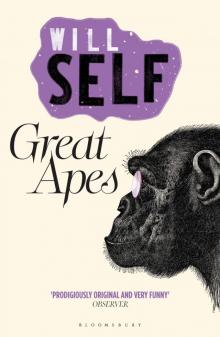
Will Self's Collected Fiction, Vol. 2 (2014), page 133
part #2 of Will Self's Collected Fiction Series


In those days Bret had struck me as high, wide, handsome and more than a little bumptious – this was forgivable, given that he was scarcely thirty and already with the masterpiece of Citizen Kane to his credit. Now he seemed leaner – the Welles glimpsed only briefly on camera during the shooting of his Rockefellerfunded South American travelogue, a fiasco that had ended up way over budget. Perhaps it was this that had winnowed him out?
He finished ordering with a run through the white wines available by the glass, before settling reluctantly on a Zinfandel.
‘And for you, sir?’
‘Me?’ I was flustered, and as my Adam’s apple scraped in my dry throat I flashed back to the $1,000-per-night poolside cabana where I had checked myself out obsessively in the mirror before this rendezvous. What madness! How could I have forgotten the thinning hair, the pocked cheeks, knobbly knees and hairless ankles? I was Postlethwaite, of course, and no matter how many Kiehl’s bath products I lavished on myself there was no possibility of my seducing Bret, I mean, I was hardly his type.‘Uh, I’ll have … the same as him.’
It was the pathetic non-order of a subaltern of style, who knows nothing and so uses the quince spoon to ream his pipe.
Two pools of thick soup soon lay before us, inscribed in truffle oil with the worthless autograph of the sous-chef. ‘A script is a commodity,’ Bret was saying; ‘nothing more – oftentimes a hell of a lot less. It’s no longer simply a case of “to the victor the spoils”; the actual craft of screenwriting has become having the balls and the connections necessary to get your credit.’
He stopped speaking and began paddling his fibreglass face towards the soup. I already regretted having given him the whole death-of-film shtick, although at least he seemed to think it was a metaphor – and when I’d contemptuously observed Postlethwaite babbling my lines, I’d held back from admitting I was in Hollywood to find its killer or killers.
‘But, Bret,’ I said, ‘you’re a native Angeleno, your own books have been filmed – isn’t The Informers in production right now? – you must feel an affinity for the industry?’
‘Industry? It isn’t an industry any more, man, it’s a fucking business. I tellya, if I’d’ve known the whole extent of the bullshit I was going to get caught up in, I never would’ve come back – and now there’s this other crap, the writers’ strike.’
‘Why did you stay?’
He sighed, an expiration that was mouldering in its dead civility: ‘Phew … Money, dummy – I need the money.’
Welles and Ellis – they seemed like a failed anagram or a botched palindrome. Certainly, Welles had never bettered this performance, what with its re-uptake of inhibited diffidence, its Mesolithic tedium vitae. I recalled that shocking first sight of him as Captain Hank Quinlan in Touch of Evil, lunging up from his squad car, his saltpan of a face mottled and cracked. He was only forty-two when he wrote, directed and acted in the movie, yet the taint was already on him: green grave weeds, rotting at the edges. Did he see then how it would all end up, with his final role being the voiceover of Unicron, the planet-eating robot in the first Transformers movie?
The waiter came across and took our soup bowls. The restaurant had filled up with hay-hair honey-skin blondes in knock-off couture squired by men fully suited. Still, with no climate variation to speak of all four seasonal collections could be spanned by a few degrees: if the temperature fell to seventy, couples began promenading Sunset togged up as Nanook and Nyla of the north. The waiter returned with the halibuts and a bottle of Powerade tucked under his arm. I was about to remonstrate with him when he swerved aside and plonked it in between the tête-à-tête at the next table, so that it hovered in my own mid shot.
‘Whoa,’ Bret muttered, ‘the hard stuff.’ Then he went on about the death of film as he teased out fish bones with the tines of his fork: ‘I don’t think you’re right, there’s always dynamism in movie culture, whatever the mechanics of production. Even now with this, like, avalanche of product there’re still innovative things getting made.’
‘Like what?’
‘Well, Knocked Up– didya see Knocked Up?’
I groped in the mildewed reticule of my memory and came up with, ‘Um, yeah, sorta slacker comedy type thing. Not bad.’
‘Not bad? It was a whole new approach to formula pictures like that. You should read the New Yorker review – actually, it was more like an essay—’
‘By Anthony Lane, right?’ I simpered disparagingly, while thinking most of what follows.12
The Love Guru
Billboards advertising this movie’s release dominated my circumambulation of the Los Angeles basin, and during my 120-mile, week-long walk I must have passed scores of them depicting the Canadian comedian in a fake Bhagwan beard and the orange robes of a sannyasi, sitting cross-legged, one hand grasping a yellow flower, the other held – incorrectly – in the Varada Mudra pose of Theravada Buddhism: palm out, thumb and index fingers touching. Myers was, it transpired, welcoming moviegoers into an entertainment that – even by his own unexacting standards – was a pile of shit: impotent sexual innuendoes, incontinent scatological jokes, bigoted intercultural gags – The Love Guru had ’em all.
I assert this, but when I eventually saw the movie in my local hot-buttered multiplex, I realized I was in no position to judge it, for so long had I been out of the celluloid loop. Sure, it was shit – but then for all I knew all movies were shit; either that, or, given that cinema was the world’s dominant narrative medium, the silvery mirror in which Humanity viewed its own raddled features, perhaps those features were themselves daubed with shit.
Besides, I was not insensible to the halo effect, whereby the new work of any given filmmaker is surrounded by the penumbra of his or her earlier efforts. In Myers’s case, The Love Guru came haloed in shit, because I’d disliked his movies from the very first time I’d seen one, on a flight back from New York in June 1992. I suppose if I had the exhaustive critical intelligence of an Anthony Lane, rather than the planet-devouring negativity of a Unicron, then I might reserve my judgement (both then and now), not having seen the original Saturday Night Live sketches on which Wayne’s World was based. But I appeal to your own better judgement: would it really have made any difference?
Sixteen years ago I failed to find any charm in the two provincial bohunks and their amateurish cable TV show. My companion on the flight, Charles Hudson, was, however, happy to lose himself in the fartantics of Myers and his co-star Dana Carvey for 94 minutes. Then we talked, drank vodka miniatures and I smoked. Strange to recall how cigarette smoke looked in plane cabins: the ghost of a smirch in the rapidly rarefying atmosphere; it’s something my own children will never see, although they may well live to witness the extinction of mass air travel that my own generation saw evolve – all those dinoboeings, choked on their own tailpipes.
We drank many, many Smirnoff miniatures and decompressed from our Stateside trip in the acrid fuselage. On our first evening in Manhattan the crack vials had crunched under foot as we made our way downtown to go clubbing. Late that night I had to wake Charles up and ask him for a sedative – I knew he had some, old-school things, chalky little manhole covers inscribed with one of those Big Pharma coinages – Evaqual? Navarolt? Intephrine? – that make anxiolytic medications sound like the bastard offspring of a Turkish fisherman and a planet-eating robot.
Slowly, the Kematrol beat the cocaine hydrochloride molecules into submission. I stopped having to patrol the nylon trench in between the twin beds, ceased to be worried that the TV stand would sink further into the tufted orange hotel carpet. A couple of hours later I fiddled open the glassine envelope and tipped the last of the coke on to the toilet seat in a stall at La Guardia, then flubbered it up.
The flight to Syracuse was uneventful, if, that is, you’re used to the transcendent misery of realizing you have been sent back from the future and at any minute will be killed – a murder that you yourself witnessed as a small child. I was used to this. From the airport I took a cab to the university’s Health Science Center. Dr Thomas Szasz, a dapper septuagenarian in a neat blue suit, was waiting for me in a room full of ventilation ducts and polystyrene fire-retardant tiles that audibly crackled with static electricity.
I recall my conversation with Dr Szasz perfectly well (or should I say, with his impersonator, for I realized soon enough that he was being played by Donald Pleasence in his last major role), and in particular his goulash-thick Hungarian accent that added the suffix szasz (pronounced zarj) to many of his words, thus: ‘Yesasz, my criticszasz are many, my enemieszasz ubiquitouszasz,’ giving me the uncanny feeling that his speech was a form of prayer, consisting in the incantation of his own – possibly divine – name.
Not that there was anything self-worshipping about the veteran anti-psychiatrist (as portrayed by the valetudinarian actor). I had a journalistic assignment, but was also interested in speaking with him because he had known Zack Busner well during the early 1960s. At that time Szasz was working on what would become his signature work, The Myth of Mental Illness, while Busner was setting up his ‘concept house’ in Willesden. Both were engaged in a revolt against the dehumanizing character of institutional psychiatry, both fundamentally questioned its view of mental pathologies, but only Busner had ended up on celebrity game shows.
Peering over his bifocals, Szasz looked at me as if I were a psychic gift sent by his old comrade in arms-thrusting-from-the-walls-of-her-flat. I told him about the Riddle, and how buying up shares in the manufacturer had almost financially bankrupted Busner, just as publicizing the enquire-within tool had done for him professionally. ‘I seeasz, I seeasz,’ Szasz muttered as I spoke; then when I’d concluded he said: ‘It isasz, I think, a caseasz of hubriszasz.’
‘Hubris?’
‘Exactly, hubriszasz. You seeasz, like me, Zack Busnerasz believed that schizophreniasz was not a pathology at all, only a semantic confusionasz.’
‘And it isn’t?’
‘No, of courszasz not – researcasz in the last thirty yearszasz haszasz conclusively established the genetic basiszasz of schizophreniasz, if not its actual causzasz.’
‘So, you were wrong?’
‘We were wrong, which is by no meanszasz to endorszasz the way the therapeutic state treats schizophreniasz, or to admit that any other so-called mental illnessasz – such as depressionasz – are anything of the sort. But in this caszasz, we were wrong. I think perhapszasz that Busner is too proud to admit thiszasz, and so …’
His fingers, which had been steepled beneath his chin, now interleaved, then inverted to reveal all the pink little people straitjacketed in his institution. So, as you can see, it was an epochal encounter for me – one that had far-reaching consequences, especially when I became aware that Szasz had cofounded, with the Church of Scientology, the Citizens Commission on Human Rights.
For the rest of the interview Dr Szasz treated my questions seriouszly if peremptorily, szwiping them out of the air in such a way as to suggest he was translating from one conceptual language into another. Which made it all the more bizarre when, at the end of our hour together, he turned hospitable – very hospitable – and suggested that while he had no wish to detain me against my wishes, I might like – on a purely voluntary basis, of course – to be his guest in a nearby facility … indefinitely.
On the same trip to the States, Charles and I went up the Twin Towers. Given subsequent events, I’d like to be able to tell you that they made a big impression on me, but that would be a lie. Indeed, I can honestly say that I never gave the vast blocks another thought from that day until 11 September 2001, whereas my revulsion from Mike Myers returned again and again over the years, rising unfunnily up my gorge whenever I caught a few seconds of a trailer for one of his movies, saw a poster, or even heard the words ‘Mike’ and ‘Myers’ in completely unrelated contexts.
The scene in The Love Guru that most outraged me was one involving the actor of restricted height, Verne Troyer, who Myers had imported from his earlier Austin Powers movies to play the foul-mouthed manager of the Toronto Maples ice hockey team. I suppose that given my own issues it ill behove me to be quite so censorious, but when I saw Troyer upbraiding the Guru (Myers) and his star player (Timberlake) in a scaled-down office obviously modelled on the dwarfish train carriage set in the Marx Brothers’ At the Circus13, I longed for one of those vodka miniatures that I drained during the 1992 JFK to Heathrow flight to magically reappear in my hand, so that I could smash it against the wall of the cinema, then plunge it into Myers’s chipmunk cheek.14
It may be the vagaries of memory, but I think the vodka miniatures were glass. I don’t believe either Charles or I behaved at all badly – we didn’t even raise our voices, only unravelled the way even well-knit folk do when drinking to excess on long-haul flights. Nevertheless, about an hour before landing the stewardess approached our scaled-down barroom and told us that she refused to serve us any more liquor, and that if we didn’t moderate our language she would have the pilot radio ahead and we would find the police waiting for us upon touchdown.
‘He was wearing crocodile-skin shoes the last time I saw him,’ Bret was saying of a former brat pack writer-buddy. ‘He told me they cost $20,000.’
I pushed my spoon through the quarter-inch of tarte au chocolat and it clicked with china. The waiter materialized with a vodka tonic for Bret; then, as he turned away, he moved the bottle of Powerade from one point on the adjacent table to another more exactly in my own mid shot. As if this set-dressing were the cause, the voices of the other diners were now right in my ear.
‘It’ll be huge, see,’ the man was saying. ‘I mean, we’re with this guy all the way – he doesn’t know who he is any more, hell, he doesn’t know who anyone else is either.’
‘Uh-huh.’
I’d misread the situation: this wasn’t a date; the suit was pitching to hay-hair, who had to be a studio exec.
The suit pressed on: ‘Everyone he runs into is played by an actor – some well known, others not so, and people’ll have a great time trying to identify who’s who – that’s how they identify with his, his—’
‘Condition, yeah, I hear you.’
‘But there’s more’ – he began waving his hands – ‘our guy has these delusions, he sees things, he hears voices, everything is incredibly significant – everyone is in on the conspiracy –
‘He’s a paranoid schizophrenic, right?’ She was bored. ‘Lissen, Griffin, I don’t want to, like, pop your bubble, but I’ve had people coming on to me with these psycho ideas for months now – it’s all over town like a goddamn rash.’
I could understand why Bret didn’t want to sit next to anyone in LA. I couldn’t tell if he’d overheard the schizopitch; his face bore an expression of frightening ennui. I began babbling: ‘I’ve been reading your Lunar Park, man; it’s great, truly great – maybe your best yet. I love the way you play with your own identity, create a doppelgänger – but isn’t that what the movies can do now, there’s no disbelief so heavy that it can’t be winched up with fleets of computer-generated helicopters? I mean, it’s also like a psychosis, believing in this stuff even for a second – that’s why they’re putting so much into the new 3-D technology. Shazzam! And you’re in the insect mines of Minroad. Shazzam! again, and you’re in some poor fucker’s liver, kayaking down his bile duct … and, well, this is what we fear, isn’t it? The numbers of people with mental illnesses are increasing exponentially – bipolar, hypomania, OCD, dementia, addiction, schizo-fucking-phrenia – it’s a plague, and these Hollywood movies are expressing that fear! What’s so incredible about the Hulk? I’ll tellya: he’s got BDD, body dysmorphic disorder. He’s a perfectly ordinary guy but he thinks he’s got green skin and this, like, obscenely muscled—’
The waiter was back with a credit card receipt to sign. I scanned it and from the total realized we were going Dutch. Bret was already tucking his Mont Blanc back inside his jacket. I had no idea if he had heard what I’d been saying – or if I’d said it at all.
‘Look.’ He was staring at my retreating figure in the rear-view mirror of his mind. ‘All work and no play makes Jack a dull boy – this script, the rewrites, it’s been grinding me down, besides I gotta drive.’ Bret got up to leave, and when he turned his back I snagged the Powerade from the next table, cracked the lid and drained it in a single heady draft, then I followed his shrinking back.
While we waited under the porte-cochère for Bret’s car, I tried to revive the conversation. Where was he living? Did he get out much – socialize? The more fatuous my questions, the more his face folded in on itself, an origami of mouth tucked under ear, ear poked behind eye. Eventually I resorted to blandishment: ‘Ellen DeGeneres is throwing a little party for me Friday evening at the Bar Marmont.’
‘For you?’
‘It’s a very little party – more of a gathering, really. Anyway, if you show up that would be … nice.’
The parking valet leapt from behind the wheel of a big black Beamerish wagon and held the door open for Bret. I was reminded of the scene in Swann in Love, Volker Schländorff’s adaptation of A la recherche du temps perdu, in which Odette de Crécy (played by Ornella Mutti) is dressed by her maid with a sensuousness all the more compelling for being an expression of the way nineteenth-century labour relations made of one woman’s body a workhorse, and another’s a commodity to be sponged clean, then boxed in its clothes.
The valet clothed Bret in his black BMW, tucking him between its steely folds and binding his breasts with a nylon band. The final touch was to lift his limp legs and insert them into the leatherette hole formed by the seat and the dash before shutting the car door with the sumptuous delicacy of someone smoothing rumpled silk. The window moaned down and I was confronted by two anxious Postlethwaites leering from the lenses of Bret’s Ray-Bans.