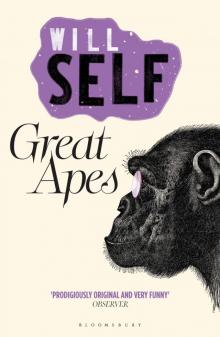
Will Self's Collected Fiction, Vol. 2 (2014), page 119
part #2 of Will Self's Collected Fiction Series


Mm, house truffle, Earl Grey pearl and liquid salted caramel – popping one of the dusty balls into my mouth I preferred to think of Him as a cosmic artisan du chocolat. The plane had reached its cruising height of 35,000 feet over Ireland, but why not 350,000 so we could orbit the earth with fiery Apollo, or 3,500 so we could see the zephyrs comb the heathery chest of the Black Mountain? Ach! The vicious constraint of worshipping the infinite through the contemplation of the vanishingly small was getting to me – that and the multiplying and then dividing of truffles, clods, bald-headed men and book pages … I must have slept, exhausted – or at least assumed I was dreaming, otherwise it would’ve been madness to pop the catch of the overhead locker with the frummer’s great crate in it.
The plane hit an air pocket and the case slammed down on top of me. The zip was already open and Sherman tumbled out, dressed in a black rollneck and black jeans, equipped with a head torch and wire cutters. ‘What the fuck!’ he exclaimed. ‘I assumed the frummer would check me in as hold baggage.’
I looked up the aisle, but the cabin crew were all goofing off in their curtained booth; as for the passengers, not a single one seemed to have noticed – they were all lost in the light caves hollowed out of the back of each other’s heads. Sherman disentangled himself from old-fashioned flannel underpants, long black socks and a prayer shawl. I watched him, thinking of the first six-inch TV I’d had back in the early 1980s.
While the miners had fought the Battle of Orgreave, I lay on a slagheap of mattresses watching James Robertson Justice play Vashtar, the leader of an enslaved people (I don’t recall the J-word) compelled to build a mighty pyramid for the Pharaoh. The wide open desert, the massed teams of extras pulling stone blocks on rollers, the whole CinemaScope sweep of the epic compressed into that tiny screen – I squinted at it, awed.
‘C’mon,’ hissed Sherman, leading me aft.
As we prowled up the aisle the plane banked slightly and my eyes were flung sideways down through a window to where, 17,000 feet below, the emulsive cloud had congealed into a vast simulacrum of the paths, box hedges and yew avenues of a formal eighteenth-century garden. As I watched, humbled, a monstrous baby staggered upright from the horizon 300 miles away, its chubby arms formed by vortices of cumulo-stratus. As the plane drew closer I saw that this apparition was one of my own children; it seemed that Gaia had been busy uploading the essence of my sentimentality and fashioning it into this towering love object – which we flew straight through.
‘Will you come on!’ Sherman pulled my sleeve, and reluctantly I joined him between the stainless-steel galley and the flimsy toilet doors, where he went unerringly to a section of carpet and lifted it to expose a D-ring. He opened the hatch and we let ourselves down into the cold booming hold, the beam of his head torch picking out the Samsonite blocks on pallets.
‘Y’know Faulkner had a screen credit on Land of the Pharaohs’, I remarked, apropos of everything, but Sherman only hissed:
‘Will you shut the fuck up,’ and went about his task with a will, snapping combination locks with his clippers, then unzipping the bags so that their contents spilled on to the aluminium deck.
‘Look at this drek,’ he said, snatching up a handful of stuff. I recognized the seat covers we had had in my childhood home, the print of a historic map of Worcestershire that had hung above the phone table, a paperback edition of C. E. M. Joad’s Guide to Modern Wickedness and my mother’s dentures.
‘Can you believe people cross the Atlantic with such tat,’ he spat, ‘and pay for it too!’
‘Dentures are pretty much essential,’ I said, ‘if you don’t have any teeth.’
Sherman slid down the baffler of bags until he was sitting. The cyclopean eye of his torch dazzled me, and his voice – nasal, insistent – soared above the jeremiad of the jets. ‘You and your dumb books!’ he prated. ‘Micro-satire, dirty doodlings in the margins of history!’
‘I say, that’s a bit harsh.’
‘Is it? When Gutenberg invented the printing press there were at most a hundred titles produced annually; by 1950 this had swollen to a quarter of a million; now a book is published somewhere in this dumb world every twenty seconds, and you have the nerve – no, the gall, to contribute to this flood of verbiage that is inexorably inundating the land with illcontrived metaphors!’
‘I – I …’ I wanted to rebut him forcefully; instead I only spread my hands and said, ‘I don’t know how to do anything else.’
Add a dream, lose a reader – isn’t that Uncle Vladimir’s line? Well, the lover of little girls has aught to teach me. I awoke as the British Airways flight settled down over Toronto and shat its undercarriage, sending said reader end over end, down to where the survivors had retreated, a network of tunnels deep under Chaillot. The victors stood guard over a kingdom of rats. In the half-light before full consciousness I took in the drear panorama of the razed city, the stalk of the CN Tower wilting among the charred stumps of the skyscrapers, the grid pattern of blackened rubble – all of it irradiated by the sickly green glow from Lake Ontario.
I remembered my first visit to Canada in 1977, with my father. We stayed out in Dundas with his friend, the philosopher George Grant. While they debated Red Toryism, I lay upstairs on an iron bedstead smoking. I loved the Players pack, the way one side read ‘Players Filter’ and the other ‘Players Filtre’ – all of Canadian happenstance seemed bound up in the reversal of e and r.
I took a bus into town and wandered the Hagia Sophia of the Eaton Center in a consumerist ecstasy – it was big enough to swallow whole five of London’s poxy malls. I bought a disposable lighter for a few bucks – the first I’d ever seen – and when I got back to Dundas I lay back down on the iron bedstead, then held the translucent green canister to my eye so as to look through the liquid gas.
I left the frummer behind where we had been sitting. He appeared stricken, making none of the phone calls that other passengers had begun the instant the plane had landed; nor did he rise to retrieve his flight bag from the overhead locker. But I couldn’t concern myself with that – the flight had arrived almost two hours late – and so I strode off through the dun corridors, hopping on to travelators with whistling insouciance. The two men crammed into dun uniforms at Immigration only glanced at my passport. I was kicking about in the dun arrivals hall, pondering my transport options, when I became aware of snuffling behind me and turning discovered the frummer looking very down-in-the-beard and accompanied by a member of the airline’s ground staff, who was pushing a wheelchair in which sat the obese flight bag, its front zip creased in a complacent smile.
‘What’s the problem?’ I asked brightly.
‘It’s dusk … so, it’s Shabbat,’ he muttered. ‘You must’ve noticed me, on the flight … as soon as I realized we were gonna be delayed I began trying to get through to someone by phone.’
‘And?’
‘Yes’ – he stared shamefaced at his black dress shoes – ‘I guess you’re right – it wouldn’t’ve made any difference, I can’t go in any car on Shabbat.’
I was merciless. ‘Or bus, or train.’
‘Or bus, or train.’
‘You’ll have to stay out here at the airport.’
‘No, no, I can’t do that, it’s a really important Shabbat, the last before my youngest son’s bar mitzvah, I must get home.’
‘Well, you should’ve thought about that before you booked a flight with an insufficient margin of safety.’
‘I know, I know,’ he moaned.
‘Of course’ – I looked towards the main doors where gentilemobiles were pulling away from the kerb with unholy despatch – ‘you could always walk.’
‘Walk …’ He savoured the word in a prayerful way.
‘Yup’ – plunged my hands into the pockets of the Barbour – ‘walk – I think I’ll walk into town, the weather’s OK and I could do with stretching my legs. You’re welcome to come with, but I’d advise you to check that into left luggage – it’s a good seventeen miles.’
‘Walk …’ I hadn’t noticed the flattened vowels of his Canadian accent before, the a cowering as if an umlaut had been fired over its head. ‘Yes, I guess I could walk, but I’ll have to bring my bag, it’s got valuable, uh, stuff in it.’
‘Stuff, or a valuable person?’
‘I’m sorry, I’ve no idea what you’re talking about.’
One of his fish-belly-white hands flipped towards me. ‘My name’s Reichman, Howard Reichman, and … well, it’s an awfully big favour to ask but would you consider helping me with the bag – unless, that is, you keep Shabbat yourself?’
I shook my head.
‘And I could pay you—’
I shook it again. I felt guilty – but then I always do. In this instance it was guilt over my snide thoughts. However, it wasn’t this that motivated me, but the sheer challenge. ‘Pleased to meet you, Mr Reichman,’ I said. ‘Now let’s get going.’
As I took the flight bag’s handle and trundled away, I wondered: was this one of the Reichmann brothers who ran Olympia & York, at one time the largest property developer in the world? If so, it was a curious coincidence; after all, before they went bust in the recession of ’92 they had built the biggest skyscraper London had ever seen, Canary Wharf; not only the biggest – the most banal. I looked back; he was struggling along in my wake. His coat looked hot – his hat hotter; he was as illequipped for exodus as anyone I’d ever seen.
On we went along Airport Road, then Silver Dart, before crossing beneath the 427 expressway. To begin with I waited for Reichman to come puffing up in his woefully constricting cummerbund, but soon enough I was struggling with the dumb bag, which lurched from one tiny wheel to the other, yanking my arm in its socket as if it were a drunkenly dependent toddler. I had to lift it over the cobbled ravelins under freeway bridges and hump it up grassy embankments. He was tirelessly grateful. ‘Thank you, oh, thank you, most kind,’ he kept saying as we rumbled between the down-at-heel warehouses and unbusinesslike premises that lined International Boulevard. When I looked back, the sun was setting behind the airport and the jets coming into land incandesced in its last gleaming.
We reached the Royal Woodbine golf course and I yanked the bag along aggregate paths to a culvert containing Mimico Creek, a rivulet of tea-coloured water that a hundred yards further on disappeared into darkness under Highway 27. ‘Surely,’ Reichman said, ‘you don’t mean to …’ But I did, and so manhandled the bag down to the flat bottom, then dragged it splashing through the shallows, while the observant corvid flapped blackly along behind me.
The Kufic script of aerosol graffiti rippled on the concrete walls; ducklings paddled serenely past. On the far side of Highway 401 I weight-lifted the bag up the embankment and clambered after it, to discover that, although we were now benighted, we were nonetheless entering a kind of Eden – vetch tangled with brambles, maple saplings and the occasional wild iris. We were both entranced: the mondial groan and turbofart of the Lester B. Pearson International Airport had been utterly abstracted by this profound localism. In place of multi-storey car parks there was only an ear of wild wheat bowed to listen to the breeze.
Despite the season and the hour we were both sweating now, and I envied Reichman, because he was able to remove his coat, hat and cummerbund, then, with his back obscuring my view, unzip his case and pack them away inside. I sat groggily on the ground. When Reichman straightened up, Sherman was lying there in the long grass, naked in the half-light save for a skullcap – a newborn, middle-aged savant, with his clever thumb in his intelligent mouth. Nothing is ever funny twice, but it was cheering to hear that immortal line once again: ‘Can you tell me the way to Grods?’
But of course he wasn’t there – any more than my companion had disrobed outside on Shabbat; both visions were products of my fervid expectation, cooked up in waxed cotton. If I’d taken the Barbour off, I would have to have carried it over my shoulder like a child that had to be returned to its bed – and there was no bed to be found. Still, I went on half expecting Sherman, as all that long Saturday evening I continued hauling the frummer’s case through West Deane Park, Ravenscrest Park, Thomas Riley Park, until we eventually reached a jollily lit convenience store on Bloor Street, where I bought a bottle of Evian. He davened, I drank, then we went on again past apartment blocks and monstrous Tudorbethan houses further and further into the city.
Reichman may have been grateful to me for leading him through this suburban netherworld, but I was equally grateful to him. His sanctity enfolded me and I felt as hermetically sealed as a suitcase encased in polythene by one of those weird machines at the airport. I needed this: I needed my cheating heart to remain safely inside of me, foetally curled in my own dirty laundry. I had foolishly craved the freedom of travelling light, yet arrived in the New World more encumbered than ever. It was better to at least share the psychic burden, and so we went on until we reached the junction of Dundas and Spadina in Chinatown, where our ways naturally divided. Reichman got me to drag the bag the last few yards to where it could be temporarily entrusted to the doorman of an apartment block where some friends of his lived. Then, back out in the street, he turned to face me and said, ‘I can’t thank you enough. You’ve performed a great mitzvah – you will be blessed.’
He offered me his hand, but I had to restrain myself from grabbing his shirtfront and nestling into his beard.
‘You never told me your name,’ he said.
‘No,’ I answered. ‘I never did. But listen, leave me alone now like a good chap, will you. I’m footsore and sad, and I want …’ I nodded to the restaurant beside us, its window hung with orange-glazed ducks, ‘… to eat some pork.’
4
The LongPen
Tony Blair stood, his Church’s shoes squishing into the Albertan muskeg, all his vaulting ambitions reduced to this halting lecture tour, all the breadth of his vision focused now on the 1.7 trillion barrels of bitumen – but why not 17,000,000,000,000, or 170,000,000,000?– that constitute the world’s largest oil deposit, the Athabasca Tar Sands. Meanwhile I rode up to the twenty-second floor of the Westin Harbour Castle Hotel – but why not the 220th, or a queered mezzanine between the second and third storeys?– already straitjacketed by Canadian politeness.
Inside the room there were the little comforts, the scaleddown soaps, the cotton buds and the sewing set borrowed from the Borrowers. On the back of the bathroom door hung a terry-towelling robe with a monogram that implied the hotel and I were one. Outside a window that had been shut for thirty-three years genotypic skyscrapers stood about the lake front, awaiting the call to stand in as parts of New York or Chicago.
By way of unpacking I took off the loathsome Barbour; then I rode the elevator up to the penthouse suite, where I registered for the book festival and received my folder full of never-to-be-read info-sheets. The roomesque space was dominated by paper doilies, muffins and a tub of vicious poinsettia; in the corner a tablet computer linked to a desktop computer sitting on a workstation. ‘The LongPen,’ a functionary in a knee-length cardigan dripped (Canadian gushing). ‘You’ve heard about it? Peggy Atwood’s invention so that authors can sign their books long distance.’
“…”
‘We’re very excited to have it here – Peggy herself will be doing some signing during the festival.’
I was excited as well – sexually excited. I felt my penis sleepily unfurl in its 92 per cent cotton, 8 per cent Lycra burrow. I hadn’t had any erotic thoughts in a while – or, rather, I had repressed them savagely, since the adrenalized counting of licks, tweaks and caresses was a torment, let alone the division of caresses by licks, or the multiplication of tweaks by … grunts. But the LongPen could well be the solution, interposing thousands of miles between the infinitesimal motions of a single fingertip and the 8,000 nerve endings packed into a few thousandths of an inch of tissue. Although why not… ?
‘Is the suite open twenty-four hours?’ I enquired innocently.
‘Uh, no,’ the cardigan rumpled suspiciously. ‘We’re staffed until midnight.’
‘Oh, OK.’ I filed the intelligence away.
For four days I lay in Room 2229, planning a trip out to have one of the eyelets on my left walking boot repaired. During the walk from the airport a metal grommet had become detached and the lace subjected to microwear – an aglet was splitting open. I lay there on the made bed and thought how strange it was that such a small thing could immobilize a grown man. And I thought about Nicholson Baker’s obsessive detailing of the microwear of his shoelaces in The Mezzanine, and I thought of Baker himself, with whom, a decade before, I had shared a stage at a similar book festival in Brighton. I remembered how pinheaded he had seemed – considering the size of his thoughts; and how later that night I had swallowed a powderywhite MDMA pill with a titchy dolphin stamped on it; and how still later I’d ended up in a boutique hotel room knocking back whisky miniatures with a man who will reappear at the end of this tale to confirm that my life has had no narrative – which implies a linear arrangement of events – but only spiralled either out of control, or into a vicious centrifuge of repetition and coincidence.
Enslaved characters from children’s classic literature shared Room 2229 with me – Stuart Little paddled up and down the bath in a birch-bark canoe, Moomintrolls trampolined on the pillows, the aforementioned Borrowers strung together climbing ropes out of my dental floss, then expertly tackled the four pitches necessary to ascend to the top of the armoire. Then they triumphantly rappelled back down with an individual UHT milk carton that they winched up to where I lay, pinioned by the invisible – yet unbreakable – hawsers of my obsessive-compulsive disorder. As they dribbled the last homogenized drops between my cracked lips, I croaked my thanks, then manumitted them.
Eventually I forced myself from Room 2229 and abseiled down the lift shaft into the subway. At the Royal Ontario Museum I became transfixed by the bags visiting high school students had left trustingly strewn across the lobby: how could anyone be allowed to receive an education who insisted on dragging about that much stuff? And transfixed again in a subterranean gallery by the pensées of the former premiere Pierre Trudeau: ‘To remove all the useless baggage from a man’s heritage is to free his mind from petty preoccupations, calculations and memories.’