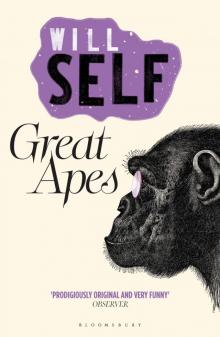
Will Self's Collected Fiction, Vol. 2 (2014), page 129
part #2 of Will Self's Collected Fiction Series


The signal phasing was weighted heavily against the pedestrian, while the clearance zone at each intersection was wide enough to swallow tribes of the impious. But there was one of me to tens of thousands of the Transformers. Each wait for the stickman to shine through the nuages was a vigil – I was finely balanced between grief and joy, while Hal cloned himself from one pole to the next. Eventually, at Florence, the sidewalk gave out and I was forced into the ur-suburba. As I ascended the Baldwin Hills, it occurred to me that almost all my life had been a topiary hare’s hopeless race along silent sidewalks beside empty homes. The buttery swathes of the lawns, the oh-so-slow lava flows of the crescents and drives, the Ionic, Doric and Corinthian columns as hollow as subprime mortgages – it didn’t matter a jot if the inhabitants were white or, as here, black, suburbs were always at once pre-and post-apocalyptic. In the two-car garage the wayward Cal-Tech physicist connects a purloined cyclotron to a Barcalounger – with devastating results.
The stop lady for Highland Elementary hustled some kids – including me – across the road and I arrived at Homebase, where a score or more of Hispanic extras hung out in the parking lot to see if they’d be taken on for a day impersonating gardeners in long shot. I stopped to chat: no, they didn’t mind the stereotyping, but ‘Y’know, my friend, in this part of town ground staff are almost always whites – it’s, like, a status symbol,’ said one with Coppertone skin and a Fu Manchu goatie.
‘Yeah,’ his buddy concurred. ‘For a reactive industry Hollywood is so fuckin’ slow.’
I went on past caged-in basketball courts and reached the scrubby uplands where oil pumps rose and fell like dipping bird toys. The Jeffs were waiting for me and I conspicuously ignored them as they set up for a long shot in a lay-by. Still, I was grateful for their perfect timing: the nuages maritimes were lifting, and to the north the Los Angeles basin lay revealed: 300 square miles of eyes and camera lenses. Somewhere out there was a killer or killers and I needed the crew’s prophylaxis badly; unprotected, who knew what I might become prey to – surely only the pathetic selfconsciousness of adolescence, which commences with checking for zits in wing mirrors, and culminates – ten years or yards along the road – in a screen test?
Absorbed in the steady rhythm of my paces I forgot about the Jeffs. I was walking through the Ruben Ingold County Parkway – a strip of greenery that ran along the spur above Slauson – when down in the valley, on the far side of the highway, I spotted a bum asleep on a bench. At least, I thought that’s what it was – I couldn’t be certain from this distance. There was an uncanny flatness to the static figure – besides, I knew most LA benches were bum-proofed, their seats either canted forward so it was impossible to find repose, or else segmented with hip-spearing ridges.
I turned aside from the path and plunged downhill, leaping fences and crashing through the undergrowth. Was it a man, or some weird hallucination of mine, provoked by sleeplessness? It wasn’t until I reached the verge and Escalades were whipping past the toes of my shoes that I realized it was a trompe l’œil ad for Will Smith’s latest movie, Hancock, in which, cast against type, the suave actor played a bum who also happens to be a superhero. Swept with an unreasonable rage, I glowered on Smith’s life-sized 2-D copy: the reflective shades, the stubbly jaw, the woolly hat and Hawaiian shirt. 1-800-LAW, NO WIN-NO FEE – that I could cope with, but movie ads should stick to billboards, the hopeful tombstones of dead drive-ins.
I rolled down the hills to Leimert Park, where I got a bucket of tea and stopped for a smoke by the art deco movie theatre that marks the cultural epicentre of the city’s black population. The bench I reclined on burned with a slogan for the MAALES project (Men of African American Legacy Empowering Self): ‘Bisexual, curious, or straight but fool around now and then?’ Then, like a bandsaw’s blade, I juddered my way through the Carpenter Gothic streets of Crenshaw and West Adams, which, under the guise of Sugar Hill, was the only racially desegregated neighbourhood in 1920s Los Angeles: Theda Bara, Busby Berkeley and Fatty Arbuckle had been replaced by a weeping fat boy pushing an obviously new mountain bike, whose father taunted him, ‘You can’t ride it, you’ll never ride it!’
When I came along Jefferson to the leafy environs of USC, the mission Muslim architecture gave way to postmodernist parkland. I patted myself down for sawdust and tried smiling at the coeds, but they took one look at my middle-aged white man horror mask and swerved away. There was a flyer up outside one of the halls advertising a lunchtime jam by NWPhd, and, intrigued by the sounds that were emanating – Gil Scott-Heron mixed improbably with Orlandus Lassus – I plunged inside. The Jeffs, who were still strapped up in their equipment, couldn’t follow me into that darkness, so joined Will Smith on a bench to wait.
Up on a low stage four tall African-American men were rapping; one of them was doing the Latin: ‘Hoc quicquid tandem sum, caruncula est et animula et animi principatus.’
The next the English: ‘Whatsoever I am, is either flesh, or life, or that which we commonly call the mistress and overruling part of man: reason.’
While the others picked out a word or two and scatted with it in a deep undertone, so: ‘Quicquid-quicquid-principatus-quidipatus…’ Or: ‘What-so-what-so-what-so-reason.’
It was a commanding performance. The four were dressed conservatively in bankers’ suits, shirts and ties, their hair closecropped, and so resembled a new generation of the Modern Jazz Quartet. Their rapping was at once percussive and euphonious, plaiting the two languages together: ‘Missos fac libros: noli amplius distrahi; sed ut jam moriens carunculam contemne: cruor est ossicula et reticulum, ex nervis, venulis et arteriis contextus.’
(‘Venulus-nervis, venulus-nervis, nervulis-venis …’)
‘Away with thy books, suffer not thy mind any more to be distracted, and carried to and fro; for it will not be; but as even now ready to die, think little of thy flesh: blood, bones, and a skin; a pretty piece of knit and twisted work, consisting of nerves, veins and arteries; think no more of it, than so.’
(‘Veins-an’-nerves, veins-an’-nerves, neryvein-vein …’)
I was surprised there wasn’t more of an audience for NWPhd – only a few lounging emos picking their hangnails in plastic chairs; but then, what did I know?
‘ Quin etiam animam contemplare, qualis sit: spiritus, nec semper idem, sed quod singulis momentis evomitur et resorbetur.’
(‘Spiritus-singulis, spiritus-singulis…’)
‘And as for thy life, consider what it is; a wind; not one constant wind neither, but every moment of an hour let out, and sucked in again.’
(‘One wind – one life, one life – one wind …’)
Not much, although even a moderately competent Latinist would have been able to detect the incorporation into the English translation of later interpolations.
‘ Tertia igitur pars est animi principatus; ad hunc igitur animum intende: senex es; noli pati, ut ille amplius serviat, aut amplius impetu insociabili raptetur aut amplius fatum vel praesens inique ferat vel futurum horreat.’
(‘Serviat! Raptetur!’)
‘The third, is thy ruling part; and here consider; thou art an old man; suffer not that excellent part to be brought in subjection, and to become slavish: suffer it not to be drawn up and down with unreasonable and unsociable lusts and motions, as it were with wires and nerves; suffer it not any more, either to repine at anything now present, or to fear and fly anything to come, which the destiny hath appointed thee.’
‘Slavish lust! Slavish lust!’
As each of the doctoral rappers completed his line, he took up this chant, until all four were hammering it out: ‘Slavish lust! Slavish lust! Slavish lust!’ Building to panting crescendo: ‘Slavish luuuuuust!’
By way of applause there was a scatter of ironic fingerclicking from the stoner kids; NWPhd didn’t seem to mind. Exactly like any professional combo, they slid straight into bickering about the performance: Howie had been a beat out on Quin etiam, but – Howie rejoined – it shouldn’t be con-temnee but con-tem-nay.
The college kids filed out into the noonday sun. I found myself unable to leave yet too shy to approach the group. Eventually, one of them dropped off the stage and shuffled across to me, his leather soles squeaking on the woodblock floor.
He saluted me lazily, ‘Word up, man,’ then double-took. ‘Oh, you’re that guy – Brit actor, ain’tcha? Saw you in that kids’ movie – wha’ wuzz it, now?’
‘It was Harry Potter, man,’ said another, still taller NWPhd coming up beside him. The two of them stood towering over me, mild curiosity on their handsome faces.
I flannelled: ‘Um, yeah, I did do those films but it was only for the—’ I pulled myself up short: how could admitting to mercenary motives be an excuse? I tried another tack: ‘Y’know, I was in Malick’s The New World, a biggish role – I’m not primarily a Hollywood casting.’
‘True dat.’ This came from the third NWPhd, who was wearing a purple silk Chanel tie. ‘You daybooed in that kerazee movie that starts wi’ you raping some sorry bitch in a goddamn alley. I guess you’d know all about slavish lust.’
‘It’s ambiguous.’
‘What you say?’
‘It’s not certain that I’m raping her – I mean, that the character I was playing was raping her.’
He shook his head gloomily, ‘Motherfucker, if that’s your idea of consensual sex I hate to think what you rapin’ would look like, sheee!’ He blew hard then collected himself: ‘No disrespect, man – what’s your name, anyway?’
I ignored this and said, ‘Y’know your English translation doesn’t exactly match up – there’s nothing about wires and nerves in the Latin.’
‘Oh, really?’ Purple Tie called to the last of the NWPhds, who was coiling a microphone flex on the stage: ‘Howie, get over here will’ya?’
As Howie approached I saw that he wore studded leather wristlets, and that, although he was dressed like his fellow band members, the crotch of his suit pants hung low – almost between his knees.
‘Yeah?’ He looked at me belligerently, eyes bloodshot in ochreous skin, wispy hairs threaded his lower lip to his chin.
‘Man’s questioning the translation, Howie,’ Purple Tie said, then to me: ‘May I introduce you to Professor Howard Turner; he holds the chair in classics and comparative literature here at USC, so, if you-gonna-be-questioning’ – he poked me in the chest to emphasize each word – ‘you-gonna-be-answering to Howie, you fill me?’
All four NWPhds had ranged themselves menacingly around me. ‘You dig Aurelius, man?’ Howie growled.
‘Well, we’d all do well,’ I wittered, backing towards the sunlight, ‘to maintain a stoical attitude in the face of … y’know – stuff.’ Outside I could see the Jeffs sharing a bottle of Powerade Aqua; they and it both looked appealing.
‘Don’t come down this way again,’ said the leader of the NWPhds, who had the passionate beauty of the young Marvin Gaye. ‘Unless you be confident you can parse a Latin sentence purr-fic’-lee.’
‘An’ declaim some,’ said the second giving me a light shove.
‘An’ display appropriate rhetorical style,’ Purple Tie added with a fist flourish that knocked me into the realization that he was being played by Jamie Foxx.
‘Listen,’ I said, ‘you won’t believe this, but the day before yesterday, back in Britain, I took a long walk with Morgan Freeman.’
‘What the fuck’re you talking about?’ Foxx had backed me right to the door. I made another bid to connect:
‘I don’t want to be intrusive, but did you learn anything about Cruise when you worked with him on Michael Mann’s Collateral, for example, the sigmoidal flexure of his … ah, penis?’
Foxx looked almost pitying: ‘I don’t wanna know nothin’ ‘bout that, my friend,’ he said. ‘This here is a litigious town – and then there’s the Scientologists.’
We were in the open air; SUVs full of coeds farted past. Waving a plastic bottle at me, Gofer Jeff called out, ‘I’ll getcha a Powerade, Pete.’
‘Pete?’ Foxx looked at me speculatively.
‘I’ve gotta get going,’ I said. ‘I’m due over at the Shrine Auditorium, but one thing: you were awesome back there, you guys gigging anywhere soon?’
Foxx laid a hand on my shoulder. ‘Anything is possible, my friend.’ The transition in a few seconds from anger to incredulity to sympathy would’ve been bewildering if he weren’t such an accomplished actor. ‘You take care out there.’
5
The Atrium
A statue of a Shriner stood in the parking lot – like me, he was slightly bigger than lifesize. Unlike me, he wore a bum-freezer and a fez and was holding a child of around five in the crook of his arm. But, there again, like me, both figures had faces the colour of pipe clay and eyes like pee holes in the snow.
I had walked to the Shrine Auditorium for obvious reasons: if, as I believed, buildings were corporeal things, briefly animated by mind or minds, then this was one of the corpora delicti that would prove not just that film was dead – but that it had been murdered. From the 1940s through to the 1990s the Shrine had hosted Oscar ceremonies; even standing in the open air, looking through the barred doors, I could still smell the reeks of stale narcissism, avarice and hunger. I banged on the doors until a security guard played by Ken Sansom came stumbling through the gloom, then palmed him a couple of hundred bucks to let me in. I strode through the darkened halls and passages, before stepping out into the cavernous auditorium itself.
Vast plaster swags bellied from the roof a hundred feet overhead; above the stage dangled a chandelier the size of a flying saucer. The polyhedral niches and recessed colonnettes to either side of the proscenium, the latticed screens that rose behind the forty-seat boxes, the ogee arches standing proud of the curving walls – it all post-hypnotically suggested an alternative history for the Americas: Los Angeles settled from the west in the fifth century after Muhammad by Arab dhows that had rounded the Capes of Good Hope and Horn, their lanteen sails dipping like rocs’ wings into the long swell of the Pacific. The indigenous tribes of the Californian littoral had all joyously submitted to Islam, green flags fluttered along the spine of the Sierra, and two centuries later the Shrine was raised as the physical embodiment of the evolving Al Malaikah consciousness, its dome swimming in the bilious smog of a million Al Forsan autos … But I remained unaware of this until the following evening, when the desk clerk at the Roosevelt snapped his fingers.
I walked out on to the stage followed by Sansom, who was morphing – his hair reddening and curling, his face growing shinier and more venal – until he was not just an acceptable standin but a dead-ringer for the founding charlatan of Scientology. Hubbard approached and, raising a hand to my forehead, tipped me straight back into the mind-bath of Dianetic reverie, where I lay feeling the warm current of time course along my flanks and sweep between my parted thighs. Then Hubbard gave me a gentle push and I found myself carried swiftly upstream, my arms and legs mutating into flippers, then fins, then polyps – until there I was, beached in the Upper Palaeozoic, with Hubbard rapidly opening and closing his fleshy hand to simulate my shell, and so sending waves of anxiety through the audience of pre-clears unable to cope with their own molluscan memories.
As one genetic entity to others, I sympathized, yet at the same time I could feel that every single sleight, cramp, twinge and sniffle I had experienced in all my multitudes of animal lives had been accepted, digitized and rewritten in the binary encoding of my analytic brain, a smoothly functioning computational device with the power of a thousand networked super-computers – although this analogy is woefully impoverished, implying a clackety-plastic clunkiness to what’s beyond the grasp of any pre-clear, especially you.
I, the Thetan, lifted off from the stage, my silky-brown hair haloing my superfine 35,000-year-old features, and so L. Ron and I danced a pas de deux as, to the amazement of the crowd, we orbited the chandelier before touching down together, hand in hand. ‘Ladies and gentlemen,’ Elron boomed, ‘I give you the first clear, Sonya Bianca, a physics major and pianist from Boston. In addition to her many other accomplishments, Miss Bianca has full and perfect recall of every moment in her life. But first, if you will my dear, please tell us how Dianetics has helped you.’
‘Well.’ To begin with my voice was tremulous and my pulse raced, but as I spoke I grew in confidence: ‘I had a strange and, um, embarrassing allergy to … well, paint.’
‘Paint?’
‘That’s right, paint – whether wet or dry; and if I came into contact with it at all – which is, as I’m sure everyone realizes, difficult to avoid, well, I got a painful itching in my eyebrows. Now the condition has cleared up and I feel … well, like a million dollars!’
There was a scattering of applause, but there were also mutterings of discontent and somebody called out, ‘Tell us what you had for breakfast on October the third 1942!’
I fidgeted with the hem of my twill skirt. ‘That’s easy, a bento box. The sushi and sashimi were fine, and I asked for a refill of miso soup, which I sipped together with mouthfuls of green tea from a china beaker—’
In a chain Japanese diner on Figueroa? I don’t think so – not a china beaker, only a lidded styrofoam cup, the textured dimples of which squeaked beneath my sweaty fingertips; across the road Felix the Cat pole-sat with a come-hither grin on top of a Cadillac dealership. ‘I’ve scheduled a meeting for you with Michael Lynton at Sony Pictures in Culver City this Friday – the thirteenth,’ said Ellen DeGeneres’s voice in my ear. Frank Tenpenny was sitting with a table of LAPD patrolmen next to mine – a more or less solid block of heavy-duty navy cotton accessorized with forearms, side arms and crew-cut heads on V-shaped plinths of white T-shirt. It was true about the bento box, though – the lacquered tray littered with rice lay on the table beneath my eyes. ‘Kinda unlucky, maybe …’