Vendetta, page 1


About Vendetta
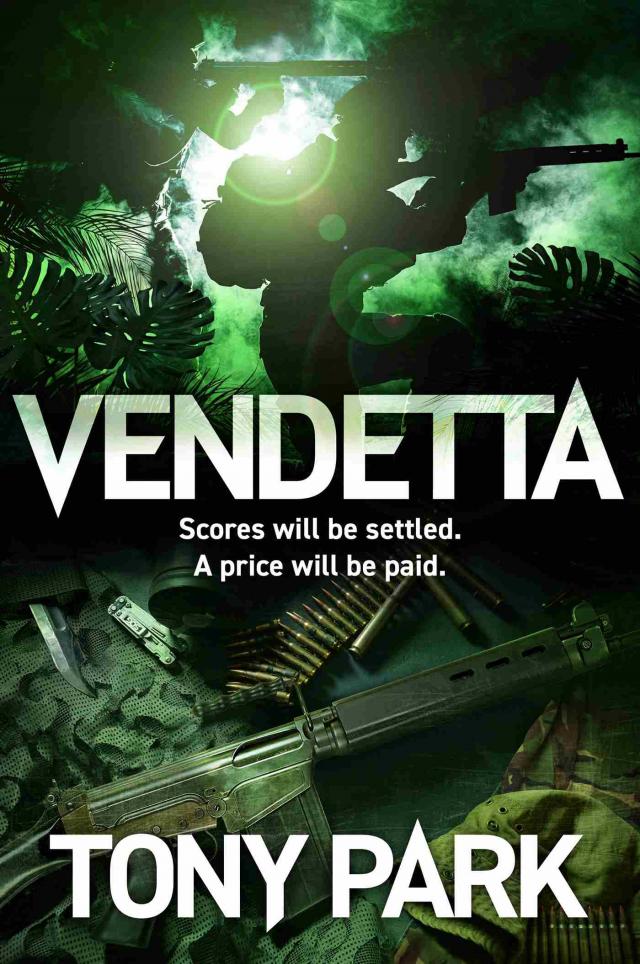
Captain Sannie van Rensburg and safari guide Mia Greenaway are caught in the crossfire of a decades-old feud between five veterans of South Africa’s apartheid-era Border War.
Haunted by the deadly mission that shaped their lives forever, the ex-paratroopers must finally confront their demons, and each other, at the funeral of a comrade in the red dunes of the Kalahari Desert.
But their scars run deep, and as the truth emerges, each man must ask himself: When serving your country, what makes you a hero and what secrets are worth killing for?
Also by Tony Park
Far Horizon
Zambezi
African Sky
Safari
Silent Predator
Ivory
The Delta
African Dawn
Dark Heart
The Prey
The Hunter
An Empty Coast
Red Earth
The Cull
Captive
Scent of Fear
Ghosts of the Past
Last Survivor
Blood Trail
The Pride
Part of the Pride, with Kevin Richardson
War Dogs, with Shane Bryant
The Grey Man, with John Curtis
Courage Under Fire, with Daniel Keighran VC
No One Left Behind, with Keith Payne VC
Contents
Cover
About Vendetta
Also by Tony Park
Title page
Contents
Dedication
Map
Prologue
Chapter 1
Chapter 2
Chapter 3
Chapter 4
Chapter 5
Chapter 6
Chapter 7
Chapter 8
Chapter 9
Chapter 10
Chapter 11
Chapter 12
Chapter 13
Chapter 14
Chapter 15
Chapter 16
Chapter 17
Chapter 18
Chapter 19
Chapter 20
Chapter 21
Chapter 22
Chapter 23
Chapter 24
Chapter 25
Chapter 26
Chapter 27
Chapter 28
Chapter 29
Chapter 30
Epilogue
Acknowledgements
About Tony Park
End ads
Copyright page
Newsletter
For Nicola
Prologue
Hazyview, Mpumalanga, 2012
The book of the dead. That’s what Frank Greenaway called the old photograph album he was hunting for in the mildew-smelling reaches of the top cupboard of his second-hand wardrobe.
Frank’s fingers found it, and as he dragged it out from under a mouldy suitcase he felt the clear plastic dust cover start to crackle and disintegrate under his touch. The catalogue of memories, good and bad, had lain there, undisturbed, for more years than some of the men in it had been alive; longer still since the dates of their deaths.
He swayed on the small stepladder. Frank felt dizzy, weak. He was babalaas, but when was he not hungover? This, though, was a bad one. Perhaps it was the DTs, delirium tremens, from having been in the Hazyview police cells for the best part of the previous two days. He didn’t know the symptoms – he couldn’t remember how long it had been since he’d gone thirty-six hours without a drink.
Slowly, he navigated his way down and retraced his tracks, sticky spots of blood on the floor tiles, from the bedroom to the lounge. He usually went barefoot around town, in the same uniform of rugby shorts and T-shirt that he wore this warm September day. He told anyone in the pub who would listen how he could walk the length of the Kruger without shoes, but he was human. Just. He was bleeding from whatever piece of rubbish he’d trodden on in his unkempt front yard.
Frank sat at the cane and glass dining table – someone’s cast-off, though he couldn’t remember whose. Mia smiled down at him from the school portrait on the wall. She had her mother’s eyes. Frank sniffed. He opened the album, then reached for the half-jack of Klipdrift brandy and poured himself a tot.
‘Frik.’ He raised his glass to the first of the fallen, the twenty-year-old grinning under the weight of the radio on his back and flashing a peace sign. Frank drank.
The edges of the album pages were stained brown with the same nicotine that had dyed his fingers and coated the grimy ceiling fan above him. Outside, Mrs Baloyi’s Africanus dog barked incessantly and a cape dove mocked him with its call. Work harder, work harder. He hadn’t had a proper job since the bloody parks board had fired him.
Frank took his eyes off the photos to fossick in the ashtray for a stompie with a little life left in it. He found one, lit the cigarette butt and coughed through the burned, stubbed-out end.
Mia would have loved to have got her hands on this album. She asked him about the army often, and he could hear the amateur psych in her questions, wanting to know how he felt, did he have flashbacks, did he want to talk about the war? He was a Parabat, and ’Bats didn’t get PTS-bloody-D. The war hadn’t fucked him up, bloody people had.
He didn’t talk; he drank. Smoke curled upwards as Frank turned the pages, tracking his time through basics, infantry training, learning to jump out of aeroplanes, then perfecting the business of killing, in Angola. He found the photo he was looking for. Ondangwa, 1987 was written in faded pencil on the back. He stared at Evan, Ferri, Adam, himself and the trackers. The others were smiling.
After all these years of hardening himself, medicating with the booze, trying and failing to get on with life, the memories broke free. They pushed out from his brain and his soul, through his skin, oozing out of his pores and into the judgemental daylight. He started to cry.
How many times had he sat at this table, planning how to take his own life? It was usually moments like this one, when he knew Mia was away on some school camp or visiting a friend, so that she would not be the first to find his body.
That had been his answer, his one certain way to escape the memories, the shame, the failures of his life. Frank turned another page. There he was in his dress uniform, sergeant’s stripes freshly sewn on, ramrod-straight. Dead eyes. Lost a war, lost a wife, lost a job.
Frank blinked. He felt nauseous, weak, like a bad flu was coming on. He coughed again; looked at his watch. Midday on a perfect Lowveld day. As good a time as any to put an end to twenty-five years of hurt.
*
Nokuthula Mathebula alighted from the minibus taxi at the four-way stop, where the Zimbabwean man sold his metal warthogs and the tiny tin San hunters, who crouched with their bows and arrows. She tutted at the tourist trinkets and shook her head. Nokuthula hadn’t seen a Bushman, as the San used to be called, in her entire life.
She checked her phone. It was two o’clock, but Frank was not a stickler for punctuality. She walked slowly, not wanting to perspire into her new blouse. Sometimes Frank didn’t know what day it was. Her heart was heavy for him, but it would be good to see Mia again.
Nokuthula had known Mia since the day she was born, and had carried her on her back, wrapped up like a Shangaan baby, and taught her the language and the ways of her people. When Mia’s mother had died, the little girl had become like one of her own.
They had all cried when Frank had told them, some years earlier, that he had lost his job in the Kruger Park, and that he could no longer afford to employ Nokuthula fulltime. Now Mia was nearing the end of her schooling, a beautiful, smart, independent young woman, but Nokuthula still secretly thought of her as her baby. Nokuthula looked forward to seeing Mia on the infrequent occasions when Frank had enough money from whatever casual job he had found to pay for her to clean the house.
As Nokuthula walked up the street, with its face brick and tile single-storey homes set behind walls topped with razor wire, she saw Mrs Eva Baloyi, Frank’s neighbour, standing outside his security gate.
‘Inhlikanhi, Eva,’ Nokuthula said.
‘Ayeh minjani.’
‘Phukile,’ Nokuthula replied. She was ‘awake’ and well this afternoon, happy at the thought of seeing her daughter when Mia returned from the school camp tomorrow. The plan was for Nokuthula to stay the night in her old room, the domestic’s quarters.
Mrs Baloyi was wide-eyed. ‘Ndzi swi twile gunshot.’
‘What?’ Nokuthula recoiled a pace. ‘You heard a gun firing? In Frank’s place?’
‘Yes.’
Nokuthula scrabbled in her big handbag for the gate remote. She pressed it hard and Mrs Baloyi followed her in and across the overgrown lawn. She fumbled with the keys until she found the one for the front door, then burst inside.
Nokuthula screamed.
Chapter 1
KwaZulu-Natal, the present
‘He must be the town drunk,’ the teenage girl said, her voice low but audible from the open window of the Porsche Cayenne.
Adam Kruger pretended not to have heard her. Stereotypes – his country was still fixated with them. He saw himself through her eyes – why else would a middle-aged white man be working in a car park? The boy behind the wheel was not much older than the
‘Baie dankie,’ Adam said, touching the tip of his faded Toyota baseball cap. He started to direct the young man out of the car space, but the youngster floored the accelerator. The girl screeched with joy; an older Indian couple stepped back to avoid being hit.
Adam remembered himself at that age, showing off to girls, wearing a tank top to display his Parabat ink, his paratrooper’s wings. Stupid. The girl’s words cut him, partly because there was a grain of truth in them. He was not an alcoholic – even though he might have been one at some points in his adult life – but it was true that the money he made as a car guard at Scottburgh Mall went on the meagre booze ration he allowed himself these days.
Sweat trickled down his body under the second-hand long-sleeve shirt and reflective vest that read ‘Car Guard’. The shirt was fraying at the collar, but the creases in the sleeves were ironed to a knife’s edge. The jeans were hot in this weather, but like the shirt they kept the sun off him. Rassie Erasmus, the medic who Adam had fought alongside in the war, had survived Angola, two marriages and a proper battle with the bottle, then passed from melanoma five years ago.
Adam heard a horn hoot and turned, narrowing his eyes as he slipped the single coin into his zippered imitation leather bum bag. Porsche boy had not got far; he was stopped behind a white Fortuner. There was a young man behind the wheel of the Toyota, which was parked in the middle of the road, blocking the exit. The youths in the Cayenne yelled abuse.
The Fortuner driver was alert, checking the rear-view mirror, not checking his phone. Why had he stopped? Adam felt the hairs come to attention on the back of his neck. He looked to the mall entrance. A security guard in body armour had his back against a wall, an LM5 assault rifle held at the ready; he’d chosen a good position but his attention, like most of the people in the car park, had been diverted by the road-rage incident currently unfolding fifty metres away from where Adam was standing. A cash-in-transit van was parked in the disabled spot near the entrance to the mall; two guards were walking out with boxes full of money.
Adam looked around. He saw four young men striding between the cars. Like him, their clothes were wrong for the beach and the weather. One opened his jacket and Adam saw the glint of sun on steel, a short-barrelled AK-47.
‘Gun!’
Adam had the attention of the security guard; he pointed at the advancing men. All of them had now drawn weapons: two had rifles, two pistols.
The guard raised his weapon but was too slow. The first round from the AK thudded into his body armour. The man was slammed back into the wall, winded, his eyes wide with surprise – maybe that he was still alive. Gasping and clearly in pain, he tried to raise his rifle again, but the second round hit him in the neck.
Adam bent low and ran between the parked cars as shoppers screamed and fled. The Porsche was reversing. One of the armed bandits fired at it. The others opened up on the cash-in-transit guards, who dropped their cashboxes and were fumbling for side-arms.
Adam was unarmed, but he moved towards the robbers anyway. There was a thud and the screech of metal on metal as one car backed into another. The Fortuner was still blocking the way out, and the line of holiday shoppers that had been circling the car park looking for convenient spaces near the mall was gridlocked as panicked people tried and failed to get away from the shootout.
The two guards who’d been inside the mall were firing back. By calling out a warning, Adam had forced the hijackers to show their hands much earlier than they would have liked. One was advancing; the way he walked tall, rifle up and firing, made Adam wonder if he was jacked up on drugs. Maybe he’d purchased umuthi from a sangoma to make him bulletproof. A slug from one of the guards’ guns punched him backwards.
‘Adam!’ a voice hissed.
Adam, still ducking and moving, glanced over the bonnet of a Ford Ranger and saw Wilfred, a Zimbabwean parking attendant, keeping pace with him.
‘Go back, take cover,’ Adam said.
Wilfred shook his head. ‘No. This is our duty.’
Madness, more like it, thought Adam, but he felt the adrenaline, all but absent in this second half of his time on earth. It powered him up, making him forget this life, taking him back to another. He smelled the cordite, heard the percolator pop of an AK on full auto. Another windscreen shattered; people were screaming.
Adam heard his own pulse, then the report of a pistol being fired from further away in the car park. A bullet punched a hole in the door of a Polo right in front of him. The shot had come from the flank. Adam raised his head and saw a shopper, a man going grey, like himself, aiming a nine-mil. The robber with the AK swung and fired a burst on full automatic and the vigilante dropped to his belly.
Adam looked around for a weapon and saw a broken paver on the edge of a garden bed. He picked it up. The thieves’ momentum had slowed and Adam heard a siren. The man with the AK turned his attention back to the guards and emptied his magazine at them. One of the security men cried out in pain and this prompted the remaining two criminals to resume their advance.
The rifleman fumbled while replacing his magazine and Adam closed on him from behind.
One of the man’s comrades called a warning as Adam rose fully upright; he knew he only had a second or two in which to act. The gunman spun around and raised his AK-47. Adam noted that while the fresh magazine was now fitted, he hadn’t seen the man pull back the rifle’s cocking handle. The robber pulled the trigger; nothing happened. Adam drove into him, knocking the rifle barrel to one side, and smashed the broken paver into his face. The man’s head snapped back. Adam was on him, unleashing his rage; he dropped the broken piece of cement and punched the man in the face. Wilfred joined him and Adam took the rifle from the dazed and wounded man’s hands. Wilfred held the man down while Adam cocked the AK with practised ease.
The feel of the wooden handgrip and stock; the weight of the rifle; the heat from the barrel; the smell of oil – all threatened to overwhelm his senses. The muscle memory brought the weapon up into his shoulder and he almost craved the kick of the recoil as he searched for a target.
The thief who had called the warning turned, moving between an Amarok and a Land Cruiser Prado, and his gun hand tracked towards Adam.
‘Drop it!’ Adam leaned over the bonnet of the Polo, lowering his profile, making himself a smaller target as he took a sight picture.
The young man grinned and pulled the trigger. Adam saw the boy’s hand buck, heard the crack-thump of the nine-millimetre projectile cleave the air next to him, then squeezed the trigger himself. Adam’s bullet hit the target in the shoulder, knocking him backwards.
Adam ran to the downed man. He had dropped his pistol when he was hit, and was now trying to roll over to get to it. Adam bent down, picked up the pistol and stuffed it in the waistband of his jeans.
The last of the thieves sprinted for the Fortuner that had been blocking the car park exit in the instant the attack went down. As Adam had suspected, this was the getaway vehicle.
Adam tracked the fleeing man through the AK’s sights, but he was not about to shoot him in the back. As the robber opened the rear door of the Fortuner the driver put his foot down, forcing the bandit to run faster, holding on to the handle. He managed to hop, skip and drag himself into the back as the Toyota reached the mall entry. A battered South African Police Service bakkie rolled into the car park, heading the wrong way up the one-way access road, and the two vehicles collided, head-on.
Steam hissed from the two punctured radiators and the driver of the Fortuner was struggling to get out from behind his airbag as the police exited their vehicle, guns drawn. The two men in the getaway car surrendered.
Two other car guards emerged from where they had taken cover behind vehicles and ran to Adam, who was now on his feet. ‘Watch this one with the bullet hole in his shoulder. Find something to stop the bleeding,’ Adam said to them.
Adam ran to the wounded security guard. He was being treated by one of the cash-in-transit guards, but Adam immediately saw that the man holding his hand to the other’s neck was also wounded. His face was grey and as Adam arrived, the first responder slumped back against the wall.