The Vexed Generation, page 1


The following is intended to be a fun, comedic sci-fi/fantasy novel. Any similarity between the events described and how reality actually works is purely coincidental.
Magic 2.0: A Partial Explanation
One night, while exploring a server he probably shouldn’t have been, Martin Banks discovered a file that proved his reality was computer generated. By manipulating the file, he found that he could perform feats that seemed like magic—things like flight, teleportation, and time travel. He knew that his newfound power could dramatically improve his life, but he’d have to be careful and avoid drawing attention to himself.
He did neither of those things. Instead, he immediately messed up very badly and attracted the attention of government agents.
Martin fled to Medieval England, a time and place where people believed in magic and wizards were revered. He reasoned that he could be the most powerful being in the world and live a life of ease and luxury if he showed some restraint and used his power wisely.
Again, he did neither of those things. Again, he immediately messed up very badly, and attracted the attention of several other people who had found the same file, developed even better powers, and migrated back in time to live as wizards long before Martin got the idea.
Among Martin’s new acquaintances were Gwen, the woman he grew to love; Phillip, who became his best friend; and Brit, a woman who had tangled her own timeline so thoroughly that her past self and her future self now have to deal with each other on a daily basis, a prospect neither of them relishes. One thing all these wizards shared in common was that they wanted nothing more than to enjoy their lives and not bother anyone.
They do neither of those things. Instead, they all tend to mess up on a regular basis and attract the attention of pretty much everybody. In an effort to rectify this, Martin and Gwen have married and moved back to their original time, started a family, and now spend their days attempting to maintain the facade of a “normal” life.
1.
“This is a bad idea, Martin.”
“You agreed to it, Gwen.”
“That doesn’t mean it isn’t a bad idea,” Gwen said. “I’ve agreed to a lot of bad ideas. Most of them came from you.”
Martin held Gwen by the shoulders and looked into her eyes. “It’s gonna be fine. You’ll see.”
“And every single time, you’ve said that.”
Martin turned away from Gwen and went back to straightening his black bow tie in the bathroom mirror. “Look, we both agreed that if we were going to have a normal family, we have to seem open and forthcoming with our kids. We can’t come off as mysterious.”
“Well, after today there won’t be any mysteries. They’ll know everything.”
“No, they won’t. All the twins are gonna learn is what every kid learns on Bring Your Children to Work Day. That the real world is much less interesting than they ever expected—even the interesting parts.”
“But the interesting parts of our lives are interesting . . .”
“Granted, but they won’t see that today.”
Gwen held up a finger and cocked her head to the side.
Martin stopped talking.
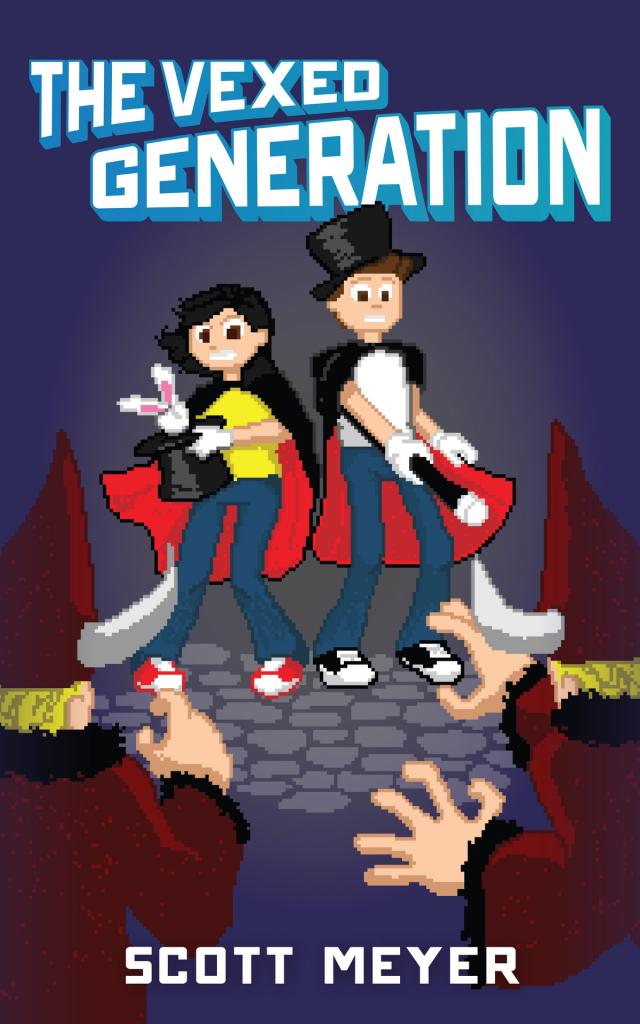
They both heard a soft creaking noise, followed by a quiet giggle. Martin and Gwen stuck their heads out the door of their master bathroom and saw Mattie, their ten-year-old daughter, entering their bedroom, elbows raised and fingers splayed in a cartoonish attempt at sneaking. She saw her parents looking at her and froze. Her jet-black hair was pulled into twin braids, and she wore a knee-length, lace-fringed dress, somewhere in the middle ground between yellow and beige—an entire dress made in the color of a permanent stain. The simplicity of her hair and dowdiness of her dress stood in marked contrast to her sparkly blue sneakers and fuzzy pink socks.
Gwen said, “Mattie Banks, what have I told you about eavesdropping on us?”
“You said don’t do it.”
“And what are you doing?”
After a long pause, Mattie said, “It. I’m sorry. I just came to tell you I’m ready to go.”
From another room, a young boy’s voice shouted, “Are not!”
Mattie shouted, “Nobody asked you, Brewster!”
Brewster ran up the hallway: a ten-year-old boy with sandy-brown hair, wearing a tweed three-piece suit and a blue tie. “Her shoes are wrong. Mom, tell her, her shoes are wrong. Dad said we have to wear our historical costumes and those aren’t the right shoes.”
Mattie shot a nasty look at her brother. “But Daddy, those other shoes are so hard. They don’t feel good.”
Martin said, “That’s what children’s shoes were like in Victorian London. Their lives back then were much worse than ours. And today, you’re going to experience it for yourselves! You’ll smell the air, and the people, and the horse droppings in the street! Maybe, if you’re lucky, I’ll arrange it so you can work a shift on an industrial loom!”
The kids looked at each other uneasily.
Gwen said, “Now go put on the right shoes, Mattie.”
Mattie ran back down the hall.
“What about my tie, Mom?” Brewster asked. “Did I tie it right?”
“You did a great job, for a ten-year-old.”
Brewster looked utterly unsatisfied with that answer. “Did I tie it right?”
Martin leaned out of the bathroom and looked at his son. “Yeah, that’s a decent four-in-hand knot. It’ll do.”
“It’ll do?”
“Yeah. It’s fine. That’s the four-in-hand’s thing. It’s the easiest knot that’s good enough for any occasion.”
Martin smiled as Brewster looked at his tie, frowned, and walked back down the hall muttering, “Good enough. That’s no good.”
Gwen was not smiling.
“Gwen, I know you’re uncomfortable, but this is the right move. Look, we agreed that if we wanted to seem like a normal family, one of us had to work outside the house. I’m happy to do it, but if it’s going to seem real, I can’t be secretive about it, and that means eventually letting them see me at work. That means taking them to where I work, which is all I’m doing.”
“It’s not taking them where you work that worries me.” Gwen peeked down the hall to make sure they were alone, then lowered her voice. “It’s taking them to when you work.”
“If they’re going to see me do my job, they have to be there when I do it. Right now, they’re old enough to tag along but young enough to keep under control. It’s only going to get harder as they grow up.”
“We should have done this last year,” Gwen replied.
“Last year you put me off until next year, which is this year.”
“Maybe we should put it off again, and you can use the time to phony up an office job.”
Martin shook his head. “It wouldn’t work, and it’s not necessary anyway. They already know what I do, and they already think it’s boring.”
“They think you’re a magician at a theme park.”
“A historically accurate educational theme park. To a kid, that’s an offensive concept, like a raisin cookie, or underwear for Christmas. And I’ve told you a hundred times: People think they like magic tricks until someone does one. The average person’s eyes glaze over as soon as you say pick a card or please observe this simple handkerchief.”
“But people pay to see your act.”
“They’re made to pay up front. That’s not by accident. And besides, even if some of the audience members do really enjoy magic, we know our children don’t. Gwen, I’ve been pulling coins and scarves and live doves out of every orifice in those kids’ heads since they’ve been old enough to know it was wrong. Has either of them ever seemed even the slightest bit impressed?”
Mattie ran back into the bedroom. “Okay, I put on the shoes. I’m ready to go.”
Without turning to look, Gwen asked, “Did you change your socks?”
Gwen tried to hide the amusement on her face as she waited through the moment of thick silence that followed. When she and Martin did look at their daughter, they saw her crouching down, attempting to poke the exposed parts of her pink fuzzy socks into the tops of her shoes.
“Mattie,” Gwen said. “Go change socks.”
“But, Mom, who says they didn’t have pink fuzzy socks back then? They had socks. They had the color pink. They had . . . fuzziness.”
“But they hadn’t put it all together yet. Go.”
“Do I have to? I don’t wanna untie and retie the shoes again.”
“I said, go.”
Mattie trudged, slump-shouldered, back down the hall to her room.
“She is just smart enough to be dangerous,” Gwen said.
Martin laughed. “Yeah, she gets that from me.”
Brewster walked in, looking much the same as when he left, only with a larger, more symmetrical knot in his tie.
Gwen said, “Retied the tie, huh? What is that, a Windsor knot?”
Brewster replied, “A half Windsor.”
“Oh. A half Windsor,” Martin said.
Gwen asked, “Where are you learning all these knots?”
“There are instructions online. Didn’t I do it right?”
Gwen said, “You did fine.”
“Fine?”
“You tied it very well.”
“But there’s something wrong.”
“No,” Martin said. “Nothing’s wrong. The half Windsor knot is okay.”
Brewster looked down at his tie, mumbled, “Okay,” and walked back to his room.
Martin said, “That
“No,” Gwen said. “You’re going to give him a nervous breakdown. He gets that from me. I don’t like this, Martin. It’s a terrible risk.”
“Making what I do every day seem like a big secret would be a risk, too.”
“Yeah, but is this the lesser of the two risks?”
“Maybe. Maybe not. It’s definitely the more fun of the two risks.”
Martin pulled on his black satin tuxedo jacket with tails.
Mattie’s feet made an exaggerated clomping noise as she ran up the hall. “Mom, Dad, you know what I just figured out? Cowboy boots are from the same time as the rest of my costume, just about. They don’t have laces, and they hide my pink fuzzy socks!”
Martin nodded knowingly at Gwen. “It’s true. That’s why Wyatt Earp wore them.”
Mattie proudly pointed below the hem of her drab knee-length dress to her red-and-black vinyl cowboy boots.
Gwen stared back and said nothing.
Mattie said, “No?”
Gwen stared.
Mattie said, “No.”
Gwen stared.
Mattie said, “I’ll put on the shoes and socks you laid out for me,” and went back to her room. As she walked away, Brewster passed her. His suit and shoes were unchanged, but the knot in his tie was as large as his fist. “I jumped up to a double Windsor knot, though it looked like it and the single Windsor might be the same thing. It’s confusing. Maybe I should go try again.”
“No, Brewster,” Gwen said. “You look perfect.”
“Perfect?”
Martin opened his mouth to speak, saw the look on Gwen’s face, and said, “Perfect.”
Gwen raised her voice to be heard a few rooms away. “And Mattie will look perfect, too, once she has the right shoes and socks on.”
Mattie shouted. “Just a minute! I’m tying them. It takes for eeeeever.”
Martin said, “We’d better get moving. It’s Bring Your Children to Work Day, not Bring Your Children to Work Late Day.”
Mattie came out of her room and stood in the hallway, wearing black leather shoes and drab, off-white socks.
Martin said, “Don’t you both look darling.”
Brewster glared at Martin. So did Mattie.
“Your mother worked hard making those historically accurate outfits. You should thank her.”
The twins said, “Thanks, Mom,” in a slow, unenthusiastic tone, their voices creating an unpleasant minor-key harmony.
Martin smiled and pointed at the kids. “Ah-ah-ah! Thank her in a period-accurate manner.”
The kids glared at him again, then Brewster bowed, Mattie curtsied, and both said, “Thank you, Mother.”
Gwen chuckled in spite of herself. “You’re welcome. Now go. You all have to get on the road.”
“But before we go, there’s one last thing.” Martin stepped toward the kids. “No child in Victorian London would go anywhere without their handkerchief!” He reached down and pulled a white hankie out of Mattie’s ear.
“And you’ll want to have some pocket change, just in case!” He reached out, placed his hand over Brewster’s nose, then placed his other hand beneath it and caught several coins that seemed to fall from the boy’s nostrils. Martin looked at the children expectantly.
They smiled uneasily.
Martin beamed at Gwen. “See! It’s gonna be fine.”
They went down the hall, past the kids’ rooms, and down the stairs to the family room. Gwen followed, shaking her head.
Martin stepped into the middle of the family room and swept his arms out wide. “Kids, are you ready for a magic-filled journey into the past?”
The children made unconvincing but vaguely affirmative sounds. Martin smiled at Gwen, who came dangerously close to laughing.
He opened the front door for the children.
Gwen knelt down next to them. “Do you both have your emergency necklaces?”
Mattie and Brewster said “yeah,” more or less in unison.
“Let me see.”
They both reached into their collars and pulled out identical woven lanyards holding blue plastic triangles decorated with white stars and moons, which formed a stylized wizard hat.
Gwen nodded. “Good. Now, remember, if you’re in trouble, you just break the wizard hat in half between the moon and the star, and you’ll be taken somewhere safe.”
Mattie asked, “How does that work?”
Gwen said, “It’s very complicated.”
Brewster looked at the plastic wizard hat in his hand. “Is it like a radio?”
Gwen said, “It has to do with computers. Your father and I set it up. Hopefully, you’ll never have to find out how it works. Why is that?”
The kids both said, “Because we can only ever use it once.”
“And they won’t need it today,” Martin said. “They’ll be with me!”
Gwen looked both children square in the eyes and said, “Keep the necklaces handy.” She hugged the twins as if she might never see them again.
She followed them out the front door, stopped on the front porch, and called after them. “Okay, be good, be safe, and do what your father tells you, except when it contradicts the first two things I said.”
“Wave to your mother,” Martin said, pulling his nondescript black sedan out of the driveway of their unremarkable yellow Arts and Crafts bungalow, and drove down the street, past all the other Arts and Crafts bungalows and neutral-colored sedans.
The kids both sat in the back seat, which was standard Banks family procedure. It prevented fights about who got to ride in the front at the cost of occasional complaints about having to sit together.
Martin glanced at them in the rearview mirror. Mattie sat sideways in her seat, her face pressed against the window. Brewster looked Martin square in the eyes through the mirror and asked, “What’s the name of the park you work at again?”
“Dickensiana. Why?”
“My friend at school, Donald, says he never heard of it.”
“Well, I feel bad for Donald then. He’s missing out.”
“But Donald says if there was a park like that, he’d know.”
“But we’re going to the park, and he doesn’t know about it, so he must be mistaken, right?”
“Yeah, I guess.”
“How did you and Donald end up talking about the park?”
Mattie turned and smiled at Brewster, who squeezed his mouth shut like the top of a laundry bag with the drawstring pulled tight.
“Brewster,” Martin asked, “were you talking about Daddy’s work at school?”
Brewster said nothing.
“It’s okay, Brewster. I’m not mad. We all make mistakes. But you know you’re not supposed to tell people that Daddy works at the park, or even that there is a park, right?”
“Yeah, I know.”
“Why?”
“Because it ruins it if they know you’re just pretending.”
“That’s right.”
“Dad?”
“Yes, Brewster?”
“Why did they make a park about what life used to be like in England here, not England?”
“Because the English already know all about it, and Seattle has the most England-like weather of any city in the United States.”
Brewster said, “Oh,” but still seemed puzzled.
Mattie asked, “Is your magic show like the one the guy who did his show for our school was like?”
Martin took a moment to decipher the sentence. “I don’t know. What was his show like?”
“It was kinda dumb. He did a bunch of dumb tricks with rings, and cards, and foam balls, and a lady he cut in half, but there wasn’t even any blood.”
Martin smiled. “No. My show isn’t like that. My show’s cool.”
Mattie smiled. “Oh. Good.”
“I do amazing tricks with big gold rings, giant cards, and rubber balls. And we make a lady float in the air, then cut her in half.”
Mattie’s smile faded.
“You and your friend Phillip, right?” Brewster asked.
“He’s our friend. He likes all of us.”
Mattie and Brewster both said nothing.
“Don’t you two like Phillip?”
Mattie said, “He’s nice. He’s just . . .”
“Weird,” Brewster finished her thought.
Mattie nodded. “He acts weird when he comes to the house.”
“Yeah,” Martin agreed. “He does, but only around you two. See, Phillip’s a very nice man, but he’s not comfortable around children. He likes you both very much, and wants you to like him. It makes him try too hard.”