

Operation Ivy Bells, page 6
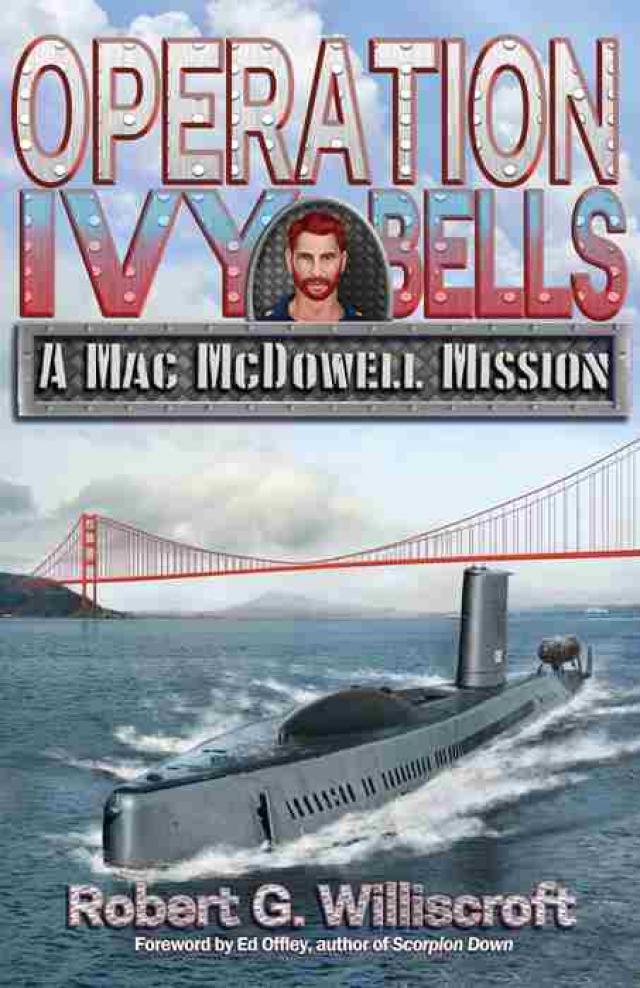


USS Halibut – Mare Island
I had chosen to walk to the Halibut this morning. I wanted one last hour of fresh air, morning breeze, singing birds, and the occasional pretty secretary on her way to an early work assignment. It was about to be a long dry spell.
As I had already delivered my gear aboard, my hands were empty. It was early. The sky was blue and the sun was out, but the air was still chilly. I was dressed in summer khakis and was wearing a fore-n-aft cap. I liked it so much better than my peaked cap, because I could fold it into my belt, and never have to look for it when I needed to go topside. And it gave me unrestricted vision. Caps with bills made me feel like I was wearing blinders.
I finally arrived at the gangway, requested permission to board, saluted the stern and stepped aboard the dark gray surface covered with an anti-slip compound. Our newest attack subs avoided using anti-skid because the turbulence it caused added a measurable level of noise to the sub’s underwater signature. In our case, however, we were already so noisy that any additional noise created by non-skid paint was way below our baseline profile.
By now the topside guys knew me, and the watch waved me aboard with a cheerful “‘Morning, El-Tee!”
“‘Morning, Skidmore.” I had most of their names down pat, too.
It had been a long haul, getting the equipment ready and keeping my crew razor sharp. I couldn’t have done it without Master Chief Ham Comstock. Ham was an amazing guy, having punched his ticket at the Navy Experimental Diving Unit and then the Man-in-the-Sea Program. At forty, with his sharp blue eyes and thinning, short-cropped dark hair, Ham was a father figure to the guys, and had become my friend. But we were a team, and it really took all of us to get it done.
I mentally reviewed my dive team. Chief Boatswains Mate Jack Meredith, Ham’s thirty-five-year-old understudy, had left the SEAL Teams to become a saturation diver. He compensated for his bald pate with a trimmed, brown beard flecked with gray. His weathered face rarely smiled, and his stocky, five-foot-eight muscular frame was deeply tanned. Sonar Tech 1st Class William Fisher – Bill to all of us – had reddish hair and a ruddy complexion like me. He appeared younger than his twenty-five years, and not even Snorkel Patty could rid him of his shyness. Electronics Tech 1st Class Harry Blackwell was an electronics whiz. He could fix anything with electrons – and I mean anything. At twenty-six, he was tall, slender, and athletic with short-cropped brown hair and brown eyes. Hospital Corpsman 2nd Class James Tanner – we called him Jimmy – was a battlefield medic with the Marines in Nam. He was tall, athletic, and wore his light brown hair like a Jarhead. He was twenty-five, and smart as a whip – maybe even smarter than Harry. Quartermaster 2nd Class Melvin Ford – Whitey, because of his light blond hair – was a muscular five-nine. At twenty-three, he boasted more female conquests than the rest of the team combined. His trademark was a small silver bell on a ring pierced through his foreskin – it seemed to fascinate the ladies. Finally were Engineman 2nd Class Wlodek Cslauski – Ski, for obvious reasons, and Auxiliaryman 2nd Class Jeremy Romain – Jer to the rest of us, because he promised to kick ass on anyone who called him Jeremy or Romain. Ski and Jer were former submariners, both having served on the USS Skipjack, the first “modern” fast attack. They were twenty-six and twenty-five respectively, and almost like peas in a pod – stocky and tough, and deeply tanned. Ski’s eyes were blue while Jer’s were dark. Ski wore his dark hair as long as regulation allowed; Jer cropped his short. Both had graduated from a class before us, and had accumulated some real-world saturation diving experience before joining us.
These seven guys under Ham’s leadership were my responsibility for the months ahead. We were a close-knit team. Our individual lives depended on the knowledge, ability, and judgment of each team member. To an outside observer they might have appeared a motley crew, but these guys were hand-picked for the task ahead; they were the best of the best, way smarter than your average bear, and in tip-top physical condition.
Today we started what the Navy calls a “fast cruise.” Since we were going to be out for an indeterminate length of time, but certainly longer than a month, we needed to be certain that everything was running as perfectly as humanly possible. For forty-eight hours, we would operate alongside the pier as if we were out to sea. We would operate every piece of equipment onboard, trying to break it before we left, so that when we left, everything would work.
I dropped through the hatch into the Control Room.
______________
1 See Red Star Rogue by Kenneth Sewell with Clint Richmond, Simon & Schuster, New York, NY, 2005, for the story of K-127; and Scorpion Down by Ed Offley, Basic Books, New York, NY, 2007, for the Scorpion story.
CHAPTER SEVEN
USS Halibut – Fast Cruise, Mare Island
In many ways fast cruise is tougher than being out to sea. When you’re out, you just do your job, and take in stride what comes along. During fast cruise you deliberately push everything to the limit. If it’s going to break, better alongside the pier than 2,000 miles away from nowhere, or on the bottom in the Soviets’ back yard.
So we pushed it. Ham and I came up with every angle we could devise, including the one that nearly broke my butt on Elk River – but we simulated it, of course. The guys had been working the system for weeks. Ham and Jack were on “port and starboard” watch (alternating duty days), and had done a virtual fast cruise every night watch since we came aboard. The system was as tight as a virgin’s…well, anyway…. Try as hard as we could, during the real fast cruise we couldn’t break anything. So we drilled.
And I mean drilled! Sat systems are complex, and because they operate under continuously varying high pressures, things can go wrong in a thousand and one ways. Not too long before, during the experimental workup stage for the Navy’s saturation diving program there was an incident.
A bit of background. When you’re saturated at any depth inside a DDC, you have to eat, drink, and eliminate. Eating and drinking are not difficult. The outside crew passes food and drink through the medical lock – a small airlock through the chamber hull just big enough to pass medical supplies and a pot of food or a cold drink. Forget that under pressure any food tastes like cardboard – you still have to eat. And then you have to get rid of it.
In smaller chambers you use a bucket and pass it out the lock. But when you have four to six guys living tightly packed in a DDC, the last thing you want to do is spend your time passing shit and pee through the main lock. For long duration dives, it was obvious that we needed a built-in sanitary system. It’s pretty simple, really, a lot like an airliner toilet – basically a holding tank with a seat. Actually, it’s much more like a submarine toilet. It has a big ball valve between the toilet bowl and the holding tank. Once the tank gets nearly full, you close the ball valve, and open an outside valve in the waste line. Internal gas pressure in the tank blows the waste out. When you’re done, you close the outer valve, and then crack open the inner valve slowly so you don’t pressurize the entire holding tank in a flash. Because the holding tank is quite small, the gas it uses barely changes the DDC pressure at all.
This differs from a submarine in that the inside of the sub is at one atmosphere and the outside is at ambient pressure – the depth of the submarine. In the DDC, it’s the other way around. The inside of the DDC and holding tank is at ambient pressure of the dive, while outside is one atmosphere. So the last stage of the operation in a sub has the holding tank at ambient pressure – high pressure compared to the inside of the sub, whereas in a DDC, the holding tank ends up at one atmosphere, way below the DDC pressure. On a sub this can lead to the situation where a sailor has just completed doing his business into the bowl. Forgetting that the holding tank is pressurized, he leans over the bowl and cracks the ball valve to flush. He is instantly covered with shit and pee as the pressurized gas blasts through his business! It makes a mess, but you can clean it up.
Unfortunately, in a DDC, the equivalent action can turn out disastrously. On one occasion, as I mentioned, a diver had just completed his business, and instead of standing up to flush, he cracked the ball valve while still sitting on the commode. The pressure inside the DDC instantly tried to flush him through the ball valve. What actually happened, of course, was that some of the parts of him that could be sucked through the valve actually were – sucked through, that is. His butt made a seal on the seat, and most of his large intestine was sucked out through his anus before the system could be stabilized. He nearly died, and it almost caused a shut-down of the entire program.
So, like I said, shit (literally) happens, and we were determined to reach a peak of tuned response so we could handle anything Mr. Murphy tried to throw at us.
Since Jack was Ham’s understudy, he assumed the role of Saturation Dive Master for most of the drills, while Ham and I threw at them anything and everything we could think of. I even had Ham cross-connect the helium and oxygen valves once, to see how long it would take the team to discover the problem, modify their procedures to accommodate the change, and get the system repaired and back on line. They caught it at once. Not bad, really.
Jack was flushing the empty chamber with four simulated occupants pressurized to 200 feet. This meant he had to keep the pressure constant while adding pure helium, while mixing sufficient oxygen in the stream to maintain the correct percentage of gases. He discovered the oxygen level skyrocketing in about two seconds, and shut down the flush. Then he tweaked in some helium to lower the oxygen percentage. When he saw the oxygen level go even higher, he shut off the valve and grinned at Ham.
“You sonofabitch!” As I mentioned, Jack didn’t have much of a sense of humor.
Since a Chief doesn’t normally address a Master Chief like that, the whole crew looked up in anticipation. Ham just grinned back.
“That was quick,” he said. “Good job.”
“So, do I fix it now, or run it cross-connected?”
Ham just shrugged.
“Finish the dive, boys.” Jack changed his focus back to the panel. “Stay sharp. We’ll fix it after.”
Half-way through the fast cruise, the Skipper called me to his stateroom. I left the drill in Ham’s capable hands and walked forward. We had not spoken but a word or two during the first twenty-four hours of the cruise. He had his hands full making sure that Halibut and crew were ready to go, and you know what I was doing. I knocked on his door.
“Enter!”
I did. He was sitting at his small desk puffing a stogie. I came to attention. “Skipper…”
“At ease, Mac. Take a load off.” He pointed to his built-in couch.
“How’s the cruise going?” His question was casual, but he was dead serious. I know better than to whitewash anything.
“We’ve wrung out the system – nothing’s wrong. It’s tight. Ham and the boys did a great job.” I leaned forward. “We’re running through every operational contingency we can think of. When we get underway tomorrow, the guys will be ready.”
“Give me a final report when fast cruise ends.”
“Aye, aye, sir.” I started to get up.
“Another thing, Mac.”
“Sir?” I continued to my feet.
“I’ve got a good Wardroom, Mac. All my officers are qualified – and you know that’s pretty unusual.”
I nodded my head.
“I know your submarine background, Mac. You’ve got a bunch of patrols, a lot of deck time under your belt.” He paused, puffing his cigar, looking me over with his steel eyes.
I don’t rattle easily, and this guy knew that, but he just stared at me with those penetrating eyes with their slight twinkle.
“Sir…” Where was he going?
“I want you to join my watch list.” He paused. “I can’t order you, according to Dan, but I need another qualified watch officer. You can be on the step in a couple of weeks…” His voice trailed off.
Interesting! “Be delighted, Skipper! It’ll keep me busy on the transit. Of course, I’ll have to stand down while on station.”
“Of course. I’ll inform the SWO2.” He turned toward his desk.
“Sir,” I said, and left his stateroom.
______________
2 Senior Watch Officer
CHAPTER EIGHT
USS Halibut – Mare Island
“Set the Maneuvering Watch!” Speakers blared throughout the boat. “Set the Maneuvering Watch – underway in thirty minutes!”
My watch read 0730. I dropped my pen, folded up my small stateroom desktop, grabbed a life vest, and headed for Control. I shared the small stateroom with Ops Officer and Navigator Lieutenant Commander Larry Jackson and Chris Barth, Com & Sonar officer. Since I was not part of the regular crew, I ended up with what was left – the bottom bunk in the three-tier. Ops had the center, of course, and I guess Chris just liked to be on top of it all.
So I arrived to the controlled mayhem that is Control as the Maneuvering Watch is being set. I donned my life vest, pulled my fore-n-aft from my belt and put it on, and climbed up the long ladder and through the hatch just below the open Maneuvering Bridge on the top of the sail. Two lookouts were already in place, Skidmore who had Topside Watch when I reported, and a young Hispanic sailor I hadn’t met yet.
“Hey, Skidmore.”
“El-tee.”
“Who’s your friend?”
“I’m José Roscoe.” He saluted. “Arrived just before fast cruise. They’re breakin’ me in.”
I returned his salute. “Welcome aboard, Roscoe. I’m pretty new myself. The Old Man’s breaking me in today, too.” I grinned at him and turned my attention to the deck below.
The COB, with handlebar mustache perfectly groomed, was out there directing the linehandling team. Six sailors from the fast attack moored just ahead of us were standing by the lines holding us to the pier. The COB and all his guys were wearing life vests, and were standing by the deck cleats. It had been a while since I had done this, but like riding a bike – you never really forgot. Besides, Halibut was equipped with a full set of side thrusters, so moving to or away from a pier was a piece of cake. I had checked the tide tables earlier – there was a slight ebb tide running southeast, so all I had to do was drive us from the pier using the port thrusters, then push the bow out a bit further with the forward port thruster, and then put her in gear, bring her about, and take us out with the tide. Like I said, piece of cake.
The bridge box squawked, “Cap’n to the bridge!” as the Skipper’s head appeared through the deck hatch.
“Cap’n on deck!” I announced as I saluted him and stepped back to make room.
“Morning, Mac.” He returned my salute and nodded to the outlooks. “Skidmore, Roscoe.”
They dropped their salutes.
“Conn, Bridge, what’s your status?” I inquired of the Chief of the Watch down in Control.
“Green board, Sir.”
I looked at my watch – 0755. “Five minutes to underway, Skipper. We’re ready to go.”
“Take her away, Mac.”
“Aye, aye, Sir.” And to the bridge box, “Lieutenant McDowell has the Deck and the Conn.”
It squawked back, “El-tee McDowell has the Deck and the Conn, Aye.”
“Single up all lines, COB.” I used the bullhorn.
Skidmore was wearing a pair of sound-powered phones. ‘Single up all lines, Aye; from the COB, Sir.”
I watched as the guys on deck loosened the hawsers holding us alongside. The sailors on the pier cast the secondary loops over the bollards as soon as there was sufficient slack, and the deck guys hauled the lines aboard. It was done in less than a minute.
“All lines singled, Sir; from the COB,” Skidmore reported.
I turned to the Skipper. “Permission to get underway, Sir.”
“Granted.”
“Cast off lines one, two, three, five, and six. Hold line four,” with the bullhorn. “Fore and aft port thrusters. Ahead slow,” over the bridge box, and paralleled over the sound powered phones.
The boat eased from the pier, and then began to pivot slowly to starboard. On the bullhorn: “Give me some slack on four.”
The guys eased off on four. “After port thruster stop. All ahead slow.” I noted that the stern had plenty of clearance now. “Cast off four,” on the bullhorn. “One long blast.”
As the ship’s whistle sounded, echoing off the nearby sheds and low buildings, I glanced at my watch – 0800. “Underway, Skipper.” I grinned at the Captain. “All ahead one-third.” I waited for the stern to clear the fast attack moored ahead of us. “Starboard stop. Port bow thruster, ahead full. Right full rudder.”
Halibut turned in a tight arc. “Stop thrusters.” I lined her up for the center of the channel. “Rudder amidships. All ahead one-third.”
“Bridge, Nav – Recommend course one-four-four.” Chief Sam Gunty was doing his job.
“Right standard rudder, make your course one-four-four,” I said to the bridge box. Slowly, Halibut eased onto course down the center of the channel.
“Good job, Mac. Professional. I’ll be in my cabin.”
“Aye, aye, Sir.” And to the bridge box, “Cap’n off the bridge. Secure the Maneuvering Watch.”
Control announced the change in status, and finished with, “Set standard watch routine, Section A.”
On deck, the COB supervised four guys stowing the hawsers in cages below the deck plates where they were securely tied to the bulkheads so they wouldn’t rattle. The other two turned over and secured the cleats. The COB personally checked each hawser and each cleat to make sure they would remain silent. Where we were going, it would not do for some periodic rattle or clunk to be transmitted into the water – that was a sure sign of human presence.
USS Halibut –San Francisco Bay
The morning was crisp and beautiful. The surrounding hills glowed golden in the bright sunlight. We were heading into a slight breeze that resulted in a twenty-five knot wind from the southwest across the bridge. Roscoe went below while Skidmore waited to be relieved by the duty section. I asked Roscoe to send up a jacket. Stupid of me not to have taken one with me initially. Skidmore’s relief arrived with the jacket a few minutes later. It was Seaman Rocky Faust, bundled up for a long, cold bridge watch. He handed me the jacket, and settled down to scan the water ahead of us with his binoculars.


