Babel, page 63


Discover great authors, exclusive offers, and more at hc.com.
Also by R. F. Kuang
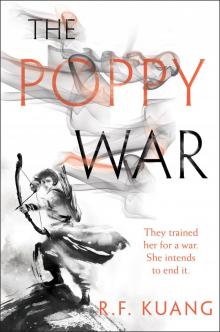
The Poppy War
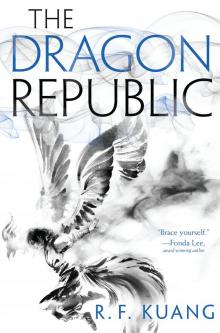
The Dragon Republic
The Burning God
Copyright
This is a work of fiction. Names, characters, places, and incidents are products of the author’s imagination or are used fictitiously and are not to be construed as real. Any resemblance to actual events, locales, organizations, or persons, living or dead, is entirely coincidental.
BABEL. Copyright © 2022 by R. F. Kuang. All rights reserved under International and Pan-American Copyright Conventions. By payment of the required fees, you have been granted the nonexclusive, nontransferable right to access and read the text of this e-book on-screen. No part of this text may be reproduced, transmitted, downloaded, decompiled, reverse-engineered, or stored in or introduced into any information storage and retrieval system, in any form or by any means, whether electronic or mechanical, now known or hereafter invented, without the express written permission of HarperCollins e-books.
Harper Voyager and design are trademarks of HarperCollins Publishers LLC.
Cover design by Richard L. Aquan
Cover illustration @ Nicolas Delort
Crest illustration copyright © 2022 HarperCollinsPublishers
Map and tower illustration copyright © 2022 Nicolette Caven
FIRST EDITION
Digital Edition AUGUST 2022 ISBN: 978-0-06-302144-0
Version 06062022
Print ISBN: 978-0-06-302142-6
About the Publisher
Australia
HarperCollins Publishers Australia Pty. Ltd.
Level 13, 201 Elizabeth Street
Sydney, NSW 2000, Australia
www.harpercollins.com.au
Canada
HarperCollins Publishers Ltd
Bay Adelaide Centre, East Tower
22 Adelaide Street West, 41st Floor
Toronto, Ontario, M5H 4E3
www.harpercollins.ca
India
HarperCollins India
A 75, Sector 57
Noida
Uttar Pradesh 201 301
www.harpercollins.co.in
New Zealand
HarperCollins Publishers New Zealand
Unit D1, 63 Apollo Drive
Rosedale 0632
Auckland, New Zealand
www.harpercollins.co.nz
United Kingdom
HarperCollins Publishers Ltd.
1 London Bridge Street
London SE1 9GF, UK
www.harpercollins.co.uk
United States
HarperCollins Publishers Inc.
195 Broadway
New York, NY 10007
www.harpercollins.com
* For example, I never heard anyone refer to High Street as ‘The High’ when I was at Oxford, but G.V. Cox tells us otherwise.
* In Book IV, Chapter VII of The Wealth of Nations, Adam Smith argues against colonialism on the grounds that the defence of colonies is a drain on resources, and that the economic gains of the monopolistic colonial trade are an illusion. He writes: ‘Great Britain derives nothing but loss from the dominion which she assumes over her colonies.’ This view was not widely shared at the time.
* I killed Cock Robin.
Who saw him die?
* William Blake, ‘Jerusalem’, 1804.
* As Robin’s family had only recently migrated south, he had grown up speaking both Mandarin and Cantonese. But his Cantonese, Professor Lovell informed him, could now be forgotten. Mandarin was the language of the Qing imperial court in Peking, the language of officials and scholars, and therefore the only dialect that mattered.
This view is a side effect of the British Academy’s path dependency on scant previous Western research. Matteo Ricci’s Portuguese-Chinese dictionary was of the Mandarin dialect he learned at the Ming court; Francisco Varo, Joseph Prémare, and Robert Morrison’s Chinese dictionaries were also of Mandarin. Britain’s Sinologists of that era, then, were far more focused on Mandarin than on other dialects. And so Robin was asked to forget his preferred native tongue.
* ‘Robbery, butchery, and theft – they call these things empire, and where they create a desert, they call it peace.’
* Hampstead Heath rhymes with teeth. Example: ‘She’s still got all her baby hampsteads.’
* Dinner, sinner.
* A reasonable error. By rape, Pope meant ‘to snatch, to take by force’, which is an older meaning derived from the Latin rapere.
* Because he owned slaves.
* This was to be the last Marryat title Robin ever read. It was just as well. Frederick Marryat’s novels, though full of the high seas adventuring and valour that endeared them to young English boys, also portrayed Black people as happy, satisfied slaves and American Indians as either noble savages or dissolute drunks. Chinese and Indians he described as ‘races of inferior stature and effeminate in person’.
* As the weekly papers recorded the climbing death counts, Robin asked Mrs Piper why the doctors could not simply go around healing the sick with silver, as Professor Lovell had done to him. ‘Silver is expensive,’ responded Mrs Piper, and that was the last they ever spoke of it.
* Here Mr Hallows forgets that chattel slavery, wherein slaves were treated as property and not persons, is a wholly European invention.
* Indeed, in the wake of Haiti’s liberation, the British began toying with the idea of importing labourers of other races, such as the Chinese (‘a sober, patient, industrious people’), as a possible alternative to African slave labour. The Fortitude experiment of 1806 attempted to establish a colony of two hundred Chinese labourers in Trinidad to create a ‘barrier between us and the Negroes’. The colony failed, and most labourers soon returned to their native China. Still, the idea of replacing African labour with Chinese labour remained attractive to British entrepreneurs, and would be continually revived throughout the nineteenth century.
* Formerly known as Gropecunt Lane, Magpie Lane was originally, as the name suggests, a street of brothels. This was not mentioned in Robin’s guidebook.
* There had once been a boy named Henry Little who’d visited Hampstead with his father, one of Professor Lovell’s colleagues in the Royal Asiatic Society. Robin tried to engage him in conversation about scones, which he thought as good an opening salvo as any, but Henry Little merely reached out and stretched Robin’s eyelids out so hard that Robin, startled, kicked him in the shin. Robin was banished to his room, and Henry Little to the garden; Professor Lovell had not invited his colleagues to bring their children over since then.
* This was true. University College had produced, among others, a Chief Justice of Bengal (Sir Robert Chambers), a Chief Justice of Bombay (Sir Edward West), and a Chief Justice of Calcutta (Sir William Jones). All were white men.
* 無 (wú) means ‘negative, not, without’; 形 (xíng) means ‘appearance, form, shape’. 五行 means not just invisible, but intangible. To illustrate: the poet Zhang Shunmin of the Northern Song dynasty wrote once that ‘詩是無形的畫, 畫是有形詩’; that poems were incorporeal (wúxíng) paintings, and paintings were corporeal poems.
* 幫忙 (bāngmáng), ‘to help, to lend a hand’.
* Sarah Stickney Ellis, a well-known author, published several books (including The Wives of England, The Mothers of England, and The Daughters of England) arguing that women had a moral imperative to improve society through domestic propriety and virtuous conduct. Robin had no strong opinion on the matter; he’d picked up her work by accident.
* This is, frankly, quite a generous description of the Legal Department. One could also argue that the business of translators in Legal was manipulating language to create favourable terms for European parties. One example is the alleged sale of land by King Paspehay to the English in Virginia ‘for copper’, despite the obvious difficulty of translating precisely the notions of European kingship or land as property into Algonquin languages. The Legal solution to these issues was simply to declare that the Algonquins were too savage to have developed those concepts, and it was a good thing the English were there to teach them.
* He was not. The eighth floor of the Institute had been reconstructed seven times since the building’s initial construction.
* A good amount of foundational Western scholarship on Sanskrit was done by German Romantics such as Herder, Schlegel, and Bopp. Not all of their monographs had been translated into English – at least, not well – and so most students studying Sanskrit at Babel were also required to learn German.
* Cf. the related German unheimlich.
* This is true. Mathematics is not divorced from culture. Take counting systems – not all languages use base ten. Or geometry – Euclidean geometry assumes a conception of space not shared by all. One of the greatest intellectual shifts in history involves the transition from Roman numerals to the more elegant Arabic numerals, whose place-value notation and concept of zero, signifying nothing, made possible new forms of mental arithmetic. Old habits died hard; in 1299, merchants in Florence were banned by the Florentine Arte del Cambio from using both zero and Arabic numerals: ‘He shall write openly and fully by letter.’
* Like Robin, Ilse was known to the English not by her birth name but by an adopted name; a combination of a chosen Anglicized name (Ilse) and the island from which she’d come (Dejima).
* The boys stayed out of this one. Privately, Ramy thought Letty had a fair point that as a woman, she was entitled to inherit none of the Price estate to begin with. Robin thought it was a bit rich for her to call herself ‘impoverished’ when they were all receiving stipends sizable enough that they could dine out whenever they felt like it.
* Robin, Victoire, and Ramy were all very disappointed to learn that corned beef had nothing to do with corn, but with the size of rock salt crystals used to cure said beef.
* A swindler, a grifter.
* Thief’s slang for a gaoler (jigger meaning ‘door’, and dubber meaning ‘closer’).
* 坦途.
* ‘On Agriculture’.
* These receptions were entertaining at first, but quickly grew tiresome when it became apparent that Babel scholars were there less as distinguished guests and more as zoo animals on display, expected to dance and perform for wealthy donors. Robin, Victoire, and Ramy were always treated as national representatives of the countries they appeared to hail from. Robin had to put up with excruciating small talk about Chinese botanical gardens and lacquerware; Ramy was expected to elaborate on the inner workings of the ‘Hindu race’, whatever that meant; and Victoire, bizarrely, was always being asked for speculation advice in the Cape.
* Through Colin Thornhill and the Sharp brothers, Robin became aware of various ‘sets’ of people one might run with, which included ‘fast men’, ‘slow men’, ‘reading men’, ‘gentlemen’, ‘cads’, ‘sinners’, ‘smilers’, and ‘saints’. He thought perhaps he qualified as a ‘reading man’. He hoped he was not a ‘cad’.
* Many romantic Univ undergraduates fancied themselves successors to Percy Bysshe Shelley, who rarely attended lectures, was expelled for refusing to admit authorship of a pamphlet titled ‘The Necessity of Atheism’, married a nice girl named Mary, and later drowned in a violent storm off the Gulf of Larici.
* Robin, despite his general dislike of Shelley, had still read his thoughts on translation, which he grudgingly respected: ‘Hence the vanity of translation; it were as wise to cast a violet into a crucible that you might discover the formal principle of its colour and odour, as seek to transfuse from one language into another the creations of a poet. The plant must spring again from its seed, or it will bear no flower – and this is the burthen of the curse of Babel.’
* For example: ‘You know how the French refer to an unfortunate situation? Triste comme un repas sans fromage. Sad as a meal without cheese. Which is, really, the state of all English cheese.’
* Karl Wilhelm von Humboldt is perhaps most famous for writing in 1836 ‘On the Structural Difference of Human Languages and Its Influence on the Intellectual Development of the Human Race’, in which he argues, among other things, that a culture’s language is deeply tied to the mental capacities and characteristics of those who speak it, which explains why Latin and Greek are better suited for sophisticated intellectual reasoning than, say, Arabic.
* The military applications of this match-pair were really not as useful as Professor Playfair made them sound. It was impossible to specify which pieces of knowledge one wanted to remove, and often the match-pair only caused enemy soldiers to forget how to lace their boots, or how to speak the fragmented English they knew. The Duke of Wellington was not impressed.
* In the late eighteenth century, there had been a brief craze of the silver-working potential of created languages such as the abbess Hildegard of Bingen’s mystical Lingua Ignota, which had a glossary of over a thousand words; John Wilkins’s language of truth, which involved an elaborate classification scheme for every known thing in the universe; and Sir Thomas Urquhart of Cromarty’s ‘Universal Language’, which attempted to reduce the world to a perfectly rational expression of arithmetic. All these faltered upon a common obstacle that later became accepted as basic truth at Babel: that languages are more than mere ciphers, and must be used to express oneself to others.
* 風暴.
* 颱風.
* ‘Awkward,’ Victoire would say, pointing to Robin, ‘comes from the Old Norse aufgr, which means “turned the wrong way round, like a turtle on its back”.’
‘Then Victoire must derive from vicious, not Victoria, for you are nothing but vice,’ Robin would retort.
* 尼.
* 涅槃.
* An understatement. A few short decades after Potosí’s ‘discovery’ in 1545, the silver city had become a death trap for enslaved Africans and drafted indigenous labourers working amidst mercury vapour, foul water, and toxic waste. Spain’s ‘King of Mountains and Envy of Kings’ was a pyramid built on bodies lost to disease, forced marches, malnutrition, overwork, and a poisoned environment.
* Two weeks into Michaelmas several freshers at Balliol had rented several punting boats and, in their drunken revels, created a traffic jam in the middle of the Cherwell that piled up three barges and one houseboat, costing incalculable pounds in damages. As punishment, the university had suspended all races until next year.
* It took a great deal of rigour and scrutiny to contribute anything to a Grammatica. Oxford was still smarting from the embarrassments dealt by a former visiting lecturer named George Psalmanazar, a Frenchman who, claiming to be from Formosa, passed off his pale skin by saying that Formosans lived underground. He had lectured and published on the Formosan languages for decades before he was exposed as a complete fraud.
* Omar ibn Said was a West African Islamic scholar captured into slavery in 1807. When he wrote his autobiographical essay in 1831, he was still enslaved by American politician James Owen in North Carolina. He would remain enslaved for the rest of his life.
* This was only the beginning of the multiple flaws of Schlegel’s work. Islam he considered a ‘dead empty Theism’. He also assumed that Egyptians were descended from Indians, and argued Chinese and Hebrew were inferior to German and Sanskrit because they lacked inflection.
* Many of Babel’s customers were ready to believe that their silver-work made use of foreign languages, but not that their maintenance involved foreign-born scholars, and more than once Professor Chakravarti had had to enlist one of the white fourth years to accompany him and Robin on trips just to get them through the door.
* The manuscript in question – named the Baresch Codex after the alchemist who brought it to public attention – is a vellum-bound codex of what appears to be magic, science, or botany. It is written in an alphabet combining some Latin symbols and wholly unfamiliar symbols; this alphabet employs no capitalization and no punctuation marks. The script appears closest to Latin, and indeed makes use of Latin abbreviations, but the manuscript’s purpose and meaning have remained a mystery since its discovery. The manuscript was acquired by Babel in the mid-eighteenth century, and many Babel scholars since have failed to translate it; the alphabet used for resonance links takes inspiration from the manuscript’s symbols but represents no progress in deciphering the original.