

Exposition, page 7
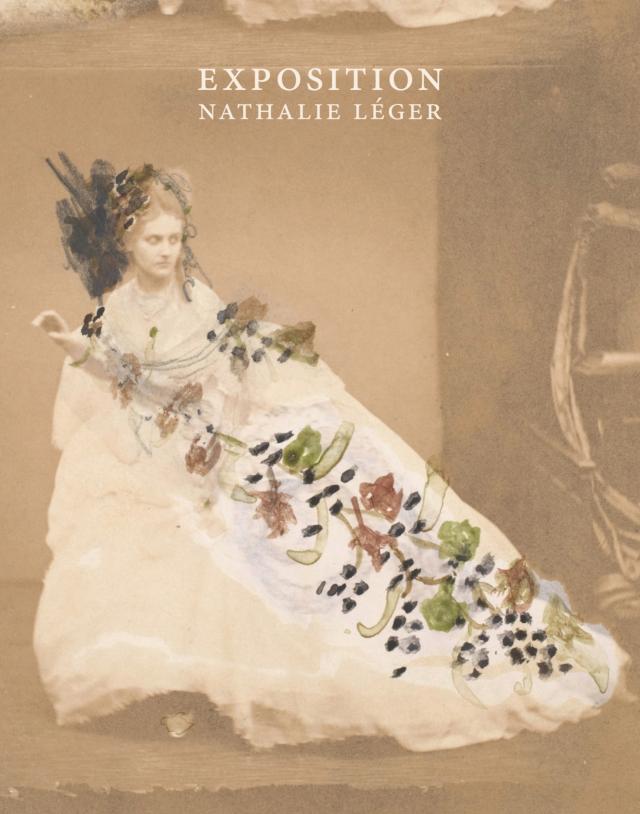


They didn’t love her like they should have. They scorned her. So she would withhold her presence from everyone who didn’t give a damn, who was even relieved—it was her against the world. She shut herself away. The first confinement was in 1858. Having seduced the emperor, she thought she could replace the empress, but was made to understand that she had gotten carried away, and was advised to return to Italy. And so she shuts herself up in Villa Gloria on the hills of Turin. A young diplomat, secretary of the French Legation, emboldened, climbs to her door one day in December 1860. Later he recounts the story of his visit, telling it like a slow tracking shot, spinning and zooming in: “The weather was gloomy, the sky gray. The Po, much restricted at this point, roiled at our feet in torrents. The city, couched in the plain with its snowy roofs and black steeples; then at the horizon, close to us, the long range of the Alps, white from summit to base. The trees were bare, the paths buried under dead leaves. The beautiful recluse was stretched out on a sofa. What lies at the bottom of her heart, whose very existence was denied by many?” Later, after returning to Paris in 1861, after new wounds (they underestimated her, they insulted her, they hurt her, they envied her, etc.), she shut herself up in her little house in Passy. Here or there, she was always lying on her daybed, tired of not having been understood, so fatigued, so melancholic; certain suitors wander to her bedside in search of everything that she won’t give, they pile on the descriptions, risk epithets, stammer a homage, and finally, haggard, exhausted, they sum it up: “Woman, in toto!” They’re at the end of their ropes, taken, fascinated, terrified by too much beauty, they approach her trembling and excusing themselves: “I desire you with all of the power of my soul and my body. I hope that this confession doesn’t displease you too much,” one of her lovers wrote to her, a good man whose colleagues could describe him as: “A fine and delicate mind, resistant to passion and to enthusiasm.” When she is too tired to chat, they read to her in low, gentle voices, they take up their classics again, they must have read Goethe’s Faust, Part I: “Gaze not upon her! ’Tis not good! Forbear! / ’Tis lifeless, magical, a shape of air, / An idol. Such to meet with, bodes no good,” or Schiller’s On the Sublime, overcome with emotion: “Faced with the Terrible, we preserve the painful feeling of our limits through its instigation, so we do not, however, flee it, but rather are attracted by it with irresistible force,” well, they’re caught, done for, too bad for them.
In this solitude, in this dismal waiting without purpose, as she staggered in bitterness through the dark, dirty rooms within, did she allow herself to cry? Is it possible to imagine this woman sobbing? Did she sometimes surrender to the catastrophe of her face in tears?
All of this unfolded against the hectic background of the fête impériale: competition to spend more, industrial fireworks, the excitement of luxury, a society, haggard, given over to the double fury of speed and immobility, to the railway and to photography—to the passion for transformation and the fascination with the identical. Its apotheosis was anticipated on May 1, 1867, opening day of the International Exposition. In the photography section, Pierre-Louis Pierson exhibited the portrait of the Countess of Castiglione as the Queen of Hearts. She was dressed in her famous costume, which she wore to the ball at the Ministry of Foreign Affairs ten years earlier, in February 1857. An hour of glory as tawdry as the dress she wore, studded with hearts clasped in gold chains and strategically placed, to the point that the empress drily let slip, “Your heart is a bit low, countess,” which delighted the court. Pierson’s photographs were taken well after the ball. In the meantime: humiliation, exile, brooding, return, more brooding. And so she came back, made the journey to the studio again ten years later, put her costume back on, did her hair just as it had been, put back on the soft little green slippers, and presented herself before the lens. There, it’s done, she’s put time in a bottle. On the Champ de Mars, where the Eiffel Tower will later cast its great void, in the middle of the park, they’ve constructed an oval city organized in seven concentric circles. At night, the perimeter of this provisional palace conceived by Le Play and Krantz was illuminated by a ring of lights. Around it, bridges, greenhouses, an aquarium, galleries, trophies, Turkish baths, a train station, catacombs, an izba, theaters, the Chinese garden, the great lighthouse on the lake, legendary fortresses, oriental attractions … everything fused into a fantastic, disjointed panorama, a bazaar or carnival, all of it in trompe l’oeil that left the soul cold and the senses crazed, which dazzled the eye more than it spoke to the intelligence, said the journalists. For the first time, the arts were presented under the same vaulted ceilings as the products of industry, Cabanel had a big hit with The Birth of Venus, or was it Paradise Lost, while a few steps away the Prussian section exhibited Krupp’s giant cannon, subtly commented upon by the press: “It is not as it was in the past, when one stopped before the graceful, nearly elegant shape of a richly embellished cannon bearing a coat of arms. Even the ladies now only wish to hear about these gigantic, overwhelming works of modern artillery; for example, they absolutely demand the immense rampart cannons that load at the breech, of the sort that comes from the large molten steel factory at Essen.” On that day, with Prince George of Prussia on her arm, she paraded her beauty around those breeches; they will have stopped there, and he no doubt will have carefully explained, without useless metaphors, the operation of the engine. They ascend to the galleries, they’re under the glass roof, families go on excursions on the slopes of the big city, sensing vaguely that in the face of so much accumulation so adroitly masked by spectacle, one could only exist by removing oneself from it. The organizers of the Exposition said: “The public requires a grand concept that strikes the imagination. They want to contemplate an enchanting view, not similar products grouped uniformly.” The organizers didn’t want to simply gather all of the products of industry and commerce in a single place, not just to organize the “federation of material” as the Goncourt brothers put it, but to transform each object into merchandise, to transfigure merchandise into enchantment, ultimately to convert the real into fetish, to dance on the object’s grave. You look, you don’t touch—subtle law of exchange value. And so she went, on the arm of a dignitary, to verify this, her own body, her real body undone by photography, offered in the splendor of trompe l’oeil.
Once the Exposition was over, once the great halls and huge glass roofs had been taken down, there were stuffy salons where people tried to distract themselves by imagining new, spectacular configurations, all in bad conscience. During the Second Empire, good works provided countless occasions for high society to enjoy itself: they put on disguises, went on parade, danced for the victims, the epidemics, for the flood victims, for the orphans, they multiplied their successes, they eulogized what they hated, they made themselves at home in the outrageous tyranny of kindness, it didn’t take much for them to organize a grand salon for Universal Generosity. But they had to go to the greatest lengths, not recoil at any indignity, hold an audition, invent an entire dramaturgy. So, on a beautiful day in 1863, after a flash of inspiration on the grand staircase of her private mansion: good grief, but of course! Countess Stéphanie Tascher de la Pagerie, cousin to the emperor, hurried to see Castiglione, in Passy, Rue Nicolo, noting incidentally that the house was “modest, bourgeois, poorly furnished, nearly poor,” and convinced the beautiful recluse to grace them a little with her person. She noted in her journal that her presence would be “excellent bait for selling tickets.” All of Paris was astir at the announcement of the lady’s appearance. The newspapers proclaimed that she would “reveal herself to spectators for love of the poor.” She was the main attraction, the ticket office was working overtime. The charity party took place at Hôtel Meyendorff on Rue Barbet-de-Jouy. They hoped she would be nude. The rumor had gone around that she had demanded a grotto setting, and they imagined her unclothed as a nymph, a siren, as Ingres’s Source, against a canvas backdrop painted like a cave. A packed house. When the curtain rises, to their astonishment, it is a nun who appears at the doorstep of her hermitage dressed in the attire of a Carmelite, made of severe homespun, the hostile face obscured at the forehead and chin by her veil, her posture stiff. A little sign on the cardboard grotto reads: “The Hermit of Passy.” Silence. The tableau is striking. Then they pull themselves together, they are outraged, they whistle and boo at her, and she saves herself (“Oh, the vile lot!” she would have said), acting sincerely as if she were the one who wasn’t satisfied. However, everyone played his or her role in the marvel, the ruse had reached its full potential and the tills were full.
Besides that, she exhibited fragments of her body during what were called “living statue” sessions, an arm, an ankle, a thigh, a breast. She had a few molds made of these bits and sometimes gave them to her admirers. After her death, Montesquiou acquired them in the 1901 sale, carefully preserving them in display cases. “This woman’s life was one long tableau vivant, a perpetual tableau vivant.” She appeared nude for a happy few, men who came in the evening to hold their salon around the recluse. If boredom won out, if conversation lulled, she revealed the ace in her sleeve: nude, she appeared nude. She vanished, she prepared herself at length, and then appeared, it is an exhibition, she lets the scarves fall one by one, nude, she believes she is a Nude, but she is merely showing her nudity, she is caught up in her skin. “Ugh, she smelled like sweat,” said General Gaston de Galliffet, the one who commanded the famous cavalry charge at the Battle of Sedan. No matter, she would make good on it at her next sitting with the photographer. Images don’t smell.
Point 6 in Robert-Houdin’s manual on conjuring: “Moreover, wherever you have encountered failure, always refrain from admitting your defeat: exhibit self-assuredness, cheerfulness, and spirit; improvise, redouble your skill, and the public, stunned by your confidence, will perhaps think that the trick was supposed to end that way.”
We could start the exhibition with Guillaume Paris’s Theophanic Matter V (2000). It is a deep green cube measuring 60 × 60 × 60 cm, nearly luminescent, cut out of air-freshening gel which shrinks due to evaporation over the course of its exhibition, its shape condenses, hardens, darkens deeply, its shape crumples, slowly ruining itself but always preserving within itself the essence of the initial cube.
They tell me it’s her. Room 16, visitors have become scarcer. I still have one of the big albums in front of me, and I slowly turn the pages. The auctioneers lean over my shoulder and comment on an enigmatic photo attributed to Pierson. They want my opinion: Is it her or not? A woman naked, tangled in white tulle from her face to her knees, one hand on her hip, the other on the squat little armchair near which she is standing. They say it’s her. But they hesitate, start again, recognize that they would like for that to be her. For the auction. The photo is undated, but they know that it is contemporaneous with Castiglione’s visits to Pierson. It is a strange image of this woman with her face hidden under the density of the tulle skillfully arranged, above, to mask her face, her gaze; and to reveal, below, beneath a very slight opacity, under the conventions of concealment, her breasts, her stomach, her pubis. “A very modern image,” one of them says, “the surrealists could have made it.” Her face is masked under a thickness of tulle, but you suspect that it’s staring at the lens. “The posture of the body is always arranged based on the gaze,” says the other, running his index finger along the woman’s face. He pulls his finger away, leaving a light trace of vapor on the plastic sleeve protecting the image. I scrutinize the placement of the face, as if, by pulling away his finger, he might have lessened the opacity of the veil and made some of the woman’s traits appear. We don’t see her, but she is very certainly staring at us. How was the scene arranged? Had the pose been suggested by the lady? Was it a man, her lover or the photographer, who posed her there, nude under the simulacrum of a wedding dress, manipulating her, and she perhaps having some fun, or maybe not, despite the laughter, while in the wings of the studio, behind poorly constructed walls, yet another person is watching, completely at ease, as Geneviève Mallarmé described to her father the scene at Nadar’s viewed through the unexpected chink in a door, which allowed her to see Princess Caraman-Chimay posing nude in a pink silk undershirt (“What a chest and what a behind!” she wrote, so that her father imagined the scene well, all too well). The lady in tulle isn’t smiling anymore. Now, hidden under her veil, she looks at the man without his knowing it. No more need to compose her features, to act sweet, beautiful, to coax the other, to force him to look at you, to love you like Castiglione in her photos, the inclined head, the way of attracting, catching, and of retaining. What face would you find behind the luminous tulle, what gaze? The one we have when no one is looking at us, a hostile face, a blind gaze, a disoriented face, the face of a monster, a seething face, perhaps. “So, is it her or not?” No, certainly not. I show them, the hair here, the arm there, look, it’s not the same anatomy, here the ankles are finer, the skin duller. I try not to hesitate, to show my certainty. I compare the images, I break them down, I argue, I seem to be talking about a familiar body. “You know her well,” they tell me.
It isn’t irrelevant that someone else is watching. I say it again, but the cultural attaché doesn’t understand. “If Castiglione were alive today, her oeuvre would be that of a Cindy Sherman,” he says, moving the piles of books spread out across the shelf behind his desk, then moving them back. “She would have been a photographer, or she would have simply bought a digital camera and taken photos of herself. She would have written, like Cindy Sherman did in her diary, you’re familiar with her diary? She wrote ‘Play on Narcissism / real Autoportrait’ or something like that, and there you have your Castiglione.” At this point, someone knocks. I wait for him to respond, but he moves the books again, sits down at his desk without a word, opens the file placed before him, sinks into it, suddenly hunched examining the first document he comes across, his diagonally striped tie looping around and sagging limply against the glass tabletop. They knock a second time. Leaning back in his armchair, one of the sheets in his hand; all of the signs of the most attentive reading are displayed on his face, I turn my head toward the door, he interrupts his reading, puts the sheet back down, props himself up on the table, clasping his hands before him, looks at me with an encouraging expression, eyebrows raised, smile on his lips, the conversation must go on, I repeat that the presence of the photographer wasn’t so negligible as he seems to believe. “The fact that a man is watching isn’t irrelevant, is it?” But he isn’t listening. “That a what is watching?” I repeat what I’d said.
Once the men had fled, once the lovers had been turned away, there was only one man left, and that was Pierson, provider of services. You might think that he doesn’t count, after all, he’s just a supplier, and yet it was to him that she went to assure herself that her face was not like the one she saw in her mirror, a face that was insane or already dead. Pierson, even-tempered as a hero, a veritable Perseus with a floating gaze that fends off the blows in the shelter of his darkroom, extending the reflective surface of the paper toward her. A few years later, Montesquiou embarked on his research and conversed with him at length. The photographer told him a few anecdotes—for example that she had said to him one day while he calmly raked the gravel paths in the atelier courtyard between two sittings: “Are you well aware of what God has done for you in making you the collaborator of the most beautiful creature that has existed since the beginning of the world?” (he looked at her without saying a word, then resumed his raking); he also said that he tore out his hair because she never listened, only adjusted her head, couldn’t care less about the light since she was the light (at the same time, he wrote in his treatise Photography, the History of Its Discovery: “Light is a paroxysmal instrument that never obeys the desires of the photographer in a complete way.”) You might have taken him for the lady’s servant, a shrewd businessman, a skillful technician, but in truth he was Edison in Villiers de L’Isle-Adam’s novel, creating the ideal, searching for the future Eve: “I will reproduce this woman exactly, I will duplicate her, with the sublime radiance of Light! And then, projecting her through her RADIANT MATTER, I will fill with the visions of your melancholy the imaginary soul of this new creature capable of amazing angels. I will cast Illusion to the ground and enclose it in a prison! In this vision, I will compel the Ideal itself to become apparent …” And she, Castiglione, was more like Claude Bernard in his laboratory, making photographic experimentation a method for obtaining facts, nothing but the facts. In their own way, each of them thought that in the midst of general disorder, the only possible place is locked in the darkroom, that’s where everything will be put in order, groping blindly, without understanding.





