

Exposition, page 2
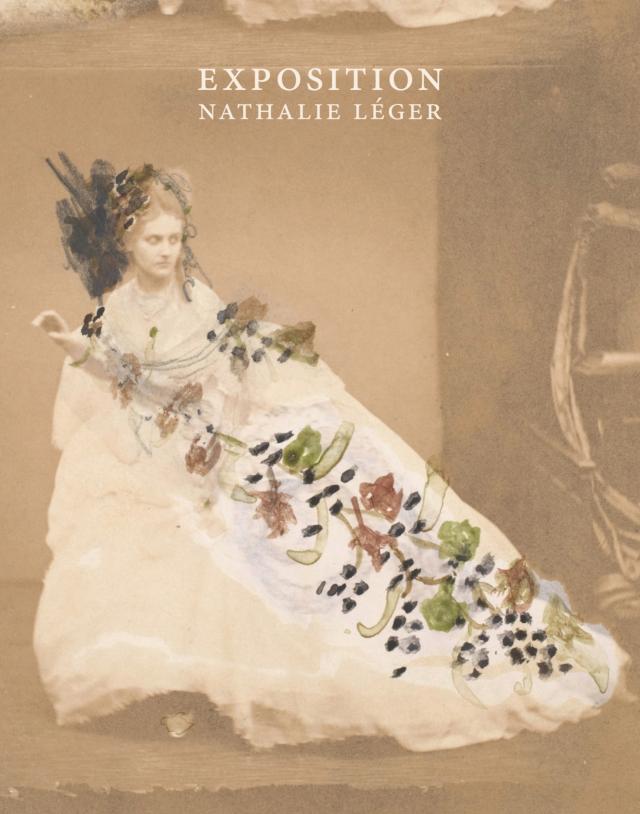


It would be best to leave it at what the painters say on the subject: “I hold on to my motif,” Cézanne told Gasquet. And what is a motif? “A motif, you see, is this …” said Cézanne, clasping his hands. He drew them together slowly, joined them, gripped them, made them fuse together, merging the one into the other, Gasquet recounted. That’s what it is. “This is what you have to achieve. If I go too high or too low, it’s all ruined.” What is my motif? Something small, very small, what will be its gesture? I look at her face in Portrait with Lifted Veil from 1857, her eyes downcast, her mouth so weary, tight and thin, her air of mourning. This woman’s sadness is frightful, a sadness without emotion, true self-defeat, an inner collapse, desolation. Photography can create an image of it, but to make a motif of it, something more is required; one must use words to bring things together slowly, join them, fuse them.
I wander through the show rooms at Hôtel Drouot. I wait. I linger among the furniture. I know that I’ll end up descending to the second lower level, to room 16, where the auction is being held. I move along the narrow paths leading between the tables and the cabinets. I walk along Second Empire chaise longues, stacks of chairs upholstered in old velvet, chinoiseries, inlaid gaming tables. There must be a reliable way to contain impatience, a method for presenting oneself calmly before that which is awaited, wanted, but I don’t know what it is. I exist in a state of clumsy deferral, walking around, looking around, at what I don’t know. As long as the mind tires of sliding over these accumulations of objects, it’s not possible to know. The furniture overwhelms the prim rooms hung with red brocade, rooms that are somewhere between supermarket display cases and cabinets of curiosities, completely bathed in the opaque light of fluorescent tubes, a light that turns pallid, which gives the illusion of excess all around you and creates a vacuum, a baseless, incomprehensible vacuum, when the sky outside is as pure as theory. I don’t look at anything. I hardly glance at a little cabinet of yellow wood whose numerous drawers frame a minuscule mirror at eye level, mottled to the point of opacity. I don’t look at anything. I think only of the space that separates me from the second lower level, room 16. I picture it, its light, its grayness, the bodies gathered together seeking ever more forms for their solitude, ever more objects for their consolation. I let the escalators carry me to the second lower level. I suppose a desire that has been mastered and deferred always ends like this: in a rush, albeit a carefully concealed one, no more ploys, an internal rush, even if, from the outside, everything remains very calm.
Room 16 is dusty, too large for the glass cases standing nearly empty at its center, too formal, as if perpetually poised to welcome something greater than what it currently offers. From the entrance, I notice pictures leaning against the wall at the back, put forward without ceremony, proffered almost negligently. At the long viewing tables, a few people are hunched in concentration, slowly turning the pages of large compendiums and conferring in hushed voices. The ostentatious signs of splendor (the red hangings, the moldings, the dignified and courteous personnel) only serve to magnify the mediocrity of the place, its insipidness, an insolent farce. I take a seat and begin speaking to the experts with the requisite amount of dignified reserve (tomorrow at auction, who knows, maybe I’ll buy an important lot) and feigned nonchalance. People gather around. Like the walls, they’re full of false solemnity and indifference.
She is upright, dangling arms, eyes nearly half closed. She is seated on the floor, bowed down among some cushions. She is seated on the floor, almost slumped, looking at a little boy dressed as a Scotsman. She is carrying a parasol and a wide-brimmed hat. She is supine on a little sofa. She is seated, propped on her elbows at a table laden with bottles. She is lying on the floor, seemingly asleep. She is upright, a fan in her hand. She is upright, a knife in her hand. She gives herself a sidelong glance in a mirror. She is looking at us through an empty frame.
So then, why the disillusion? Because the red of the hangings in room 16 seems gray under the neon lights and the moldings are faux wood? I regard the images silently. They are drab. I pretend to stare at them with interest, but disillusion wins out, the abrupt desire to give up on them, to be uncompromising, to leave. I had imagined them gleaming, alive, revelatory of a presence, all I have in my hands are mediocre prints, poorly protected by their transparent sleeves, in exhausting abundance: this overexposed body, this stubborn refusal to ever be satisfied with herself, this obstinacy to always return to the self, to this small slice of face, to these postures (this careless pose, in profile, tip of one finger just slipping into the décolleté of her blouse, this insistent gaze toward the photographer, this air of innocence that nonetheless insists, the vulgarity—and so: disgust, the desire to leave the subject immediately), and her head always tilted, her gaze at once defiant (I’m not who you think) and imploring (take me for what I am), believing she has grasped her own truth while only counterfeiting herself. One day Janouch said to Kafka, speaking of photography: “The apparatus is a mechanical Know-Thyself.” But this woman never comes to know herself, only to confirm herself, to repeat herself, to hold herself forever in ignorance of herself. And Kafka responds: “You mean to say, the Mistake-Thyself! All of these heads tilted for photographic portraits, these heads subdued by the image.” To leave the evil spell of this submission, to break with this cruelty. I cast a jealous eye on the other collections of images displayed nearby. I would prefer to buy this Roman landscape—heavy foliage bathed in light leading toward the shade of a villa, 1880, carbon period print, this calm, this inadvertence, this absence of intention—but let’s face it, that’s not what I’m looking for. I look at the photographs again. They show a woman in mourning for her own body.
Marie Angélique Arnauld, abbess of Port-Royal, wrote to an admirer: “I cannot pardon your vain desire to have my portrait, and I tell you before God that I believe it would be a mortal offense against Him, should I consent to let myself be drawn. Can it be possible that you do not see the vanity of the desire, nor the grievous sin that I would commit by consenting?”
Pierson must have known women well, he had a good eye. In his own way, he must have been a sort of Charcot: he knew how to look at a body, he was an expert on the subject. He knew that there was no need to touch in order to grasp, all that was needed was a little distance. And the invention of a device. Like the one Yves Klein used in his anthropometry workshop: it requires elevation and white gloves. The nude model slathers paint on her body, then carefully lies down on a large sheet of white paper spread across the floor. The painter, perched on a stepladder, gives orders from above in a self-possessed tone, well articulated, slow, chant-like: “Go on, spread the paint around, that’s it, all around on your stomach and thigh, yes, all over your stomach (a pause), all over your breasts (a pause), good, very good, make sure you are truly present for the surface, your whole body in contact, turn, press yourself down fully, apply yourself, look out, look out, look out, your stomach, press your stomach to the paper, come on now!! Move away, move away! Ah! It’s really very beautiful, really very very beautiful.” And so each week Castiglione goes to the man who knows how to look at her. The photographer adjusts his devices, maybe they talk but only so much, they must have been accustomed to quiet; they’re at work. Each week, she comes to be present for the surface, she turns, she turns around, applies herself, then moves away. She passes through great reception rooms with allegories painted on their ceilings (rosy-fingered Dawn, the Sun in its chariot, vanquished Night laying down its arms), then come the rooms where the shoots happen, those are all garlands, those are all astragals; they glitter with gold, silk, and bronze, say the chroniclers, and at the back are the powder rooms, and over there in the maze of corridors, in the private rooms, the darkrooms, everything there is black as a tomb. This place is mechanized like the basement of a theater, moving screens on invisible springs measure the light and modify the gradient of its rays according to the needs of the operation, canvases of all shades slide in their grooves and come to form the background of the tableau, painted skies, sea floor and fortresses, accessories on top of that, balustrades, benches, columns, barriers, stones, plants in pots and a piece of furniture in carved oak that can transform into a buffet, a fireplace, a piano, a prie-dieu, a desk. They’re ready. She has thought at length about the subject of the sitting—which scene, which outfit, which character? And the light, the orientation of her profile, and the story, the tale of herself, the legend retold each time, reinterpreted, with countless interjections and variants, the inner story that is muttered on some days, rapid and fluid on others, sung out. Montesquiou writes that she would return home to change, get an accessory, put on a piece of clothing. One could also imagine her undressing in one of the little chambers adjoining the studio, putting on costumes there. Judith or Elvira or the queen of Etruria. A Norman from the Pays de Caux (seated erect on a little wicker chair in a red wool dress, thick blue apron, and towering headdress of guipure lace. She’s holding some knitting, a large striped sock she seems to be finishing. Her elbows are pressed against her chest but under the heavy skirts her thighs are spread, her legs planted solidly, her feet wedged in little patent leather flats with straps. The ball of yarn has rolled onto the floor, and a strange, silly grin drifts across her face). She is an eighteenth-century marchioness, a severe Carmelite, she is Legouvé’s Béatrix, she is chaste, drowned Virginie, she is a man-eater as Donna Elvira, she is dressed as a Chinese woman, a Finnish woman, and here are funerals, a banquet, a ball. She prepares herself behind the scenes. Picture her hesitating before the cheval glass, trying on accessories, jewelry. The session begins. She appears on the little stage, always quickly assembled for the sitting. The session begins, and Woman makes her great appearance. She will try to put together a scattering of gestures and sentiments, turning them into one single image—telling a story in one single moment. She makes herself present, she turns, turns around, applies herself, then moves away. Look out, look out! Go! During those same years, the illustrious magician Robert-Houdin wrote a manual on conjuring whose eighth recommendation was: “Although everything said during a session may be, in a word, nothing but a web of lies, one must immerse oneself deeply enough into the spirit of one’s role in order to believe oneself in the reality of the fables being uttered.” She immerses herself, she immerses herself. And when the session is over, while Pierson gives instructions to the lab, she lingers a little, she is no longer thinking of anything, the curtain has finally fallen on her inner theater, its phantoms have been done away with. She watches the rain fall on the skylights, the starbursts opaque on the panes. She stands there, inert, as if entombed underwater, almost totally drained, standing still in the studio’s great luminous void, entrusting herself to a moment of silence and the absence of images, vanishing, carried away, swallowed up in the whiteness.
In 2005, the actress Isabelle Huppert was photographed by Roni Horn. Her face is bare, without makeup, without artifice. The series is titled Portrait of an Image. Someone told me that in each photo the actress had condensed the identity of one of her great roles: Madame Bovary, the Lacemaker, Violette Nozière … And so we lean forward, we look, but we don’t see anything—nothing but the actress’s face in each photo, a face with features drawn, a muddied complexion. Her gaze is hard, the texture of her skin uneven. A natural face, we think, a normal woman, attractive as each of us, plain as all of us, one who abandons all accessories to show us the true work: that Madame Bovary isn’t a wide-brimmed hat and a pinafore, but a detail, this imperceptible detail, this drooping corner of the mouth, this controlled distance between the eyebrow and the eyelid. We can’t see anything, but it’s there, this intensity, the work on the minutest nuance, an actress’s true work. We look again. No, that’s not it. The sole subject of this series is not the actress’s work, nor the incredible invisible machinery of acting; she herself is the sole subject, how could it be otherwise? Besides, the actress said: “When you pose for a photo, you want to know who you are, to be closer to yourself.” The sole subject is simply this woman, her nudity, her consent to the banality of her face. Somewhere in the eye of another woman, she laid down the traits of her ugliness. Perhaps this is what the theologians of the Port-Royal abbey called a “truthful portrait” (with visible simplicity, a portrait of excess and humiliation, a true portrait of oneself, formlessness in its very form, perhaps). A woman known for her beauty, Isabelle Huppert, her skin so white, her mouth so fine and ocher, her gaze cold, her presence unshrinking, dares to show herself to us without artifice. As she is. True determination. Courage, almost. However, by one of those rhetorical tricks inherent in self-representation, this truthful portrait is, by the very excess of its sincerity, the height of artifice and seduction. It declares precisely that which it pretends not to say. She gave false testimony (she who could largely rely on deception in all types of photography), gave it like the others, like all of the others, she—as we know well and can never forget, for these images are there to remind us of it—she who is always greater than the others because she exposes what the rest of us want to conceal, because she consents to her imperfection, because she consents to her ugliness. Nadar once said the photographic pose is a disease of the brain.
Another scene. The photographer is named Bert Stern and the model Marilyn Monroe. He makes her turn in space, indicates the poses, the accessories, gives a few instructions. He repeats that he wants her in a pure state, naked. He says it again. He even writes it down. He is unwavering in his conviction. Though his model opens herself to him easily, the photographer likes to believe that it will be difficult. Finally, he bypasses the difficulty he had invented and gets her drunk so he can photograph her.
Under one of her portraits, around 1861, she copies out these two lines: “Upon seeing such beautiful Sadness, / Who could desire Happiness?”
And suddenly in room 16, something appears. A woman with her back turned, bending over, leaning toward the back of the image—if such a thing exists. All that is visible of her is the bulk of a gleaming cloak thrown toward us. The sumptuous spray of white satin edged in swan feathers slides down to reveal bare shoulders. The photo is called Bal de l’Opéra. Castiglione triumphed, then she lost everything, she was exiled and, after having endured humiliation and separation, she returned, believing she’d carried the day, but instead endured the brutality of a new defeat. And so the photographer’s studio became a mythical space in which her empire silently expanded and where her legend was written. A woman with her back turned leans toward the back of the image where we can hazily make out a few decorative accents (wainscoting adorned with a tiny floral pattern, a little pedestal table, a bouquet, a lorgnette that captures a flash of light). The outline of a large mirror stands out, as if suspended in the shadow. She leans toward it, bent over in reverence. She turns her back to us, patiently offering us only the truncated mass of her body (head extended toward the mirror disappearing toward the back, into shadow), a body without forms, entirely absorbed by the dome of moiré fabric that falls in heavy folds, out of which the perfect contours of her shoulders spring up, pure curves of flesh, a clear line in the excess of clarity. This woman is waiting patiently. She waits for the camera to slowly take its shot. From the murky depths of her own image, in the stale, dirty water of the mirror, she looks at us, a woman leans into the depths of her own image, simultaneously offering herself to the mirror and to the lens. In the oldest photographic prints, like this one from the Braun atelier preserved in the Haut-Rhin departmental archives, you can make out the blurred, slightly sepia reflection of her face turned toward us, diverted through the mirror. One day, let’s say in 1863, she went into the photographer’s studio and they patiently arranged the details of this scene. We don’t know how long the sittings went on—a long time certainly, sometimes ten, fifteen shots, costumes, accessories, a veritable rehearsal, and the pose, constraining, not counting developing the collodion plates, which had to be done immediately after each photo, everything being constructed, constricted, nothing escapes. These images, and this one in particular, speak only of the long preparation of a body for battle, the long exhibition of a body to its own seduction, that combat, this protracted and meticulously premeditated death. There is no pathos in these pictures, nor anything dazzling: nothing of what you often discover in photography, celebration of the instantaneous, mushrooming, eruption, bursting forth, nothing of the heroic gestures that endure in photography but represent only a brief apocalypse in reality: a man raises himself on a hilltop, shot straight on, hauling himself up and collapsing at once; a woman turns toward the lens in a movement of happy surprise; a woman atop a pyramid of bodies hoists the flag of a nation in a dramatic gesture; a man condemned to death looks into the lens with the calm insistence that is the very mark of our passing, deathly still as he already is. Here, in contrast, everything is still, everything is captured in its duration, in the persistence of the body in exhibiting itself, keeping its pose, frozen in its reflection, watching us watch it watching itself. This woman observes. She is the predator. She is her prey. She is the swan. She is Leda. She is just waiting to be taken, ravished, but by herself alone.





