

Bradshaw On, page 3
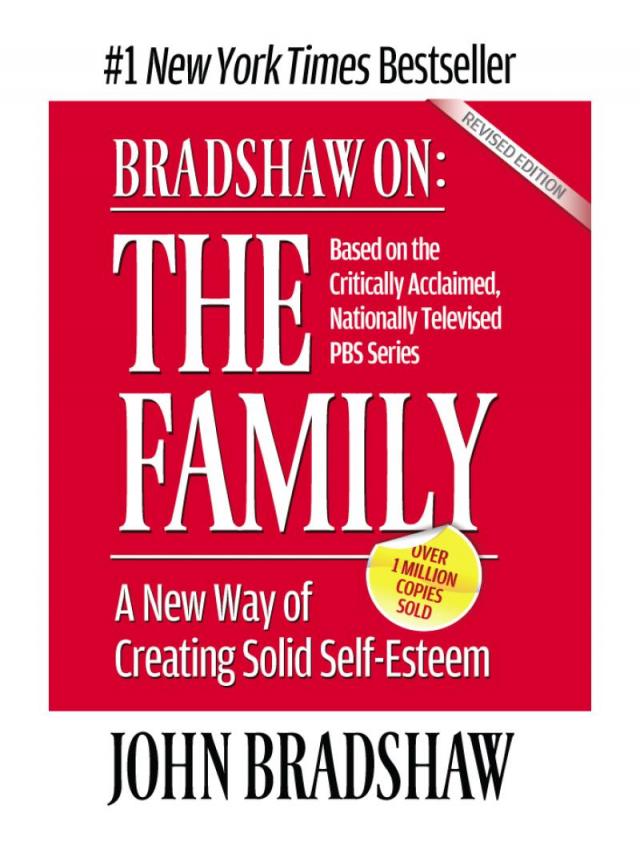


The crisis is far worse than is generally known because adults who parent their children badly cover up their shame-based inner selves. So the crisis is not just about how we raise our children; it’s about a large number of people who look like adults, talk and dress like adults, but who are actually adult children. These adult children often run our schools, our churches and our government. They also create our families. This book is about the crisis in the family today—the crisis of adult children raising children who will become adult children.
The Family Rules
The rules about raising children are the most sacred of all rules. They are authenticated by religious teaching and reinforced in our school systems. Seriously questioning them is considered sacrilegious. This is why the crisis is so dangerous.
Like the story of the emperor with no clothes, we are not supposed to look. But in this case, the consequences are far more serious. We share a collective denial and a cultural no-talk rule. This no-talk rule is rooted in the rules governing parenting. Children should speak only when spoken to; children should be seen and not heard; children should obey all adults (any adult) without question. To question is an act of disobedience. And so the rules are carried out by the obedient child in all the adults who are raising families. The hidden child in every adult continues to obey, so that the rules are carried multi-generationally, and “the sins of the fathers” are visited on the children, to the third and fourth generations.
The crisis is cunning and baffling because one of the rules comprising the sacred rules is that we can’t question any of the rules. We are not supposed to talk about the rules. This would dishonor our parents.
We have no alternative. We must break the sacred rule and question these rules because unless we talk about them, there is no way out. We must evaluate them in the light of our newfound knowledge of families as systems.
We must also examine these rules so that we can come to terms with our compulsiveness. Shame, with its accompanying loneliness and psychic numbness, fuels our compulsive/addictive lifestyle. Since the child in the adult has insatiable needs, we cannot find fulfillment. As grownups we can’t go back as children and sit in Mom’s lap or have Dad take us fishing. And no matter how hard we try to turn our children, lovers and spouses into Mom and Dad, it never works. We cannot be children again. No matter how many times we fill the cup, we still want more.
Shame fuels compulsivity and compulsivity is the black plague of our time. We are driven. We want more money, more sex, more food, more booze, more drugs, more adrenaline rush, more entertainment, more possessions, more ecstasy. Like a starving person, even more of everything does not satiate us.
Our dis-eases permeate everyday life. Our troubles are focused on what we eat, what we drink, how we work, how we sleep, how we are intimate, how we have orgasm, how we play, how we worship. We stay so busy and distracted that we never feel how lonely, hurt, mad and sad we really are. Our compulsivities cover up a lost city—a place deep inside of us where a child hides in the ruins.
COMPULSIVE/ADDICTICE BEHAVIOR
I understand compulsive/addictive behavior as a pathological relationship to any mood-altering experience that has life-damaging consequences. Such a definition helps us move from our stereotypical pictures of the dives and back alleys of drug and alcohol addiction to the respectable corporate and religious lives of work and religion addicts. It also helps us see the effect of the broken relationship with our original caretakers that produced shame. Because our original dependency bridge with our survival figures has been broken, we are set up for problems with dependency and with relationships. In the abandonment relationships that shame us, our compulsivities are set up.
Our families are the places where we have our source relationships. Families are where we first learn about ourselves in the mirroring eyes of our parents; where we see ourselves for the first time. In families we learn about emotional intimacy. We learn what feelings are and how to express them. Our parents model what feelings are acceptable and family-authorized and what feelings are prohibited.
When we are abused in families, we learn to protect ourselves with ego defenses. We repress our feelings; we deny what’s going on; we displace our rage onto our lovers, spouses or our friends; we create illusions of love and connectedness; we idealize and minimize; we dissociate so that we no longer feel anything at all; we turn numb.
Our addictions and compulsivities are our mood alterers. They are what we develop when we grow numb. They are our ways of being alive and our ways of managing our feelings. This is most apparent in experiences that are euphoric, like using alcohol and drugs, compulsively having sex, eating sugar, the adrenaline rush that comes with the feelings of ecstasy and righteousness. It is not as obvious in activities that are used to distract from emotions, such as working, buying, gambling, watching television and thinking obsessively. These are mood-altering nonetheless.
Addiction has become our national lifestyle—or deathstyle. It is a deathstyle based on the relinquishment of the self as a worthwhile being to a self who must achieve and perform or use something outside of self in order to be lovable and happy. Addictions are painkilling substitutes for legitimate suffering. To legitimately suffer we have to feel as bad as we feel.
The fastest-growing problem in our country is sexual addiction. Some estimates say that the number of sex addicts is equal to the number of chemical addicts. Grave social consequences have arisen from this problem. The spread of AIDS is certainly fueled by sexual addiction, as are incest and molestation. And while all sex addicts are not child molesters, most child molesters are sex addicts.
Another major factor in family dysfunction is the addiction to power and violence. Battered children and battered wives expose the horror of physically abusing families.
Violence itself can be an addiction. An essential component in any abusing relationship is the addiction to being victimized. Traumatic bonding, a form of learned helplessness, is a true addiction that enslaves and soul-murders.
I stated earlier that the old rules no longer work. What are these old rules?
Poisonous Pedagogy
The Swiss psychiatrist Alice Miller in her book, For Your Own Good, groups these parenting rules under the title “poisonous pedagogy.” The subtitle of her book is Hidden Cruelties in Child Rearing and the Roots of Violence. She argues that the poisonous pedagogy is a form of parenting that violates the rights of children. Such violation is then reenacted when these children become parents.
The “poisonous pedagogy” exalts obedience as its highest value. Following obedience are orderliness, cleanliness and the control of emotions and desires. Children are considered “good” when they think and behave the way they are taught to think and behave. Children are virtuous when they are meek, agreeable, considerate and unselfish. The more a child is “seen and not heard” and “speaks only when spoken to,” the better that child is. Miller summarizes the poisonous pedagogy as follows:
1. Adults are the masters of the dependent child.
2. Adults determine in a godlike fashion what is right and wrong.
3. The child is held responsible for the anger of adults.
4. Parents must always be shielded.
5. The child’s life-affirming feelings pose a threat to the autocratic parent.
6. The child’s will must be “broken” as soon as possible.
7. All this must happen at a very early age so the child “won’t notice” and will not be able to expose the adults.2
_____________
2 Alice Miller, For Your Own Good: Hidden Cruelties in Child Bearing and the Roots of Violence (New York: Farrar, Straus, Giroux, 1983), 59.
If followed, these family system rules result in the absolute control of one group of people (parents) over another group of people (children). Yet in our present society, only in extreme cases of physical or sexual abuse can anyone intervene on a child’s behalf.
Abandonment, with its severe emotional abuse, neglect and enmeshment, is a form of violence. Abandonment, in the sense I have defined it, has devastating effects on a child’s belief about himself. And yet, no agency or law exists to monitor such abuse. In fact, many of our religious institutions and schools offer authoritarian support for these beliefs. Our legal system enforces them.
Another aspect of poisonous pedagogy imparts to the child from the beginning false information and beliefs that are not only unproven, but in some cases, demonstrably false. These are beliefs passed on from generation to generation, the so-called “sins of the fathers.” Again, I refer to Alice Miller, who cites examples of such beliefs:
1. A feeling of duty produces love.
2. Hatred can be done away with by forbidding it.
3. Parents deserve respect because they are parents. (Note: Any 15-year-old can be a parent without any training. We give telephone operators more training than parents. We need telephone operators, but we need good parents more.) [Emphasis mine.]
4. Children are undeserving of respect simply because they are children.
5. Obedience makes a child strong.
6. A high degree of self-esteem is harmful.
7. A low-degree of self-esteem makes a person altruistic.
8. Tenderness (doting) is harmful.
9. Responding to a child’s needs is wrong.
10. Severity and coldness toward a child give him a good preparation for life.
11. A pretense of gratitude is better than honest ingratitude.
12. The way you behave is more important than the way you really are.
13. Neither parents nor God would survive being offended.
14. The body is something dirty and disgusting.
15. Strong feelings are harmful.
16. Parents are creatures free of drives and guilt.
17. Parents are always right.3
_____________
3 Miller, 59-60.
Probably no modern parents embody all of the above. In fact, some have accepted and imposed the opposite extreme of these beliefs with results just as abusive. But most of these beliefs are carried unconsciously and are activated in times of stress andcrisis. The fact is, parents have little choice about such beliefs until they have worked through and clarified their relationships with their own parents. I referred to this earlier as the problem of adult children. Let me explain further.
CHILDREN’S BELIEF PATTERNS
The great paradox in child-parent relationships is that children’s beliefs about their parents come from the parents. Parents teach their children the meaning of the world around them. For the first 10 years of life the parents are the most important part of the child’s world. If a child is taught to honor his parents no matter how they behave, why would a child argue with this?
The helpless human infant is the most dependent of all living creatures. And for the first eight years of life, according to the cognitive psychologist Jean Piaget, children think nonlogically,egocentrically and magically. You can better understand nonlogical thinking by asking a four-year-old boy, who has a brother, if he has a brother. He will probably answer “yes.” But if you then ask him if his brother has a brother, he will usually either be confused or answer “no.”
An example of egocentric thinking is to stand across from a pre-five-year-old child who knows his right hand from his left. Hold your hands out and across from him. Ask him which is your right hand and your left hand. As his right hand will be opposite your left hand, he will say that your left hand is your right hand. His mind is immature and has not yet attained the ability to completely differentiate or separate himself from objects around him. The child projects his own view of the world on everything. His viewpoint is the only viewpoint. Winnie-the-Pooh has exactly the same feelings the child does. Little matter that Pooh is a toy bear. This egocentricity contains a survival value for the child as it relates to self-preservation.
The magical part of the child’s thinking deifies the parents. They are gods, all-powerful, almighty and all-protecting. No harm can come to the child as long as he has parents. This magical idealization serves to protect the child from the terrors of the night, which are about abandonment and, to the child, death. The protective deification of the parents, this magical idealization, also creates a potential for a shame-binding predicament for the child.
For example, if the parents are abusive and hurt the child through physical, sexual, emotional or mental pain, the child will assume the blame and make himself bad in order to keep the all-powerful parental protection. For a child at this stage, realizing the inadequacies of parents would produce unbearable anxiety.
In essence, children are equipped with an innate ability to defend their conscious awareness against threats and intolerable situations. Freud called this ability an ego defense. The earliest defenses are archaic and, once formed, function automatically and unconsciously. It is this unconscious quality of these defenses that potentially makes them so damaging.
In a recent book called The Fantasy Bond, psychologist Robert Firestone elaborates on Freud’s work. According to the author, the fantasy bond is the core defense in all human psychological systems, ranging from those of psychotics to the systems of fully functioning individuals. The fantasy bond is the illusion of connectedness we create with our major caretaker whenever our emotional needs are not adequately met. The fantasy bond is like a mirage in the desert that enables us to survive.
Since no mother, father or other parenting person is perfect, all humans develop this fantasy bond to some degree. In fact, growing up and leaving home involves the overcoming of this illusion of connection and protection. Growing up means accepting our fundamental aloneness. It means that we face the terrors of the night and grapple with the reality of death on our own. Most of all, it means giving up our parents in their illusory and idealized form.
The more emotionally deprived a person has been, the stronger his fantasy bond. And paradoxical as it sounds, the more a person has been abandoned, the more he tends to cling to and idealize his family and his parents. Idealizing parents also extends to the way they raised you.
Development of the False Self
No child, because of his helplessness, dependency and terror, wants to accept the belief that his parents are inadequate, sick, crazy or otherwise imperfect. Nature protects the child by providing the egocentric, magical and nonlogical mode of cognition I spoke of earlier. To be safe and survive, an abandoned child must idealize his parents and think of himself as bad, thus splitting himself. This split-off part is actually the parts of his parents that he has rejected. He projects this split and forbidden self to others, that is, to strangers who are not of his clan or family. He then introjects his parents’ voices. This means that the child continues to hear an internal shame dialogue he originally had with the parents.
The child parents himself the way he was parented. If the child got shamed for feeling angry, sad or sexual, he will shame himself each time he feels angry, sad or sexual. All of his feelings, needs and drives become shame-bound. The inner self-rupture is so painful, the child develops a “false self.” This false self manifests in a mask or rigid role that is determined both by the culture and by the family system’s need for balance. Over time the child identifies with the false self and is largely unconscious of his own true feelings, needs and wants. The shame is internalized. Shame is no longer a feeling; it is an identity. The real self has withdrawn from conscious contact and therefore cannot be the object of his esteem.
Even after the magical period passes, around the age of eight, and the child moves into a more logical way of thinking, nature continues to provide an egocentric idealization of the parents. The youngster now thinks in a concretely logical manner and assumes the point of view of others. He “gets it” that Santa Claus cannot be in six department stores at the same time. At this stage he is more cooperative in games and play. He is less magical (stepping on a crack does not really break Mom’s back). He now has greater appreciation for rules.
Even so, the logical child will remain egocentric and undifferentiated until early puberty. Only then will he have the capacity for full other-centered love and understanding. Until then, he will make a hypothesis and then cast it in bronze. If new data emerge to refute this hypothesis, the child will revise the data to fit his hypothesis.
One such hypothesis carried by children (because it is taught at the magical age) is that adults—parents especially—are benevolent and totally good.
Parents are good and no amount of evidence to the contrary will convince children differently. In addition, the emotional and volitional reasons the child clings to this belief is that children love their parents and are emotionally bonded to them. Abused children are more powerfully bonded. Abuse creates intense bonding because as a child is abused, his self-esteem diminishes and his choices are limited. The more he feels worthless, the more he feels powerless to change. The more he feels powerless, the fewer choices he feels he has. And the more he accepts the rules and introjects the parents’ voices, the more the child idealizes these rules so as not to separate himself from his parents.
In other words, in order for a child to reflect on parental rules and find them wanting, he would have to separate and stand on his own two feet in childhood. A child cannot do this.
Once in adolescence, most of the child’s energy is directed toward leaving the family, and it often appears as if adolescents are rejecting their parents’ rules. In fact, the more fantasy-bonded an adolescent is, the more bonded he will become to his peer group, which serves as a “new parent.” However, once this identity crisis is over, most adolescents return to the fantasy bond with their families. This is especially evident when a person settles down and starts his own family. What was famil(y)iar comes back and feels right, and this includes the rules for parenting. The poisonous pedagogy is transmitted multi-generationally as a sacred body of truth.


