

Bradshaw On, page 1


Health Communications, Inc.
Deerfield Beach, Florida
www.hcibooks.com
Library of Congress Cataloging-in-Publication Data
Bradshaw, John, 1933-
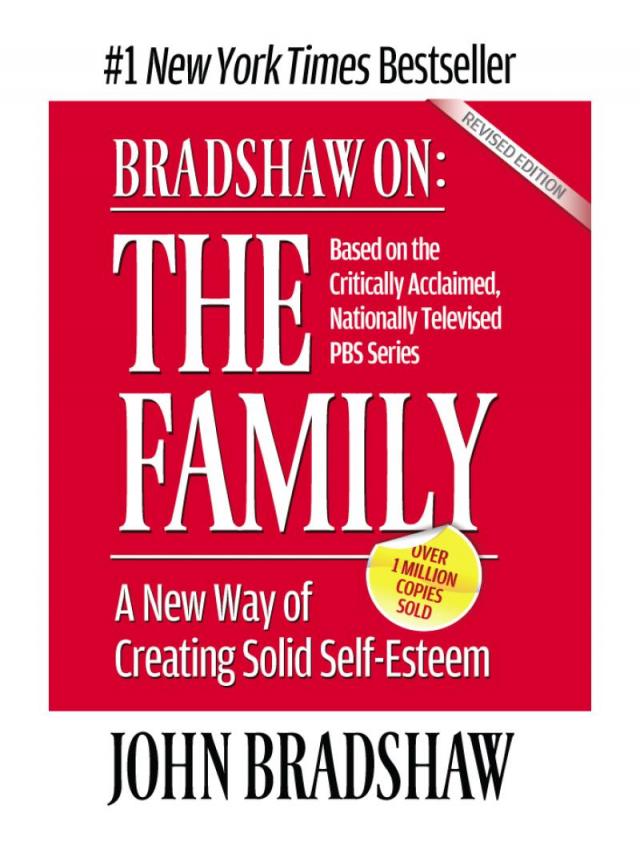
Bradshaw on the family: a new way of creating solid self-esteem/
John Bradshaw. —Rev. ed.
p. cm.
Based on the television program entitled: Bradshaw on—the family.
Includes bibliographical references.
ISBN-13: 978-1-55874-427-1 (paperback)
ISBN-10: 1-55874-427-4 (paperback)
ISBN-13: 978-0-7573-9733-2 (ePub)
ISBN-10: 0-7573-9733-6 (ePub)
1. Family—United States—Psychological aspects. 2. Self-actualization (Psychology) 3. Family—Religious life—United States. I. Bradshaw on—the family (Television program) II. Title.
HQ536.B72 199696-34325
306.8'5—dc20CIP
© 1988, 1996 John Bradshaw
All rights reserved. Printed in the United States of America. No part of this publication may be reproduced, stored in a retrieval system or transmitted in any form or by any means, electronic, mechanical, photocopying, recording, or otherwise without the written permission of the publisher.
HCI, its logos and marks are trademarks of Health Communications, Inc.
Published by: Health Communications, Inc.
3201 S.W. 15th Street
Deerfield Beach, FL 33442
Cover redesign by José Villavicencio
ePub created by Dawn Von Strolley Grove
To Nancy, who is my friend and
the most gentle person I have ever known.
Together we shared a sometimes difficult
and always exciting journey
of family-making.
Contents
Preface to the First Edition
Preface to the Revised Edition
A Parable: The Story of Hugh
1. Overview: The Crisis
2. The Family as a Rule-Bound Social System
3. Profile of a Functioning Family System
4. Profile of a Chronically Dysfunctioning Family System
5. Compulsive Families: Checklist for How Your Self-Esteem
Was Damaged in an Addicted Family
6. The Persecuted: Checklist for How Your Self-Esteem Was Damaged in a Sexually or Physically Abusing Family
7. The “Bad” Child: Checklist for How Your Self-Esteem Was Damaged in an Emotionally Abusing Family
8. The Most Common Impact of Chronic Family Dysfunction: Co-dependency
9. Road Map for Recovering Your Disabled Will: Stage I—Finding a New Family of Affiliation
10. Road Map for Uncovering Your Lost Self: Stage II—Breaking the Original Spell
11. Road Map for Discovering Your True Self: Stage III—Spiritual Awakening and Compassionate Social Action
Epilogue: Revising Traditional Values
References
Preface to the First Edition
The material presented here is an amplification of a recent television series entitled Bradshaw On: The Family. These programs were recorded ad-lib before a live audience, during which I used no manuscript or Teleprompters. Consequently, the material often lacked detail. In that medium this lack was acceptable, as my goal was to present material not only for content but also for emotional impact on the listener.
This book is for those who want to pursue the material in more depth. It is also for anyone from a dysfunctional family, whether the individual viewed the series or not, and for anyone in our society who is not aware of the potential for emotional numbing, deselfment and addiction embodied in our patriarchal rules for raising children.
The chapters follow the general outline of the television series. I’ve extended the material on families as systems and made a separate chapter out of it. I’ve also changed the specific titles of the last three programs.
In this series I offered a new understanding of emotional health and illness, as well as an understanding of the way this health and illness are multi-generationally transmitted. This book offers you a way to recover your lost childhood self, as well as a new way to enrich your self-esteem. It will also help you understand why functional families are absolutely essential if we are to heal our societal wounds.
Much has been written about the family as a system. Most of the writing has been directed toward counselors, therapists and clinicians, the professional practitioners in the field. To my knowledge, little has been directed to the layperson; the nonexpert. But the layperson also needs a bridge of understanding to these innovative and powerful concepts. The most important aspect of this understanding is how each of us may have lost our true self in the family system shuffle, and how our family systems embody and create the addicted society we live in.
While only 45 years old, the concept of families as social systems is a new and effective approach to the understanding not only of ourselves but of major social problems as well.
Ronald David “R. D.” Laing, the great existentialist psychotherapist, has suggested that the theory of family systems is in as much dramatic contrast to past theories as the work of Sigmund Freud was to the practice of imprisoning disturbed people in asylums. This may be an exaggerated claim, but I’m convinced that unless I know and understand the family system from which I came, I will have difficulty understanding my true self and the society I live in.
What has been said about cultural history is true of individuals: If we do not know our familial history, we may be doomed to repeat it.
In what follows, I shall draw freely from the work of many pioneers in the field of family systems theory. Men such as Milton H. Erickson, Murray Bowen, Nathan W. Ackerman, Gregory Bateson, Jay Haley and Carl A. Whitaker immediately come to mind as fathers of this movement; and the great mother of the movement, Virginia Satir, has had a tremendous impact on my own work. I also acknowledge my indebtedness to Alice Miller, Renee Fredrickson, Gershen W. Kaufman, Robert W. Firestone, Sharon Wegscheider-Cruse and Bob Subby.
Special thanks go to Terry Kellogg, who appeared on programs 7 and 8 of the television series. Terry’s insights have been an important help in clarifying some aspects of my own position. In all cases, unless I quote these sources directly, I take responsibility for my interpretations of the thoughts and ideas of others.
As a theologian I have concern for the spiritual issues involved in our knowing and loving ourselves. These issues, grounded in the family, have a major impact on society. I have underscored this concern by my choice of the subtitle: A New Way to Enrich Your Self-Esteem and Foster Deep Democracy.
Spirituality is about wholeness. One source of the wounds that destroy our wholeness can be uncovered by exploring our family systems. My thesis is that there is a crisis in society today that is reflected in our families, a crisis in which we are cut off from our true selves.
Part of the remedy lies in identifying the roots of the crisis in the families our society creates and the society created by our families. The family is the major source of the wars within ourselves, and in a real sense, the wars with others.
One of my great teachers, Gregory Baum, has defined the demonic as “a structure of evil which transcends the malice of men and women.” In Baum’s sense this book confronts the demonic in human experience and offers some choices as to a way out.
Preface to the Revised Edition
I’d like first to express my gratitude to all of you who watched the PBS series Bradshaw On: The Family and read the first edition of this book. Your kind words and testimonials of transformation made the labor more worthwhile than I could have ever dreamed of. Your support and enthusiasm more than allayed my fears relating to the relevance of the material presented in this book.
I am also grateful to those of you who took the time to write me constructive criticisms and suggested ways to expand certain ideas I presented in this book.
I am grateful to the public critics whose sometimes vitriolic attacks forced me to critically think and rethink certain positions I had taken and presented on television and in this book. I am grateful for the opportunity to add new materials and update my ideas in this book.
Bradshaw On: The Family was my first book and has the bold stamp of youthful passion and idealism. I was on fire with almost evangelical zeal when I wrote it. When I made the PBS series in October of 1984, I still felt anger and pain over my own childhood wounds and was in the throes of my own original pain grief work. I had just come to a full awareness of how the theory of family systems applied to my own alcoholic family and had identified with the characteristics relating to Adult Children of Alcoholics (ACoA).
This knowledge was so exciting to me and helped me reduce my toxic shame so much that I embraced family systems thinking like the devotee of a salvational religion. In 1984, the adult child movement and the newly understood discussion of co-dependency were just beginning to gather momentum. I felt that my work would further the recovery movement.
Today, I realize that my own unfinished business and my passionate belief about family systems as a kind of salvation system colored my presentation, which was at times polarized. However, I still believe that the PBS series and this book were needed at that time. If I hadn’t done
I had no idea of the impact that the TV series and this book would have on people’s lives. Almost immediately after airing the PBS series, I received numerous requests (far more than I could begin to handle) from all over the U.S. and Canada for live talks and workshops. Since its publication in January of 1988, this book has sold more than 1,250,000 copies. Some 250,000 people have attended my workshops and lectures.
The early energy of the recovery movement has now subsided. Much of the recovery philosophy has become a way of life for many people. Phrases like “dysfunctional family,” “shame-based personality” and “wounded inner-child,” which were uncommon when I began this work, are now commonplace, at times even clichés. The reality of these phrases has been taken seriously, and according to the testimonial letters I have received, real healing has taken place.
The recovery movement has been ridiculed, criticized, debated and challenged. I believe it has stood the test of time. Many people now see it as an important part of a larger historical phenomenon. Let me briefly discuss why I think this is so.
Human evolution and human history have been characterized by what the French call prise de conscience. Prise de conscience refers to the process of enlightenment and self-understanding that takes place in the growth and maturity of an individual or a group. Once the evolutionary process reached the self-reflecting level of human consciousness, there was a deepening awareness of those elements that constitute human nature. This awareness extends to an understanding of the kinds of environments that allow our essential nature to flourish. Humankind is constituted precisely as human by virtue of our ability to reason, exercise free will, develop moral conscience, be creative and live by the rules of law. There seems to be very little argument that these human activities are enhanced more by democratic forms of human governance than by monarchial, dictatorial (whether patriarchal or matriarchal) forms of political leadership. But monarchy has ruled most of Western history.
A large portion of that history is characterized by the social agreement that allowed powerful kings and/or landlords to have enormous power in exchange for their protection and security. Life during most of human history was far more primitive than any of us can imagine. Until a little more than a century ago, we had no electricity, mass communication, rapid transit, airlines, TV, refrigeration, microwaves, computers, Internet, etc.
It is difficult to imagine what life was like without the products of the industrial and informational revolutions. I once remember reading that people in colonial times held their evening parties on the night of the full moon because that was when there was more light. Monarchial systems (mostly patriarchal) worked well to organize social life and give people a sense of security.
Religious patriarchy validated the political structure with doctrines like the divine “right” of kings and the belief that all authority (no matter how corrupt) was from God and must be obeyed. Unjust kings and rulers were held accountable to God, and blind obedience was even more virtuous in the face of kingly or princely injustice.
The family naturally took on this monarchial structure. This is where the parenting rules I refer to in this book as poisonous pedagogy come from. Parents were to be obeyed as if they were gods. They were to be honored. Children were never allowed to raise their voices or express anger toward their parents. Like the great monarchs, parents were held answerable to God. And within the parental dyad itself, there was hierarchy. Women were subject to and were to obey their husbands. Both father and mother had the right to hit and spank their children. Anger was especially forbidden and punished. It seems clear why monarchs did not want their subjects to have anger. Anger is the feeling that gives us energy to fight those who violate us. Our anger protects our rights. Since subjects had few rights, the monarchs wanted to make sure they did not protest their lowly status. Anger, if allowed, could be the energy that sparked a revolution. As parental authority mirrored kingly authority, anger was forbidden to children. The family hierarchy of power was blatantly nondemocratic.
The French and American Revolutions were direct responses to the abuse of monarchial power. They ushered in representational democracy. But even with representational democracy, the family maintained its authoritarian structure. I personally know men who fought in the wars to make the world safe for democracy, yet rule their families like Nazi dictators.
Hitler’s Nazi regime was the extreme social embodiment of monarchial patriarchy. Vater über alles (the fatherland over all) was a Nazi slogan endorsing the extreme cruelty of unbridled power that fostered the most heinous and inhuman crimes the world has ever known.
I look upon the defeat of Nazism as the end of Western monarchial patriarchy. Obviously we still have strong remnants of patriarchal/matriarchal systems in current social life. But Nazism magnified the inherent potentiality for abuse and brutality in monarchial-type dictatorships and made it clear that this social structure is far too dangerous and risky to continue to use.
I see the last 50 years as the beginning of a new and deeper stage of democracy. Our consciousness has expanded immensely beyond the sexism, racism, homophobia and emotional primitiveness of pre-World War II patriarchy. Our expanded consciousness has also been aided by the 19th-century existentialist movement in philosophy. Prior to this movement, philosophical thinking was dominated by rationalism. The rationalist thinkers believed that everything could be explained logically. Thinkers like Dostoevski, Kierkegaard, Kafka and Nietzsche were prophetic voices. Dostoevski predicted the rise of communism. Kafka and Nietzsche warned about nihilistic wars and the atrocities spawned by them. All of these philosophers were clear about the consequences that follow the repression of will and the emotions. They understood long before modern physics that whatever is repressed in an energy field will ultimately be expressed. A case could be made that our 20th-century wars, social revolutions, acute anxiety and massive addictiveness are the expressions of centuries of monarchial patriarchy and rationalistic repression of affective life—the life of emotion, will and desire. While monarchial patriarchy and rationalism were necessary stages in the evolution of consciousness, we now see that they do not help us reach our highest potential. They keep us emotional primitives.
All these factors—the French and American Revolutions, the catastrophe of Nazism, the existential revolt against rationalism have helped raise our consciousness to a new awareness of the meaning of democracy. We are now seeing that a deeper democracy is the way to more fully actualize our essential nature.
In my zeal I desperately wanted people to understand how the new shift in consciousness was exposing the old patriarchal model of child rearing as abusive. One of the patriarchal methods for keeping children in their place was shaming punishment. I saw how this toxic shaming damaged my own self-esteem. Others saw this also. Marilyn Mason, a psychologist in Minnesota, has referred to toxic shame as the most damaging form of domestic violence there is.
I wanted to warn parents that these socially accepted normal parenting rules were damaging their children’s self-esteem, especially since the parents were doing this unknowingly or unintentionally. I tried to make it clear that it is not a matter of blame. Our parents did the best they could within the limits of their own awareness. Monarchial child rearing is seen as abusive only when our consciousness shifts toward a deeper internalization of democracy.
The first edition of Bradshaw On: The Family served an important function in focusing our collective consciousness on some revolutionary new information explaining the ways that families work. Never before in history has such a precise knowledge about family dynamics and how families work been available. And I believe the material in this book is still totally relevant as a resource for revising traditional values and healing our pressing societal wounds.
For the first time in human history we now have a sense of the family’s awesome power—how it can shape our primal identity and how it can impact its members’ lives for generations. We are also learning how to enhance the family’s health and how to strengthen it over generations.
Families, like species, can go into extinction. Understanding the dynamics of how this can happen gives us valuable information for strengthening our families for future generations.


