

Picasso's War, page 25
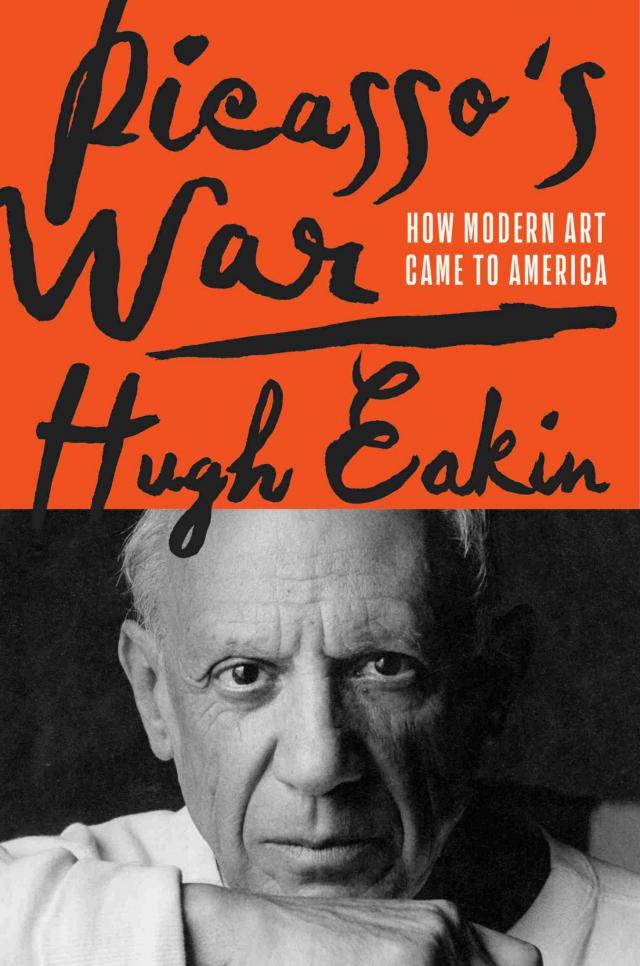


If the Museum of Modern Art was going to change the way Americans thought about art, Barr knew he would have to quickly overcome his trustees’ timorousness. That winter, for his third show, he finally presented a survey of some of the leading living modern artists, including Braque, Rouault, Vlaminck, Matisse, and Picasso. Yet even these works—which were again mostly borrowed from trustees and their friends—provided a peculiarly conservative view of modern art. “American collectors, as a rule, seem rather afraid of Picasso’s strongest and most characteristic arguments,” the French critic and artist Jacques Mauny wrote in The Arts after seeing the show. “They are somewhat like the tourists who order ham sandwiches when they visit Prunier’s oyster bar.”[7]
Barr agreed with Mauny’s criticism. Already he was beginning to think about a far more ambitious show to give the full measure of Picasso’s work. As with so many of his other ideas and plans, however, he was hampered by the severe limitations of what was available in the United States. Overwhelmingly, the artworks he needed were in Europe. In this respect very little had changed since the days when Quinn and his friends were seeking Brancusis and Rousseaus. Barr needed to go to Paris.
First, though, he had something even more important he had to settle: Daisy Scolari, the woman he had met at the opening show. Shortly after they met, Barr invited her to a tearoom near the museum. A few days after that, he asked her to dinner at a Chinese restaurant. Then she began coming to the museum. In almost every way, they were opposites. He chose his words with great care; she was quick-tongued and effervescent. He was reserved and strategic; she was energetic and unrestrained. To his physical delicacy, she contrasted natural athleticism. And while he had almost total recall but was hopeless with foreign languages, she could be somewhat scattered but spoke four languages fluently. Almost immediately, they made a powerful connection. “I know of no pair more divergent in background, in emotional inheritance, or in outward manner,” a mutual friend of theirs later observed, “and more devoted or more reliant upon the well-being of the other.”[8]
Born in Rome in 1901, Margaret Scolari-Fitzmaurice was the daughter of an antiquarian dealer from the Veneto and a patrician Irish Protestant mother. The war began during her early adolescence and she experienced it directly: Her father died when she was fifteen and her mother volunteered in military hospitals. Still, she had a free-spirited youth. She attended a coeducational high school, where she had many friends; then she enrolled at the University of Rome, where she briefly studied medicine and then languages. She taught herself Greek, read Proust, and did a perfunctory course in art history, but she never finished her degree. Instead, she got a coveted job as a bilingual secretary at the American embassy.
In 1922, she witnessed Mussolini’s march on Rome and quickly acquired a distaste for Fascism. But the new regime had little impact on her own existence. “I had nice clothes,” she recalled. “I adored dancing and I danced three or four times a week, in the afternoon and at night.” She and her friends often went skiing in the Italian Alps. After a few years, however, she decided she had greater ambitions, and through an embassy connection, she landed a job at Vassar teaching Italian to undergraduate coeds. “It was quite extraordinary,” she said. “After having had this complicated life in Rome so full of young men and flirtations, to land in a female world…I can’t say that I liked it much.”
At Vassar, however, she began taking courses in art history, which fascinated her. Evidently, she was a quick study. Even though she had never completed her undergraduate degree, she was granted an M.A. for her work; then, a few months before she met Barr, she received a Carnegie Fellowship to New York University. By the spring of 1930, she had attracted sufficient notice to be offered a job on the art history faculty at Smith College in Northampton, Massachusetts. She was also promised the directorship of the Smith College Museum when the current director retired, the following year. Quite apart from her lack of museum experience, the second part of the offer was noteworthy as it would put her on track to be one of the first woman directors of any museum in the country. In March, Scolari accepted the job, which was to begin in the fall. She also found a large apartment in Northampton, with sufficient room for her mother, who had been living alone in Rome, to join her.
By this point, however, she had become seriously interested in Barr. Throughout the winter, she had been making regular visits to the Heckscher Building, and then joining his crowd—Jere Abbott, Philip Johnson, the handsome young Tennessee poet Cary Ross, and the German émigré art dealer J. B. Neumann—for their gatherings after long days on the twelfth floor. The discussion was excited and freewheeling, and despite the financial crisis and the enormous constraints on the museum, there was an intoxicating sense of possibility. “You felt an unbelievable vibration,” Scolari recalled. “It sort of centered around Alfred, but…everybody was adding their contributions, reminding one another of things and saying, ‘We could do this.’ ‘We could do that.’ ”
Barr was inscrutable, but he, too, seemed to enjoy Scolari’s company. He also had definite views, extending to her own name. When she and Barr attended an art history conference together, he found “Margaret Scolari” written on the program and crossed out the last three letters, so it read “Marga.” “Why don’t we do this?” he said. In his own awkward way, he was showing his deep affection, and it stuck. From that point on, she was “Marga” to all but her oldest friends.
By late winter, they were inseparable. “We fell insanely in love with each other,” Scolari said. She was also twenty-nine years old—an age that at the time was considered advanced for a single woman. Still, uncertainty hung over their relationship. Confronting his feelings for her, Barr seemed unsure what to do. “More than naturally, he deeply hesitated about the idea of getting married, or marrying me,” she recalled. As she was well aware, he did not have much of a history with women, and an overwhelming number of his close friends were openly, or somewhat openly, gay; both architectural historian Henry-Russell Hitchcock and Johnson had confided their boy troubles to her. (“You are the only one who knows about Cary and me,” Johnson wrote her that spring, referring to Cary Ross.[9]) In New York, Barr continued to share an apartment with Abbott, his devoted friend—a curious situation for the director and deputy director of a new museum. He also was incredibly driven and worried about the constraints that marriage might place on his work. “I deeply sympathized with him,” Scolari recalled.
Then, at the beginning of May, to the surprise of almost everyone, Scolari and Barr announced their engagement. It was less than six months since she and Barr had met and less than six months since the museum had opened. All at once, it seemed, Barr had found a new vocation and a new life. For Scolari, though, the change was arguably even more dramatic. She told Smith College she would be turning down the job after all, and more important, forgoing the chance to run a museum of her own. Her mother would stay in Rome. “All this had to be given up,” she recalled. From now on, she would be devoting herself to Barr and his museum.
22
THE PARIS PROJECT
If not quite an elopement, Alfred and Marga’s Paris wedding was hardly a traditional affair. Arriving alone in mid-May 1930, Marga checked in to an inexpensive hotel while she made last-minute preparations. They hadn’t ordered any announcements yet, and she didn’t have a wedding gown. Flanked by Henry-Russell Hitchcock, the young architectural historian, who had come to Europe for the summer, she went up and down rue Saint-Honoré shopping for a ready-made dress and hat. (“Mademoiselle is not going to marry me,” the flamboyant, red-bearded Hitchcock announced to the shop clerks in his booming, Bostonian French. “Moi, I am the best man.”)[1]
Finally Alfred arrived and they made hasty arrangements for the ceremony. To satisfy Alfred’s father, they had agreed to have a religious rite at the American Church on the Quai d’Orsay, but they discovered that the church was closed for renovation. In the end, on a cool Tuesday afternoon, they gathered in the living room of the church’s rector. The entire wedding party consisted of Marga’s mother, who came by train from Rome; Hitchcock; and Cary Ross, who also happened to be in Europe.[2]
After the ceremony, Ross and Hitchcock took Marga’s mother to the theater while the newlyweds went to look at some new flat-roofed townhouses near the Bois de Boulogne. In the late 1920s, the French architect Robert Mallet-Stevens had caused a stir in Paris with his rectilinear brushed-cement dwellings, some with hanging gardens of purple geraniums and pink hydrangeas, which seemed to flout all the old rules of domestic design. In The Architects’ Journal, one critic argued that “it would be hard to find a row of buildings anywhere more nicely calculated to shock the conventional lover of architecture.” Alfred decided that Mallet-Stevens was not quite Le Corbusier, but it was a pleasant walk, and he thought the houses might be relevant for a show he was planning with Henry-Russell Hitchcock and Philip Johnson on modern architecture. When it came to exhibition scouting, he was not one to be deterred by a wedding, even his own. “Work begins,” Marga noted the next morning.[3]
As he began his first European foray as director of the Museum of Modern Art, Barr was under enormous pressure to deliver. On the strength of art-in-a-skyscraper novelty and crowd-pleasing shows, their first season had merited unexpected acclaim. Lacking a collection, though, they were only as a good as the art they could borrow, and Barr had quickly burned through most of the best material owned by the trustees. Already The New Yorker’s Murdock Pemberton was lampooning the museum’s reliance on its founders’ personal collections, arguing that the shows were beginning to look like “Some Pictures We Thought Good and Some That Have Been Bought by the Directors.” In Paris, Barr was determined to change that, and over the next six weeks, he intended to gather a year’s worth of loans.[4]
The task was almost comically daunting. Paris was used to opening its doors to rich collectors and well-connected connoisseurs, and dealers like Paul Rosenberg were always on the lookout for museums that were prepared to pay handsomely for a prestigious Monet or Renoir. But Alfred was virtually unknown and had no funds to spend on art; he also was young and didn’t speak French. Even his job carried limited prestige. “The name of the Museum of Modern Art seemed to work no magic at all,” Marga observed. “Many had never heard of it.”[5] At the Louvre, he needed a letter from his mentor, Paul Sachs, just to get an appointment. And when he could get through, many collectors were wary of sending works on loan across the ocean, which was highly unusual at the time.
Undeterred, Alfred quickly established the high-stakes approach that would soon become a hallmark of his show making. First, from magazines, photographs, catalogs, and other sources, he sought to identify the most outstanding examples for each artist or subject he was interested in. Then he would seek them out, however formidable or resistant their owners might be. Like Quinn, if he found that a particular painting couldn’t be had, it made him all the more determined to get it. And if, in the end, he could not get what he sought, he preferred to cancel a show than go with second-tier works. It was an absolutism that, when it succeeded, could yield improbable results: That summer, Alfred convinced the Louvre and Berlin’s Nationalgalerie to make their first-ever loans to an American museum. But it also made the risk of failure all the greater. For the moment, though, there was very little competition and Marga was surprised how far his uncompromising stance seemed to take him. “In most cases,” she wrote, “ ‘fortune favors the bold.’ ”[6]
His plans were almost Alexander-like in scope. First, he would raid Paris’s and London’s leading collections to obtain pictures for a blockbuster pairing of Corot and Daumier—two more nineteenth-century “ancestors,” who were more radical than generally recognized. Then, in a rapid march through Germany, he aimed to extract, from more than a dozen museums, a decisive selection of German modern art, a field so unknown in the United States that he had to make an elaborate case for it. At the same time, he was continuing to think about the groundbreaking survey of international modern architecture, sending Hitchcock and Johnson on advanced reconnaissance in Holland and Germany, where they careened around in Johnson’s Cord convertible documenting factories, hospitals, workers’ housing, villas, and other potential targets. A single one of these complicated shows should have consumed the summer—especially given that Barr had zero experience arranging loans in Paris and Europe. Yet for him, they were merely a prelude to an even bigger quarry: Pablo Picasso.
At least since the midtwenties, Barr had viewed Picasso as “the most inventive intelligence in modern art.”[7] At the time, this judgment was far from widely shared in the United States, even among modern enthusiasts. Only a tiny number of connoisseurs like Quinn, Davies, and a few others fully embraced Cubism, while—as Rosenberg had painfully experienced in 1923—Picasso’s misunderstood neoclassical style turned off diehards who feared he was giving up on the avant-garde. And while Matisse’s decorative interiors had begun to win a larger American audience, Picasso’s continual shifts seemed to resist apprehension. Even Henry McBride, who had followed his work since the Armory Show and was one of the country’s greatest modern art champions, admitted that “Picasso always was difficult, and, I suppose, always will be.”[8]
For Barr, however, it was precisely the difficulty—the ways that Picasso’s work was continually at war with the existing order, and with itself—that underscored his importance. Like Quinn, who had followed Picasso through all of his phases, he had come to view the artist as the elusive, complicated, throbbing center of the new art. He had absorbed and transformed the art that had come before him, from Greek antiquity and pre-modern Africa to El Greco and Cézanne; he had also laid out a series of new pathways for contemporary art. At the same time, he seemed to be guided only by his own inner compulsions, embodying what for Barr would become a defining quality of the twentieth-century artist: freedom. “In a world in which social pressures—democratic, collectivist, bourgeois—tend to restrict the freedom of the exceptional individual,” Barr later wrote, “Picasso’s art assumes a significance far beyond its artistic importance.” Without Picasso, it was impossible to tell the story of modern art.[9]
Almost as soon as he and Marga were married in Paris, Alfred’s thoughts turned to Picasso. He knew that the artist’s ceaseless forays—whether his Cubist papiers collés or his recent Surrealist portraits—would have a crucial place in any number of the shows he wanted to do. At the same time, he hoped to gain insights into Picasso’s current direction and influences, and the internal dynamics of the roiling art scene of which Picasso had often been the center. Above all, though, he was anxious to begin work on a project that he had already been entertaining for months: a large-scale exhibition devoted entirely to Picasso’s own work. “Ever since the beginning of the Museum of Modern Art, Alfred wanted to have a Picasso show,” Marga wrote.[10]
But he also knew that getting together a group of noteworthy paintings would not be enough. Smaller group exhibitions, like what Lincoln Kirstein had just done at Harvard, were unable to capture the power of Picasso’s work. And on the few occasions when the artist had been given a show of his own, it had confused the public. By the time of Quinn’s death, the country was prepared to walk away from one of the greatest collections of his work in the world. Although a few of the artist’s early Blue period paintings had begun to be better known, for many Americans, Picasso seemed to stand for everything that was wrong about modern art. Even Frank Jewett Mather, Barr’s forward-thinking Princeton mentor, a man who wrote a whole book called Modern Painting, had dismissed Picasso’s work as “less a struggle for liberation than a protest against prevailing styles.”[11]
To pull off a cultural shift, Barr would need to offer something far more definitive: a sequential view of Picasso’s art that captured the unfolding drama of modernism itself. To start with, he wanted to give viewers the tools to understand the issues Picasso was trying to solve at each stage of his development. Out of his vast output—thousands of artworks in an astonishing array of media—Barr aimed to gather several dozen of his greatest pictures, together with related material for each. With his usual urge to classify and order, he had already divided Picasso’s career into thirteen distinct phases and counting, each of which he ranked in importance: Wartime Cubism and recent “Surrealism” got the maximum three stars; the ballet sets for Diaghilev got none. He planned to foreground such obscure but gravity-shifting paintings as Les Demoiselles d’Avignon, and even Picasso’s little-known sculptures. Carefully laid out for the viewer, the show would transform the bewildering contrasts and abrupt shifts in the artist’s work into a thrilling story of modern discovery.


