

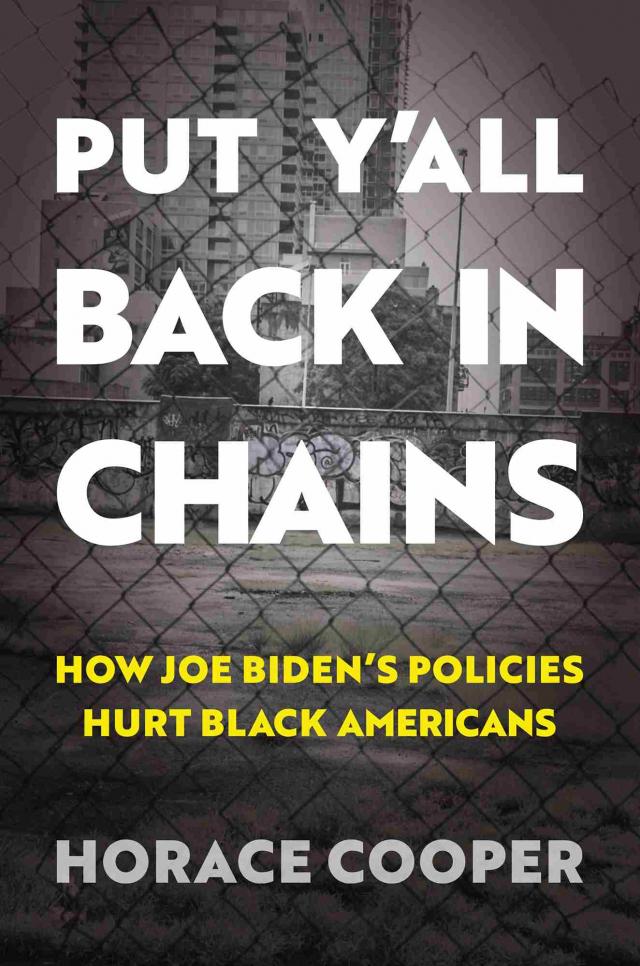
Put Y'all Back in Chains, page 1


Advance Praise for
Put Y’all Back in Chains
“Whether you agree or disagree, Horace Cooper’s latest book tackles the question of how Joe Biden’s policies affect Americans, especially those in minority and underserved communities. His research shows that the injuries are calamitous. Instead of a rising tide lifting all boats, the Biden policies are having a reverse effect, one that devastates bank accounts, crushes entrepreneurship, and steals the promise of the American Dream.
“Horace painstakingly combs through the harsh results of these efforts, especially on lower income and working class people, who are hit hardest by the woke-policies of Joe Biden. If you want to see the real story the media isn’t telling, this book is a must read!”
– Sean Hannity, Fox News Host
“Horace Cooper ‘breaks every chain’ while shining the light on racist, divisive politics from President 47. Read this eye opener today.”
– Alveda King, PhD
“It’s always been one of life’s great mysteries: why is it that 90 percent of blacks vote for Democrats year after year when the Dems have done so much to hold blacks down? Horace Cooper shows the folly of blacks voting for the policies that deter advancement and attainment of the American Dream.”
– Stephen Moore, who formerly wrote on the economy and public policy for the Wall Street Journal, is a distinguished fellow in economics at The Heritage Foundation
Also by Horace Cooper
How Trump is Making Black America Great Again: The Untold Story of Black Advancement in the Era of Trump
Published by Bombardier Books
An Imprint of Post Hill Press
ISBN: 978-1-63758-706-5
ISBN (eBook): 978-1-63758-707-2
Put Y’all Back in Chains:
How Joe Biden’s Policies Hurt Black Americans
© 2023 by Horace Cooper
All Rights Reserved
Cover Design by Matt Margolis
No part of this book may be reproduced, stored in a retrieval system, or transmitted by any means without the written permission of the author and publisher.
Post Hill Press
New York • Nashville
posthillpress.com
Published in the United States of America
To Dr. Sylvia Cooper—an inspiration and a model of rectitude
Table of Contents
Introduction
Chapter One: Bidenomics Is Lynching Black Americans’ Economy
Chapter Two: Biden Embraces the Woke
Chapter Three: Running for the Border How Biden’s Open Border Policies Harm Blacks
Chapter Four: The Killing Fields Biden’s Policies Unleash a Crime Wave in America
Chapter Five: America Is Running Out of Gas
Chapter Six: Killing Blacks Better: The Biden Approach to Abortion
Chapter Seven: Put Y’all Back in Chains
INTRODUCTION
In the fall of 2019, Biden’s campaign was tattered and failing. Despite his best efforts, Biden’s third try at the White House was struggling. To many analysts, it was looking a lot like the first two in 1988 and 2008.
Let’s review:
In 1987, Biden was the Chairman of the Senate Judiciary Committee, where he was working with Senator Ted Kennedy to thwart Reagan’s appointment of Robert Bork to the Supreme Court and simultaneously setting up a run for his first presidential campaign.
Robert Bork was a sitting judge on the most prestigious federal appeals court: the D.C. Circuit. A former Yale Law School professor, Bork was a highly regarded constitutional scholar. Court watchers predicted that he might provide the critical fifth vote to overturn Roe v. Wade.
Joe Biden’s academic credentials weren’t as impressive: he had earned a BA at the University of Delaware and later received his law degree from Syracuse University. Unlike the Supreme Court, politics doesn’t require exceptional academic credentials.
Biden likely considered that his high profile as Chair of the Committee overseeing the nomination could only aid his nascent presidential run. For this reason, Biden publicly promised that Judge Bork would have a “full and fair” hearing. However, at the same time, he had not so privately promised civil rights groups (in order to aid his presidential campaign) that he would lead the opposition to the nomination.1 At the time, even the Washington Post—no friend of Robert Bork—editorialized about Biden’s cynicism, writing, “As the Queen of Hearts said to Alice, ‘Sentence first—Verdict Afterward.’”2
But Biden’s presidential campaign ended as quickly as it began. For a candidate known for being a long-winded gaffemachine,3 it shouldn’t be a surprise that it was this very trait that took him down. Biden’s presidential campaign was tripped up by a speech he gave at the Iowa State Fair in September 1987,4 which was copied almost word for word from one that had been given by British Labor Party Leader Neil Kinnock.5 Maybe Biden thought that it wouldn’t be noticed, since Kinnock was based in the UK and he was in the USA.
But the press noticed, and once they started digging around, they discovered that there were many instances of misappropriation and falsehoods by Biden, going all the way back to his law school days. For instance, he was forced to admit that he had given speeches by Hubert Humphrey and Robert Kennedy, presented as his own. Further digging revealed that he’d misrepresented his class ranking in law school. In fact, he’d barely graduated.6 It was also uncovered that Biden had publicly said in a debate that he’d never supported tuition tax credits—the bete noire of the teacher’s unions—but his voting record showed otherwise.7 It seemed that Biden’s willingness to dissemble was widespread.
Shortly after his 1988 campaign began, it was over.
The 2008 campaign wasn’t much better. Running in a primary that was a Who’s Who of prominent Democrats—including Barack Obama, Bill Richardson, Hillary Clinton, John Edwards, and Chris Dodd—Biden positioned himself as the “national security” candidate.
Once again, he talked himself out of the race. One of his biggest gaffes occurred in trying to damn Obama with faint praise, calling him “the first mainstream African-American who is articulate and bright and clean and a nice-looking guy.8” The pushback by Democrats was intense. His campaign management abilities weren’t much better—he fell well short of the $20 million fundraising goal that he had said he’d need to compete in the early primary states, raising just over $11 million instead. He would get blown out of the water in the Iowa Caucuses, scoring less than 1 percent of the vote, and dropped out shortly thereafter.
Proving his commitment to the “triumph of hope, over experience,” Biden ran for a third time in 2019. But the sophomore who had boasted to classmates, at the famed Archmere Academy in Claymont, Delaware, that he wanted to be President of the United States found himself, yet again, spending time in his latest campaign explaining his exaggerations and gaffes instead of pushing his platform.
First, in the summer of 2019, there was “segregationist-gate,” based on Biden’s wistful memory of working with segregationist Senators Eastland and Talmadge. “I was in a caucus with James O. Eastland,” Biden boasted. “He never called me ‘boy,’ he always called me ‘son.’” Then he praised his own ability to work with Talmadge, saying that he was “one of the meanest guys I ever knew,” but “Well guess what? At least there was some civility. We got things done. We didn’t agree on much of anything. We got things done. We got it finished.9” Blacks and progressives—key constituencies of the party—were horrified.
Then, near the end of July, during the second presidential primary debate, Biden said that illegal immigrants wouldn’t be a priority and that they should “get in line” and wait to enter the country legally. Later, in August, he explained that “poor kids are just as bright and just as talented as white kids.10” These gaffes fed into his reputation as a blowhard and raised concerns about what his core beliefs really were.
But the rank and file had additional criticisms. They worried that the 77-year-old Biden was too old to be President. A whisper campaign started about his mental agility, and some commentators openly wondered if this campaign would end the way the two others had. In response, before the year was out, he’d be forced to release medical records showing that he was healthy, with no significant medical issues.
Unsurprisingly, the early primaries were especially brutal to Biden. In Iowa, Biden ended up in fourth place, behind Pete Buttigieg, Bernie Sanders and Elizabeth Warren. In New Hampshire, he did worse, placing fifth behind all of those he’d lost to in Iowa, and now even behind Amy Klobuchar.
What was a murmur then became a roar: media observers were saying openly that third time might not be the charm for Joe Biden. Other insiders were suggesting that he adopt a “second ballot strategy”—since he wouldn’t be able to win the nomination outright, he should stay in the race long enough to win at a brokered convention.
And then Biden’s campaign had an epiphany, realizing that the first primaries were dominated by non-black voters, even though blacks are the Democratic base. If the campaign could get blacks to vote for Biden, he would have enough support to win the primary outright.
It worked. Biden worked behind the scenes to get South Carolina Rep. Jim Clyburn’s endorsement. In a passionate speech, Clyburn told Democrat primary voters, “I’m fearful for my daughters and their future and their children and their child
The rest is history. Thanks to the backing of blacks, Biden—the “law and order” author of the 1988 crime bill and lifelong opponent of busing—would go on to win the 2020 primary. He would then win the election, fulfilling his childhood dream.
But what of black voters? In many ways, what should have been seen as a great accomplishment for blacks has turned into a nightmare:
Biden’s shifts in policies created turmoil for most Americans, but especially for blacks.
Biden bragged that he would reverse Trump’s policies, and he did. Blacks would find out the hard way what this meant.
Since 2017, Blacks have seen record low unemployment. Record numbers were able to buy their first home or new automobile or start their own business.
But by the summer of 2022, much of their successes had been wiped away. According to the Employment Policy Institute, the black-white unemployment gap had risen to 2.2 to 1 (blacks are unemployed 2.2 times the rates of whites)—higher than it had been in the last year of the Trump Administration. The policies of Joe Biden have led to record levels of inflation, which have hit blacks the hardest. Biden’s mismanagement of the supply chain has created scarcity at the grocery store, and gasoline prices have jumped to levels never seen in the U.S. before. Through it all, blacks have been among the worst to suffer.
This outcome isn’t simply bad luck or coincidence. Galatians 6:7 must be remembered: “Be not deceived; God is not mocked: for whatsoever a man soweth, that shall he also reap.12”
Blacks, as well as other Americans, have been severely economically damaged—not by the pandemic, but by falling for the idea that policies that confiscate wealth and punish those who are successful, treating us all based solely on group identities (thereby rejecting the idea that Americans are individuals), is the best way for everyone to succeed.
Perhaps the most dangerous idea of all is that these policies could occur at the hands of a central government located in Washington that would create and ensure prosperity is provided to the people at large. This scheme has never worked anywhere or anytime it has been tried. In fact, it can never work. Add to that the toxic notion that our physical characteristics are the primary factors about us as citizens, which has been poisonous for blacks and further limited achievement. History shows that punishing achievers by confiscating their wealth so that bureaucrats can redistribute it only makes everyone poorer.
The failure of this idea is obvious when looking at how America—and in particular, blacks—prospered from 2017 to early 2020 due to policies that reward thrift, risk, and achievement. Unlike most recent U.S. economic growth spurts, during the Trump years, the least among us—underserved groups, including blacks and the working class in general—gained ground faster than everyone else. Yet today, the policies Biden promotes have yielded the opposite effect, and blacks have been hardest hit.
The following chapters will explain his policies and their effects. Americans, especially black Americans, have been put back in chains.13
Chapter One
Bidenomics Is Lynching Black Americans’ Economy
Perhaps the greatest measure of President Joe Biden’s destructive anti-black policies is his unacceptably poor stewardship of the economy. Having inherited the hottest economy in a generation, America might now be headed for a double-dip recession, which disproportionately hurts black Americans.
Going into the COVID-19 pandemic, black employment was setting records on a near-monthly basis, hitting marks that in some cases had not been seen in half a century, and in other cases had never been seen at all.1 The massive disruptions caused by the virus and the government-mandated lockdowns—promoted by an elite professional class that enjoyed the benefits of remote work in white-collar jobs—was devastating to working- and middle-class workers, who are disproportionately minorities.2 However, by the second quarter of 2020, employment was sharply rebounding, and the economic recovery was well under way when President Biden was sworn into office in January 2021.3
That was the critical moment when the federal government decided to make a sharp turn backwards to heavy regulation and expanded government welfare programs—policies not put in place in decades. This approach has undeniably stalled the jobs recovery.
According to the U.S. Bureau of Labor Statistics, many of the gains that blacks made during the Trump years have been lost. By the end of December 2021, black unemployment was twice as high as that of whites.4 After dropping to a record low of 5.4 percent, it reached 7.1 percent in December 2021.5
Two years before, pre-pandemic, the labor market had been as tight as it is today. One might think this is good news. A worker shortage should give workers leverage for higher wages, strengthening the social fabric. Prior to the pandemic, unemployment rates overall had reached their lowest level in over thirty years, and the number of total population working also set records. Additionally, both the employment growth and wage increases were greatest among the groups who traditionally fare the worst in the workplace: women, young workers, minorities, and the less educated. This reduces welfare utilization and crime levels in urban communities, which makes them more attractive places for business and residential development, which in turn creates even more jobs and can lead to higher levels of marriage and family stability.
However, today’s worker shortage has resulted in a labor market so tight that—as Federal Reserve Chairman Jay Powell said—it is simply “unhealthy.”6 Fewer Americans are working; the labor force participation rate—the measure of the percentage of working-age Americans in the workforce—is lower now that it was pre-pandemic.7 Consequently, the tight labor market isn’t helping those who could benefit the most but instead has enriched those already well-entrenched in the workforce. The present tight labor force isn’t reducing welfare use, and it is generally more concentrated in the suburbs or rural parts of the country. In other words, thee poor, young, and minorities do not benefit.
Another major consequence of the present overly-tight labor market is that the price of almost any service that requires labor is substantially more costly. This situation disproportionately hurts working- and welfare-class households. When significantly fewer people are working, the compensation for those who are working is dramatically higher. This is very beneficial if you’re employed in a high-paying job, but everyone else will face significantly higher prices for everything, from eating out to going to the movies to grocery shopping. Likewise, middle- and upper-income families are not only more likely to be employed now, but they can also absorb these hikes, while those with lower or no income—especially blacks—cannot.
Why is this tight labor market different? The Biden Administration’s anti-growth policies are the chief cause. They place more emphasis on government making payments directly to Americans, instead of creating an environment where more jobs can be created (letting people find their own prosperity in the private sector as a result). The results are slow or zero wage growth, a lower job participation rate, and inflation that has completely overtaken wage growth—families that take home more income find that their household expense increases have erased their gains. Thus, the Biden policies have created stagflation: high inflation with limited economic growth. America has only seen this phenomenon once before: in the 1970s, when a moderately high inflation period was impacted by the embargo of oil by the Organization of Petroleum Exporting Countries (OPEC).
Oil Price Spikes
In 1973, President Nixon supported the state of Israel in the Yom Kippur War. The oil-producing countries of the Middle East responded by ending oil sales to America. This embargo hit an already weak economy. The price of oil shot up nearly 400 percent. Though the embargo only lasted through 1974, oil prices never returned to their pre-embargo level; they stayed more than 33 percent higher for nearly a decade.8 At the same time, the Federal Reserve adopted a policy of keeping interest rates low to stimulate the economy. The embargo caused moderate inflation and slow growth to turn into explosive inflation, and economic growth all but stalled. Economists say that America’s low economic growth, the expanding welfare state, funding for the Vietnam War, a declining manufacturing sector, and rising inflation joined with the oil embargo to knock America’s economy flat.9 This stagflation lead to Americans’ economic suffering for nearly a decade.


