

Fiction Complete, page 8


It took time for our biologists to accomplish, but finally they took a poor, helpless little female guinea pig—it’s we women who suffer for the good of humanity, I’ve always maintained—and twisted up her hormones and genes and things to the point where she was a perfect animal duplicate of a Centaurian female.
Then they sent her through an I.T. transmitter, bred her—she seemed willing to accept both ordeals calmly, I’m assured—and in the course of time has become the mother of the finest, fattest little litter you ever saw. So my congratulations to you.
This provides I.T. with still another bug to work out, but as a sideline I suppose we can someday treat Centaurians who marry Terrans so that they can become parents.
I’ll be arriving on Tarko Sil in about two months for a combination business and pleasure trip. Irving will be with me, of course. I hope for a good rest and a long visit with the Centaurian branch of my family, including the coming new arrival. Also I intend to groom you, Roger, to eventually take over the firm, but don’t expect that for a long, long time. As I told you in my last letter, there’s life in the old girl yet.
God bless you all.
Your loving aunt,
Elizabeth Demmara Stillon Baum
faint-heart
when man moves out into the spaceways, the most terrible dangers will come not from bug-eyed monsters but from within his own mind. here is a gripping story of deep space by a promising young author interviewed by fantastic worlds for its first issue.
YOU ENTER YOUR STATEROOM with your knees trembling and your heart smashing with painful fury against your ribs. You lock the batch behind you, no longer trying to wipe the insistent sweat from your face. There is no need now to bide your fear, for you are alone. Alone, but never so alone as you will be in a few minutes when you are shot frat the Jameson’s air lock and cut into . . .
What?
Horror. Terror. An ebon pit of airless, Infinite space. Black nothingness, and you encased in a leatheroid tomb. The thought of it brings back that awful memory of the night in your childhood when the walls of the abandoned well into which you had fallen seemed to press upon you and crush you, and you know that the heavy spacesuit covering your perspiring, aching body will bring back the claustrophobia that has cursed you ever since.
You won’t be able to clench your nails into your palms hoping that the pain will help you forget, because your Landa will be covered with leatheroid gloves, and you won’t be able to scream in an agony of fear as you could when you were five years old, because your shipmates will be listening to your every word. But they’ll be able to bear you breathe, and they’ll bear the gas escaping from your tortured bowels, and they’ll hear the wet, slapping sounds from your sweating armpits as you work frantically. Perhaps they’ll even be able to hear your heart--the accursed, resounding mechanism that pumped coward’s blood through your system.
You finish putting on the spacesuit and you want to move toward the hatch that leads to the decks of the crippled ship, but your body fights against the commands of your mind and you are paralyzed. You wonder whether you will react the same way when you are put into the airlock and out into space with all your friends watching. You know that you will.
The thought of the airlock brings fresh terror to your already cracking mind. Shooting out into that black void will be the same as the fall you took into the pit--worse, because now
you will know what to expect, and then you did not.
Out there, will you cry out again to God and your mother? If you do, there will be no one to help you, yet everyone will be watching through the viewer, and they’ll be praying. But not for you. For what you are doing--or trying to do--and for their own safety. No one watched before, unless it was God, and you have not believed in Him ever since your terrified pleading went unheard at the bottom of that pit so long ago.
Finally, carrying the helmet of the spacesuit under your arm like a fantastic human head, you manage to make your unwilling legs obey, and you lumber clumsily from your compartment, out of Officer’s Country and onto the Jameson’s main deck. Already your body is soaked with the sweat of fear and cowardice and you regret not having taken sodo-clo tablets to replenish your system with salt, but you know that to turn back now would mean you could never again open that hatch--that you would lock yourself in and remain until you starved or until they cut away the steel to get to you.
Your eyes must be glazed, but in the excitement no one seems to notice. You thank God, wanting to believe in Him now, that the cumbersome spacesuit conceals your trembling.
You are almost entirely dressed, with only your head, like that of some great, bipedular turtle, protruding from the enveloping shell of the suit. You are more thoroughly frightened now than you have aver been, and the two most terrifying steps are yet to come; the first when they fasten the helmet about your head and again when you are shot out of the air look.
Three-quarters of your ship’s crew are dead or disabled, and the remainder are all here, watching you, the one man who can bring them and the Jameson safely bate. It occurs to you that they might not yet notice your fear because they themselves are frightened at the prospect of dying here in space, but the thought brings little comfort.
The moment you have dreaded ever since you first went into space is upon you. You are a spaceman, not qualified to do the grueling work of a freespacer outside a ship’s hull. The chances were one in a thousand that this would happen to you--you thought when you enlisted that those odds would never reach you.
You sit stonily in the chair while the Maintenanoeman takes the helmet from your almost lifeless hands and raises it over your head like a metal and glassoid fish bowl. You try desperately to forget where you are and what is happening to you and automatically your thoughts go back to Marcia. And you can recall but one terrible memory.
THAT FIRST TIME IN SPACE, in Ericson’s yacht--just a jaunt to Luna and back. You had worried for days before that trip about what might happen to you. Just a glance at the Other Side, Ericson had said, and then back. He didn’t even intend to land. You went, with many misgivings, but you hadn’t been afraid of space at all. In fact, you had loved it. Rather than feeling shut in and restricted, you had felt a sense of absolute freedom. You had watched with fascination while Ericson guided the yacht beautifully up into the upper stratosphere, circled twice over California and the Pacific and headed for Luna. You had felt no fear.
Put there was much drinking and the resulting false courage had decided the little party of young revelers to land after all and explore some of the landscape--the moonscape--despite the fact that private landings were prohibited by law. You had gotten as far as the helmet that time, but when they started to screw it onto the neck of your suit you had nearly lost your mind.
The phobia that wouldn’t let you stay locked in close quarters came over you again. The spacesuit had become the confining walls of that abandoned well and you could recall yourself lying bruised and screaming at the bottom of it throughout the long, dark night, unmissed at home until your mother had gone to waken you in the morning, because you had sneaked out of the house unnoticed.
Marcia, red-faced and ashamed, had gone with the rest, while you stayed behind, retching and trembling on a bunk. You had left the ship when it returned to Terra and you had never seen any of the old crowd again. . . .
SOMEONE--THE DOCTOR, perhaps--shoves something towards your face and you gulp down fiery liquid that shocks you into awareness again. Your eyes roll frantically upward to see the dreaded helmet descending upon your head and you feel your bowels squirm uncontrollably, but no one notices for the helmet is already being bolted down. Only the tough leatheroid of the suit keeps you from collapsing. You cannot stand, but a dozen hands are lifting you to your feet, their owners eager for you to commence.
Something crackles in your earphones. It is the Captain’s voice, telling you to do your damnedest for the Jameson and for Terra. You want to shout the hell with Terra, but you can only gasp. You taste froth about your lips and your near-empty belly writhes and chums.
You feel the liquor coming up and you bend down with a strength that amazes you, ostensibly to check your boots, while the stuff trickles from your mouth and is hidden under the folds of the suit. You lick your burning lips and try to spit.
The voice reminds you that there isn’t much time and the hated hands straighten you and guide you to the air lock. You thank God again that your suit is so heavy in the Jameson’s tricky gravity that they must lift you, for your knees are like water and you can no longer move under your own power.
There is a last minute check of the three oxy-concentrate bottles, one for each hour, strapped to your back. Your stomach and your throat go through the motions of vomiting again, but there is nothing left inside you and you only gag.
The welding torch and the instruments you need for repairing the shattered electronic forward jets that will brake and control the Jameson’s coming headlong plunge into the thin atmosphere of Mars are shoved into your trembling hands. When you came into space you knew that Electronicsman was the one rank that would never be called upon to work in freespace, but you reckoned without the war and now you are the only man, officer or enlisted, who knows anything about the job to be done. The rest are dead--or dying--and only you are left. You want to swear, but you can only make vague gibbering sounds, and you bite your tongue until it bleeds to keep the sounds from your friends.
The inner door of the air look is open new and you are lifted up to the tiny cubicle between the hulls and shoved face forward into it. There is no longer a will that keeps you from screaming, but your vocal cords are closed tight in paralysis, although your mind no longer functions enough to tell you that. You think that you are yelling at the top of your lungs.
The Inner door swings shut. In a few seconds the outer one will open and you will be expelled into the void. But to you that round, dark hole will be the tiny, slimy-walled pit of your childhood, not a glimpse of the infinity that is space. Tour eyes, blurred and unblinking, watch with an idiotic fascination--waiting.
Then--
There it is! The air lock is swinging outward and there before you is that awful pit and you feel yourself falling towards it. . . .
Oh, Cod! Oh, Jesus!
Hail Mary, full of grace . . .
Oh, Jesua, Jesus, Jesus . . .
Mother! Mother! MOTHER
Field Trip
It is rumored that technology might eliminate many useless items from our regulated life of the future—including good, old-fashioned sex. However, let’s kibitz for a moment . . .
KIAL was disgusted with the slow, cumbersome train. He disliked using this uncomfortable means of travel, but since he wanted to learn more about these strange creatures who were his ancestors, he had decided to try to become used to their ways.
He was lonely in this strange, backward age and when he unexpectedly saw another being like himself in the same coach, he hastened to make his presence known. He introduced himself and asked politely:
“When are you from?”
“8000,” the other replied. “Name’s Broyk, from VII Galaxy.”
“I’m from out XIX way myself,” Kial said. “Just a country boy. But 8000—that’s only a period ahead of my own time. Maybe you could tell me . . .”
“Ah, ah!” the other admonished. “Remember the First Law of Thek!”
“Oh, Center,” Kial grumbled. “I know: ‘One may not divulge any scientific, technical or social information to anyone from his own past whom he may meet at an equidistant point in a ‘Thek-travel.’ I forgot.”
“Bad,” Broyk said. Then he added, almost jokingly: “You wouldn’t want to be marooned in this dismal era, would you?”
Kial shuddered. “Of course not. But the Laws seem so ridiculous.”
“Not a bit,” Broyk said, warming up to the subject. “It’s very simple, really. Same principle that doesn’t allow anyone to Thek-travel into the future.
“Look. I’m from 8000. Say that I went into 12,000, where I memorized as much information as I could on some subject such as medicine. So I return to 8000, retaining all such knowledge in my mind that’s been learned in four periods. Therefore, I’d have knowledge that wasn’t dreamed of in my own time, but was discovered sometime during the next four peripds. But then it couldn’t be discovered, because I’d brought it back to 8000 and—well, I’m no Logician, but you see my point.”
“Oh, it’s reasonable, I suppose,” Kial admitted. “I realize the Laws are really for our own good. By the way—I’m here on a field trip to gather material for my thesis on Advanced Therapeutical Psychology and its development since the Twentieth Century. What phase of this era are you here to study?”
“I—Pm afraid I couldn’t tell you that,” Broyk said. “It’s of rather a secret nature and . . .”
“You mean we might violate a Law and be stuck here for good—is that it?”
“Yes—in a way.”
Frightened, Kial let the matter drop. His gaze wandered through the coach, examining the other passengers with interest. As time travelers from a different spacetime plane from their 20th Century ancestors, he and Broyk were naturally invisible to their fellow travelers.
Two pompous old gentlemen were lighting cigars and Kial was about to remark on the habit of smoking when he noticed an even more remarkable phenomenon. A few seats ahead of them sat a good-looking young couple, oblivious to others about them.
“Look!” Kial cried excitedly. “Lovers! Honeymooners! I’ve read about such things! Isn’t it disgusting?”
“Oh, I don’t know,” Broyk said, a little wistfully. “I sometimes think it was a mistake for Center to do away with sex. It must have been interesting.”
“Atavist!” Kial snapped in horror.
Had his peoples’ emotional make-up provided for blushing, Kial would undoubtedly have turned beet-red. Broyk’s words had caused him acute embarrassment.
AS HE SAT reflecting upon his strange companion, he suddenly began to feel a sensation he had often heard about but never before had experienced. Terror and dismay filled him as he sought to throw off the probing finger that was penetrating his mind.
He looked at Broyk. There was the faintest notion of a smile on the other’s face as he said: “Yes, Kial—I am a Telepath.”
Kial’s mind reeled. He felt himself on the brink of some gigantic abyss and then, as suddenly as it had come, the searching sensation faded away.
“Since you are unable to enter my mind,” Broyk said calmly, “it’s only fair that I tell you about myself. You were right—I’m an atavist. Even in period 8000, such things can happen. Always such creatures are destroyed after their first psychotests, but my case was different. The Controller who bred me was only a dabbler in such things. I was a failure, but he took a fancy to me. I was allowed to mature secretly—few people knew of my existence. When I reached my majority my presence became dangerous and I was sent back into time to try and find the proper place for myself. And I think I’ve found it—here!”
Kial was a very amazed young man. “But such a barbarous age,” he complained. “Sex and atom bombs and everything . . .”
“Remember,” Broyk smiled, “these people are the forebears of the geniuses who created Center and the Galactic Empire. They’ll survive, despite their barbarism. The existence of Center is proof.”
“It’s rather horrible to contemplate,” Kial said thoughtfully, calmer now, “and yet, this might really be a great age. In a way I almost envy you.”
“Of course you do,” Broyk said. “You have certain tendencies—they bother you, although you manage to hide them well. I discovered them when I took the liberty of telepathing you. Artificial Genetics isn’t perfect, even in our time—perhaps because we originally sprang from man. Perhaps we’ll never be quite perfect, because of that, even after thousands of periods of breeding.”
Kial took another look at the loving young couple. “It—it might be fun, after all.”
Broyk laughed. “You needn’t envy me at all, you know.”
Kial frowned.
“I’m telling you about myself,” Broyk went on, “I have also told you of a specific condition existing a period ahead of your own time. Remember the First Law?”
“Center!”
“We’re marooned in the Twentieth Century. You have to accept it.”
“But what will we do?” Kial’s mind was reeling again.
“Since we’ve already broken the First Law,” Broyk said, “we may just as well break the Second: ‘No Thek-traveler may enter the body of a native of a foreign spacetime . . .’ ”
The young lovers kissed again and this time there seemed to be an added zest, even to their passionate embrace.
———— THE END ————
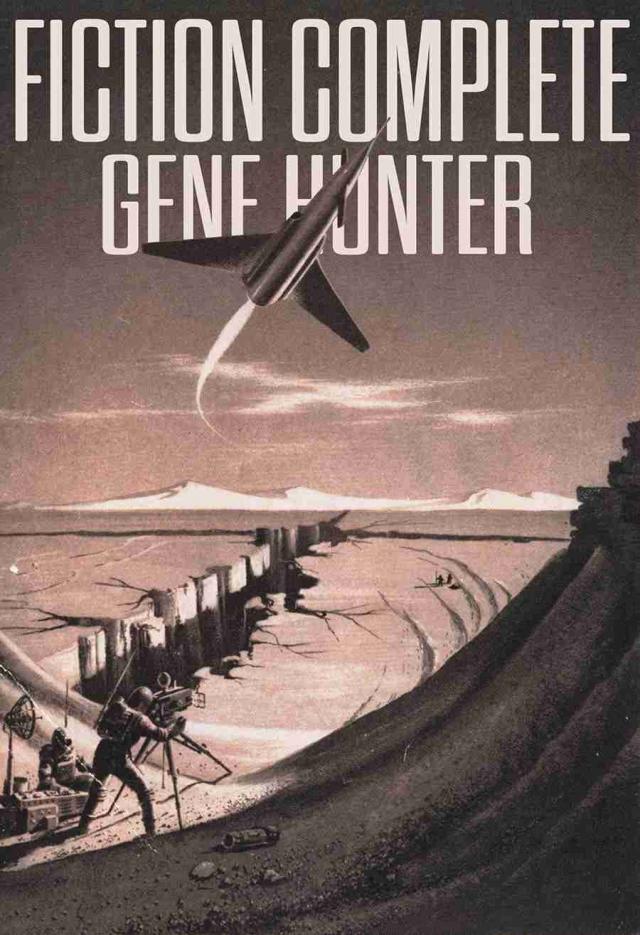
Because she was getting old and fussy Earth was trying to sabotage her own colonies.
The GLAD SEASON
By GENE HUNTER
ILLUSTRATED BY MORRIS SCOTT DOLLENS
“Youth is to all the glad season of life; but often only by
what it hopes, not by what it attains, or what it escapes.”
—Thomas Carlyle
“It is difficult to believe today,” the lecturer droned on, “that the conditions we are studying existed only three centuries ago.”
Jef Cortland squirmed impatiently in his chair, caring little for the subject at hand and thinking of his shaggy-haired dogar and the fresh, cool stream at home, so far away in the middle of a school day.
“Why,” continued the lecturer with a little more fervor, “the ancestors of some of you very students were persecuted and discriminated against simply because of their ancestry or their particular coloring. A man with only a tiny fraction of Negro blood, for instance, was considered entirely ‘black’, no matter what his actual pigmentation, and most of his God-given rights were taken away.”


