The Lessons of History, page 9


If we take a long-range view and compare our modern existence, precarious, chaotic, and murderous as it is, with the ignorance, superstition, violence, and diseases of primitive peoples, we do not come off quite forlorn. The lowliest strata in civilized states may still differ only slightly from barbarians, but above those levels thousands, millions have reached mental and moral levels rarely found among primitive men. Under the complex strains of city life we sometimes take imaginative refuge in the supposed simplicity of pre-civilized ways; but in our less romantic moments we know that this is a flight reaction from our actual tasks, and that the idolizing of savages, like many other young moods, is an impatient expression of adolescent maladaptation, of conscious ability not yet matured and comfortably placed. The “friendly and flowing savage” would be delightful but for his scalpel, his insects, and his dirt. A study of surviving primitive tribes reveals their high rate of infantile mortality, their short tenure of life, their lesser stamina and speed, their greater susceptibility to disease.77 If the prolongation of life indicates better control of the environment, then the tables of mortality proclaim the advance of man, for longevity in European and American whites has tripled in the last three centuries. Some time ago a convention of morticians discussed the danger threatening their industry from the increasing tardiness of men in keeping their rendezvous with death.78 But if undertakers are miserable progress is real.
In the debate between ancients and moderns it is not at all clear that the ancients carry off the prize. Shall we count it a trivial achievement that famine has been eliminated in modern states, and that one country can now grow enough food to overfeed itself and yet send hundreds of millions of bushels of wheat to nations in need? Are we ready to scuttle the science that has so diminished superstition, obscurantism, and religious intolerance, or the technology that has spread food, home ownership, comfort, education, and leisure beyond any precedent? Would we really prefer the Athenian agora or the Roman comitia to the British Parliament or the United States Congress, or be content under a narrow franchise like Attica’s, or the selection of rulers by a praetorian guard? Would we rather have lived under the laws of the Athenian Republic or the Roman Empire than under constitutions that give us habeas corpus, trial by jury, religious and intellectual freedom, and the emancipation of women? Are our morals, lax though they are, worse than those of the ambisexual Alcibiades, or has any American President imitated Pericles, who lived with a learned courtesan? Are we ashamed of our great universities, our many publishing houses, our bountiful public libraries? There were great dramatists in Athens, but was any greater than Shakespeare, and was Aristophanes as profound and humane as Molière? Was the oratory of Demosthenes, Isocrates, and Aeschines superior to that of Chatham, Burke, and Sheridan? Shall we place Gibbon below Herodotus or Thucydides? Is there anything in ancient prose fiction comparable to the scope and depth of the modern novel? We may grant the superiority of the ancients in art, though some of us might still prefer Notre Dame de Paris to the Parthenon. If the Founding Fathers of the United States could return to America, or Fox and Bentham to England, or Voltaire and Diderot to France, would they not reproach us as ingrates for our blindness to our good fortune in living today and not yesterday—not even under Pericles or Augustus?
We should not be greatly disturbed by the probability that our civilization will die like any other. As Frederick asked his retreating troops at Kolin, “Would you live forever?”79 Perhaps it is desirable that life should take fresh forms, that new civilizations and centers should have their turn. Meanwhile the effort to meet the challenge of the rising East may reinvigorate the West.
We have said that a great civilization does not entirely die—non omnis moritur. Some precious achievements have survived all the vicissitudes of rising and falling states: the making of fire and light, of the wheel and other basic tools; language, writing, art, and song; agriculture, the family, and parental care; social organization, morality, and charity; and the use of teaching to transmit the lore of the family and the race. These are the elements of civilization, and they have been tenaciously maintained through the perilous passage from one civilization to the next. They are the connective tissue of human history.
If education is the transmission of civilization, we are unquestionably progressing. Civilization is not inherited; it has to be learned and earned by each generation anew; if the transmission should be interrupted for one century, civilization would die, and we should be savages again. So our finest contemporary achievement is our unprecedented expenditure of wealth and toil in the provision of higher education for all. Once colleges were luxuries, designed for the male half of the leisure class; today universities are so numerous that he who runs may become a Ph.D. We may not have excelled the selected geniuses of antiquity, but we have raised the level and average of knowledge beyond any age in history.
None but a child will complain that our teachers have not yet eradicated the errors and superstitions of ten thousand years. The great experiment has just begun, and it may yet be defeated by the high birth rate of unwilling or indoctrinated ignorance. But what would be the full fruitage of instruction if every child should be schooled till at least his twentieth year, and should find free access to the universities, libraries, and museums that harbor and offer the intellectual and artistic treasures of the race? Consider education not as the painful accumulation of facts and dates and reigns, nor merely the necessary preparation of the individual to earn his keep in the world, but as the transmission of our mental, moral, technical, and aesthetic heritage as fully as possible to as many as possible, for the enlargement of man’s understanding, control, embellishment, and enjoyment of life.
The heritage that we can now more fully transmit is richer than ever before. It is richer than that of Pericles, for it includes all the Greek flowering that followed him; richer than Leonardo’s, for it includes him and the Italian Renaissance; richer than Voltaire’s, for it embraces all the French Enlightenment and its ecumenical dissemination. If progress is real despite our whining, it is not because we are born any healthier, better, or wiser than infants were in the past, but because we are born to a richer heritage, born on a higher level of that pedestal which the accumulation of knowledge and art raises as the ground and support of our being. The heritage rises, and man rises in proportion as he receives it.
History is, above all else, the creation and recording of that heritage; progress is its increasing abundance, preservation, transmission, and use. To those of us who study history not merely as a warning reminder of man’s follies and crimes, but also as an encouraging remembrance of generative souls, the past ceases to be a depressing chamber of horrors; it becomes a celestial city, a spacious country of the mind, wherein a thousand saints, statesmen, inventors, scientists, poets, artists, musicians, lovers, and philosophers still live and speak, teach and carve and sing. The historian will not mourn because he can see no meaning in human existence except that which man puts into it; let it be our pride that we ourselves may put meaning into our lives, and sometimes a significance that transcends death. If a man is fortunate he will, before he dies, gather up as much as he can of his civilized heritage and transmit it to his children. And to his final breath he will be grateful for this inexhaustible legacy, knowing that it is our nourishing mother and our lasting life.
WILL and ARIEL DURANT, after spending over fifty years completing the critically acclaimed series The Story of Civilization, were awarded the Pulitzer Prize for General Nonfiction in 1968. In 1977, the Durants were presented with the Presidential Medal of Freedom. Champions of human rights and social reform, the Durants continue to educate and entertain readers the world over. For more information on their work, visit www.willdurant.com.
MEET THE AUTHORS, WATCH VIDEOS AND MORE AT
SIMONANDSCHUSTER.COM
THE SOURCE FOR READING GROUPS
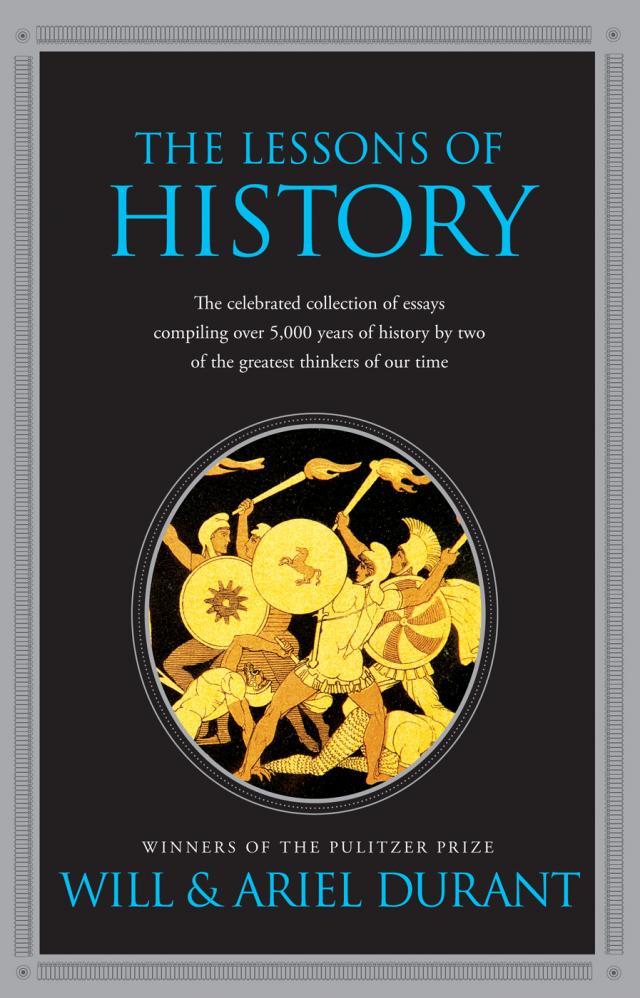
COVER ART © AJAX DEFENDING THE GREEK SHIPS AGAINST THE TROJANS, REPRODUCTION OF A GREEK VASE (COLOUR LITHO) BY ENGLISH SCHOOL (20TH CENTURY) PRIVATE COLLECTION/ ANCIENT ART AND ARCHITECTURE COLLECTION LTD./THE BRIDGEMAN ART LIBRARY
BY WILL DURANT
The Story of Philosophy
Transition
The Pleasures of Philosophy
Heroes of History
The Greatest Minds and Ideas of All Time
THE STORY OF CIVILIZATION
I. Our Oriental Heritage
II. The Life of Greece
III. Caesar and Christ
IV. The Age of Faith
V. The Renaissance
VI. The Reformation
ALSO BY WILL AND ARIEL DURANT
VII. The Age of Reason Begins
VIII. The Age of Louis XIV
IX. The Age of Voltaire
X. Rousseau and Revolution
XI. The Age of Napoleon
A Dual Biography
We hope you enjoyed reading this Simon & Schuster eBook.
* * *
Sign up for our newsletter and receive special offers, access to bonus content, and info on the latest new releases and other great eBooks from Simon & Schuster.
CLICK HERE TO SIGN UP
or visit us online to sign up at
eBookNews.SimonandSchuster.com
Guide to Books
mentioned in the Notes
ARISTOTLE, Politics. Everyman’s Library.
BAGEHOT, WALTER, Physics and Politics. Boston, 1956.
CARTER, THOMAS F., The Invention of Printing in China and Its Spread Westward. New York, 1925.
COXE, WILLIAM, History of the House of Austria, 3V. London, 1847.
DURANT, WILL, The Mansions of Philosophy. New York, 1929.
DURANT, WILL and ARIEL, The Story of Civilization:
I. Our Oriental Heritage. New York, 1935.
II. The Life of Greece. New York, 1939.
III. Caesar and Christ. New York, 1944.
IV. The Age of Faith. New York, 1950.
V. The Renaissance. New York, 1953.
VI. The Reformation. New York, 1957.
VII. The Age of Reason Begins. New York, 1961.
VIII. The Age of Louis XIV. New York, 1963.
IX. The Age of Voltaire. New York, 1965.
X. Rousseau and Revolution. New York, 1967.
Encyclopaedia Britannica, 1966 edition.
GIBBON, EDWARD, The Decline and Fall of the Roman Empire, ed. Milman, 6v. New York: Nottingham Society, n.d.
GOBINEAU, J. A. DE, The Inequality of Human Races. London, 1915.
GOMME, A. W., The Population of Athens in the Fifth and Fourth Centuries B.C. Oxford, 1933.
GOWEN, H. H., AND HALL, JOSEF, Outline History of China. New York, 1927.
GRANET, MARCEL, Chinese Civilization. New York, 1930.
ISOCRATES, Works. Loeb Library.
KAUTSKY, KARL, Communism in Central Europe in the Time of the Reformation. London, 1897.
LANE, EDWARD, Manners and Customs of the Modern Egyptians, 2V. London, 1846.
LEMAÎTRE, JULES, Jean Jacques Rousseau. New York, 1907.
PASCAL, BLAISE, Pensées. Everyman’s Library.
PAUL-LOUIS, Ancient Rome at Work. London, 1927.
PLATO, Dialogues, tr. Jowett, 4V. New York: Jefferson Press, n.d.
PLUTARCH, Lives, 3V. Everyman’s Library.
RENAN, ERNEST, The Apostles. London: Methuen, n.d.
———, Marc Aurèle. Paris: Calman-Lévy, n.d.
SÉDILLOT, RENÉ, L’Histoire n’a pas de sens. Paris, 1965.
SEEBOHM, FREDERICK, The Age of Johnson. London, 1899.
SIEGFRIED, ANDRÉ, America Comes of Age. New York, 1927.
SPENGLER, OSWALD, The Decline of the West, 2V. New York, 1927.
THUCYDIDES, History of the Peloponnesian War. Everyman’s Library.
TODD, A. J., Theories of Social Progress. New York, 1934.
TOYNBEE, ARNOLD J., A Study of History, IOV. London, 1934f.
Notes
CHAPTER I
1. Sédillot, René, L’Histoire n’a pas de sens.
2. Durant, Our Oriental Heritage, 12.
3. Age of Faith, 979.
4. Sédillot, 167.
5. The Reformation, viii.
6. The Age of Reason Begins, 267.
CHAPTER II
7. Pascal, Pensées, No. 347.
8. Plato, Phaedo, No. 109.
CHAPTER III
9. Caesar and Christ, 193, 223,666.
CHAPTER IV
10. Gobineau, Inequality of Human Races, XV, 210.
11. Ibid., 211.
12. Ibid., 36–7.
13. In Todd, A. J., Theories of Social Progress, 276.
14. See Our Oriental Heritage, 934–38.
CHAPTER VI
15. Caesar and Christ, 211.
16. The Renaissance, 576.
17. Our Oriental Heritage, 275.
18. The Reformation, 761.
19. The Age of Reason Begins, 394.
20. The Age of Voltaire, 64.
21. Our Oriental Heritage, 265.
22. The Reformation, 763.
23. The Age of Voltaire, 487.
24. Gibbon, Edward, Decline and Fall of the Roman Empire, I, 314.
CHAPTER VII
25. Caesar and Christ, 296–97.
26. The Age of Faith, 525–26.
27. Plato, Laivs, No. 948.
28. Our Oriental Heritage, 205–13.
29. Ibid., 416–19,434, 504.
30. Renan, The Apostles, xxxiii.
31. Lemaître, Jean Jacques Rousseau, 9.
32. Durant, The Mansions of Philosophy, 568.
CHAPTER VIII
33. The Reformation, 752.
34. The Age of Louis XIV, 720.
35. Plutarch, Life of Solon.
36. The Life of Greece, 112–18.
37. Plutarch, Tiberius Gracchus.
38. Caesar and Christ, 111–22, 14244,180–208.
CHAPTER IX
39. Encyclopaedia Britannica, II, 962b.
40. Our Oriental Heritage, 231. We have revised the date there given for Hammurabi.
41. The Life of Greece, 587–92.
42. Paul-Louis, Ancient Rome at Work, 283–85.
43. Caesar and Christ, 641 f.
44. Szuma Ch’ien in Granet, Marcel, Chinese Civilization, 113.
45. Ibid.
46. Our Oriental Heritage, 700f. The dates there given are being revised for a new edition.
47. Gowen and Hall, Outline History of China, 142.
48. In Carter, Thomas, The Invention of Printing in China and Its Spread Westward, 183.
49. Our Oriental Heritage, 724–26.
50. The Age of Reason Begins, 249–51
51. Kautsky, Karl, Communism in Central Europe in the Time of the Reformation, 121, 130.
52. The Reformation, 383, 391, 398–401.
CHAPTER X
53. Renan, Marc Aurele, 479.
54. Gibbon, Decline and Fall, 1,31.
55. Gomme, A. W., The Population of Athens in the Fifth and Fourth Centuries B.C., 21, 26, 47; Life of Greece, 254.
56. Thucydides, Peloponnesian War, iii 10; Life of Greece, 284.
57. Plato, The Republic, Nos. 56064.
58. lbid, No. 422.
59. Aristotle, Politics, No. 1310.
60. Isocrates, Works, “Archidamus,” No. 67.
61. This paragraph has been copied from The Life of Greece, 46466.
62. Caesar and Christ, 128–30.
63. Ibid.
CHAPTER XI
64. Our Oriental Heritage, 446.
65. Caesar and Christ, 218.
66. In Seebohm, The Age of Johnson, xiii.
CHAPTER XII
67. Our Oriental Heritage, I.
68. See The Mansions of Philosophy, 355; Toynbee, A Study of History, IV, 27f.
69. Quoted from Bazard’s Exposition de la doctrine Saint-Simonienne, in Toynbee, I, 199.
70. Spengler, Decline of the West, 1 353, 90, 38.
71. This is the initial theory of Toynbee’s Study of History, I, 271f.
CHAPTER XIII
72. This section appropriates some passages from an essay on the same subject in The Mansions of Philosophy.
73. Anon, in Bagehot, Physics and Politics, 110.
74. Ecclesiastes, i, 18.
75. Lane, Edward, Manners and Customs of the Modern Egyptians, II, 66.
76. Our Oriental Heritage, 237.
77. Todd, Theories of Social Progress, 135.
78. Siegfried, André, America Comes of Age, 176.
79. Rousseau and Revolution, Ch. II, Sec. iii, William Coxe, History of the House of Austria, III, 379.
* We should add that some historians consider the age of the Antonines as an unsuccessful “rally” in the decay of Rome. See Arnold J. Toynbee, A Study of History (London, 1934 f.), IV, 60.
* See Taine’s unforgettable description in The French Revolution (New York, 1931), II, 209–33.
Index
Dates in parentheses following a name are of birth and death except when preceded by r., when they indicate duration of reign for popes and rulers of states. A single date preceded by ft. denotes a floruit. A footnote is indicated by an asterisk. All dates are A.D. unless otherwise noted.
Abélard, Pierre (1079–1142), 53
Achaeans, 27
Actium, 57
Aeschines (389–314 B.C.), 100
Aeschylus (525–456 B.C.), 97
Africa, 30, 84
agriculture, 16–17, 110
mechanization, technological advances, 22, 54, 58
a stage in economic history, 37, 38, 39, 41, 47, 88
state ownership or control of, 59–64 passim
airplane, impact on civilization, 16
Alcibiades (c. 450–404 B.C.), 39, 99
Alexander the Great, King of Macedon (r. 336–323 B.C.), 12