Call of the Raven, page 4
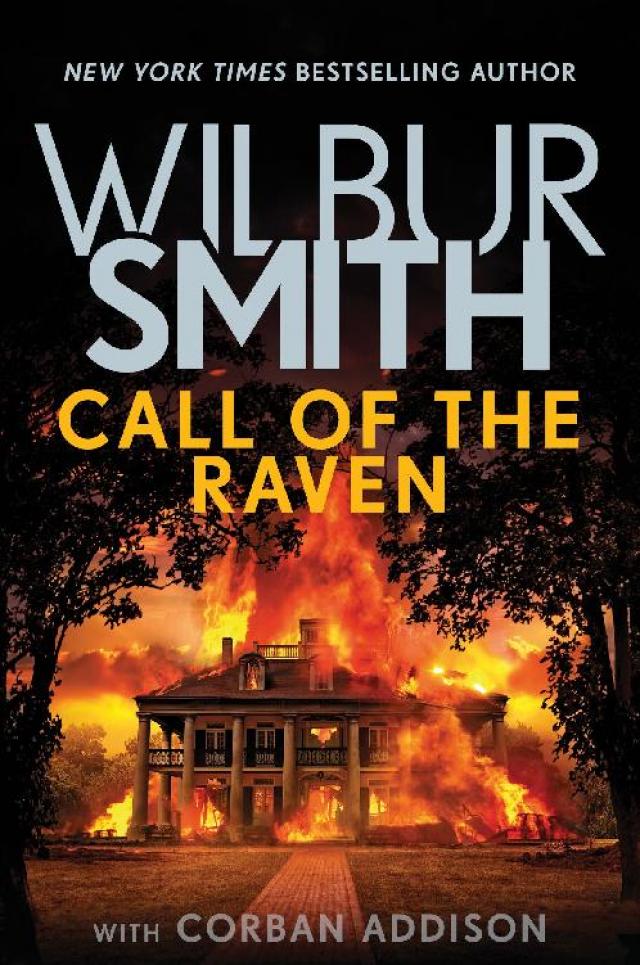


Over the din, he heard the crack of a gunshot. A bullet flew by and buried itself in one of the oaks to his left. He glanced back. Chester had run out of the house and was standing on the porch, holding his pistol. By the tree, Granville and two of his henchmen stumbled after him. But they only had pistols, and against a moving target at that range they stood no chance.
Mungo passed the slave quarters, the drying sheds and the cooperage, and left the house behind. He rode across the soft earth of the empty fields, giving Bristol her head. Where now? After Chester’s betrayal, he did not know if he could trust any of Windemere’s neighbors. Richmond was a better bet, but it was miles away. Bristol had already done almost two hundred miles hard riding in the last two days. Already, Mungo could feel her beginning to slow. Behind him, he heard the barking of dogs and the neighing of horses. Chester’s men must have mounted up to follow him.
Half a mile from the main house, he entered a knot of trees where a creek led in from the river. He guided Bristol down the bank and splashed into the creek. Halfway across, he slid out of the saddle and dropped into the water. The horse looked at him curiously.
“Go on.”
Mungo took his sea bag from the saddle where it was still tied on, then slapped the horse on her rump. She trotted away and up the far bank, leaving a deep trail of hoofprints in the mud. At the top of the embankment, she paused again and looked back.
“Go,” Mungo said again.
With a whinny, she tossed her head and vanished into the trees. With luck, Chester’s men would see her tracks and be led a merry dance before they realized their mistake.
Mungo did not follow her. He turned downstream, holding his bag above his head and breasting through the water. Toward the mouth of the creek, where it met the river, an island had formed in the stream. There had been a bridge once, but it was gone now. A row of rotten pilings poking through the surface were all that remained.
Mungo hauled himself out and climbed onto the island. The thickly wooded ground rose up the slopes of a long hill, a pocket of the pre-colonial wilderness that had survived the St. Johns’ improvements to the land. There was only one path, almost invisible and seldom used. Mungo prayed that Chester did not know it.
The air in the forest was quiet and dank. Briars and branches overhung the path, but it was not completely overgrown. The thicker branches still wept sap from their splintered ends where an ax had pruned them roughly back. In hollows where the earth stayed damp, Mungo saw footprints that must have been made since the last rain.
He took out the pistol case from his sea bag and reloaded the gun he had taken from his captors. He continued cautiously up the path. The forest deadened sound, but in the distance he could still hear the barking of dogs. He hoped the creek had washed clean his scent.
At the top of the hill, the trees thinned out into a clearing. A red brick building stood in its center—an octagonal shape with a domed roof. Mungo’s grandfather had built it as an observatory and Mungo had spent many nights there with the old man, studying the stars through the heavy telescope that Benjamin had imported from Italy. After his death, Mungo’s father sold the telescope and left the observatory abandoned. The forest had drawn in, and a canopy of leaves now blocked any view of the heavens.
But it had other uses. Someone seemed to be there now; the door stood open, and a pair of skinned rabbits were strung up from the bracket where a lamp had once hung. They were freshly killed; their blood pattered down on the carpet of leaves.
Mungo advanced into the clearing, gun ready. He had been playing in these woods since he could walk, and knew how to move silently. Barely a leaf stirred as he approached the door.
He waited outside. He could hear snuffling inside, a sort of snoring. Someone was in there. But if they were asleep, perhaps Mungo should pass by and not disturb them.
Then some sixth sense prickled down his spine. He turned, pressing his back to the wall, to see a figure emerging from the forest. Her white dress shone bright among the gray wood.
His heart lifted. For the first time since he had landed in Baltimore, he felt a spark of hope.
“Camilla!” he called.
A stack of firewood tumbled from her arms and she gave a yelp of fear, turning to joy as she recognized him. She ran across the clearing and threw herself at Mungo. He caught her in his strong arms, wrapped them around her and hugged her close to him as he kissed her on the lips. Even in the chaos and ruin of that afternoon, for that moment at least the world seemed to hang still in perfect peace.
She buried her head in his chest. “Thank God you are here. I prayed every night that you would come.”
He held her back so he could study her face. Her skin was the color of mahogany, a beautiful reddish brown that seemed to glow with the fire of an inner warmth. She wore her hair in two braids tied back behind her neck, framing an oval face with full lips and wide round eyes. She must have been in the forest some time; her features were drawn, and she had lost weight. But the spark inside her, the one that Mungo remembered so well, remained undimmed.
“I wish I had come sooner,” Mungo said. A thousand questions crowded his mind, but he had no time to ask them. “Chester knows I am here and has put the hunt up. We must escape.”
“It is not so easy.”
She pulled free and led him into the observatory. Inside was a single dim room, empty apart from a makeshift bed of ferns and dry leaves in the corner. A white-haired man lay there, next to a balled-up blanket he must have thrown off.
“Methuselah,” said Mungo softly.
The old man had worked the plantation as long as anyone could remember. Among the slaves he had served as headman, judge, shaman and spokesman. He was also Camilla’s grandfather.
“What happened?” Livid welts criss-crossed Methuselah’s back, gleaming with the ointment Camilla had rubbed on them. “Who beat him?”
“Chester said all the slaves were to be sold,” said Camilla. “Methuselah said we belonged to the St. Johns, and once Mr. Oliver was dead we should be free. Chester had his man, Granville Slaughter, thrash him nearly dead.”
She raised her eyes to look at Mungo. “Do you know Granville?”
Mungo rubbed his arms, still bruised from the hands that had gripped him. “I’ve met him.”
Camilla shuddered. “Of all the men I ever met, black or white, I never saw one who scared me like him.”
“Did he touch you?”
“No. That night, before we were to go away, me and my Granddaddy managed to get out. He couldn’t go far, but I remembered this place. How you and me used to come here.”
She dropped her gaze shyly, remembering the first night they had gone there together. Mungo had been eighteen, and she sixteen, on the cusp of womanhood.
“If Chester had touched one hair on your head, I would tear him apart like a dog.” Mungo’s voice was cold and resolute. “As it is, a bullet may suffice.”
He rose. “But I do not like the odds at present. We must go.”
“We can’t.” She took Mungo’s hand and pressed it against Methuselah’s forehead. “Feel him. He took sick from his wounds—he’s burning up with a fever.”
Mungo looked into her eyes, hating the pain he saw there.
“If I had been here, I could have put a stop to all of this.”
Camilla looked as if she might be about to cry, but she caught herself. “It’s not your fault.”
Mungo’s touch had woken the old man. Methuselah stirred, and seemed to mumble something. Camilla leaned over and placed her ear beside his mouth. He murmured again and turned onto his side, pulling his knees toward his chest like a baby.
“Not making any sense,” she said, straining to listen. “Something about a . . . black heart. And . . . thirst.”
A withered hand reached out toward Mungo, clawing the air to beckon him. Camilla moved aside to let Mungo move closer.
Methuselah let out a cough that shook his battered body. His eyelids opened, revealing the yellow-white of his eyeballs. They rolled back in his skull—sightless orbs that fixed on Mungo like two moons.
“Beware the black heart,” the old man croaked, “and the thirst that never quenches.”
A cold shiver went down Mungo’s spine. The words meant nothing, yet they seemed freighted with menace. He knew the slaves venerated Methuselah as much more than an elder or a foreman. Unlike most of them, he had been born in the soil of Africa; he alone had been inducted into the old mysteries of their people. He was their shaman, a seer who could commune with their ancestors’ spirits across the divides of time and oceans and death.
“What do you mean?” Mungo whispered. “What did you see?”
For a moment, Methuselah went rigid: as stiff as a dead man. Then his body relaxed. His eyes closed, his breathing eased and he sank back into the mattress.
From outside the observatory, Mungo heard the barking of dogs again. It was louder now; they must have crossed the creek and picked up his trail. He shook off Methuselah’s grip, angry for letting himself be gulled by the old man’s mumbo jumbo. He should know better.
“We must go,” he said abruptly.
“Leave me here,” Camilla said. “There is nothing they can take from me. But you know what they would do to you if they caught you helping a runaway.”
“Two years in jail and a thousand-dollar fine,” said Mungo. “I can afford both.”
He said it lightly, though he knew that was the least of it. For a white man to help a fugitive slave, especially the scion of a famous family like the St. Johns, was to betray every principle the South was built on. Mungo would be ostracized. His friends would melt away; his associates would disown him. Strangers would cross the street to avoid him, or stay so they could spit at him. In his fight with Chester, he would be left without a single ally.
“You are not a runaway,” he told Camilla. “You should be free.”
She stiffened. “The law says I belong to Chester.”
“I intend to prove otherwise.”
“Which will be easier if you are not in jail yourself.”
“But I do not care to let him have you.”
Mungo smiled. It was a look she knew well, the same charming smile he had worn when they met in the observatory that first night. The look of a man whose will was as unyielding as granite.
In a part of her mind, she wondered what truly drove him now. Was it love for her, or simply the determination to have what was his? When he had her in his arms, he was so tender she felt that their souls were joined and there was nothing between them. Yet even then, his heart remained impenetrable to her. And whatever she felt for him—a terrifying, breathless knot of feelings—she had never been able to escape one immutable fact. Just as much as the fields and the buildings, down to the last stick of furniture in the great house, she was his family’s property.
The dogs were getting closer. Now she could hear shouts and the snap of branches as men fought their way through the undergrowth.
“Granddaddy cannot travel,” she said.
Mungo ignored her. He lifted the old man off the bed and carried him outside in his arms, like a child.
“Where are we going?”
“Mud Island. You know it?”
Camilla nodded. It was a low-lying islet in the middle of the James River.
“The dogs will not find us there. Old Jonah the boatman used to keep a raft in the creek opposite. We should be able to get across.”
At that moment, a dark shadow sprang out from the trees and raced into the clearing. It was a bloodhound, daubed with mud and snarling through its ferocious jaws. Mungo had the pistol in his belt, but his arms were full carrying Methuselah.
The hound bore down on them. Mungo did not have time to reach his pistol. Then something small and bloody sailed through the air and landed just in front of the hound. Camilla had snatched one of the skinned rabbits hanging by the observatory door and thrown it at the hound. The scent of fresh meat drove out every other thought from the dog’s mind. It stopped its charge and began tearing the rabbit carcass apart.
It would not be distracted for long. Mungo laid Methuselah on the ground, drew the pistol and shot the dog through the chest. The animal collapsed without a sound. Two more dogs had followed it into the clearing; now they halted, sniffing at their fallen companion and whimpering.
Mungo grabbed the pistol case from his bag and began to reload. But he was out of time. Even as he rammed home the ball, the dogs’ owners burst into the clearing. There were six of them, all on horseback and all armed: Chester, Granville and one of his men, and three men in the blue coats of the Charles City County Militia.
They spread out in a loose circle, rifles raised. Mungo stepped forward, putting himself in front of Camilla and Methuselah.
“Have you called in the army now to do your work for you?” he asked Chester, nodding at the militia men.
“We were riding by the gate from our muster when we heard shots. We came to investigate.” The leader of the militia was a stern-looking man of about fifty, with a lieutenant’s insignia on his shoulder. His name was Jeremiah Cartwright and Mungo knew him well; he owned the neighboring plantation to Windemere. “What in God’s name have you done, Mungo?”
“He trespassed on my property, attacked my men and then tried to escape,” said Chester, before Mungo could speak.
“I cannot trespass on what is rightfully mine,” Mungo retorted.
“I am the owner. These two negroes—” Chester pointed to Camilla and Methuselah—“belong to me. And this man has been helping them escape.”
“Don’t listen to him. He is a thief and a murderer,” Mungo replied.
Cartwright looked uncertainly between the two men. Chester Marion was nothing more than a county lawyer, a man of no background or family; the St. Johns had been the masters of Windemere since before the War of Independence. Yet there was no denying the evidence of his eyes. Why else should Mungo be out here in the forest—bloody, filthy and unshaven—with two fugitive slaves?
“Please, Jeremiah,” Mungo said humbly. “Would you do this to my family?”
It was lucky the militia had arrived so soon, Mungo thought. If Chester and Granville had found him themselves, they could have killed him quickly; his body would never have been found. Now there were witnesses, men Mungo had known all his life. The balance had shifted.
“Chester killed my father and he has swindled me out of my inheritance,” he told Cartwright. “For the close bonds that have always tied our families together, give me the chance to prove it.”
The low sun shone through the trees over Cartwright’s shoulder, so Mungo could not see his face under the shadow of his hat. He waited, wondering what Cartwright was thinking.
“Oliver St. John was a good man, and I was proud to call him my neighbor,” Cartwright said.
In fact, Oliver St. John had been a sanctimonious pain in the ass—treating his slaves too soft, giving them notions above their station. Ideas like that had consequences; slaves gossiped with each other. Cartwright had lost count of the beatings he’d had to give his own field hands because they’d been infected by Oliver’s hands’ way of thinking.
All that passed through Cartwright’s mind as he looked at Mungo. That, and a great many other things. He gave Chester a sideways glance and nodded.
“These are serious charges. Best take him to the jail.”
“He doesn’t need a trial,” Chester complained. “The evidence of his crime is all around you. I say we lynch him here.”
Cartwright looked horrified. “That wouldn’t be lawful.”
“Are you always so nice about points of law?”
“Mr. St. John may be a criminal, but he is a gentleman. We’re not stringing him up like some common negro.”
Mungo saw Chester’s finger twitching against the trigger of his gun. But he could not murder Mungo in cold blood in front of witnesses. He swung down from the saddle and walked across the clearing. He did not look at Mungo, but went straight past him to where Camilla kneeled beside Methuselah.
“I am obliged to you for restoring what is rightfully mine,” he said to Cartwright.
He drew his pistol, aimed it at Methuselah’s chest, and fired.
The bang echoed around the clearing, startling a flock of black birds from their roosts. The old man’s body jerked once and went still. Camilla screamed and threw herself over her grandfather. Mungo lunged for Chester, but Granville read his intentions. He spurred his horse forward and struck Mungo’s shoulders hard with the butt of his rifle as he cantered past. Mungo was knocked flat onto the ground.
Granville dismounted. He grabbed Camilla by her arms and wrestled her off her grandfather, her dress now stained with blood and earth. Chester walked over to Mungo. He planted his boot on the back of Mungo’s head and squeezed down, pressing Mungo’s face into the mud.
“The old man was worthless,” he said, “and I have no time for assets that do not turn a profit.” He bent down, lowering his voice to whisper in Mungo’s ear. “As for your little black whore, I did intend to sell her with the others. But now she’s gotten a taste for freedom, no one will pay good money for her. There’s nothing you can do with a bitch who’s gone wild—except shoot her down.”
Mungo rose out of the mud so suddenly Chester was thrown onto his back. Careless of the armed men around him, Mungo lunged for his enemy. If he could get his hands on him, he would snap his neck and witnesses be damned. He would not let Chester kill Camilla.
But Mungo could not touch him. The militiamen leaped off their horses and piled into Mungo. He fought them off with all his strength, but they were fresh and strong. Even then, they could not overcome him until Cartwright managed to get a loop of rope over his head. He fastened the other end to the pommel of his saddle and spurred his horse forward. The rope closed around Mungo’s throat. He had to stagger after the horse or he would be throttled.
He twisted his head back, staring at Camilla on her knees beside Methuselah, mouthing words that only she could see. He would never forget the way she looked back at him. Her eyes were wide with the shocking knowledge she was about to die, the frantic disbelief of a small bird cornered by a cat. Mungo clawed at the rope around his neck, but Cartwright was moving so fast he could not loosen it.