House of Two Pharaohs, page 12


Their spirits soared as they ran, laughing at how close they had come to capture, breathing in the desert air that seemed so alive after the hot, choking dust of the dead city.
But their elation did not last long. Piay’s heart leapt into his throat as they sighted armed men in the distance, silhouetted against the setting sun. His fingers closed around the hilt of his sword as he and Taita slowed their pace to a jog and approached with caution.
‘Blues!’ Taita announced triumphantly, a broad smile breaking across his face as he made out the uniforms of the Blue Crocodile Guard.
‘I have been more glad of your keen eyes today than at any other time I can remember,’ Piay replied with a laugh.
Reunited with the Blue Crocodile Guard, Piay immediately called the captain to him. Twenty-eight of the original fifty guardsmen had escaped the city. Three of them were badly injured, but the rest, while filthy, bloody and exhausted, were unharmed.
‘God of the dead or not, the Shuyet owes us a debt of blood,’ Piay said as Taita began to move amongst the wounded. ‘On the memory of the brave men who fell, I swear that I will make him pay it.’
• • •
O
nce Nut, the goddess of the sky, had swallowed the sun and darkness had fallen over the desert, Taita urged Piay to stop and to allow his weary men to rest. ‘If the Shuyet had intended to pursue us, his raiders would have caught us by now. We saw just how quickly they can cover the ground.’
Piay agreed, and called the Blue Crocodiles to a halt. They slumped down in a dry gully and swilled back the water that remained in their hides.
As he reclined against a large rock and gazed up at the soaring vault of the heavens, Taita seemed as troubled as Piay had ever seen him.
‘What are you thinking?’
Taita didn’t break his gaze from the spray of stars. ‘I am beginning to think our adversary is as formidable as any I have encountered. I cannot yet divine his nature, but he is more perceptive, more calculating, than any of the Hyksos barbarians. He knew everything we had planned for him today. He was ahead of us at every turn. It was only your talent with a blade that allowed us to escape.’
‘I should have listened to you,’ Piay conceded. ‘You asked me if I really thought we had the upper hand. We should not have charged in.’
‘I did not become who I am today by never making mistakes,’ Taita replied, turning his gaze on Piay. ‘Every great leader has his moments of blindness. And watching you lead your men today, I am certain that is what you have become.’
‘A great leader would have been more careful, as you advised.’
‘Perhaps. But, had we turned away, we would not have learned valuable information about our adversary.’
‘Twenty Blue Crocodiles died, and the Shuyet is still free,’ Piay remarked grimly. ‘That is a poor exchange.’
‘All men die, Piay. It matters little how or when, so long as Egypt endures. Our task is to see that it does.’
‘What do we do now?’ Piay asked in frustration.
Taita considered the question, shifting his gaze back up to the stars above them. ‘Now, it is time to consider our own strategy,’ he replied. ‘The stakes in the game have been raised. If we are to win, we must learn who the Shuyet is and what he plans.’
• • •
T
he bats erupted from the crumbling towers of Avaris like floodwaters finally breaching a dam, blotting out the bands of crimson streaking the western sky and throwing a chill across the city’s narrow streets.
With a shudder, Hannu looked away from the swooping creatures, each with wings longer than his forearm. The doorway in which he sheltered allowed him to overlook the soaring walls of the Temple of Baal – once a glorious monument to the god of the Hyksos, with an immense and forbidding compound and a lofty portico supported by ten gargantuan stone pillars. Hannu had waited every night for the last five days, for the purple banner that the one-eared man had told him of. And now it fluttered in the early evening breeze – beckoning all of those who understood its meaning.
Hannu unfurled his fingers to examine the prize he held in his palm: the painted clay disc stamped with the jackal head of the god of the dead.
The disc bought entrance to the Hall of Anubis when the purple banner flew: that’s what the one-eared man had said. Hannu had little idea of what awaited him beyond the gates of the Temple of Baal. Someone was recruiting men – and a large number of them – but for what reason, he couldn’t yet discern.
The streets of the former Hyksos capital had become quiet. The beggars and whores had no doubt trailed away to the harbour, where they might still extract something from the remaining sailors stoking their fires along the wharf.
As he watched the dust being whisked along the empty lanes by the breeze, Hannu sensed movement. Figures started drifting towards the temple from all directions – five men, then ten, then suddenly more than he could count.
Hannu studied the arrivals. Their steps were light, eager. They must have been promised something compelling. He could only assume that it was a cut of the treasure left behind by the Hyksos. In a desperate city like Avaris, that would attract any number of men.
For a moment, Hannu considered why someone would select the Temple of Baal as their recruitment centre. It seemed to him an odd choice. Anubis was not a Hyksos deity. No, Hannu thought as he wrapped his cloak around him, the man behind all of this was almost certainly an Egyptian. Perhaps the location of the Hall of Anubis was a mark of victory – proof to those that followed him that the Egyptian gods had triumphed over the god of the barbarians.
Bowing his head, Hannu joined the men trudging towards the compound’s gate. As he drifted between the pillars that led to the temple, he saw that the stone had been desecrated with curses, carved by those residents of Avaris bitter at being abandoned by the Hyksos.
From under his brows, Hannu watched the men around him. Not a single man spoke, and not one of them acknowledged the others.
The moon was rising as the men in front of Hannu approached the shadows beneath the portico, where a formation of guards, perhaps fifteen of them – armed with swords and spears, broad-shouldered and upright – waited. Hannu felt a twist of unease. Once he reached the guards, there would be no going back. Some might say he was a fool for venturing so far – his life would be over the moment he was discovered for the imposter that he was – but when Piay had found him on the street, this is what he had vowed to do: to serve Egypt and Pharaoh in any way he could.
Hannu’s skin puckered as he stepped beneath the portico. His fellow recruits had come to a halt in front of him, as the guards questioned them and demanded the token that they had been given by the tall man with the white sash, the cheriheb.
But what if the guard who had thrown him out of the tavern was there, and recognised him?
Hannu had a distinctive appearance – short and squat, a cripple. He lowered his head as he moved forward, so that his face was masked in shadow.
As he closed on the guards, listening to the men in front of him offer their answers to the questions that were put to them, he realised his mistake. The cheriheb had rejected him at the tavern because he had revealed that he had been a soldier from the Upper Kingdom. The man behind this is not only an Egyptian, Hannu concluded, but from the Lower Kingdom – proud of his history, a disciple of the Red Pretender.
When he reached the front of the line, Hannu kept his eyes on the ground, fixing his gaze on the three pairs of sandalled feet in front of him.
‘Token,’ one of the guards growled.
Hannu held out his open hand. The guard snatched the Anubis disc that lay upon it. ‘Name?’
‘Tanus.’ Hannu felt a pang of regret at choosing the name of the great general of Thebes. It was foolishness. What if the guard recognised it and questioned him further?
Hannu’s heart thumped in his chest as he continued to stare at the dusty flagstones. Just when he thought he might be exposed, the guard hawked up a mouthful of phlegm and spat it on the ground.
‘From?’ the guard grunted.
In a low, rumbling voice, Hannu mimicked the accent of the Lower Kingdom. ‘Bubastis.’ He would not mention Thebes again.
‘Inside.’
• • •
W
ithin the temple, the almost full moon shone down through the collapsed roof, creating a jumble of angular shadows behind the fallen beams and broken masonry. Ahead of him, Hannu noticed a man wearing a faded and cracked leather cuirass. It bore the marks of the Red Pretender. As he followed the man, Hannu mulled the markings on his armour. Did this confirm his theory? Or was it simply a coincidence?
Beyond him was another guard, standing in the shadows. He jerked a thumb and the man in front of Hannu disappeared past him into an abyss.
Hannu saw a doorway, with steps leading down beneath the temple. There was no light from below, which made him feel as if he was about to step directly into the Duat.
He waited while the guard scrutinised him, then, when the man jerked his thumb again, Hannu took the narrow, sloping stairwell into the depths.
The steps curved around as he descended, corkscrewing into the rock beneath the temple. Eventually, Hannu stepped out into a small chamber. It shimmered with the light of a single torch, and he choked on the sharp reek of burning pitch in the constricted space.
On the far side of the chamber, he saw another doorway, which opened into a much larger space. There, the flames of numerous brands forced the shadows from the wide room. The men who had already been admitted were massed there, in the ruddy glow that lit up the ceiling.
Hannu pushed himself into the crowd and away from the eyes of the guards who stood against the walls. The air was hot and the stink of sweat quickly became nauseating, but as soon as he was enveloped in the mass of bodies, Hannu felt himself breathe a little easier.
Though he was shorter than most and his view was obscured by the crowd, Hannu managed to get a sense of the space he was in. The ceiling was perhaps the height of a man above his head, the ragged chisel marks clear in the flickering light. But around the edges, the rock was untouched, suggesting that this was a natural cave adapted for the bloody rituals that the Hyksos had no doubt conducted in the space. There looked to be around eighty men packed into the hall, and here and there along the walls there were openings – tunnels, most likely. Hannu imagined a labyrinth of catacombs extending beneath the vast temple and out into the city.
Pressing the man in front of him aside to get a better look, Hannu glimpsed a dais set at the far end of the chamber. The man whirled and glared, but finding himself faced with Hannu’s own glowering countenance, he nodded deferentially, and stepped aside to give him an unimpeded view of the stage.
For what seemed like an age, Hannu waited, until the pain in his damaged leg was almost unbearable. Beneath his thick cloak, sweat trickled down his back as more and more men pushed their way into the crowded hall, until they were jammed from wall to wall.
Finally, when a period of time had passed with no new arrivals, the guard standing at the entrance to the chamber stepped across it, blocking further admission. Though he was sure that he did not stand out, Hannu ducked down lower, as the guard looked out across the heads of those packed inside – towards the dais – and gave a quick hand signal.
The heat from the torches, and so many bodies crushed together, seemed to fuel the sense of anticipation as two men emerged from the shadows. The first was tall and broad-shouldered, with the posture of a seasoned warrior. His chest was bound in a leather cuirass, similar to the armour that the Hyksos wore, and hide thongs were lashed around his muscular forearms. He gazed out fiercely over the crowd of men before him, gripping the haft of his spear.
The second, taller man Hannu recognised instantly. It was the one he had encountered in the tavern – the cheriheb – still dressed in the elegant black robe with the white sash, though now seeming even more commanding.
As the warrior hammered the haft of the spear on the ground three times, Hannu tried to imagine what purpose could be served by this theatrical display. It resembled the beginning of rituals that he had seen priests enact on feast days, but the men in the hall were not a rowdy throng that needed silencing before a ceremony began.
When the echoes of the final spear-strike had faded, the cheriheb began to address the men before him in a clear, resonant voice. ‘The course of your life has been altered this night. Your days of struggle are over. By entering the Hall of Anubis, you have chosen to make a new life for yourselves, one of plenty and of purpose. For your bravery, the gods will smile on you, in this life and the next.’
Hannu glanced at the rapt faces closest to him, seeing the torchlight dancing in their eager eyes – the tall man’s words had touched their deepest hopes.
Pushing himself up on his toes, Hannu took a better look at the dais. Standing prominently in one corner, he could see what appeared to be a throne, shaped from some dark wood – ebony, perhaps – so that it looked almost as if it was one with the shadows in the wavering torchlight.
Hannu expected the cheriheb to climb onto the dais, and to take his seat upon the throne, but he made no such move. Instead, the warrior beside him cracked the spear haft on the ground three more times and announced: ‘He is coming!’
The cheriheb raised his hands into the air. ‘Anubis is coming!’
A murmur of anticipation ran around the hall and Hannu felt a palpable shift in the air around him, as expectation mingled with dread.
‘Anubis is coming! Bow your heads! Anubis is coming!’ the warrior boomed, the pounding of his spear against the ground reminding Hannu of the solemn beating of a war drum.
Hannu glimpsed a flash of movement – someone throwing a handful of powder onto a brazier behind the dais – and a cloud of white smoke billowed out towards the crowd. This was not sorcery, but it was an impressive display nonetheless – as carefully choreographed as anything Hannu had seen priests perform at any temple. The men standing rigidly around him were entranced.
‘Anubis is coming!’ the cheriheb repeated.
As Hannu watched, a shadow began to appear through the folds of smoke. He felt a shiver run down his spine. The figure exuded a presence of such power that those gathered in that hall could only gape in mute awe.
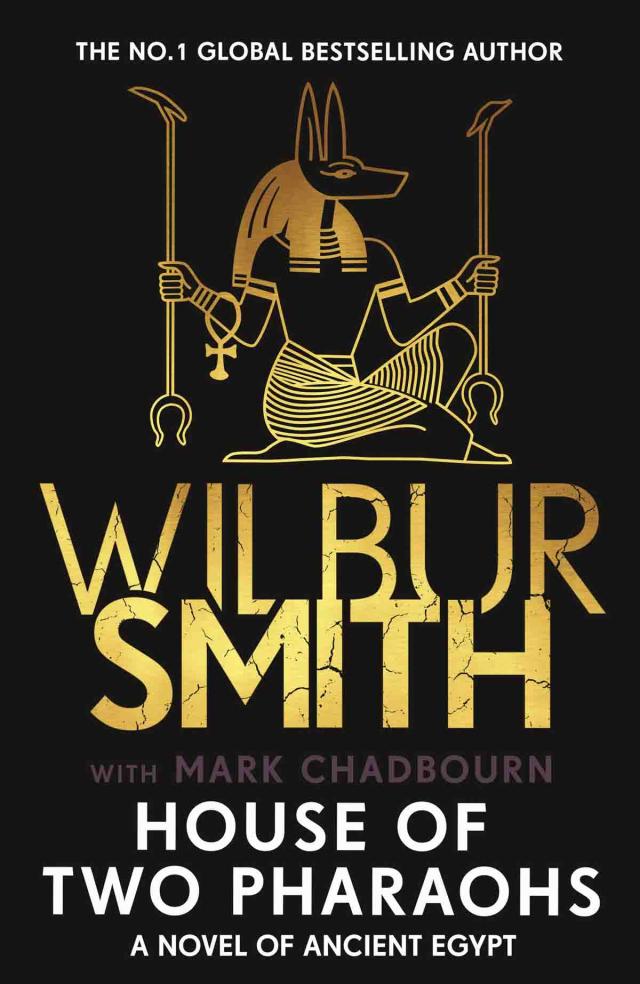
Taller than most men, with black robes that swirled like a pool of ink around him, the jackal-headed god, the Weigher of Hearts, the Lord of the Sacred Land, stepped forward. Amid the collective gasp that followed, Hannu blinked in amazement.
It was Anubis.
It had to be a man in a mask, Hannu told himself, as the jackal head gleamed in the torchlight, its long snout flanked by piercing eyes outlined in white and ears that rose sharply upright, like daggers. But even if it was a mask, that did not mean that the god was not present. The priests who wore the masks of the gods in their rites became vessels that the deities could inhabit. And so this was Anubis. For who would risk the wrath of the god of the dead by pretending to be him? Especially in the hidden chamber at the heart of the Temple of Baal.
‘Hail, Anubis!’ proclaimed the cheriheb.
‘Hail, Anubis!’ the men in front of the dais responded, awestruck.
In his left hand, the god of the dead carried the ankh, the symbol of eternal life. In his right, he held the flail. As the figure settled onto the throne and looked out across the torchlit faces, Hannu felt himself swept up by the thought that here before them was the god who would determine the worthiness of each of the men in the hall, who would decide the fate of every living soul.
Hannu shook himself, trying to shrug off the cold fingers of dread that gripped him. No. This is just a man, he told himself. A man in a mask.
‘You have all been found worthy.’ The cheriheb’s voice boomed across the hall as he took up a new position beside the throne. For the first time, Hannu noticed the faint guttural tones of the Lower Kingdom as he spoke. ‘Here, in this Hall of Anubis, our lord, the Shuyet, to whom this realm known as the Lower Kingdom rightfully belongs, welcomes you into his service. His army, of which you will soon be a part, grows by the day. It will soon be as vast and unstoppable as the waters of the Nile.’
Hannu’s eyes narrowed as he struggled to make sense of what he was hearing. The word shuyet meant shadow. Was it the name of the man behind the jackal mask? The man whose body Anubis now inhabited?
‘With the Shuyet, you will never know want, or doubt, or lack of purpose,’ the cheriheb continued. ‘Your hearts will sing with the rising of Ra’s great orb each morning, and you will drift into contented sleep under the watchful lamp of Khonsu each night. Here, you will make your vow to follow the Shuyet until the end of your days, when, as reward for your devotion, he will usher you into the afterlife as his good and faithful servant.’
The cheriheb paused, allowing a long silence to settle on the hall before he began speaking again.
‘Once you have sworn your oath, you will be bound to the Shuyet forever.’
Hannu now had no doubt that the man before him, dressed as Anubis, was the Shuyet. He marvelled at how easily this masked man and his spokesman were able to mesmerise the men who had come to them, but a wave of dread quickly replaced his wonder. Whatever the Shuyet was, he was not a man who would be content with stealing gold from caravans or pilfering from vaults – no matter how impenetrable. This man would have far greater ambitions.
‘Under the rule of the Red Pharaoh, the people of the Lower Kingdom lived as the gods intended,’ the cheriheb continued. ‘But our birthright was taken from us fifty years ago, when the Hyksos first invaded from the east. The barbarians stole our riches and forced our people to become their slaves. Never again will we endure such suffering.’