

Trump, page 3
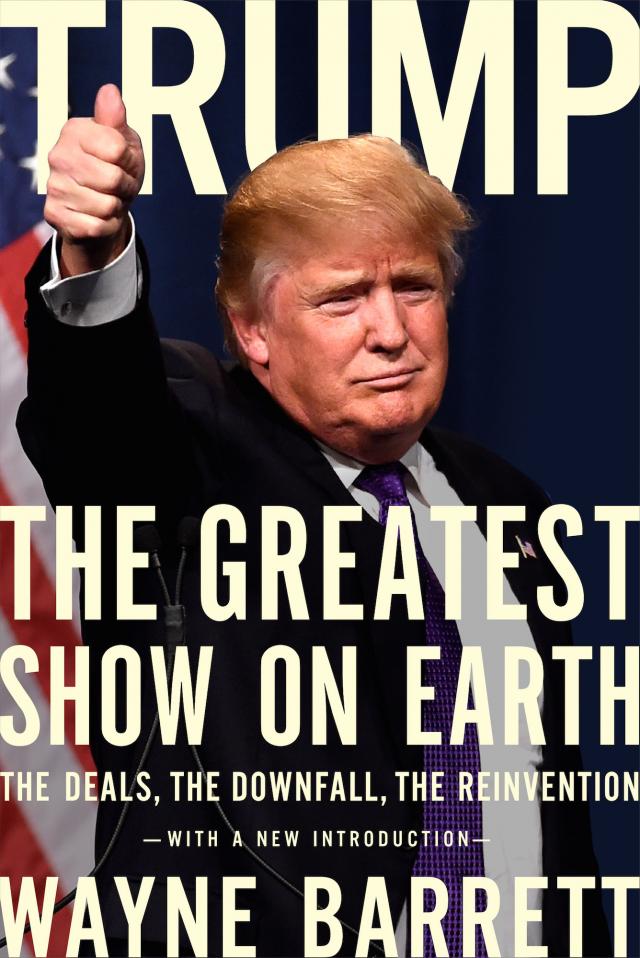


Race, from African-Americans to Mexicans to Muslims, is the accelerant that’s propelled Trump’s campaign. His genius is that he’s known for years how well it could work. “If you want to rouse a dog, why whistle when you can roar,” was his strategic break with the Republican pack, which long preferred code to clamor. And when his divisiveness drew mostly minority protestors to his rallies, he reaped a bonus, a viral jolt to his base, which rose to match the anger of “the others,” a backlash to a backlash that upped Trump’s numbers.
The violence began all the way back in September when Trump’s director of security Keith Schiller and others in Trump’s disturbingly large army of bodyguards grabbed posters from protestors demonstrating on the sidewalk in front of Trump Tower, with Schiller smacking one Latino in the face who tried to get his MAKE AMERICA RACIST AGAIN sign back. The Trump campaign response to the brief media hubbub was a loud snort of defiance.
This showdown was a prelude to sucker punches and bloody brawls at Trump rallies, with the candidate often revving it up. It culminated with the arrest of campaign manager Corey Lewandowski for grabbing a female reporter’s arm at a Trump event, leaving bruises on her arm. When the incident occurred, Lewandowski and Trump derided the “delusional” reporter’s account, and even when a police-released video confirmed it, Trump remarkably barked: “How do you know those bruises weren’t there before?” Until the Lewandowski arrest, all the conflict fed the narrative Trump appeared to want, namely that he and his “movement” were shaking up America with their inchoate outrage. In-your-face politics had its own new face.
It also helped, of course, that Trump didn’t need majorities. In a 1999 New York Times interview, contemplating a race as the Reform Party candidate, he calculated that all he needed was “33⅓ percent, a little more, figure 34,” the same slice of the Republican electorate he appears now to be poised to ride to the nomination, a small enough base that a race and ruckus campaign could rule. He is running as a white Pootie Tang, the Louis C.K.-and-Chris Rock–created Blaxploitation superhero whose unintelligible, pig-Latinesque jive can only be translated by transfixed fans and reporters.
Trump’s other genius is his shocking understanding that news broadcasting and sports broadcasting are now indistinguishable, promoting the very games they cover, living by ratings alone, embedded at the pleasure of the star of the show in the presidential sweepstakes they record. Donald is the all-time champion of unearned media—on the tube forever without paying for it or saying much of substance. Not since Lily Tomlin’s Ernestine has a phone operator gotten as much airtime as Trump.
In a season of broadcast blunders, the worst was the race cover-up, with vacuous analysts, especially on primary nights, going on and on about anything but race explaining the Trump tide. It was anger in New Hampshire, though it has the lowest poverty rate in America and unemployment is virtually nonexistent. It was the newest catchword of the babbling class—Trump’s “outsider” persona—that supposedly carried him through the Deep South on Super Tuesday, even though the same voters in Alabama were simultaneously reelecting the chair of the banking committee, Senator Richard Shelby, buoyed by a $19 million war chest, mostly from the likes of Goldman and J.P. Morgan. Shelby, an eight-one-year-old incumbent forever, won 65 percent of the vote, avoiding a run-off.
As Trump swept ten of the eleven Confederate states—only losing Texas to native son Ted Cruz—Jake Tapper and Dana Bash on CNN marveled night after night about how stunning it was that a kid from Queens was sweeping the Deep South without offering even a speculative word about the power of his racial message. Tapper asked Trump the toughest question of the televised campaign, hounding him about the KKK leader’s endorsement, not relenting even when Trump demurred, unsure, apparently, if condemning David Duke might also cost him Jefferson Davis. But neither Tapper nor any of the myriad other anchors would offer a clear-cut explanation of the impact race was transparently having, as if it was a specter beyond, when it was the very tissue of the Trump triumphs.
It’s possible that Tapper and other broadcast wise men are victims of exit polls that never ask, at least as far we are told on television, if Trump voters think white people are discriminated against in America now, or if they fear a future nonwhite majority, easy measures of racial resentment affirmed in issue polls not cited by the networks. But the cowardly silence about race as a determining factor—shared across the dial—is a shirking of the truth-teller duty of journalists, an accommodation not just for Trump but for his supporters who enlarge the ratings. When the president delivered a journalism is “more-than-handing-someone-a-microphone” critique of campaign coverage, the speech went virtually dark on the same channels that had delivered one live Trump rally after another.
Donald intuited from the beginning of the campaign that television executives and producers are easier to buy or scare than politicians. If he was good television, and he knew he would be, they would give him billions in exposure while demanding little more than unpredictable conflict and controversy from him. They, too, he understood, believe his life is a movie and are competing, often on his terms, to sell tickets to it.
Les Moonves, CBS’s CEO, told a Morgan Stanley conference that his company was making huge profits because of the Trump spectacle, urging Donald to “bring it on, keep going.” Moonves encapsulated the season of circus: “It may not be good for America, but it’s damn good for CBS.” Moonves reminded us of the 1950s bromide of President Eisenhower’s defense secretary who intimated that what was good for General Motors was good for America. As false as that equivalence, it pales when a broadcast executive channels it, since his industry only exists because government allows it free access to at least half a trillion worth of public airwaves, “a privilege not a right,” said an FCC commissioner a decade ago, in exchange for serving public interests.
“America’s id is running for president,” said Jon Stewart after Trump’s announcement, calling him the guy whose brain tells him at 3:00 a.m. “let’s go take a shit in a mailbox.” If Trump tweeted it or put it on the schedule, cable cameras would rush to the mailbox and peer right down the chute.
Yet, when The Daily Beast interviewed disabled vets with vendor licenses that Trump forced off of Fifth Avenue at the very moment that he was hosting a charity event for veterans in Iowa, not a single network sent reporters out to talk to the vets Trump regarded as incompatible with splendor. Restricted to side streets around the corner from the tower and other trophies, the vets were only feet away from most broadcast headquarters.
Save for ABC’s Brian Ross, new networks aren’t doing their own digging, much less giving airtime to the serious investigative pieces done by the New York Times, The Washington Post, the Smoking Gun, Politico, The Daily Beast, Reuters, Bloomberg and many other news organizations (including their own websites, especially CNN’s). Instead, they cover the horse race and spitfire between candidates, playing right into Trump’s spittoon. They even sometimes wring their hands on the air while they’re doing it.
Strangely, though, after nine months of coverage that inflated the Trump balloon, the broadcast consensus shifted in March, as one, feasting daily off of Trump gaffes that once got only momentary attention. The swing occurred after Trump bailed on the last debate and said he would do no more of these ratings-bonanza events, and just as Joe Scarborough and others began openly salivating on air about the grand payday of a contested convention. If that’s a coincidence, it’s another happy one for a business set to profit from a Trump spring and early summer, even if, this time, the questions and commentary will be more probing.
“The show is Trump,” Donald told Playboy in 1990 when his family and business were drowning. “And it is sold-out performances everywhere.”
1
Unraveling
Rushing like a great comet to the zenith, his path a blazing trail, Frank Cowperwood did for the hour illuminate the terrors and wonders of individuality. But for him also the eternal equation—the pathos of the discovery that even giants are but pygmies, and that an ultimate balance must be struck.
THEODORE DREISER, THE TITAN
Donald Trump had not granted an interview or smirked into a camera in nearly a month. It was his longest media dry spell since 1986—when he started taking reporters on grand tours aboard his black Puma helicopter, laying claim to the Manhattan to Atlantic City landscape with a lordly wave of his hand. At forty-four, despite almost daily, banner-headlined catastrophes since the beginning of 1990, he was still willing to play posterboy, and a birthday was a great photo opportunity. So, after weeks of hiding from a suddenly carnivorous press, he decided to surface at a birthday blast organized by his casino dependents. With his golden hair backing up beneath his starched collar, a wounded half smile on his silent lips, and perfectly protected by his ever-present blue pinstriped suit, the icon of the eighties—slowed in the first six months of the new decade to an uncertain pace—worked his way out onto a Boardwalk blanketed by a mid-June haze.
The gray clouds that clung to the spires and cupolas of the Taj Mahal—one of three casinos Trump owned in the seaside town—would not dampen his day. Neither would the newspapers, which had sunk to portraying him as a kind of pop prince of Ponzi, a colossal, one-man pyramid scheme. And neither would the dozens of bankers who were gathering back in New York even on this summer Saturday morning to pick apart the bones of his empire, to add secondary liens to nearly everything he owned. His organization—which he saw as a visionary amalgam of “artful deals”—had already suffered through three weeks of almost surgical exploration at the hands of chameleon moneymen who’d once thrown unsecured millions at him and were now barking at one another over how much life-support pocket change each would agree to offer him. It was just as well he’d gotten out of town, even if he had to leave aboard one of his overleveraged helicopters.
The thousands who were there to greet him—his Atlantic City army of dealers, maids, bellhops, cocktail waitresses, security guards, cooks, and half-dressed dancers—knew perfectly well what he meant to them. Anyone could hire them, but he was more than an employer. The Taj catering manager Barbara Epstein exhorted them from the stage set up in front of the casino’s cement elephants. “Let’s stand behind our Donald,” she pleaded, “because he’s the father of our babies.” It was an image that troubled him, but he understood that they were reaching for words to define him. He was their life force.
Atlantic City mayors came and went, often departing for jail, but Donald Trump had just kept getting bigger and bigger—he now owned fully 40 percent of the city’s casino hotel rooms and ruled it like a potentate. Hadn’t he given wealth a populist glamour? Hadn’t he lived his staff’s fantasies, chasing the sky with flash and glitz, his towers rising from the sand like beacons? Hadn’t he made their town his own, buying and building it felt table by felt table?
They were reaching out to touch him now as if he were still draped in dollars. They were saying they loved him. They were telling a nation it was lucky to have him. They were begging him to stay afloat.
Yet his gargantuan gaming empire had helped give the town its Third World economic flavor—its cash product siphoned out for use elsewhere, its casino enclave arrayed against a skyline of wilting poverty like desert mirages. Though the city’s meager 37,000 population made it a small town, its stretches of decay interspersed with glitz gave it the look of a gutted big-city whore, cheaply overdressed and covered in splashy makeup. After a decade in New Jersey, and a symphony of promises, the Great Builder had yet to erect his first unit of housing on its downtown vacant plains, sidestepping obligations that were, at times, binding covenants that ran with the title to land he bought with city approval. The Taj itself sat on a seventeen-acre site, much of which was cleared with government funds earmarked for rebuilding the city. A side part of this parcel had long been designated for affordable, oceanfront housing, and while Donald had once agreed to build it, there was little doubt now but that it would never be completed.
Even as his subjects chanted for him that morning, the police were ripping up portions of the Boardwalk just a block or so away, scouring its underside for the decomposed body of a murdered homeless man who’d supposedly been buried inside the elaborate, garbage-strewn maze of tunnels dug by the city’s legion of street people for shelter. Just as the rally ended, another homeless man, sleeping in four feet of grass and weeds on a lot near the Taj, was fatally chopped to pieces by a brush-hog mower attached to a tractor.
A screaming ambulance siren became background music for the birthday speeches. A roulette dealer took the mike to call Donald “a superhero” and repeat a homily she might have used on a loser or two at her table: “Success is getting up one more time when you fall down. He’s a real success story.” A professional motivator, Douglas Cox, hired to whip the crowd up, had them cheering frantically for Donald’s brief thank-you statement. “This is unbelievable. You folks are fantastic,” he said. “Over the years, I’ve surprised a lot of people. And the biggest surprise is yet to come.” It was a word of encouragement wrapped in mystery, a tease designed to please the crowd while not offending the nervous bankers, who would not stand for another arrogant declaration of triumph. Donald posed for a photo with a vendor who presented him with an eight-foot-tall rug portrait of himself and prepared to leave. He disliked crowd scenes and was so formal and fastidious that he washed his hands after even boardroom handshakes, drank his diet soda through a straw, wore starch and a suit to tennis matches, demoted casino executives when he found as few as four cigarette butts in an out-of-the-way stairwell, and suggested AIDS tests to applicant bed partners. He knew he would have to go through one more of these flesh-pressing events that night, when a more intimate party of high rollers and hotel brass was planned at a ballroom in his marina casino off the Boardwalk, Trump Castle.
Even as he shuffled off—engulfed by the still cheering throng and bulky bodyguards in dark suits, armed with walkie-talkies—he was alone. He could not remember when he wasn’t alone. Over the years, during his many media interviews and elsewhere, he loosely referred to mere acquaintances as “friends” if they were prominent enough. But those who knew him best said he had virtually no real friends—because, in his own view, no one was actually worthy of his trust. He’d watched his older brother, Fred Jr., die in 1981 and had diagnosed the cause as Fred’s trusting nature. It had killed him at forty-three, when Donald’s decade was just starting, and for Donald the tragedy had become a chilling message. Only a few months earlier, he’d confided to the million or so men who read Playboy that, while alcohol had technically killed his brother (the death certificate lists no cause), he had really died, swore Donald, of openness. “I saw people really taking advantage of Fred, and the lesson I learned was to always keep my guard up one hundred percent, whereas he didn’t,” he said. When he repeated the story on national television in an interview with Connie Chung, he said of Fred Jr.: “He totally gave of himself. And I tend to be just the opposite.”
More than condos or casinos, he’d spent his life building defenses—walls to fend off the people around him. The tally for his three homes—including mansions in Palm Beach and Greenwich, Connecticut, as well as a double triplex in Trump Tower—was 250 rooms, enough to hide in forever. He’d bought a boat with another hundred rooms on six levels. He’d bought a plane large enough to seat 200, but had it redesigned to include a bedroom, full bath, and office. He had New York’s largest living room in the Trump Tower complex. Even his grand and virtually sold-out condo project opposite Central Park, Trump Parc, was black at night because almost no one lived in its most expensive front apartments. The apartments were speculative investments or retreats for offshore corporate visitors. It was as if he could never have enough rooms, decorated in luxurious stillness. Each of the significant people in his life had also contributed, in his or her own way, to his loneliness. None had ever really got past his self-contained wariness.
He had turned his wife into a corporate officer and considered it a promotion. In the mid-eighties he’d given her a casino to run a hundred miles away from him and, week after week, their helicopters had passed each other in the early evening as she flew home and he flew to Atlantic City for the weekend. His top staffers had taken to calling it “the Asbury Park marriage” because that was just about the point in Northern Jersey where they calculated the choppers were close enough to almost touch. While he later shifted her to his landmark hotel in New York, the Plaza, she grew to like her Trump Organization job so much that she kept it when their marriage ended. The couple had not slept together for two and a half years when their peculiar partnership had finally been buried under an avalanche of jointly generated headlines four months before the birthday celebration.
Their life together had begun with an escape hatch—the first of four pre- and postnuptial bargains, the only love letters he’d ever written her. The architect who designed his signature building, Trump Tower, built early in their marriage, told friends that Donald had asked him to plan a second apartment in the building just for him, in case he and Ivana split. Donald would eventually admit that he might have had a “deep-seeded premonition” about life with Ivana, even at the very beginning. In news stories before their separation became public, he distilled their relationship to such a point of shallowness that he turned interview questions about her into opportunities to post notices of his own availability.
“How is your marriage?”
“Just fine. Ivana is a very kind and good woman. I also think she has the instincts and drive of a good manager. She’s focused and she’s a perfectionist.”


