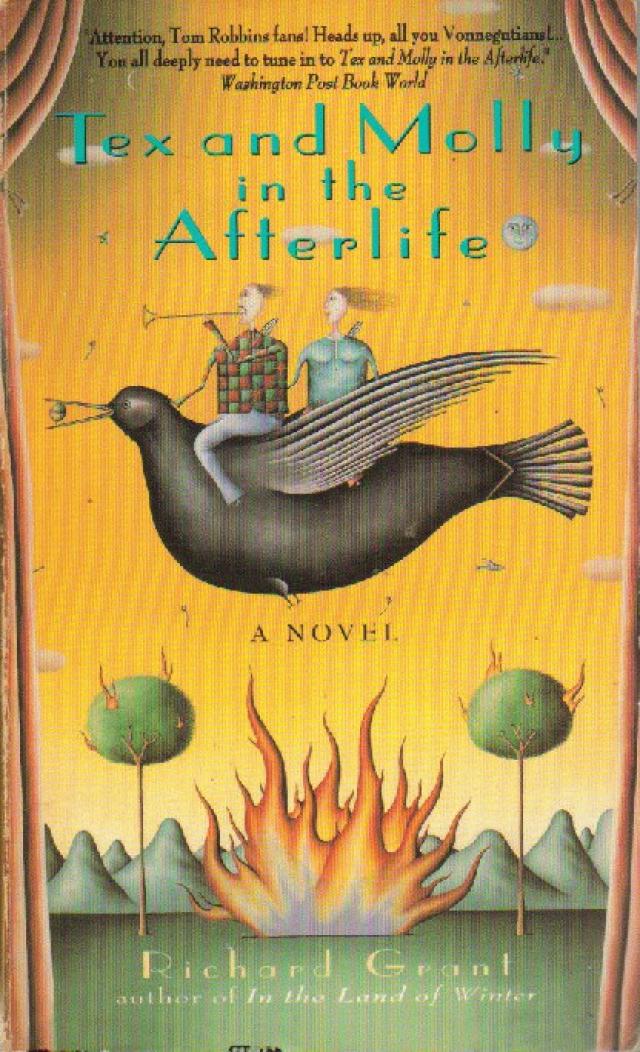
Tex and Molly in the Afterlife, page 1


10-02-2023 - Epub produced from an HTML file and gently tweaked
Tex and Molly in the Afterlife
by Richard Grant
I
The spectacle of Nature is always new, for she is always renewing the spectators.—Goethe, quoted by T. H. Huxley in the first issue of Nature, 1869
time ran out.
* * *
Wizard or no Wizard, the ritual had to begin. The great sun god Belenos was not going to wait for Guillermo to find a parking place where the cops wouldn't notice his inspection sticker or whatever else the little mortal hangup might be. Gods and seasons and celestial bodies have their own gigs to get on with, their own (totally alternative) lifestyles to lead. When noon arrives on the 1st of May, and Beltane is due to come down, it comes down, and that's the end of the story. Molly had gone over this with the Street Players way beforehand. But you know how it is. There's always somebody who doesn't get the word.
"He's done this before," Tex reminded her.
Right, Molly thought: life is cyclical. She gave Tex a smile and smoothed her black feathers down. No sense getting ruffled over things that can't be fixed.
"I told you that guy was wrong for the part."
Tex obviously was not letting go of it. Molly stroked his fur.
"Okay, everybody," she said. "The shoe must go on."
—forcing herself to sound jaunty, adjusting the jut of her raven beak. Sacred bird of the Dagda, right? Bosom bud of the Sandman? Two major demos taken care of right there. A committed player to both pit and gallery, Molly did not neglect the obeisances.
Tex, though, was hung on the testosterone thing. "We ought to get rid of him," he growled.
"You can't just get rid of a Wizard," said Molly. Her beak clacked at him. Quite an edge on that papier-mache. "Remember: they're whatever it is, and quick to anger."
Tex looked at her for a moment blankly. Then (getting the Tolkien reference: ha) he smiled. When he smiled, a glint like starlight shot from the dark centers of his eyes. Mysterious, twinkling energy. Fetishes danced at his ears. "Come on, Bear," Molly said, patting his furry shoulder. "Put your head on."
"Rrrr," he rambled, companionably. He slipped the big toothy headpiece onto his, shoulders, inhaling the comforting trace of taxidermic chemicals, and stared through the gap in the jaw. Raven claws scratched his neck, soothingly. Tex felt like himself again.
"Let's go, gang," Molly called to the rest of the troupe. And so the four Seasons and the five Elements (including Akasha, a sort of Vedic phase-space, just added for this performance), along with the cardinal Directions, Mother Earth, Father Sky, the Moon, the Sun, and an assortment of totemic Beasts—the entire roster of the Cold Bay Street Players except for the Wizard, who was late—shuffled out of the C-Vu Cafe into the principal intersection of Dublin, Maine: until last year, when Wal-Mart opened, the only place in the county with a traffic light. It was just before noon on Beltane, the pagan planting festival. The sun (actual sun) poured down on them like a full-spectrum fluorescent bulb, bright but not warm enough. An offshore breeze carried fresh memories of mountains and of winter. The street was almost empty; the air was quiet; tourist season was six weeks off and the local economy was still in hibernation. Everything was cool.
Without the Wizard, the performance was going to be a little strange.
Well, it was strange anyway. But it did proceed according to a certain internal logic.
SCENARIO
Like: MOTHER EARTH, lying cold and lifeless under the dark spell of WINTER, is summoned to wakefulness by the SUN, who passes across FATHER SKY with a retinue of ELEMENTS. The SUN's way is impeded, however, by various BEASTS who represent the vested interests that resent the coming of springtime. A fat tusked PIG, for instance, stands for the vendors of heating oil, who ritually jack up their prices each November; while Molly's RAVEN embodies those spirits enamored of darkness—Death, struggling bards, talk-show hosts. Against these, the BEASTS of Light and Warmth rise up: a ROBIN, symbol of migrating second-home owners, and a MOUSE, which has got cabin fever from spending the winter behind your refrigerator, and naturally a BLACK FLY, champion of those heroic tiny creatures that keep Maine green and beautiful by driving normal people away.
The contesting BEASTS dance in ritual combat, reaching a frenzied stalemate that is broken when the WIZARD (who up to now's been standing like a calm center of the whirling cosmos, directly beneath the traffic light) leaves the safety of his magic circle to awaken the BEAR—i.e. Tex, in his genuine Ursus americanus pelt. Then BEAR, who not only enjoys ancient associations with the pan-Eurasian Goddess but also important Native American connections, bestirs himself lazily, sniffs at the AIR, paws the EARTH, investigates the angle of the SUN. Time to wake up, he figures. And so with a roar he drives away the BEASTS of Darkness and Cold. Then he rumbles off on his inscrutable way, ready (though in no big hurry) to get on with the business of eating and procreating and casting spoor about.
Exultant, the ELEMENTS join SPRING and SOUTH in a dance of birth and renewal into which, if all goes well, the PLAYERS together with members of the AUDIENCE, including perhaps the local MEDIA, will be drawn. Until at last
[Exeunt frolicking]
everyone skittles out of the street and into vehicles parked nearby and away down Route 1 before the SHERIFF gets really pissed at the drums and chants and blocked traffic.
Finis. Cast party at Eben's barn.
HOWEVER
Without the Wizard things were different.
Leaving aside questions of dramatic logic—such as, who wakes the Bear up now?—the loss of that central figure, planted like a Maypole in the middle of the intersection, left the Players without a visual reference point. These costumes were quite elaborate and it was hard to see from inside them. Plus, you could always count on Guillermo Goban (the Wiz's street name, also a made-up one), being the control freak he was, to use that long staff of his to zap any herbed-out or otherwise errant Players back into line.
So now what?
"Break a leg," said Molly.
And the Cold Bay Street Players went [Jangling. Rattling. Intoning mantras. Waving wire-and-muslin wings. Shaking staves and wands cut from oak and ash and rowan. Waving smoldering bundles of sage and cedar. Thumping stretched-skin drums and acrylic-headed doumbeks. Humming snatches of this and that. Feigning animal stances.] out into the middle of Water Street.
And everything in Dublin stopped.
Which is not to say that much had been happening in Dublin to begin with. Only:
(7) shift-workers in rusty cars heading home
from the paper mill
(2) lobstermen and (3) rangy kids hanging out
at the public landing
(1) brick mason w/ponytail perched on 2 x 6 scaffolding
above the sidewalk
(1) same-gender couple (female) browsing the Polaroids
tacked in the window of a real estate office
Surprised, then alarmed or amused or totally flummoxed by the neo-Pagan processional, these folks stared and others began to emerge from the Fleet Bank and the Real Food Co-op and other places in Dublin's micro-downtown. Mostly they smiled as the Players with their neon nylon banners and musical contraptions and sheaves of desiccated straw paraded by; and the Players got into it big-time now as they twirled and dragged their trains of flowing muslin, leapt onto the hoods of parked cars, tapped at plate-glass windows and beckoned shop clerks and other bored wage-slaves to join the festivities. Reaching now the intersection at the center of town, they arranged themselves in a circle around the spot where the Wizard should have been. Those carrying straw made a pile of it, and Molly swooped down on this with a butane lighter. Whoosh.
The air, damp and breezy and quite cool (because the first of May is only marginally springlike in these parts), filled with sweet white smoke.
The audience fleshed out.
The Players waxed shamanic.
A deputy sheriff named Doug poked his head out of the station on High Street and exchanged looks with a Fleet Bank loan officer.
Two or three car-lengths back from the blocked intersection, a biker laid on his horn. Someone in the crowd shouted at him, and after a second or two he stopped. Old hippies in the audience whooped and clapped. On his scaffold, the brick mason shimmied and carved the air with his trowel.
The loan officer sighed, and Deputy Doug shook his head. He said, "I guess it's that time again."
6 O'CLOCK REPORT
The recap on the nightly news out of Bangor takes up right about here. The reporter who looked like Gidget in a Nautica parka arrived in Dublin a little early (expecting traffic, meeting none), but there was some problem with the camera and by the time it all got straightened out Molly had already decided that—Guillermo still being a no-show—she would have to attend to the seasonal deed herself. So on the screen you see her, out-of-focus at first and then disconcertingly zoomed in on, flapping around the snoozing Bear, who you have to figure is ready to get up and bite somebody on the ass by this time anyhow. Molly plays to the camera nicely, though the prancing Beasts keep screwing up her sight lines. That's show biz.
Suddenly now—you don't catch this at first; the focus is too tight—who but the Wizard should stroll magisterially onto the scene. He spreads his robe and waves his long rowan-branch staff in a wide circle, clearing the space around himself with the dangerous efficiency of an NBA forward in the free-throw lane. He now delivers himself of a loud and portentous announcement in, pres
"HOOMDAYA. FIGDIS WAPPAPPAH! BLONG DEE MOSKOYAI!"
—and by now even the slow-uptake camera operator cannot help noticing this flashy new presence. The camera swings around just as old Bear is starting to rouse himself. So what should have been the center of attention—Tex going into his twitching and shuddering and stretching routine, the powerful forces of life beginning to stir in a new year, waking into a world remade by winter, et alia—instead is fairly tossed offscreen; then we
CUT TO:
Dancing and carousing at the end of the performance. Deputy sheriff visible in the corner of the frame, glancing at his watch. In the foreground, our Channel 5 correspondent in a tight two-shot with who else, the Wizard himself.
"Gidget" (not her real name) smiles into the camera, looking like someone who's having a little more fun than she's being paid to have. Guillermo's costume allows plenty of room for his impressive jaw (a bit like Gaston's in Beauty and the Beast) to thrust itself this way and that.
"So would you say," Gidget wants to know, "that the goal of your performance goes beyond just, mere entertainment? I mean would you say that you have any message, maybe a political message, for the people of Maine?"
"We are here" says the Wizard, so loudly you can picture the meters red-lining, "to call attention to the devastation being wrought upon the North Woods by corporate interests out to make a profit by plundering our common natural heritage."
"Are you referring to the Gulf Atlantic Corporation and its plans for the former Goddin Air Force base?"
The Wizard takes a breath, fueling up for a lengthy reply.
"Fucking Guillermo," muttered Tex. This was later, catching the telecast in Eben Creek's rented barn, which served as the Cold Bay Street Players' storage and rehearsal space. Animal masks stared down luridly from the walls. A non-UL-approved extension cord from the distant farmhouse powered a television and a lone electric light, reclaimed from the dump, that Molly called the Equity Lamp. Also there were candles and the glowing embers of hemp and tobacco. Ragged lifestyles galore around here. "Shh," hissed Molly.
On-screen, the Wizard was talking about the destruction of native habitat, a great opportunity that will be lost forever, selling out the heritage of our children and grandchildren for a favorable quarterly earnings report—it was as though he were reading from a TelePrompTer balanced, like a pirate's parrot, on Gidget's shoulder.
"You were really great, Guillermo," one of the women in the barn said. Pippa Rede.
"Sublimely, bro," Indigo Jones concurred. Guillermo acknowledged the compliments with a weary nod and a smile, becomingly strained, assuming what Tex thought of as his Sandinista War Hero mode.
"What an ass," Tex muttered.
"Be quiet," commanded Molly.
"You be quiet," said Tex. He stood up and swayed a bit reorienting himself to an upright position after having spent the last hour cross-legged on the floor. Middle age (if that's what 49 was called these days) had visited upon Tex this slight but seemingly permanent sense of dislocation. It was like his body was off-kilter by just the tiniest amount—fractions of a degree or something—in relation to the world it had grown into. The way Tex looked at it was, life had been supposed to evolve in a certain way, a particular direction, and instead History at large had made some incorrect turn—this might have happened one afternoon while nobody was paying attention, possibly during one of those dark evenings of the national soul when John Ritter was in prime time—so that now, as the years slithered by, life became increasingly, though subtly and insidiously, different from the way it was divinely intended to be. Another way you could look at it was as though you were dealing with two great tectonic plates—
—and the more they diverged and overlapped and strained against one another, the greater the pressure and the danger and the need for a release, a realignment.
Molly tugged at a fold of his cloak. "Are you okay, Bear?"
Tex did not ignore her exactly, but he did not answer her either. Recovering his equilibrium, he made for the way out—a hatch that opened to a ladder going down from the loft, covered for safety purposes by a sagging remnant of plywood.
"Hey, Tex," young Ludi called out to him. "Look, it's you! You're on TV!"
Had it been anyone but Ludi, Tex would have continued on his way. But there was in Ludi's voice—indeed, in Ludi in general—this appealing quality of Midwestern openness that he found it difficult, or inadvisable, to resist.
Besides which, Ludi was long-legged and sparkly-eyed and cute, not unlike Molly a couple of decades ago.
So he turned to look, and yo: there was himself, as Bear, on the mutant tube.
Gidget was still trying to interview Guillermo, who was now, in Wizard mode, explaining something about the delicate interlocking of species that characterize a mature woodland, that fragile web of connectedness that will be ripped asunder if Gulf Atlantic is allowed...
Suddenly the Bear, his great toothy head bobbing in the middle-ground just over the Wizard's shoulder, began yelling:
"Tell them about the Little People!"
A few moments of confusion ensued during which Guillermo continued to talk (...advances in biology have taught us that it is the super-organized system, the meta-organism if you will, rather than its species-level constituents, that is the crucial...) and Gidget politely to listen while glancing back in a discreet but anxious effort to zero in on this fresh commotion. It was the camera operator who resolved the issue, finding the Bear too viewer-friendly to ignore. He zoomed in on Tex and evidently cued Gidget as well, because she aimed her microphone into the wired-open bear jaw and called out, "Little people?"—flashing a distinctly nervous smile back to the imaginary audience out there in TV News Land.
"Sure, you know—the elves and dryads and wood-sprites!"
Tex was shouting, but his voice rose muffled and strangely distorted from the depths of the bear-head. "You know, the spirits of the forest. Where are they supposed to live, if you go in and wreck their homes? You expect a thousand-year-old Oak Man to move into some snot-nosed baby fir tree? Ha!"
"Ha," said Gidget, uncertainly. "Spirits of the forest. So you object to the North Woods Project on, would you say, religious grounds?"
"What lunacy," Guillermo moaned: real-time Guillermo, there in the Players' barn. "Here we had this wonderful opportunity, this media exposure, and he completely blew it."
"Who blew it?" said Tex, moving a step closer to where Guillermo sat in the blue glow of the television screen. (On which, in extreme close-up now, the Bear was outlining the tenets of Druidic Animism.) "You think you can turn people on by reciting things you've memorized from the Sierra Club calendar?"
Guillermo rose with a grand show of weariness—as in, weighted down by his battle fatigues and his trusty Khalashnikov—and said, "Turning people on. Is that what you think we're trying to do here?"
"What I thought," said Tex, thrusting himself forward, a full head shorter than Guillermo but not willing to let this guy shout him down in body language, "what I thought was that we were having a Beltane festival to welcome back the spirits of growth and make some noise and have a good time. And if people come away from that with a feeling for what spring and green leaves and regeneration are all about, then that's cool. That's great. And if they don't, then the spirits can dig it, anyhow."
Guillermo shook his handsome head. Sickened with regret, like. "The world is dying," he said, "and you want to celebrate."
"The world can't die." Tex mustered a smile. Not a happy smile. Stalwart, at best. "Nothing can die. Everything in nature is alive. Rocks, atoms, light-waves—everything. Only the forms change. This world, our world, may be a little sick—"
"This world is the only world there is," Guillermo said, louder and more forceful now. "And we are the only ones who can save it. If you can't get serious, even about that, then God help you."
"The Goddess helps," Molly said, inserting herself hopefully between the two of them, "and the Goddess nurtures. And sometimes the Goddess bites you on the ass. We all have our parts to play in the great drama."