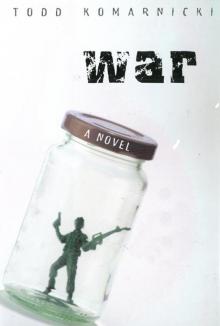
War, page 17


I didn’t need to see their faces to know who they were. To detective out their aromas or the cut of their clothes to be able to say hello. They knew me. I knew them. That was enough. What was clear was that they expected me to walk and they would follow. I began to protest the redundancy of my lostness, but they silenced me with their faith. They believed I knew which direction to head. And that gave me enough strength to begin the journey.
This was Victory Lane. But it wasn’t my Victory. It was another street that had once been thick with barbecuing neighbors and lost baseballs in the yard. A street like ten thousand before it and others yet to come, where people dig down deep, as if the wind will never blow hard enough. But war had finally visited. It traveled as it always has, inexorably, without prejudice, uprooting every inch of the planet and daring the survivors to rebuild. They will, and it will return. The cycle will never finish, I thought.
I began to wish I was in a place that deserved war. Places where the images of mustached leaders were held aloft by fanatic murderers. Cities where demand outstripped supply so that only thievery would buy justice. Vast, open deserts where tribal aim met tribal target and generators bled uselessly into the sand, until the earth itself was a wound, and there was nothing worth saving.
Or a cold place where nuclear winter existed even before the bomb. Why not a crowded Asian street, filthy with slavery and yearning, that needed a fresh beginning, a zeroing out. Yet no place deserved war. All cities, towns, villages had once been bucolic and serene. Every house had at least a sliver of hope before being blown to smithereens.
I had volunteered for a fight without caring who I was fighting. I was eager only for self-negation and the erasure of other selves along the way, be they enemy or even Y., with his broken windpipe and flailing impotence back at the hotel bar. I’d wanted to burn things down. I’d longed not just to be in a war but to become war. Itself.
Even as a teenager, I’d thought the refugees of war were lucky to be leaving. They could begin again, away from death. But death has speed and greed in its loins, and pursuit is its favorite game. It allows us to escape because it knows where we live. And death is patient because it knows if it doesn’t come to us, we will surely come to it.
Even the peacekeepers, like my Dutch wallflower, didn’t know who they were supposed to protect. That this was sacred land made of families and futures. Picnics and popcorn. Sweaters in the winter and sunburns in July. This was a real place, once, and it deserved protection. Attention. Someone guarding the gate. I had been hired as a soldier, paid well, fed and liquored, lied to and manipulated. But I was still a soldier and I was still alive.
And this final walk wasn’t about death. It was about life. That’s what my mother said, without speaking. She was just to my left, her hair tousled gray the way it had been when I found her breathless in her bed three days before I decided to go to war. She had invited me over the way she often did, with the promise of a cake and lemonade. On the few occasions that I’d accepted the invite, I’d always stopped at the corner store to get the supplies. We’d bake together, laughing and looking out the window, letting our proximity be an embrace. Then we’d drink the lemonade while the cake cooled, and I would always leave without a taste.
But on that day — with the oven preheated and an empty pitcher (its mouth awaiting sweet powder) standing guard by the sink — I’d climbed the steps calling her name, already sensing she wouldn’t need it anymore. Kissed her forehead. Massaged her arthritic knuckles, her hands still warm. “Nothing left,” I’d said, and I shed the final skin of what I thought was my life.
But this one had different wisdom. This time Mom was saying that no matter what you think you leave behind, until your heart stops, you carry it all with you. Everything. And everyone. Little brother agreed. He took my hand and forced me to keep up the pace. “We’ll lose the others,” I said.
“No, we won’t.” One look back told me he was right again. There was my ex, her face bright as a Polaroid flash. She walked with confidence and grace. I could see she believed I was moving in the right direction.
O. was behind her, his face hazier, but still held captive by a smile. His father was standing by his side. I knew little brother had my hand, was my rudder, so I kept looking back into the group who trailed behind. “Is it everyone?” I asked my brother.
“Not everyone.”
R. came into focus, as if I’d never laid him in the ground. His ruined eye seemed to heal long enough to see me, then collapsed again. But that wasn’t healing, it was his hello. I laughed. “Where are we going?” I asked him, as I had a hundred times under his command.
“You know, soldier. Walk on.” Seeing R. made me strain to find Mc., but like brother had said, this train did not hold everyone.
My sniper. He came into focus just beside R. He had the floating gait of a skater, his effort effortless. The filth had gone from his face, and by his clothes and shoes I could guess that he was an American, just like me. Nineteen, tops. Maybe he’d spared my life because he couldn’t bear to shoot the mirror. But it had cost him his. Why was he trusting me to lead the way across this humming horizon of flattened light?
“Over here,” little brother insisted, and I turned back around in time to see the man who’d died along with him. The car-crash driver and his grief-sick son. They darted in and out of my periphery as if trying to enter the busy flow of traffic. “Let them in.” I slowed, and the father and son eased in just past my left shoulder. They seemed relieved. In rhythm.
I went to speak but saw my hero instead. The one who’d dragged me to safety on the battlefield and lost his life in the pull. He was dressed in jeans and a pale yellow shirt that had fit him as a college kid and fit him still. He flashed a grin, and thank-yous fell out like broken teeth. “Don’t thank me,” I complained.
“Hush now,” little brother said. “He’s teaching. He was a teacher before this. Still teaching.” And as I watched more closely, the thank-yous became birds that fell from the cage of his mouth and winged forward so fast, it turned me back around to face front. Still walking. Still no destination in sight.
“Tell us a story,” my dead prisoners requested. It was all of them, suddenly walking in front of, beside, and behind me. They moved between the others without anyone noticing. Their skin was transparent and dark as sea stones, and hands were pressed together gently, so as not to crack the secret they were keeping.
“You tell me.” I turned the tables.
“But,———,” they said my name in unison, “we already have.”
Look up. Look up and see where you are standing. I couldn’t tell if it was me chiding myself, or little brother with one more instruction. It didn’t matter. I looked up. And saw. I was standing in front of the hotel. “Should we go in?” I asked.
“Yes,” they all answered, and then they were gone. Is it possible for a man to have his life pass before his eyes and not die? Is our worth in the collective strength of all those who have carried us? They had led me here, back to where I began. Or, if not the precise spot, then another replica in the chain that had somehow survived this long. A hiding place that would soon be swarmed by whichever side happened to win. My helpers had kept me alive long enough to teach me how to desire life. And now they had left me, like a newborn on a doorstep, with no idea how to survive beyond the decision to just keep breathing.
The hotel stood solid as a mausoleum after a flood. It was bold and square, a proud fortress. A sign had blown up against the front steps announcing the grand opening of a now-destroyed department store. The picture was a mixture of gleam and grime. “Be the first,” the copy line read, “and you won’t have to worry about being the last.” I kicked a hole in the sign and opened the front door.
A chain. A series of hotels. Used as barracks. Camouflage. Mc.’s words rang through and at last true in my mind. The reception desk was in the same spot, the furniture and the arrow pointing toward the bar. All slightly different. A little older, younger, identical as twins until you see them side by side.
There were signs of sudden departure. A few emptied weapons. A SAPI vest. A rucksack. In a back booth in the bar, a dead soldier, his gun in front of him, and another man in a bled-through shirt halfway out the service door. I didn’t linger long enough to decide who killed whom.
Whiskers had sprouted in uneven croppings along my jaw, neck, and chin. I found a mini—Dopp kit in the back of a drawer and lathered up, drawing the razor hard and down, waiting for blood. When I was done, tiny kisses of red bloomed on my left cheek and just above my Adam’s apple. I splashed aftershave over them, the sting and scent reminding me of Y. and his Aqua Vel va. “Sorry, Y.,” I said to the air. I touched my throat where I had taken him out, and regret added to the choke. “I’m sorry,” I managed to say, tilting my head up just enough to make it look like a prayer. In case anyone was watching. “Sorry for everything.”
I tried to put on my old clothes, but they’d become obsolete. Wrapped in my sheet, I went room to room looking for an outfit. Maybe khakis left behind. A white button-down. Anything. Mc. had been right. The sevens were suites. But none of the rooms had clothes left behind. Someone had already come through and emptied all the closets, splintered all the drawers.
As I stood in 307, the suite suddenly became too small. The walls and ceiling seemed to quake at the thunder of an approaching silence. The silence that comes after the screaming is over. I didn’t want to be buried alive, trapped by plaster and snake-wrapped in wires. I wanted to see the bullet coming, the arc of the arrow, kiss the flame before it swallowed me whole.
The rooms were even more lush than I’d remembered. There was a claw-foot tub the size of a coffin. Three sinks. A ransacked bed devoid of pillows that only exaggerated the size of the bed. The curtains in this hotel were all sewn to the walls in familiar fashion. Without tearing at them, I could imagine the metal hidden behind them. And behind that the night encroaching like an exhausted army.
I double-locked the door, laughing at the futility, entered the bathroom, and showered in the dark. I dug a leftover soap as deep into my wounds as composure would allow, feeling the bright spike of a pass-out more than once. Die in the shower, I laughed at myself. That’ll show them.
Lacking towels, I wrapped myself in a bed sheet to dry, then finally turned on the light. Ten years, that was my guess, and these things are always a guess: my face had added ten years in the couple of months since I’d first checked in. The circles under my eyes were dark as eggplants, with my green irises as the stems. My corneas looked fractured for all the scratches the air had laced across them. My forehead and cheeks were splotchy and raw as a boy’s skinned knees, but they didn’t share that youth. Lines of worry and regret that had been hinted at before were now deep as ditches. My lips were split from thirst, so I attached my mouth to the faucet and let cold water river down my throat and chin, chill my chest. I drank until it felt like drowning. And I was still thirsty.
The roof-access door had the international warning symbol for “Emergency Only,” and I figured I’d finally earned that status. Yet the alarm was mute as I staggered out onto the rooftop. From seventeen floors up, all the wasteland below seemed brighter than the surface of the moon. There were a couple of pipe housings that might have offered momentary shelter when the attack came, but my time and space had ended. Legs and lungs burned like last charcoal, and I battled for breath in the ruined flux. All I had left to do was wait.
Maybe in the end, it was all snapshots and blood clots. No flow, only incidents with the edges cut off. I had missed my life only to find it too late to use it. I was rich with nothing left to buy. Not even time. The night fell asleep in the arms of the day, and, wrapped in my sheet, wingless and worried, I pinned my eyes shut and dreamed of dying.
They’re here now. It’s morning, and I can hear them contemplating action and access points just outside the door. The slow hurry of loading bullets echoes out onto the roof. Jumping suddenly seems a satisfying possibility. At least, for a moment, I could fly. Up away from all the punishment of myself, to land in the graveyard that this war has already dug for me. But somehow, as I peep over the side, I don’t want to disappear down at all. I long to fly up. To vanish in clouds and purity, somewhere above all this no, into an impossible possible yes.
But men don’t fly up. We only fall down. And now is my time. The time to end all the time I have wasted. All these things I will never know. And the door opens.
They are soldiers, of course, seven, with guns aimed and confusion on their faces. Maybe that they’ve chased all this way to find a man wrapped in a sheet. Barefoot. Like I am late for a meeting. So late I forgot my shoes. Not a soldier at all. Or at least not a threatening soldier. Just a man trapped at the far edge of his life.
Two of the men are dark-skinned. One with an elegant, African face, totemic. The other short and maybe Latino, his shining face as pinched down as if something fell on it. They speak to each other in broken English and stutter-step my way.
The uniforms. That’s it. Familiar. But not green. Beige, with different shoulder patches. The five men behind look eager to shoot, but, with their commanders in front, they’ll have to wait until I run or the leaders say bang. Involuntarily, I tense in anticipation of a bullet, and they stop and crouch as if expecting a gun.
“No, no,” I say, “I’m unarmed,” instantly regretting it. It is obvious. My thin cotton layer hides no weapon, but I don’t want to be taken in, arrested for treason, locked away anywhere they choose. I want to die up here. Maybe I will jump.
They stand again, and the front two make it within fifteen feet. I begin to shake. My last dance, I laugh to myself. And they laugh, too. That’s how they get through such an execution, I guess. They laugh. So it feels less real.
“Shoot me,” I say. “Everyone. At once. That’s all I ask.” And then the laughter really comes. The African soldier takes in my English slowly, then rolls out a laugh that would seem loud at a party. The others fall in behind. Not dying at the hands of these hyenas, I decide, and I hop up onto the ledge.
“Wait,” they say in delayed unison. “No. Come here.”
“I’m not going anywhere. I’m already home.” I turn and stare down. Ready to step out and free.
“Sir,” the small face says to me. “Sir, please, stepping down.” I don’t step down, just peer back over my shoulder. The other soldiers have laid down their weapons and opened their hands like fathers who have pushed their child too far out on a swing.
“Is this America?” I plead.
“Yes.”
“I’m an American,” I say, embarrassed, relieved. “Why are we fighting? What happened here?”
“Does it matter?” From one of the crew cuts in back. He speaks out of rank, but everyone knows he’s right.
“Look. At our uniforms,” the African says. I do, and the familiarity ebbs toward knowledge. “We are peacekeepers. The fighting. It is over.” He is now inches from taking my hand and guiding me down.
“No. It’s not over.” He doesn’t know the horrors I know. The bones upon which we are standing. Yet his kindness, his open expression and listless palm extended, make me utterly weak. I cannot fight as he takes my hand, leads me back onto the roof. The soldiers surround me, pull at me, part comfort, part patting me down for hidden weapons.
“We secured the perimeter this a.m., sir.”The African speaks as if singing. “We almost didn’t check the roof.”
“Sergeant bet the place was abandoned,” the Latin man says. “Happy, lost that bet.”
“The war,” I say.
“The city is secure,” one answers. “Don’t have to be afraid.”
“Anymore,” from another.
“How long you been up here?”
I look at myself in response to his expression. The sheet is smeared with soot. My hands and feet are filthy from rainwater and the rooftop’s melted tar. Hunger crawls from my belly out into the whole of me. I touch my face and whiskers surprise my fingers. “I don’t know.” Maybe I’ve been asleep for days.
“Where is your family?”
“All gone,” I say, tears finding their surface.
“Condolences, sir. But here you are.” For a moment, everyone is sad for me, this strange man on the roof. Cigarettes are offered, taken. I look at the spot I almost jumped from and feel like I may have tricked Mc. after all.
“There’s nothing left out there,” one says, surveying the erased landscape.
“How in the world,” the Latin man asks, “did you survive?”
My answer surprises even my mouth. “I decided. To live.”
As we begin to walk, hesitantly, like friends who hate good-byes, I put my hand on the Latin soldier’s shoulder. “Where are you from? Your accent. Can I ask?”
“The Algarve,” he explains.
“I don’t know.”
“Portugal,” he answers. “It is the most beautiful.”
He opens the emergency-exit door, allowing me to go first. I step down the stairwell, and the light hits me immediately. And the sound. The sound of soldiers tearing open all the curtains. Every step down takes me deeper into the side-splashing light. “Thank you for coming so far,” I say. “To help.”
“We all live in the same neighborhood.” I pull him into a half hug as we walk down the stairs, this unexpected friend who came such a distance to find me. Reel me back in. On the second flight of stairs, we come across a dead body, face down. Two of the peacekeepers lift him out of the way, turning him over as we pass. I turn, trying not to look at any more death. It was a body I hadn’t seen on my walk up to the roof.
“Yeah, ‘cause this asshole was shooting at us.”
“‘Peacekeeper,’” the African says. “Shouted it to him ‘bout a thousand times.”
He is dead. No question. As I finally look at the dead man’s face, for a flash, it’s Mc, winking at me, playing gone again. But then it’s simply the blank face of another man who has shed his skin and slipped away. Another man with a gun who discovered it wasn’t enough. Mc. is still out there, I can sense it. Telling his stories poorly. Brilliantly. If only to himself.