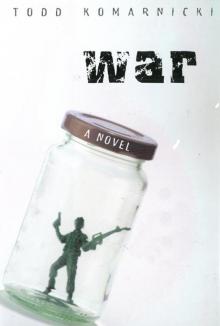
War, page 14


The footholds and hand grips had all been prefabbed into the apparatus, so ascending was easier than if I had been on a playground. I monkey-climbed it so fast, my feet didn’t have time to slip, nor my legs ache for a moment. The higher I climbed, the surer I was that this was my Sphinx and climbing was the answer to the riddle. I would get to the top and finally see what was out there. See far enough to identify or, at the very least, far enough to know which direction was next.
Ever since falling from that tree at six (the distance of which had increased in my memory every year since), I had been terrified of climbing. Wouldn’t even climb the ladder to take the slide down like other kids. I’d run up its tongue to reach the top. But these days had taught me that necessity erases fear. At least long enough to execute the action. And as I clambered up and up, the vast nothing below me, the pinnacle and its promise above me, I was weightless. Fearless. With enough steps, I could have climbed up to the sun to see how close a man could get and live.
Only twenty feet to go, and I felt so connected to the metal that it seemed I was metal. I didn’t need to hold onto any surface, I had become a part of it. Will was adhering me and gravity could not pull me off. A gust blew through the skeleton, setting off an archaic whistling, an ancient modern song. I hummed the tune to myself all the way to the apex. But I didn’t stop. I climbed up past the top until I was clutching air like a cartoon villain. Needed my feet and knees to pinch in or my climb would have been remembered by no one but the wind. And as I caught myself, I caught my breath. And with it, wrangled my fear. “Don’t look down,” I puffed, lungs burning like a prophet’s lips. I closed my eyes, but that just made the sway deeper. The tower now felt like a single needle stuck into the earth, and I the idiot angel, trying not to dance off its edge.
My fingers dug in to the metal until blood pressed out over certain edges. Metal no more. Human. Frightened human. How the fuck was I going to get down? But before that, calm yourself. Get some use out of this suicide ascension. Open your eyes. Look. If you’re so goddamn eager to see, you’re going to have to look.
A thousand soldiers. But only that number because it was at least that, and more didn’t matter. What could matter more than a thousand against one? Not that they were against me. I was pretty certain they couldn’t see me, and if they did from their distance, they wouldn’t have trusted that what they saw clinging to the top of the tower like the harvest’s final apple was a man at all.
And soldiers never look up. We were taught to look for kill shots on the enemy and at our own feet so as not to fall and bring down all those rushing behind in formation. Or to guess at land mines and dance in between. No good soldier ever looked up. If a bomb was dropping, it was already too late. Survival was at eye level. Anything else was the margin. And life was not maintained on the margins.
The soldiers were scattered enough for me to see that they were not one battalion but a few joined together for this attack. Their uniforms were indistinguishable from such a height. They appeared as insects, rushing, hoping to avoid the heel of time. I judged that if I descended as rapidly as I had risen, I could get to the truck in time to escape. But one look down and the accompanying wave of nausea said that was an improbable outcome.
“Get down here,” my father said. “Ass down here or I will push you out of this goddamn tree.” I looked at the soldiers, their approach erratic yet true. Then I looked down again. My father wasn’t there. But the wind had found his voice and carried it up to me. “Oh, I get it.” His voice as raspy as a train announcement. “Kid’s afraid. Hey, honey, your son knows how to climb up, but he’s too scared to come down. Maybe he’s a daughter.”
The smooth metal of the tower turned to knobbed branches. A flag of leaves clothed my face and I hid behind it. “He’s deaf, your daughter,” he yelled toward the house, where my mother stood helpless in the doorway. She was kneading a tea towel like a set of rosary beads. And then he started to climb. I could hear the grunts of anger, the gum stick of his shoe sole on the withered bark. He wasn’t very good, but he was strong enough to climb, and he was coming up to throw me out.
I restraddled the tower, which had become slicker as wood, and I could feel fatigue fevering into my muscles. “Here I come, you little pain in the ass. Looks like it might be a long drop. Gonna hurt,” he snorted, the tar in his lungs squeezing his breath out in short geysers. “That’ll be the first punishment.”
“I’m not coming,” I protested, my voice fragile as a glass in a drunkard’s hand. “Leave me alone.” I couldn’t tell him the reason I was late for dinner stuck up in this tree was because I was too afraid to climb down. He’d never have forgiven, nor stopped reminding me. It needed to be disobedience. That would engender a beating that would stop hurting in a day or two. Admitting fear meant fifteen straight years of humiliation and pain.
“Leave him, then,” my mother said, feigning anger with me. “Let him eat acorns for dinner.” But it didn’t stop my father. He was only a limb below me, and I could see his splotched face, red as a tourist’s.
Jump, I had thought. Just jump. That’ll scare the shit out of him. “Hey,” I said quietly enough so only he could hear. “Watch this.” And I let go. I fell too speedily to see his face on the way down, but I liked to imagine it over the years. I bet it was the one time he actually looked worried about me. Sorry. Caught. But soon I was the one caught. By hard earth and the oak’s knuckled roots.
My mother had reached me first, my father having just as much trouble getting down as I had imagined I would. His shirt snagged and tore on a stiff branch and I laughed as long as my broken ribs would let me. “That hurt,” I said.
“What did I do?” Mom said to me. She wanted to run in and call an ambulance but didn’t want to leave me alone for my father’s arrival. He landed with a toppled inefficiency before I could answer. When he stood over me, he appeared to want to kick me back into the house. “Go call,” Mom said to him. “This is your fault.” My father didn’t look at her. He kept his shame buried and then glared it into me before sidling back to the house. Slowly.
Mom knelt beside me, stroked my hair as apology. “You shouldn’t, you know,” she said. Meaning climb, challenge your father, embarrass him that way.
“I’ll try,” I whispered through the pain of what would turn out to be three broken ribs and a separated shoulder, a lucky result.
“You coming down or not, candy-ass?” he said again, up in the high-wind cool of the morning. I could see the thousand soldiers closing. See that their uniforms were not the same as mine. “Hey, Dad. Watch this.”
In my mind, I let go. But I was tired of almost dying and not ready to let my last mistake be caused by the memory of an asshole. So I climbed. Down. Not expertly. Not with legendary speed. Yet I somehow managed a foothold at a time, keeping an eye on the hurrying horizon of guns and ammo. Down, down, like a boy from a bunk bed in a stranger’s house. Searching for the next step with the tips of my toes. Finding a rhythm, faster, faster as I went.
By the time I touched soil, the soldiers were close enough to start firing. Getting in the vehicle, glass sparkled across my lap like diamonds after a robbery. I circle-reversed as their bullets pinged and skewered their way into the metal, but not into me. Not the tires, I thought, or prayed, or wished. All three were answered. I raced away from the tower, shifting gears in smooth succession, checking the rear view to ensure the final bullet wasn’t gaining on me. Letting all the faster violence pass on the left.
The climb hadn’t given me what I had hoped: a direction to go in. But it had given me one to flee. So I drove. Full tank of gas. No traffic. Even found the one radio station again. But it wasn’t playing music. There was a man speaking and then a woman. A flurry of conversation. In a language I did not understand.
I drove, I listened. Tried to ascertain the language by cadence or emphasis. But long pauses were countered by rapid exchanges, then laughter, then tidbits of a third voice. Despite the arguing, they all, somehow, seemed to be agreeing. After another hearty conspiratorial laugh from the woman, I turned them all off and buckled my seat belt.
If it had been meant to disorient, it had worked. Because even in the switching off, with my eyes glancing down to eye the knob, I had failed to see the horse. Or that it was lying in what I had thought was the street. Or that it had already been torn in half.
I collared the steering wheel hard left to avoid the head, catching just enough of the horse’s prone shoulder to put me up on three wheels. From there, with the wheel cranked so hard, it was a short distance to two wheels, even shorter to none. At fifty miles an hour, I scraped, driver’s side down, along the hard-scrabble terrain. I shed the window, then my uniform along the shoulder and back, then the skin, rubbed off like the silver on a losing lottery ticket. I screamed, but the metal screamed louder, until we both stopped.
“Never took a seat belt off a dead man” was a line I’d heard on a television show as a kid. A paramedic was explaining it to a group of children who’d been scared straight by a gruesome video montage of car crashes. I’d found the man who said this both disingenuous and cruel. He seemed to relish the term “dead man” and enjoy how terrified the little children appeared. But, like him or not, I’d always obeyed the slick-haired, mustached EMT. And on that particular day, I thanked him for my life.
I unclicked the belt and hoisted my relatively uninjured (save for the filet of shoulder and shoulder blade) body out through the passenger-side window. I examined all my limbs like a factory worker testing a robot on the assembly line. All bent, all worked. The air was bright on my peeled shoulder, but the rest of me felt blessed. Then pissed. What the hell was a horse, no, half a horse, doing in the middle of the street? I walked back toward the dead animal, as if it were a fellow driver who’d cut me off on the thoroughfare, and information and profanities needed to be exchanged.
The horse had no defense to offer. Its snout had flattened so that the nostrils were both on the same plane. Its innards had long ago dried under the ceaseless sky. Not even the flies could be bothered anymore. The gap where the rest of the horse should have been was as shocking as the horse’s presence itself. It almost looked as if it had been sawn in half. Though by whom, and with what instrument, was just another minor question sliding onto my list. I got as close as the stink would allow, but the only fact that became clearer was that this had been an old horse. A workhorse. The kind of horse rented to kids and first-time riders. The cut of its mane, the weathered sheen of its shoulders and back said this animal had lived a long life and carried its share of the load. A workhorse, in the middle of a city. A tourist’s horse, torn asunder in the midst of a chaotic, urban war. Was I in a city where horse was on the menu? Possible. But this one hadn’t been meat to anyone. This was a packhorse. An old Belgian draft. A doer. And with its expression pinned to the ground, it looked just as surprised as I.
Then I heard them. The thousand soldiers. I’d driven maybe two miles before the overturn, and that meant they were advancing at a sprint. I could hear the collective kick of their running, the low baritone of their war song, the straightforward march of their vengeance.
I tried, uselessly, to right the truck. Come on, be heroic, I prodded myself, but the truck was asleep, and there would be no rousing it. I couldn’t yet see the enemy, so I thought if I could move away from them on foot at the same speed, my head start would still be enough. And so I bent over and touched my toes like a high-school cross-country runner, inhaled oxygen for vitamins, and tore ass out of there.
Running, despite the pricks of pain in leg and back, did make me feel like a kid again. Chasing my little brother through the backyard leaves, making sure to screw up all the neat piles we’d organized under Father’s supervision.
Running for gym class in high school, where I would pick out the kid that was on the track team and outrun him in speed and distance just to make him feel as shitty as I did twenty-three hours of the day. More than once, the track coach asked me why I wouldn’t try out for the team. “I just did,” I said.
“Damn right,” he agreed. “And you made it.” He had an Adam’s apple that bounced up and down like a carnival game.
“Coach, the only time I run is when something’s chasing me.”
“But you just ran right now. Outran my best guy.”
“Just because you didn’t see it,” I smiled, happy to be confusing him, “doesn’t mean it wasn’t there.” That comment and attendant slyness got me a mandatory sit-down with the school’s mental-health counselor, a woman of such resolute stiffness she appeared to have been bathed at the dry cleaner. At the end of it she concluded there was nothing wrong with me.
“You’re really good at your job,” I told her. “What are you doing at a little high school like this?”
“I ask myself that question all the time,” she said, the thin smile nearly cracking her face.
“Keep asking,” I told her. “Repetition always helps me calm down when I don’t know what the hell’s going on.” I rose, offered my hand, and let her walk me to the door, our hands still linked.
“I wish there was something wrong with you, Mr.———. That way I’d get to talk to you a lot more.”
“What’re you gonna do, doc? Being healthy’s a bitch. Nothing to complain about. No one to listen. I’ll tell you, it’s no goddamn picnic.” My cursing crowbarred her smile open a tiny bit wider. She scolded me with her eyes, then returned me into the hall, her hand like an oven mitt easing me back into the oven.
The next week I saw track coach in the hallway. He greeted me like an uncle on holiday. “Hear you got everything straightened out with the psych. Ready to run?” He began walking down the hall with me. “What’s your spike size?There’s only two weeks until —”
“Hey, coach?”
“Yeah?” His Adam’s apple mercurying up and down in anticipation.
“Want to see me run?”And I was gone before the answer, skidding between backpacks and cliques, not stopping till I made it home. I am fast, I remember thinking. So what?
So this, I thought. Good to be fast when you can honor your commitment to only running when someone’s chasing. This ought to be easy. And it was. My body took on a sort of senselessness, where I couldn’t even feel my edges anymore, just the rumor of where I was and the fact that I was approaching.
I ran in a straight line, sweat down my temple like oil for my engine. My feet were not touching the ground but skimming over it, surfing the surface but never sinking. The quiet pulse of my heart became all I heard. The enemy and their chorus of war were far behind and not worth fearing. I had the faith that I could truly run all the way home. Past the hotel, whether it was still standing or not. Past the meeting point of my kidnapping. Past my old school where the track coach would still be timing sluggards in mesh shirts and have to stop to watch me blow by him like an unmade promise.
My tongue dried but not from fatigue. My mouth had planked open from the, yes, joy of it all. The speed, the getaway, the privacy. This is me, I thought. This is what I do. I don’t stay and wait and worry. I react and move. I get gone. My entire life had been a slow vanishing act. I could do this. I could run until my molecules became one with the filthy air. And all the dirty gray of my soul, propelled at the proper speed, would allow me, once and for all, to disappear. I could feel it happening now. My flesh coming off or the air gluing onto this shape that I carried around. Space began to wrap itself around me. Every jut and joint, from cheekbones to Achilles tendon. Every neuron and proton was sealing into place. Invisible. Invisible. A little, only just a little faster and then invisible.
My mouth closed. My lungs and heart became one. All I had left to do was close my eyes so that I would be the last one to ever see me. But I couldn’t. Not yet. There was something else I needed to see before. A thousand soldiers. No, fewer. But soldiers, still. Moving. Toward me. For a moment I thought I had been running the wrong way. But these were not my tower-view soldiers. These men moved in an accidental weave. They held hatchets and hammers, knives and broken guns. They weren’t really soldiers at all but citizens. Survivors. A militia born of skin-to-the-bone need. They weren’t running from but toward. They wanted the thousand soldiers behind me, and they had no choice but to think I was the scout. That I was the first one on the scene. That I had done this to their land.
With only fifty yards between their onslaught and my ignorant explanation, there would be no time for diplomacy. They would slice me sideways like the horse and rush on to their own death. For, despite their fervor and fury, it wouldn’t take many bullets and grenades to turn this street into their cemetery.
“I’m sorry,” I said, not stopping to explain, not having the luxury to warn. Besides, they wanted what was coming. They chose to die this way.
I maintained my speed but looked left and right. Forward and backward had ceased to be options. Memory told me I had come from the left, that my border there was the sea. So I angled right and sprinted on, even as a machete pierced the path my foot had just trod. I heard the far grumble of their language. Was it the same as on the radio show? Or was it just anger pitched at such a volume that it was its own tongue? I ran on, untired and unknown. Ran until there was silence again. Except for the distant thrash and gunfire of the tribes being culled down to one.
The train car shouldn’t have been there either. Like the horse. The electrical tower belonged in the remains of this city as a sign of former connections. Of the darkness that follows all the bright lights of war. But the horse, and now this silver-black commuter car lying on its side like a metal Labrador, had seemed to bubble up from the stew the violence was stirring.
There were no train tracks. Certainly not visible ones. And there were no other cars, hitched or unhitched. This was neither an engine nor a caboose. It was a middle child in whatever family had been pulling it, and now it was as orphaned as I was under the slow fall of the noonday sky.