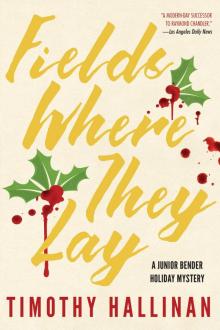
Fields Where They Lay, page 4


“It’s okay,” I said, since she showed no signs of winding down. “He spends most of his time in the dark.”
She squinted at me for a moment, trying to find her place. “An’ they pay, the mall does, for the alarms on the big doors in and out of the building. Which don’t work most of the time. I mean what do they care if we get ripped off a little? No skin off, et cetera. And the holiday stuff, tinsel and lights and Santas and witches and Easter eggs, they pay for somebody to supply those. And every now and then, like for Christmas, which is now, they buy some newspaper ads, like anyone reads a paper anymore.” She took another hit on her cup. “This is what Mr. Pickwick drank,” she said,
I said, “Really.”
She shrugged. “I don’t know. Maybe.” She raised the cup and inhaled the fragrance and blinked a couple of times, fast. “Christmas always makes me think about Mr. Pickwick. Things were better when Mr. Pickwick was alive.” She looked around the shop a bit mistily, it seemed to me. “Do you think Mr. Pickwick would have liked my store?”
“Sure,” I said. “It’s hard to imagine what he’d want that you don’t have at least one of.”
“It is a muddle, isn’t it?” She leaned forward and looked into my cup. “You’re an abstemious soul.”
“Ah, but I’m a devil once I get started. Are you losing much to shoplifting this year?”
She extended a hand, palm up, and waved it in the general direction of the store. “Lookit these people,” she said, although almost all the customers were gone. “They come in here alla, excuse me, all the time. I know their kids, some of them. We get hit a little harder in December than we do the rest of the year. I’m no math whiz, but I bet if you made a graph of the number of people who come through these doors, I mean this door, every month, with the number of people in one line on the graph and the amount of stuff that gets stolen in the other line, I bet the lines would move along like they were holding hands.” She blinked, apparently reviewing the sentence, then nodded. “Yup, ’swhat I meant,” she said. “Lose a little more ’cause we get more people this time of year, but nothing to cry about.”
“What about the other stores?”
She shrugged. “Not my problem.”
“You must hear things.”
“Everybody complains, ’specially at Christmas. Hell, two days after Christmas last year, Gabriel’s pulled out. In two days. They cheated everybody, even ducked the people returning ugly ties and stuff. Store was there and then it wasn’t.” She pushed out her lower lip and blew out, making her bangs fluff. “Everything’s better at Christmas but everything’s worse, too.”
“That’s the truest thing anybody ever said to me about Christmas.”
She shook her head. “But I mean, look at this place. Not just my shop, the whole thing. Shoplifting isn’t the big problem. The big problem is heart, I think. A loss of heart. Entropy is what my son says, but me, I think it’s sadness. Malls are finished, you know? Nobody shops in them anymore. It’s mos’ly kids hooking up and then it’s Christmas, when people realize there’s things they forgot to buy online and it’s too late to get it delivered so they go to the mall. It’s not what it used to be. Nothing is. Not even Christmas. ’Specially not Christmas.” She let the hand with the cup in it relax, slopping a little onto her lap, and some of the air seemed to go out of her. “I’m finished,” she said. “This is our last year.”
“Sorry to hear it.”
“Me, too.” She balanced the cup on her knee and gave the tinsel hanging from her left cuff an experimental tug. “Been a long time. I liked having a store called Bonnie’s. I like the kind of junk I sell. I like the kind of people who used to buy it. But now, you know, it’s just, everybody goes to bricabrac.com or some damn thing. Nothin’s the same.”
“I guess not.”
She picked up the cup and studied it. “All gone,” she said. “Like Mr. Pickwick. It’s all gone.”
5
Vlad the Impeller
Once out of Bonnie’s Bric-a-Brac, toting the carefully rolled sheets of wrapping paper I’d bought and the cigar-smoking porcelain dog that she’d given me as a memento of my venture into crime, I began to eye the place more critically.
And that applied to my lethal Russian employer, too. It was absolutely impossible for me to think of him as Tip Poindexter, so I mentally renamed him Vlad the Impeller. Despite Vlad’s thousands of dollars’ worth of clothes, his discreet gold bracelet, his arduously cast-off accent, his aspirational name, and his country club membership, his shopping mall was a dump. The place was dotted with empty, mournfully dark store spaces, conspicuous as missing teeth—perhaps one in eight—and the shops that were open had a kind of off-flavor, a beyond-the-fringe, the-card-you-didn’t-want-to-draw feeling, like Bonnie’s had, but minus Bonnie’s eccentricity and personal cheer. The Edgerton stores were a few steps down the scale from the retail outfits one associates with the upper middle class. The merchandise looked a lot alike. Except for a huge Boots to Suits discount outlet at one end of the ground floor, where there normally would have been a status department store—Neiman Marcus, Nordstrom, or even Macy’s—the big chains had either never opened or, like Gabriel’s, had fled. Rodeo Drive was in a galaxy far, far away.
Sure, the place was enormous. Sure, it was long and high, with a vaulted ceiling and a couple of low-pressure fountains playing in murky reflector pools at each end. Sure, it probably cost twenty-eight, thirty million to build, not counting the land. Didn’t make any difference. There was an unmistakable sense of foolish money chasing merely unwise money.
All the tinseled Christmas foo-foo with its bright lights and Ho! Ho! Ho! glittered mainly on the first floor, where it would draw people in, an effect that made the second and third floors look dim and February-like by contrast. The place was pretty close to the “ethnically diverse”—read: “about half Latino”—middle-class town of Canoga Park, but it marketed itself, beginning with its WASP-magnet name, mainly to the newer, richer, and whiter areas of Chatsworth, Northridge, and even Simi Valley, which was white enough to house the Ronald Reagan Presidential Museum. Still, the patrons of the Edgerton Mall represented a more variegated racial mix than those three neighborhoods had been built to attract. At this point in its existence, Edgerton Mall was not an establishment that catered to those who could afford to spend in a carefree manner.
And it smelled damp.
But it would be misleading to stop on such a grim note. In spite of the melancholy of the dark shop windows and the inescapable impression of decline, the place hosted a lot of people at that moment, many of whom seemed to be celebrating, many of whom seemed to be with the folks they loved best in the world, and many of whom were small children. It’s impossible for me to be melancholy around small children. They deserve the effort it takes us to do better. About two-thirds of the adults were orbiting around one, two, or three kids, and a lot of those kids were at the stage when Christmas is the frosting on the year, the season when anything is possible, when wishes materialize beneath a tree. Or, minus the tree, on the living room floor; or even, minus the living room floor, at the foot of the bed.
These kids were happy. In fact, right in front of me at the moment I had that thought, a boy of seven or eight with a dark unibrow that suggested a blood relationship to Frida Kahlo tugged at his father’s arm, his face gleaming, as he pointed at something in the window of the little electronics shop. He was the kind of happy adults forget having been.
It’s too easy for an adult to sneer at Christmas, at the duet for sleigh bells and cash registers that provides the season’s sound track, the shameless prices of the animated princesses dangled festively before children’s eyes by a corporate entity with an estimated worth of a hundred billion cold-blooded dollars. It’s impossible to connect all that modern spreadsheet calculation and cheap, icy glitter to the raw, unrestrained amazement in the faces of the shepherds who supposedly attended the birth on the straw. Whether you buy the Christmas story or not, there’s a spontaneous combustion of pure spirit at its center, a sudden brightening of what it means to be human, and it changed the world, for better or for worse. And probably the only people who feel even a flicker of that wonder now are small children and possibly the stray adult like Bonnie, adults who have found a part of themselves where they can shelter the flame, maybe with an open book in front of it to shield it from the wind.
And as for me, well, I had my own complicated relationship with Christmas. It had renewed its claim on my affections when my daughter, Rina, was born, but like so many enthusiasms, my new attitude toward Christmas had faded over time.
I had mentally erased Vlad and his threats for the time being and was sitting on a bench not far from the good Santa, Shlomo, watching the faces of the smaller kids who were getting close to the front of the line to sit in the lap of the season. They mostly either glimmered with excitement or cried in terror, clinging for protection to the legs of their parents. And as happy or as frightened as those kids were about getting closer to Santa, most of them lit up a little once they’d been lifted up and he began to talk to them and tilted his right ear, big enough to have fought its way through all that hair, toward them so he could hear what they had to say. Even the criers went as bright as little lanterns. They didn’t see the skinny, ropy neck, the yellowish skin, the teacup-handle ears and tired eyes. It didn’t matter what Shlomo looked like. While those kids were talking to him, they were safe, and he was Santa Claus.
And I remembered as I sat there that the name Shlomo, despite its somewhat semi-comic Three Stooges sound, at least to the ears of uninformed Gentiles, was Hebrew for “peaceable,” about as good a meaning as a name can have, and that it was one of several variations of the ancient name that’s come down to us via the King James Bible as Solomon.
Shlomo and the kids had lifted my spirits to the point where I could get back to my exploring.
I was curious about the long-gone Gabriel’s department store, a victim, apparently, of Christmas past, so I hoofed down to the far end of the mall to take a closer look at what was there in its place. The huge space had been gerrymandered into what Bonnie had called a bazaar, lines of booths made from cheap, crappy, thinly whitewashed sheetrock. Each booth had its name and number stenciled high on the stall’s back wall. Vape and Vamp, selling an interesting mix of electronic cigarettes and lingerie, was next to Jenny’s Knit & Purl, which was next to Boyland, selling boys’ clothes, and a couple of stalls down from The Antique Geek, offering attic junk and sad old toys. The escalator to the second floor wasn’t moving, blocked by a big Christmas ribbon with a bow in it. I did a quick circuit of the bazaar and then went back into the mall. I was most of the way through my second lap of the second floor, looking down at the ground floor with its dueling Santas and beginning to see something that seemed kind of odd about the way the crowd ebbed and flowed, when my phone rang and broke my train of thought.
“How’s my favorite father in the world?”
Rina’s voice made me feel like a kid who’d just climbed into Shlomo’s lap. “If I see him, I’ll ask. Hey, I know that Christmas isn’t on your mind, but I happen to be holding a medium-size shopping bag that contains the very last thing you’re expecting.”
“Shopping bag? Where are you?”
I arrived at an escalator and got on. “In a mall.”
“How 2010,” she said.
“I hate to remind you of this, but in 2010 I was thirty-two years old.”
“And?”
“Just, you know, it wasn’t a whole geologic era ago.”
“I was eight,” she said.
“That’s grim. So, take a guess.”
“Does it plug in?”
“No.”
She said, “Take it back.”
I rode up to the third floor. “It’s based on a famous work of art.”
“Take it back.”
“It’s something no one you know, I guarantee, no one, has.”
“Does it have Wi-Fi?”
“It has a cigar.”
A pause. I heard a snatch of “The First Noel,” the bit that goes, in fields where they lay keeping their sheep, and she said, “Okay, you’re making me curious.”
“No,” I said. “Never mind. Skip it.”
I stepped off the escalator and found myself facing one of the dark windows. Scraped off the glass, but still visible, was the word records.
“You know,” Rina said, “Mom likes to say that your problem is that you’re addicted to instant gratification, but look at you. You got her pregnant and then you waited all these years just so you could crazify me. What is it? What did you get?”
The only records I’d ever owned had been left behind by my father, along with my mother and me and a bunch of other stuff he hadn’t wanted, when he abandoned us to move in with the woman my mother always called his rental. I’d only played a few of the albums before I sold them, but I suddenly felt like buying a record. I knew it was an anachronism, but it felt to me like Mr. Pickwick would have wanted to buy a record, too. “It’s a small ceramic bulldog,” I said, “holding a poker hand and smoking a cigar.”
“How did you know?” she said, her pitch scaling up. “The one thing, the only thing that I wanted in the whole—”
“This is the trouble with being a liar.” A pack of girls about her age cruised by, two of them smoking furtively, and I heaved a little sigh. “No one believes you when you tell the truth.”
“Yeah, right. What are you getting Mom?”
“What does she want?”
“Are you kidding me? Do you know what day this—”
“I’d thought that maybe a small, ceramic bulldog holding a poker hand and smoking a cigar—”
“Have you thought about this at all?”
“I’m in a mall,” I said.
“Which one?”
“Edgerton.”
“Oh, good,” she said. “They’ve probably got a special on mold.” Then she said, “It’s my dad,” in the kind of tone she might use to say she was catching a cold.
“Not a top-of-the-line mall?” I asked.
“If you enjoy the idea of owning things made by exhausted child laborers in countries where insects are raised as protein, sure. Lot of great stuff to choose from.”
“Who’s that?”
“It’s me,” she said. “Your memory really is going.”
“Who’s with you? Who did you say, ‘It’s my dad’ to?”
“Just Tyrone.” In the background I heard Tyrone say, “Ain’t no just about Tyrone.”
“Put him on.”
“Oh, sure. Stop talking to your only daughter and tell her to put someone else on. Whoops.”
“Whoops what?”
“That was premature. I’m about to drop the phone. Whoops.” The phone landed on something hard.
“Hey,” Tyrone said.
“Hey yourself. What are you getting her?”
“Can’t talk about that,” he said, “with her sitting here with her ears hanging out. What about you?”
“What do you think I should I get her?”
“Up to you, Stu,” he said, a little reproachfully.
“That’s what I was afraid of.”
Tyrone paused and let the silence take effect. “If you’ll excuse me saying so, you’re not taking this very seriously.”
“I know, I know. And don’t think it’s something I like about myself. It’s just that something . . . something . . .”
“Came up,” Tyrone supplied. “That’s lame.”
“I’m aware. Listen, if you, um, if you think of anything great, call me.”
“Sure,” he said. “I’ll call my girlfriend’s father if I think of anything his daughter might want for Christmas.”
“I already feel bad, Tyrone,” I said, but he’d disconnected. I stood there, trying not to imagine the conversation in Rina’s room. Trying not to collide with one of my issues, as I’d described it to Louie: my ever-lurking Christmas self-loathing as a failed father and husband who never felt further from the lives he had left behind than he did during the so-called happiest time of the year.
The girls who were sneaking smokes and their bubble of friends had stopped at the railing a few yards away, looking down at something or someone below. One of them shrieked a few high and unintelligible words and then jumped back and crouched down, out of sight, while her friends laughed. To my eyes, they wore too much makeup. To my eyes, they had no business smoking and hanging around some cheap mall and flagging down guys they might not even know. To my eyes, they were on the edge of trouble.
I probably would have had a negative thought or two about their parents, but I couldn’t let myself go there. I admired my daughter helplessly, but I knew better than to take any credit for her.
6
The Christmases in the Wilderness
So the secret is out: one of my issues at this point in my life is that Christmas is my season for disliking myself.
You could, I suppose, tell an entire life story in Christmases, and for all I know it’s been done a hundred times. The small child’s Christmas, one wonder after another, beginning with the ordinary living room that’s transformed overnight into Aladdin’s cave by a brilliantly gleaming tree; the early adolescent’s Christmas, the magic wearing thin at the elbows, the present you wanted either missing altogether or buried beneath the dreadful store-wrapped rectangles that might as well just blink clothes you won’t like in neon; the late adolescent’s Christmas, a seasonal obligation in a world that has turned rancid in its resolute failure to understand and acknowledge you, when Christmas is just the day when you total in your head how much the presents cost, hear the hollowness of the adults’ laughter, and notice how quickly the eggnog and rum come out.