Fields Where They Lay, page 33


“He’s a doctor? Like a medical doctor?”
“He’s their doctor. He’s the man, as they say, for all of it. From a bullet to a childbirth.”
“And.”
“I was going to go back. When I phoned you, I was going to go back, just to drop off these, these presents. Just to see—just to see him. And he said, he said if I ever came through his gates no one would see me again.” She looked down at her lap and nodded twice, decisively. “And he could do it. There are a dozen people who’d kill me for him. Pop, no problem, and I’m in the foundation of some building in Atlantic City.”
“Okay,” I said. “Not now, nothing now, all right? But in the next few months, Ronnie, I’ll bring you your child.”
“You can’t.”
“I can.”
“How?”
“I’ll steal him. That’s what I do, I steal things. Does he know you’re in California?”
“No. He . . . he, umm.” She shook her head and fell silent. Reached for the bottle.
I intercepted her hand and put it against my cheek. She didn’t pull away. I said, “We don’t need to talk about this now. We’ve got lots of time to talk about it. But I promise you, here and now, a Christmas promise: I will bring you your baby.”
“You can’t,” she said again.
“Here’s what I want for Christmas,” I said. “I want you to stop saying I can’t. I won’t do anything that you don’t know about, but I’m telling you, if I can find a way to get that child out of the house, even for five minutes, even in someone else’s charge, I can make him disappear forever, as far as your ex is concerned.”
“How?”
“I know someone,” I said. “I met her recently. A specialist. I think you’d like her.”
“It’s not going to work.”
“Here’s the deal,” I said. “It won’t be next week or the week after that, or maybe even in the first six months of the new year, but I promise you that every day that passes, you’ll be one day closer to seeing him again. To being with him.”
She was looking past me, at the hallway I’d come in through, but after a long moment, she nodded. “We won’t talk about it.”
“Not until it starts to happen.” A few seconds slipped by without making any noise. I said, “We’re invited to Louie’s for Christmas dinner.”
Ronnie said, “That’s sweet. But we’ll have to live through Christmas Day first.”
“We’ll survive it together,” I said
She brought both hands up to the sides of her face and pressed so hard that her hands shook. Then she interlaced her fingers and let her hands drop into her lap. “I have a present for you.”
“And I have one, no, two for you.”
“In that pile over there?” She lifted her chin in the direction of the spill of bags on the floor.
“That’s where they are.”
She nodded, looking at the bags, and rolled her shoulders. Then she shook her head, as though to clear it. “Not wrapped,” she said.
“No. I’m not very good at this.”
“I have paper,” she said. “I have lots of paper.”
“Well, then. Looks like we’re in business.”
“Partners,” she said. “What time is it?”
“A little after eleven.”
“My, my.” She put her arms around my neck. “That means it’s Christmas in Denver. Let’s get to work on this stuff.”
Afterward
If you’ve come this far it probably won’t surprise you when I say that my view of Christmas as we celebrate it today is equivocal. I agree with Junior when he muses in one of his (many) internal dialogues that the soundtrack for the modern celebration is a duet for sleigh bells and cash registers. And I do believe that the unremitting barrage of bright, pricey material objects—merchandise—is, on the one hand, cruel to those who can’t afford it (and to their children) and light years away, spiritually, from the event the holiday is supposed to commemorate.
I’m not conventionally religious, by which I mean I don’t subscribe wholeheartedly to any of the world’s widely held belief systems. I see them, in a way, as beaches, some facing East and some facing West, each bordering an enormous sea from which a great many interesting things wash up. Some of these things I’ve picked up and carried with me for life. Others I’ve given a wide berth. But I’m profoundly grateful to the Christmas story for its impact on Western visual art: nativities, mother and child, halos of gold, hands upraised in blessing. The rapture in the eyes of the ragged, unshaved shepherd in Van der Goes Adoration of the Shepherds; Fra Angelico, painting on his knees; the guttering candle and fanning pages in Van Eyck’s Annunciation, blown by the word of God. Some of the most beautiful images I know.
And many of the first serious paintings of women in the Western artistic tradition. Whenever I see a really individualistic painting of the annunciation I wonder what young woman served as the model for Mary and what impact the experience might have had on her. There’s probably a book there, although I’m not the person who could write it.
The writing soundtrack for Fields Where They Lay was all over the map. A reader who works in a bookstore that’s part of a mall in the Great Lakes area somehow stole and sent me a huge mp3 file of Christmas shopping music that she says she hears from mid-November through December 25. I tried, I really tried, but in the end I practically pulled my hair out trying to get my earphones off.
From then on, it was mainly classical, a lot of Mozart and Vivaldi, with some old Solomon Burke (God, he could sing), Arcade Fire, Anderson East, and a lot of the Phil Spector Christmas album, which is blessedly heavy on Darlene Love. Also an Emmylou Harris mix I made, slanted toward her stellar Christmas album, Light of the Stable (from which I deleted “Little Drummer Boy”). But a lot of Emmylou’s music has holiness in it, to my ears, so there was quite a bit of her.
As always, if you want to broaden my musical horizons (or try to adjust my attitude toward the modern Christmas), feel free to contact me at www.timothyhallinan.com.
Acknowledgments
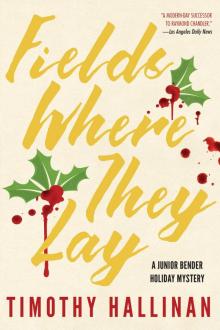
Thanks to the usual Santas—I mean suspects—for their contributions: to Bronwen Hruska for publishing it, Juliet Grames for editing it, Jennifer Ambrose for copyediting it, Rudy Martinez for that amazing cover, Rachel Kowal for shepherding it through the process, and Paul Oliver for telling the world about it. And thanks to Everett Kaser for reviewing it under a lot of pressure.
And merry Christmas to you and yours, whenever you read this.
Timothy Hallinan, Fields Where They Lay