

This side of Infinity (ssc), page 1


30-12-2023
103° today. The fourth successive day of intolerable heat. Met Swanson in the elevator at lunchtime, nearly blurted the truth about myself to him. I must be more careful. But my control is slipping. Last night in the worst of the heat I was tempted to strip off my disguise. I could no longer stand being locked in here, pivoting and ducking to avoid all the machinery festooned about me. Resisted the temptation just barely. Somehow I am more sensitive to the gravity too. I have the illusion that my carapace is developing cracks. Almost collapsed in the street this afternoon. All I need: heat exhaustion, whisked off to the hospital, routine fluoroscope exam.
You have a very odd skeletal structure, Mr. Knecht..…
Indeed. Dissecting me, next, with three thousand medical students looking on…
—From uThe Reality Trip” by Robert Silverberg.
TERRY CARR, a native of Oregon, has made his mark as an excellent science fiction writer and as a distinguished editor of s-f collections. His anthologies (not to mention his long co-editorship of Ace’s famous WORLD’S BEST SCIENCE FICTION series) include:
572701 NEW WORLDS OF FANTASY 75¢
572719 NEW WORLDS OF FANTASY #2 75¢
572727 NEW WORLDS OF FANTASY #3 75¢
629402 ON OUR WAY TO THE FUTURE 75¢
846006 UNIVERSE 1 75¢
846014 UNIVERSE 2 95¢
All, of course, are published by Ace Books.
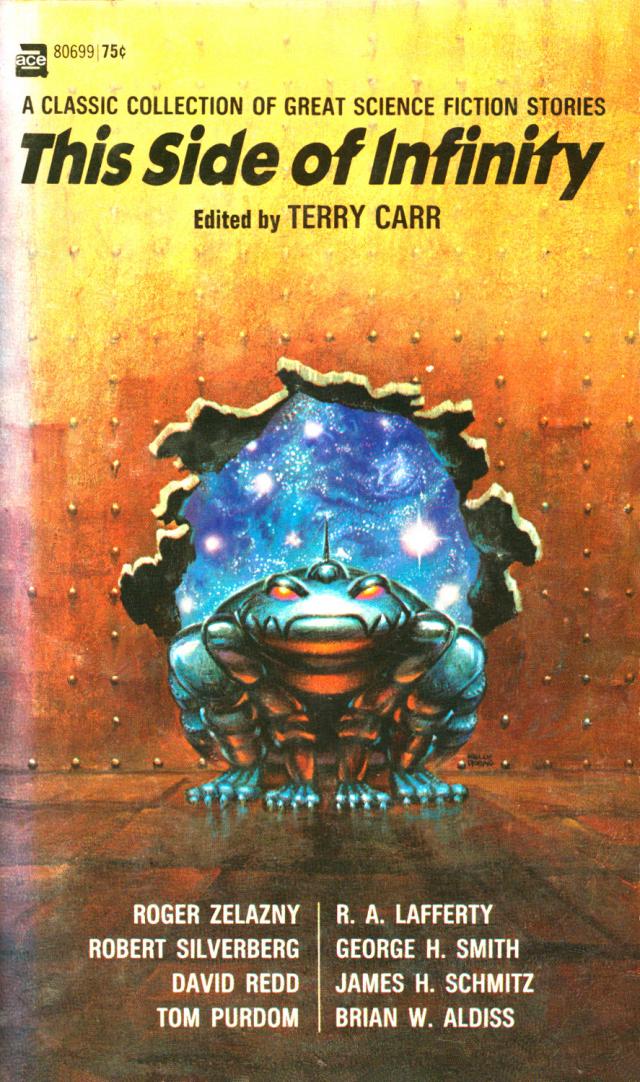
THIS SIDE OF INFINITY
EDITED BY TERRY CARR
ACE BOOKS
A Division of Charter Communications Inc.
1120 Avenue of the Americas
New York, N.Y. 10036
THIS SIDE OF INFINITY
Copyright ©, 1972, by Terry Carr
An Ace Book. All Rights Reserved,
First Ace printing: September, 1972
Printed in U.S.A.
ACKNOWLEDGMENTS:
THIS MORTAL MOUNTAIN by Roger Zelazny. Copyright © 1967 by Galaxy Publishing Corp. From If, by permission of the author and his agents, Henry Morrison, Inc.
THE REALITY TRIP by Robert Silverberg. Copyright © 1970 by Universal Publishing & Distributing Corp. From If, by permission of the author and his agents, Scott Meredith Literary Agency, Inc., 580 Fifth Ave., New York, N.Y. 10036.
SUNDOWN by David Redd. Copyright © 1967 by Mercury Press, Inc. From Fantasy i? Science Fiction, by permission of the author and his agents, Scott Meredith Literary Agency, Inc., 580 Fifth Ave., New York, N.Y. 10036.
TOYS by Tom Purdom. Copyright © 1967 by The Conde Nast Publications, Inc. From Analog, by permission of the author and his agents, Scott Meredith Literary Agency, Inc., 580 Fifth Ave., New York, N.Y. 10036.
RIDE A TIN CAN by R. A. Lafferty. Copyright © 1970 by Universal Publishing & Distributing Corp. From If, by permission of the author and the author’s agent, Virginia Kidd.
THE LAST CRUSADE by George H. Smith. Copyright 1954 by Quinn Publishing Co., Inc. From If, by permission of the author and his agents, Scott Meredith Literary Agency, Inc., 580 Fifth Ave., New York, N.Y. 10036.
RESIDENT WITCH by James H. Schmitz. Copyright © 1970 by The Conde Nast Publications, Inc. From Analog, by permission of the author and his agents, Scott Meredith Agency, Inc., 580 Fifth Ave., New York, N.Y. 10036.
.…AND THE STAGNATION OF THE HEART by Brian W. Aldiss. Copyright © 1968 by Brian W. Aldiss. From New Worlds, by permission of the author and his agents, Georges Borchardt, Inc.
Contents:-
ACKNOWLEDGMENTS:
INTRODUCTION
THE REALITY TRIP by Robert Silverberg I
II
III
THIS MORTAL MOUNTAIN by Roger Zelazny I
II
III
IV
V
VI
VII
SUNDOWN by David Redd PROLOGUE
I
II
III
IV
V
TOYS by Tom Purdom
RIDE A TIN CAN by R. A. Lafferty
THE SHELNI WHO LOST HIS BURIAL TOOTH
THE SHELNI WHO TURNED INTO A TREE
THE SKOKIE WHO LOST HIS WIFE
THE SINGING PIGS
THE LAST CRUSADE by George H. Smith
RESIDENT WITCH by James H. Schmitz I
II
III
IV
V
.…AND THE STAGNATION OF THE HEART by Brian W. Aldiss
INTRODUCTION
The human mind just isn’t capable of imagining infinity.
Go ahead, try it. See if you can conjure in your head the concept of a quantity that is really limitless, a distance that’s endless, a number higher than any other number. There’s always something more, isn’t there?
Infinity is in the basic nature of the universe. And it’s in the basic nature of man, too. (Divide infinity by two; the result is infinity. Divide infinity by one million; the result is still infinity. The concept of the All is by definition indivisible; the tiniest part of it is infinite, and that includes every single human being who ever lived or will live.)
So we’re pieces of infinity, you and I, though it’s seldom we can actually feel the reality of that. When I get up to go to work in the morning I don’t feel at all infinite. When a story I’m writing is going badly I feel limitations pressing me from all sides. When I’ve driven 600 miles in a day I end up feeling most infinite indeed.
But there are days when the limits recede from consciousness. It can happen to me when my story comes to life; it can happen when I walk beside an ocean or stand before a wind-filled forest; it happens when I’m in love. At such times I realize that many of the limits aren’t really there, and those that are just aren’t important. Everything in the universe is an example of infinity.
I think we feel this sense of kinship with the larger reality, and I have the feeling that it’s this expansive sense that draws us to science fiction. We read here stories about the future, and we feel how much the future is part of the present; we read about far worlds and we see that any trip is circular, that they all bring us back to ourselves; we read about alien beings and we realize that they are us.
When these things happen we feel a sense of wonder, and wonder is what science fiction is all about. Wonder and awe…perhaps fright, too, because we fear the unknown, and the infinite is unknowable. We get to see unfamiliar pieces of it in science fiction, though, and we come that much closer to understanding.
All this is subliminal stuff, of course; whats “really” happening is that we’re reading a bunch of stories for the sake of enjoyment. The stories in this book are some of my favorites from the last few years, plus one earlier story—The Last Crusade—that seems to get more relevant with the passing years. These are all stories that moved me, fascinated me, delighted me, opened my mind a little.
None of them reaches infinity; they’re all still on this side of it, like everything else. But I think they’re heading toward it
TERRY CARR
Berkeley, California
November 1971
ROBERT SILVERBERG is admired in the sf field for his imagination, his wit, his lyricism, his earnestness, his intensity…not to mention the sheer volume of stories and novels he’s written. But in a way, his prolificness has sometimes worked against him, for he writes so many excellent stories that he ends up competing with himself; in a year when he publishes three or four major novels and a flock of excellent shorter works, chances are that some of his stories will get lost in the shuffle. This seemed to happen with The Reality Trip, to which I call your attention here: a story of the meeting of human and alien, of love, of the opening of ourselves, and of the tension between reality and emotion.
THE REALITY TRIP by Robert Silverberg
I
I am a redemption project for her. She lives on my floor of the hotel, a dozen rooms down the hall: a lady poet, private income. No, that makes her sound too old, a middle-aged eccentric. Actually she is no more than thirty. Taller than I am, with long kinky brown hair and a sharp, bony nose that has a bump on the bridge. Eyes are very glossy. A studied raggedness about her dress— carefully chosen shabby clothes. I am in no position really to judge the sexual attractiveness of Earthfolk but I gather from remarks made by men living here that she is not considered good-looking. I pass her often on my way to my room. She smiles fiercely at me. Saying to herself, no doubt, You poor lonely man. Let me help you bear the burden of your unhappy life. Let me show you the meaning of love, for I, too, know what it is like to be alone. …
Or words to that effect. She’s never actually said any such thing. But her intentions are transparent. When she sees me a kind of hunger comes into her eyes, part maternal, part (I guess) sexual, and her face takes on a wild crazy intensity.
Her name is Elizabeth Cooke.
“Are you fond of poetry, Mr. Knecht?” she asked me this morning as we creaked upward together in the ancient elevator.
An hour later she knocked at my door. “Something for you to read,” she said. “I wrote them.” A sheaf of large yellow sheets stapled at the top—poems printed in smeary blue mimeography. The Reality Trip, the collection was headed. Limited Edition: 125 Copies. “You can keep it if you like,” she explained. “I’ve got lots more!” She was wearing bright corduroy slacks and a flimsy pink shawl through which her breasts plainly showed. Small tapering breasts, not very functional-looking. When she saw me studying them her nostrils flared momentarily and she blinked her eyes three times swiftly. Tokens of lust?
I read the poems. Is it fair for me to offer judgment on them? Even though I’ve lived on this planet eleven of its years, even though my command of colloquial English is quite good, do I really comprehend the inner life of poetry? I thought they were all rather bad. Earnest, plodding poems, capturing what they call slices of life. The world around her, the cruel, brutal, unloving city. Lamenting the barriers between people. The title poem began:
He was on the reality trip. Big black man, bloodshot eyes, bad teeth. Eisenhower jacket, frayed. Smell of cheap wine. I guess a knife in his pocket. Looked at me mean. Criminal record. Rape, child-beating, possession of drugs. In his head saying, slave mistress bitch, and me in my head saying, black brother, lets freak in together, let’s trip on love—
And so forth. Warm, direct emotion—but is the urge to love all wounded things a sufficient center for poetry? I don’t know. I did put her poems through the scanner and transmit them to Homeworld, although I doubt they’ll learn much from them about Earth. It would flatter Elizabeth to know that while she has few readers here, she has acquired some ninety light-years away. But of course I can’t tell her that.
She came back a short while ago.
“Did you like them?” she asked.
“Very much. You have sympathy for those who suffer”
I think she expected me to invite her in. I was careful not to look at her breasts this time.
The hotel is on West 23rd Street. It must be over a hundred years old—the fagade is practically baroque and the interior shows a kind of genteel decay. The place has a bohemian tradition. Most of its guests are permanent residents and many of them are artists, novelists, playwrights and such. I have lived here nine years. I know a number of the residents by name and they me— but I have discouraged any real intimacy, naturally; everyone has respected that choice. I do not invite others into my room. Sometimes I let myself be invited to visit theirs, since one of my responsibilities on this world is to get to know something of the way Earthfolk live and think. Elizabeth is the first to attempt to cross the invisible barrier of privacy I surround myself with. I’m not sure how “I’ll handle that. She moved in about three years ago. Her attentions became noticeable perhaps ten months back and for the last five or six weeks she’s been a great nuisance. Some kind of confrontation is inevitable: either I must tell her to leave me alone, or I will find myself drawn into a situation impossible to tolerate. Perhaps she’ll find someone else to feel even sorrier for, before it comes to that.
My daily routine rarely varies. I rise at seven. First Feeding. Then I clean my skin (my outer one, the Earthskin, I mean) and dress. From eight to ten I transmit data to Homeworld. Then I go out for the morning field trip: talking to people buying newspapers, often some library research. At one I return to my room. Second Feeding. I transmit data from two to five. Out again, perhaps to the theater, to a motion picture, to a political meeting. I must soak up the flavor of this planet. Often to saloons—I am equipped for ingesting alcohol, though of course I must get rid of it before it has been in my body very long—and I drink and listen and sometimes argue. At midnight back to my room. Third Feeding. Transmit data from one to four in the morning. Then three hours of sleep and at seven the cycle begins anew. It is a comforting schedule. I don’t know how many agents Homeworld has on Earth but I like to think that I’m one of the most diligent and useful. I miss very little. I’ve done good service and, as they say here, hard work is its own reward. I won’t deny that I hate the physical discomfort of it and frequently give way to real despair over my isolation from my own kind. Sometimes I even think of asking for a transfer to Homeworld. But what would become of me there? What services could I perform? I have shaped my life to one end: that of dwelling among the Earthfolk and reporting on their ways. If I give that up, I am nothing.
Of course there is the physical pain. Which is considerable.
The gravitational pull of Earth is almost twice that of Homeworld. It makes for a leaden life for me. My inner organs always sagging against the lower rim of my carapace. My muscles cracking with strain. Every movement a willed effort. My heart in constant protest. In my eleven years I have, as one might expect, adapted somewhat to the conditions—I have toughened, I have thickened. I suspect that if I were transported instantly to Homeworld now I would be quite giddy, baffled by the lightness of everything. I would leap and soar and stumble and might even miss this crushing pull of Earth. Yet I doubt that. I suffer here; at all times the weight oppresses me. Not to sound to self-pitying about it. I knew the conditions in advance. I was placed in simulated Earth gravity when I volunteered and was given a chance to withdraw and I decided to go anyway. Not realizing that a week under double gravity is not the same thing as a lifetime. I could always have stepped out of the simulation chamber. Not here. The eternal drag on every molecule of me. The pressure. My flesh is always in mourning.
And the outer body I must wear. This cunning disguise. Forever to be swaddled in thick masses of synthetic flesh, smothering me, engulfing me. The soft slippery slap of it against the self within. The elaborate framework that holds it erect, by which I make it move —a forest of struts and braces and servoactuators and cables, in the midst of which I must unendingly huddle, atop my little platform in the gut. Adopting one or another of various uncomfortable positions, constantly shifting and squirming, now jabbing myself on some awkwardly placed projection, now trying to make my inflexible body flexibly to bend. Seeing the world by periscope through mechanical eyes. Enwombed in this mountain of meat. It is a clever thing—it must look convincingly human, since no one has ever doubted me and it ages ever so slightly from year to year, graying a bit at the temples, thickening a bit at the paunch. It walks. It talks. It takes in food and drink when it has to. (And deposits them in a removable pouch near my leftmost arm.) And I within it. The hidden chessplayer. The invisible rider. If I dared I would periodically strip myself of this cloak of flesh and crawl around my room in my own guise. But it is forbidden. Eleven years now and I have not been outside my protoplasmic housing. I feel sometimes that it has come to adhere to me, that it is by now a part of me.
In order to eat I must unseal at the middle, a process that takes many minutes. Three times a day I unbutton myself so that I can stuff the food concentrates into my true gullet. Faulty design, I call that. They could just as easily have arranged it so I could pop the food into my Earthmouth and have it land in my own digestive tract I suppose the newer models have that. Excretion is just as troublesome for me—I unseal, reach in, remove the cubes of waste, seal my skin again. Down the toilet with them. A nuisance.
And the loneliness! To look at the stars and know Homeworld is out there somewhere! To think of all the others, mating, chanting, dividing, abstracting, while I live out my days in this crumbling hotel on an alien planet, tugged down by gravity and locked within a cramped counterfeit body—always alone, always pretending that I am not what I am and that I am what I am not, spying, questioning, recording, reporting, coping with the misery of solitude, hunting for the comforts of philosophy.
In all of this there is only one real consolation, aside, that is, from the pleasure of knowing that I am of service to Homeworld. The atmosphere of New York City grows grimier every year. The streets are full of crude vehicles belching undigested hydrocarbons. To the Earthfolk this stuff is pollution and they mutter worriedly about it. To me it is joy. It is the only touch of Homeworld here, that sweet soup of organic compounds adrift in the air. It intoxicates me. I walk down the street breathing deeply, sucking the good molecules through my false nostrils to my authentic lungs. The natives must think I’m insane. Tripping on auto exhaust! Can I get arrested for overenthusiastic public breathing? Will they pull me in for a mental checkup?


