The Relentless Dead, page 5


His lumen cube’s anaemic light washed over the hamlet’s wooden huts. Shadows fled from it, but no further than they had to, lurking at the edges of its reach resentfully. Clouds obscured Oleris’ red moon and its stars. Graven saw contorted shapes in every shadow, acutely aware that they stretched for miles around, reaching outwards through the fields of headstones.
His watch was almost over. Thus far, it had been uneventful. Occasionally he saw faces at windows, insomniac workers hearing his footsteps and looking out in fear. Candlelight glimmered in the rooms behind them, keeping the darkness at bay.
He heard a sound behind him. A sudden scrape of movement.
Graven whipped around, as did the Korpsman at his side, so at least he knew this sound had been real. His pistol was already in his hand. He was about to voice a challenge when his lumen light fell upon the culprit. A fat, hairy rodent – far from the first he had seen – took fright, disappearing through a hole in the planking at one hut’s base.
‘All clear, sir?’ the Korpsman whispered.
He nodded. ‘All clear.’ Perhaps, he thought, Rayoul’s prayers had been answered. Perhaps no spectres would appear tonight, nor any other night. Perhaps the death of one more traitor had been all it took.
They had almost completed their final circuit. As Graven turned back towards the old barn, something caught his eye. The dark, brooding shape of the Krieg Chimera sat nearby. His light had glinted off something underneath its chassis.
He signalled to his Korpsman and they approached with caution. Graven squatted, shedding light on a battered length of metal. He reached between the vehicle’s tracks, drawing it towards him. It ran deeper than he thought, and he wrestled with the sucking mud for it.
He found himself holding a mottled tube, around two feet in length, with an obtuse bend. ‘What does this look like to you?’ he asked.
‘An exhaust pipe, sir,’ said his Korpsman, with which Graven concurred.
‘How many vehicles have you seen here?’
‘A single truck, but plenty must pass through.’
Including, he thought, farming vehicles long ago. The pipe could have lain underground for years or decades, until tank tracks had churned it to the surface. It was rusted, but hardly more so than some of the Chimera’s working parts. He told himself, It probably means nothing.
Standing up, he dropped the pipe. Still, he took a detour on his way back to the barn. He peeled back a sheet of tarpaulin from the workers’ own old crop sprayer. He found its exhaust pipe intact and rusted into place.
He bedded down behind a ladder leading to an empty hayloft.
As he drifted off to sleep, a voice whispered in his ear, and wearily he resigned himself to the nightmares once again.
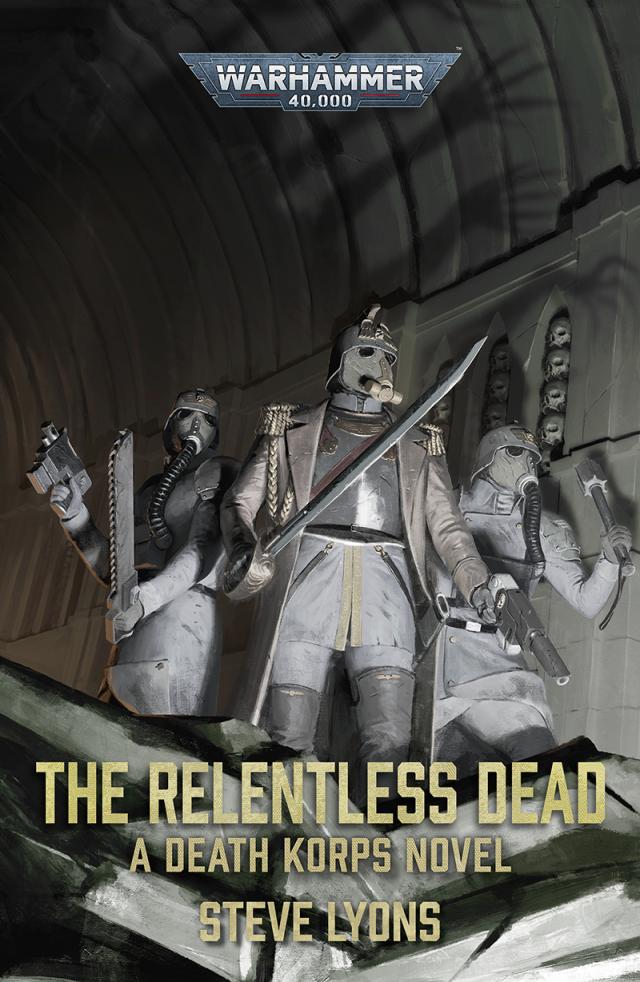
A parade of figures marched behind his eyes, each identical to all the others in their gas masks. ‘Why?’ they demanded of him, echoing his own earlier question. ‘Why did we have to die before our time, before we could fulfil our purpose? How can that have been the Emperor’s plan for us?’
‘I cannot believe it was,’ said Colonel Graven. ‘Believe me, I fought for you with all the strength I had. I prayed for you.’
‘Why not you? Have you not had your time, many times over?’
‘I know. I know that is true, and I swear I will make recompense.’
‘How can you? How can one life atone for so many hundreds wasted?’
‘I’m sorry!’ he cried, and realised that he had woken, a Korpsman leaning over him, and that he might have yelled the words aloud.
Embarrassed, he struggled to come up with something to say. Until he realised two more things. The first was that, despite his thick blanket and the stove’s gentle heat in the air, his heart and lungs felt frozen.
The second was that the figure above him, the one into whose blank face he stared in dawning horror, was no Korpsman.
It was barely even humanoid and very far from human. What he had mistaken for eyes, or rather a gas mask’s lenses, were no more than shadows. The whole thing was just a shadow, like the ones that had stalked him on patrol, imaginary monsters on the edges of his vision. He almost felt that, if he blinked, then it would fade, except that he could feel its presence, not least by the numbing cold emanating from it.
This monster was indubitably real.
He managed to croak a warning – ‘Intruders! We’re under attack!’ – as his fingers quested for his pistol, never more than an arm’s length from him.
He found the weapon, raised it, squeezed the trigger, barely taking time to aim. A beam of focused light sliced through the shadow, which shrieked as it recoiled, a high-pitched nails-on-chalkboard sound.
As Graven scrambled to his feet, reassuring cracks of las fire filled his ears. His shout had woken his five Korpsmen in the barn, bringing two sentries running from outside. Their weapons lit the dark space in staccato bursts, revealing not one but two spectres floating in the air between them, shadows wreathing them like tattered cloaks.
He added to the furious barrage. It was hard to discern the spectres’ ever-shifting outlines, but he knew some las beams had struck true – and had passed through them, having no discernible effect other than to scorch the rafters.
A spectre swooped towards a Korpsman, who stumbled as he tried to back away. ‘Target that one,’ Graven yelled. ‘They must become solid to attack!’
He was pleased to see he had deduced correctly. The Krieg redirected their fire as instructed, despite the risk of striking their own comrade, and now they made their target scream again and writhe.
Graven’s sword lay by his bedroll in its scabbard. Holstering his pistol, he stooped to pull it free. He turned back to the spectre. Though it had aborted its attack run, still it was assailed by las beams, thrashing in midair. He thumbed his power weapon’s activation stud, wreathing its blade in bright blue flames. Its hilt thrummed in his hands. Six steps and strike upwards, he reckoned. I don’t expect it has a heart, but all the same… He started towards his target.
‘Have you not had your time, many times over?’
The voice, the deathly whisper in his ear – no, not in his ear, but in his head – froze Graven’s heart again. The other spectre – still hovering beneath the old barn’s roof, the one that had attacked him, he just knew it – had turned its gaze upon him. For an instant, he made out vengeful eyes and a forked tongue uncoiling over razor teeth. But then the shadows shifted, resolving themselves into gas mask lenses and a flexible rebreather hose.
Then came the voice again, the impossible, accusing voice of a faceless, nameless comrade long deceased. The voice of all of his dead comrades. ‘Your life is undeserved. Give up your life. Your life for ours.’
A scream bubbled up from Graven’s lungs. He just about caught it in his throat, clenching teeth and fists to keep the scream contained. He was dimly aware that he had dropped his sword. It burnt blue at his feet, but his vision had tunnelled and he saw only grim-faced masks around him, half-melted, splitting at the seams to reveal horrific, suppurating burns beneath.
An instinct he had never felt before, certainly not so strongly, warred with a lifetime of conditioning. The urge to run and hide. ‘I will not shame myself!’ he howled. ‘I will not let you down again!’
And then the urge was gone, and Colonel Graven found himself on his knees, the inside of his mask damp with sweat, his heart beating like a Hades breaching drill as the barn snapped back into focus around him. He looked up at the spectre, still glaring blankly at him, and breathlessly, defiantly, told it, ‘You do not know the Krieg if you thought to make us fear you.’
It looked at him a moment longer, and then, without turning, drifted upwards through the roof and disappeared.
Graven’s hand closed around his sword hilt. Something solid, reassuring, to hold on to. Something real. He heard his watchmaster barking orders: ‘Get out there. Find them. Protect the hamlet.’
As the barn emptied out, the watchmaster stayed behind. ‘Sir?’
Graven stood, to prove to his comrade, to himself, that he was capable. His legs still felt a little shaky, but already the effects of his brief ordeal were fading. Like a dream. His heart was slowing to its normal pace. ‘The other one?’ he asked. ‘I didn’t see what happened to it.’
‘Escaped too,’ the watchmaster said with chagrin, ‘through the wall, before we could finish it off. It seems the workers spoke true after all.’
‘About some things, at least,’ the colonel growled.
IV
The remaining hours of the night passed in the usual cocktail of anxiety and tedium. The spectres remained unseen. In the dark they could have hidden anywhere around the hamlet, but as a misty sunrise banished shadows, Graven grew in confidence that they too had fled back to their own hellish realm.
Until night falls again, he thought.
Bleary-eyed workers emerged from their homes. They trudged towards a long, single-storey building at the settlement’s centre. This, Graven knew, was their meeting house, where among other things they joined in daily prayer, the nearest chapel being some miles away.
The ten Death Korpsmen joined them, finding plenty of spaces to sit on wooden benches. Rayoul led the service, which was barely an hour long. A lectern, serving as a makeshift altar, stood on a rumpled rug into which a holy symbol, the Imperial aquila, was sewn.
Rayoul thanked the Emperor for sending His soldiers to watch over them as they slept. Graven doubted many workers had slept peacefully last night, although only the barn had been attacked. He was tired too, having not slept again since being woken. Joining in the prayers, he drew strength from them.
He gathered his Korpsmen as they filed out of the hut. ‘Search the hamlet again,’ he ordered them, ‘from top to bottom. Nothing must be overlooked.’
‘Sir, is that necessary?’ asked Rayoul, overhearing. Graven turned his back, the question unworthy of the breath to answer. His watchmaster split the squad into pairs again, assigning a quadrant to each.
The colonel marched back to the Krieg Chimera, sliding into its driver’s seat. He operated the vehicle’s vox-caster and searched for a signal. Command headquarters was a hundred and thirty miles away, too far to vox directly. During this time, however – this prearranged time, the second hour after dawn – his intervening units would be at their casters too.
He was able to speak to some officers in person, receiving relayed messages from others. Squad Lambda-Two had found its assigned hamlet deserted, but its meeting house defaced by spray-painted heretical symbols. They had burnt the building. Squad Gamma-Four had fought a mob of traitors, who had posed them little threat. The commissar attached to Squad Omicron-Two was satisfied that the workers in his hamlet, though afraid, were loyal. Graven had him question them again.
No problems were reported around the mausoleum, for which he was grateful.
He also made contact with a couple of Attilan squads, one of whose captains told him, ‘A few of my riders say they’ve been hearing voices. Could be nothing, could be something. Just thought it should be noted.’
He warned each squad in turn about the spectres and had an account of the night’s events sent to headquarters, describing the creatures’ tactics and known vulnerabilities. He was still awaiting a reply, an acknowledgement at least, when shouting rose from the hamlet’s centre. A Korpsman had found something.
There was a hole in the meeting house floor. The watchmaster stood at its edge, looking down into darkness.
A Korpsman had felt that the floor was uneven, something missed yesterday. She had shifted the lectern and rolled back the rug to find the reason.
The hole was jagged, hammered through old floorboards, gouged from the mud beneath. A flakboard square had lain over it, keeping careless feet from plunging through. It was long and wide enough to fit a person, but of unknown depth.
The watchmaster had sent Korpsmen to bring a worker to him. They returned with Rayoul himself. ‘We found him lurking right outside,’ one said.
‘Hardly lurking,’ the old man protested as the watchmaster fixed him with a suspicious glare. ‘You know, this is my home you’re turning upside down!’
Still, the watchmaster didn’t speak. Rayoul sweated. His eyes flickering to the uncovered hole, he asked defiantly, ‘What of it?’
‘Where does it lead?’
‘The catacombs. Where else? You don’t know of them? This world is riddled with them – some natural, but others dug centuries ago when burial space was running out and the plague’s return was feared. We move the older bones down there to make room for the new. It’s a large part of our job.’
‘An ossuary,’ the watchmaster said in realisation.
‘As the priests call it.’
‘Then why was it hidden?’
Rayoul shrugged. ‘There are plenty of other ways in. It’s hardly a secret.’ The watchmaster didn’t know whether to believe him.
A Korpsman had brought up a lumen cube, casting light into the hole. The watchmaster could see its bottom now, some twenty feet below. ‘How do I get down there?’ he asked.
‘Why would you want to?’ Rayoul countered.
‘How do I get down?’ he asked again.
Within minutes, the watchmaster was descending a rope ladder, which Rayoul had called for and lashed to an anchoring bench. He had left four Korpsmen in the meeting house, lest someone think to trap him underground.
His flimsy lifeline swayed with each rung found by his questing feet. His shoulders scraped against soil. Then the hole’s sides dropped away and there was only space around him. Judging himself close enough, the watchmaster jumped the last few feet to the floor. He pulled the lumen cube from his pocket, held it up.
He was in a broad tunnel that curved and branched away in each direction. Shovels and pickaxes lay scattered about him. The cold air made him glad of his greatcoat. As the walls glimmered white in his light, the only light, the watchmaster blinked in surprise.
Embedded in the walls were disassembled human skeletons, bones stacked one upon another. They stretched further than he could see, neat row after neat row. Perfectly preserved white skulls leered out into the tunnels. The Krieg lived cheek by jowl with death and so the sight did not disturb him, but it made him curious. He wondered at the point of this display, which must have consumed years of labour.
The voice of his commander intruded from above. ‘What do you see?’
‘Tunnels, sir,’ he summarised, ‘and… bones.’ He took a few steps to peer along another branch. More bleached skulls stared from its walls. The tunnel ran a few yards before branching again.
He heard Graven asking, ‘How far do they extend?’
Then Rayoul’s muffled voice: ‘I told your sergeant, all the way across Oleris.’
Returning to his starting point, the watchmaster called up, ‘Anyone or anything could be concealed down here and never found.’
Rayoul’s face appeared at the hole. ‘I wouldn’t stray too far. Workers who know those tunnels a deal better than you have been lost in them for days.’
‘Can anybody hear me?’ the watchmaster shouted, cupping his mouth. ‘If anyone is down here, identify yourself!’ Only the echoes of his own voice came back to his ears.
He took a last look about himself, then stepped onto the ladder. He scaled it, back to the meeting house. Though no judge of expressions, he thought he saw relief on Rayoul’s face. Testing him, he said, ‘I could take a few Korpsmen down there. We could search and map the tunnels to a radius of, say, a mile to begin with.’
Colonel Graven contemplated the suggestion.
As all present awaited his decision, the watchmaster heard muffled sounds outside the hut. Low voices. He marched to the door and yanked it open. A group of four workers quickly looked away from him and dispersed, finding other things to do. He looked back at Graven, who had also seen it.
‘I think we might look closer first,’ the colonel said.
It was raining again as the ten Death Korpsmen reassembled by the Chimera.
Though they hadn’t used their entrenching shovels in months, still they carried them in their backpacks. Colonel Graven sectioned up the ground around the vehicle and set them to digging.
He did his share, of course, but also kept a shrewd eye on the workers in the hamlet and the fields. Whether it was a washerwoman sitting with her tub, three men tying ropes around a subsided headstone or the small group building a pyre for Malek’s corpse, every one of them looked nervous. Over and over, heads turned in his direction, even while their eyes avoided his.
When a shovel blade struck metal, Graven was not remotely surprised.
The Krieg converged upon the spot, making short work of layers of clinging mud. Barely a foot beneath the surface, ten shovels scraped a large, unyielding mass. More scraping uncovered a shape familiar to them. A circular gun mount attached to the roof of a tank, although the gun itself had been removed.
A brass-plated gun mount attached to a brass-plated tank.
While Graven had been busy, the fields had slowly emptied, workers slinking out of sight between their huts. ‘They know,’ the watchmaster said.
‘A Land Raider stripped and buried in plain sight of their homes. They could hardly not know,’ agreed Graven, ‘and now they know that we know too.’
‘Your orders, sir?’
‘Round up the workers, every one of them. Secure them in the barn. Kill any who resist, but keep some alive to question.’
His Korpsmen snapped to attention, drew their weapons and moved out across the hamlet.
‘This… this is inexcusable!’
Colonel Petrakov glared at the dataslate as if by force of mind he could rewrite the words upon it. He shifted his attention to the young captain in front of his desk, standing to attention. ‘How could you let this happen?’